clinto
Member
Two major questions in this thread:
So, I rarely use air tools anymore. I have cordless impacts and various hand tools.
But, I've always enjoyed paint work and have always wanted to do more of it. I've painted a fair amount of equipment and components and plan on painting my M35A2, my '65 fastback and my parent's Chevelle. I also have a pretty nice sandblast cabinet, that like all of them is pretty thirsty.
My 5hp, 60 gallon single stage Ingersoll Rand from 1991 is wearing out. I know I need more volume, but what I can't decide on his how much duty cycle. I plan on buying a 7.5hp, 230V single phase, 80 gallon compressor as an upgrade. There are many different units on the market, with duty cycles ranging from 60% to 100%. I feel like I need a 100% duty cycle, because I strongly doubt a sandblast cabinet is going to allow even a big unit like I'm describing to stay off long enough to cool off. Most of the units I've looked at barely hit my sandblaster minimum (21 cfm @ 80 psi). The Northern tool unit is 26 cfm @ 90 psi w/ 60% duty cycle, the Quincy is 24.3 cfm @ 90 psi w/100% duty cycle, the Industrial Air is 22 cfm @ 100 psi with an 80% duty cycle and the T30 is 24.3 cfm @ 90 psi with a 100% duty cycle.
So, for painting cars, and running a sandblaster, using an 80 gallon tank, what is the consensus? Do I need a 100% duty cycle or can I get away with less?
I don't wanna' blow $3-4K on a compressor and then burn it up by outrunning it's duty cycle.
Air system drain
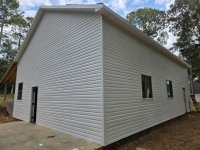
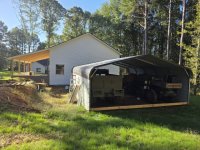
So, I recently fulfilled a lifetime goal of building a shop for my antiques. I built a 30'x40' w/ 14' walls and 12'x12' insulated doors with a side awning for my stuff. It's so nice having everything indoors and I can't wait to be able to do all the projects I've never been able to do, like paint projects. I haven't done a build thread because I ran out of money and want to wait until I finish the interior to post up my build. But I do need help with my air system.
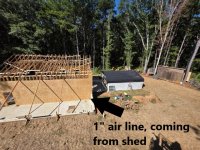
While I was laying the infrastructure out, I ran a 1" air line from my house garage, all the way back to the shop slab, and beyond the slab back to a small 12'x16' shed I use for the yardwork equipment and eventually my air compressor. I haven't wired the shed yet, so the compressor is still in the house garage, piping the air back to the shop. The house is the lowest elevation, the shop is in the middle and the shed sits at the highest elevation. Eventually, once the compressor is in the shed, it'll send air down to the shop, and then down to the house garage, so I can air up tires without having to drive back to the shop. Where the line is underground, it's sch40 PVC. Where it comes out of the ground, it's 1" black pipe and I'll be using the Rapid Air aluminum pipe in the shop and garage. There will not any PVC in the system that isn't underground.
Since the lowest point in the air line is where it turns 90° and comes out of the ground before going into the garage, it collected some water and got into the tools. I modified the 90° by adding a tee and a manual valve, as I was in the middle of a job and needed to fix the problem.
Soon I'll be finishing this up and I want to add an automatic drain at the lowest point, which is underground. I figured I'd put it in a valve / irrigation box with gravel in order to dissipate the water / air.
What kind of a drain valve should I be using? A mechanical, non-electric seems appealing for simplicity's sake, but I have also read a fair amount of complaints online about bad reliability, clogging, etc. Are there drain valves with a timer that are heavy duty enough for this application (outdoors, inside a valve box, where moisture and other environmental hazards will be present)? Any recommendations? Has anyone else built a system like this?
Some pictures:
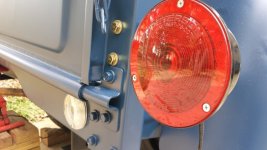
Things I've painted:

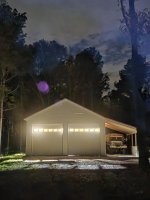
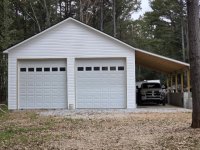
The shop:

Sandblast cabinet and compressor.

I just checked and I do have the 1/4" nozzle. So at a minimum, I need 21cfm @ 80psi.
- How much duty cycle do I need for my intended uses (described below)?
- How to drain moisture from my unusual air distribution system?
So, I rarely use air tools anymore. I have cordless impacts and various hand tools.
But, I've always enjoyed paint work and have always wanted to do more of it. I've painted a fair amount of equipment and components and plan on painting my M35A2, my '65 fastback and my parent's Chevelle. I also have a pretty nice sandblast cabinet, that like all of them is pretty thirsty.
My 5hp, 60 gallon single stage Ingersoll Rand from 1991 is wearing out. I know I need more volume, but what I can't decide on his how much duty cycle. I plan on buying a 7.5hp, 230V single phase, 80 gallon compressor as an upgrade. There are many different units on the market, with duty cycles ranging from 60% to 100%. I feel like I need a 100% duty cycle, because I strongly doubt a sandblast cabinet is going to allow even a big unit like I'm describing to stay off long enough to cool off. Most of the units I've looked at barely hit my sandblaster minimum (21 cfm @ 80 psi). The Northern tool unit is 26 cfm @ 90 psi w/ 60% duty cycle, the Quincy is 24.3 cfm @ 90 psi w/100% duty cycle, the Industrial Air is 22 cfm @ 100 psi with an 80% duty cycle and the T30 is 24.3 cfm @ 90 psi with a 100% duty cycle.
So, for painting cars, and running a sandblaster, using an 80 gallon tank, what is the consensus? Do I need a 100% duty cycle or can I get away with less?
I don't wanna' blow $3-4K on a compressor and then burn it up by outrunning it's duty cycle.
Air system drain
So, I recently fulfilled a lifetime goal of building a shop for my antiques. I built a 30'x40' w/ 14' walls and 12'x12' insulated doors with a side awning for my stuff. It's so nice having everything indoors and I can't wait to be able to do all the projects I've never been able to do, like paint projects. I haven't done a build thread because I ran out of money and want to wait until I finish the interior to post up my build. But I do need help with my air system.
While I was laying the infrastructure out, I ran a 1" air line from my house garage, all the way back to the shop slab, and beyond the slab back to a small 12'x16' shed I use for the yardwork equipment and eventually my air compressor. I haven't wired the shed yet, so the compressor is still in the house garage, piping the air back to the shop. The house is the lowest elevation, the shop is in the middle and the shed sits at the highest elevation. Eventually, once the compressor is in the shed, it'll send air down to the shop, and then down to the house garage, so I can air up tires without having to drive back to the shop. Where the line is underground, it's sch40 PVC. Where it comes out of the ground, it's 1" black pipe and I'll be using the Rapid Air aluminum pipe in the shop and garage. There will not any PVC in the system that isn't underground.
Since the lowest point in the air line is where it turns 90° and comes out of the ground before going into the garage, it collected some water and got into the tools. I modified the 90° by adding a tee and a manual valve, as I was in the middle of a job and needed to fix the problem.
Soon I'll be finishing this up and I want to add an automatic drain at the lowest point, which is underground. I figured I'd put it in a valve / irrigation box with gravel in order to dissipate the water / air.
What kind of a drain valve should I be using? A mechanical, non-electric seems appealing for simplicity's sake, but I have also read a fair amount of complaints online about bad reliability, clogging, etc. Are there drain valves with a timer that are heavy duty enough for this application (outdoors, inside a valve box, where moisture and other environmental hazards will be present)? Any recommendations? Has anyone else built a system like this?
Some pictures:
Things I've painted:
The shop:
Sandblast cabinet and compressor.
I just checked and I do have the 1/4" nozzle. So at a minimum, I need 21cfm @ 80psi.