slomaro3.4
Well-known member
- Joined
- Mar 3, 2016
- Messages
- 144


Which motor? Some of the Ford manifolds have a plug on one side of the intake you can use for the sender.I ordered a new water temp gauge for my F-150 last week. I asked Chat GPT the radiator hose size for the adapter to mount the sender. When I got ready to install the adapter I noticed it looked quite small compared to the hose. The adapter was for a 1.5" hose and turns out I need one for a 1.75" hose. A.I. fails again.I decided installing the adapter was likely the easiest part, so I ordered a new one (at three times the price for the larger size!) and proceeded with the rest of the installation. Fortunately I found an easily accessible gromment on the firewall (adjacent to the throttle cable) to route the sender's wiring into to the cab. I didn't want to pay the Autometer price for their A-pillar gauage pod, but it was the only one molded to fit correctly so I bought one. I got it all connected and working except for connectiong the temp sender. New hose adapter is supposed to arrive today so I hope to get it buttoned up tonight.
![]()


You should see what 12 can do in one night.......A fine morning of fixing forklift damage. An easy fifteen-minute job.
Pro tip one: Forklift always wins.
I'll have to straighten and flatten that metal trim:
The red angle corner protector is barely hanging on, so it'll get some love, too. Amazingly, the SS rub panel is holding up just fine, but it has to come off, too, as the metal trim has been pulled up from beneath it.
I'll use roofing tacks to anchor the metal trim back down. Screws give the forklift too much purchase and aren't easy to remove once bent all the hell and gone.
Pro tip two: When driving roofing tacks, hold them like this:
not like this:
It's amazing how much difference hitting fingers flat vs on edge makes in pain and injury.
Forklift vs. 1/4" lag bolt?
Forklift wins. I'll have to replace those with 5" bolts as the holes are torn out.
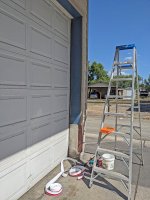
Trim metal flattisher, rub and corner protectors reinstalled. Time to hang rubber.
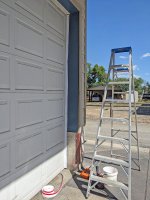
I like this silicone door seal. It's very easy to work with and has an adhesive strip on the back to hold it in place while I nail it off. The bottom with the SS plate will probably be left with nothing but the adhesive for now. No way I'm driving roofing tacks through that.
The other side doesn't take as much of a beating--not sure why.
I have a few pieces of that rigid seal. I'll get on it after lunch when the door is in the shade.
Thank Toyota, we have only one. Does plenty of damage all by its lonesome, thanks.You should see what 12 can do in one night.......
Was the operator the same as the repairman?A fine morning of fixing forklift damage.
Pro tip two: When driving roofing tacks, hold them like this:
Was the operator the same as the repairman?
I’ll look into that, thx. For the main kitchen, I’ve had good luck with Symmons units.T&S Brass "Eterna" line. I've replaced damned near every faucet in the brewery and pub with them. Easy to source, inexpensive parts--and dead easy to service. I can interchange between ceramic and gasketed valve cartridges--handy as ceramic cartridges don't last long with our city water.
Reunification started in ‘89 and was finalized in 1990. I still remember watching the Berlin Wall fall on CNN that was quite a time.Labeled “West Germany” predates unification in 1990(?).
So you have received good service.
Finished up the others:


This is why I've always installed a coolant temp gauge in one of the by-pass coolant lines that are always fed.As soon as the thermostat opens it springs to life and is working perfectly.
That makes me feel better… THX!you're not the only one who has done that.......lol.
Got the damned make-up-air unit up and running. Funny how trying to run a motor wired for 115V on 230V trips the motor protector every time.
Now to figure out how it gets 230 from a single-pole breaker--the only one I can locate marked MAU. Good thing I always test for voltage before touching a bare wire, but the lock-out rendered it safe.
This is why I've always installed a coolant temp gauge in one of the by-pass coolant lines that are always fed.
I do like to monitor when the thermostat opens.I like to say the OEM 'gauge' tells you how cold the engine is, and the aftermarket gauge tells you how hot it is.
I'm never looking at the temp gauge when the engine is not up to operating temp anyway.
You pretty much nailed it. Unfortunately, I'm pretty sure that isn't the problem, as when I measured the output of the motor control contactor, it was 230-240. I have a feeling the 120V breaker is for the controls and there is another 2-pole for the higher voltage--in a different breaker box. Not very code if so.You have what we call a high-leg delta service.
It's 3 phase and there's 240 between any two phases.
There's 120 from 2 of the phases to neutral but the 3rd phase is 208 to neutral.
The open slot you put the single pole brakes on was the high leg; 208 to neutral.
If there's an open slot that's not the high-leg, you can use it and connect the motor for 115 volts. If it were me, I would connect the motor for 230 volts and use a 2 pole breaker with the high leg and one of the 120 phases, provided the controller (starter) is 2 pole.
If you use the high leg, technically the 2 pole breaker needs to be 240 volts and not 120/240. The reason is because a 120/240 breaker is designed to safely open either pole at 120 to neutral or 240 with both poles. The high leg is 208 to neutral so if it's a solid fault and there's enough available fault current from the PUCO, the breaker might blow up.
Seriously, of all the 2 pole breakers I've seen used with the high leg, I bet less than 10% of them were 240, the rest were basic standard 120/240 models. Never a problem.