Eco Air Meters:
HISTORY OF ECO
The first ECO air meter was made around 1916 or 1917 by the Western Manufacturing Company, of Oskoloosa, Iowa. The oldest patent record that I have found is from 1914.
It appears that the first ECOs were actually called the Economy Air Meters. The name was then shortened to ECO and is pronounced EEEECO, not ECHO.
The earliest advertisement I have is for the ECO No. 8, from around 1917. The first seven were probably the Economy Air Meters. The Model 8 through the Model 20 (the number Model 20 was used twice, this is the early 20) had an unique option, it could be purchased equipped with a coin attachment. The coin attachment would require the motorist to put in a nickel, dime or quarter to get some air. I personally doubt that many of these were sold. I do know of two 1917 ear ECOs having been found and have personally seen one.
During the 1920s the Western Manufacturing Company also made equipment used to repair Model T Fords. They made engine stands, transmission stands, etc. To see some of the equipment they made, click HERE.
Around 1925, ECO announced a new series of air meters which we have nicknamed the ECO 19 Series Air Meters. There were at least eleven different units in this series.
In 1928 the ECO Division of the Western Company was purchased by the Service Station Equipment Company. SSEC moved ECO to their Bryan, Ohio factory. Bryan, Ohio, is a small town, but at the time it was also the home of AERO, a large manufacturer of automobile lubrication equipment. There may be a connection here.
Around 1930 the ECO Division was again moved, this time to Muskegon, Michigan, the home of the Bennett Pump Company, also a division of SSEC.
In 1931 five new ECO Air Meters were announced, we refer to them as the ECO 39 Series Air Meters. With the depression, this was not the best time for high price equipment, so in 1932 three more units were announced, the ECO Series 15 Air Meters. These were a very simple unit, selling for the lowest prices ever charged for an ECO meter.
In 1933, SSEC, feeling the effect of the depression, decided to consolidate their operations. Both ECO and the Bennett Pump Company were moved to the SSEC operations in Conshohocken, Pennsylvania. Before they moved, all the 39 Series and the 15 Series ECOs had the word ECO embossed on the front of the meter. During the time they were in Conshohocken, the letters SS were embossed on the front of the meter. 1934 saw the announcement of a new series of ECOs, the 33 Series Air Meter. These units contained the same mechanism that the previous series had.
In 1937, all SSEC operations returned to Muskegon, Michigan.
SSEC continued to sell the 33 Series through 1950, but they introduced the 90 Series ECO in 1947. This is the unit we are all familiar with. 1948 saw the introduction of the first ECO Islander, the 120 Series. These units were made for only four years and are very rare today. In 1952, ECO announced the 240 Series Islanders, which were made for many years. The ECO Model 97 and 98 are still being made today, but they are a great deal different than the older ones.
One more important thing about ECO. Every mechanism found inside a Gilbarco Air Meter was made by ECO, also it appears that most if not all mechanisms found inside the American Pump Company air meters were made by ECO.
*** The above is all courtesy of Jack Sim, author " An Illustrated Guide To Air Meters" Please note the Values as seen are several years old and are no longer valid.
So as previously mentioned, the ECO air meter unit that's on the outside wall of the old shop is an ECO Model 97 and the pedestal unit that's outside the barn is a ECO model 98. Both were manufactured in 1953. The wall unit needed a refreshment so the insides were cleaned...
...new copper lines were fabricated....
...internal parts cleaned, calibrated and refurbished...
...then it was reassembled into the frame which along with the outside covers were all powder coated for durability.
The springs were cleaned and painted.
I used stainless steel hardware everywhere I could.
Where you use stainless hardware you need to coat the threads with never-seize to prevent galling. Over time stainless can seize when threaded into dissimilar metals.
The face plate is porcelain over steel...
... and the edges of it had small chips that if not addressed would slowly rust.
There were also spots on the back of the face plate as well as the cut outs for the numbers that need to be sealed to prevent further deterioration.
I used "Rust Converter"...
... applied with a Q-Tip to seal the rust.
That will prevent the rust from slowly "bleeding" streaks down the face plate over time.
The face plate was then hung out to dry.
To be continued...
Thomas

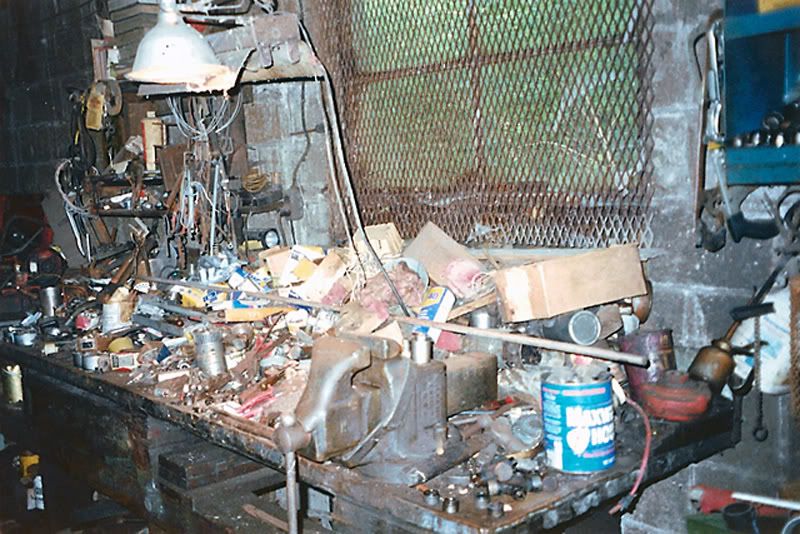
 Note the oil can in the back right of his bench.


 It's been a grand adventure so far that I wouldn't have missed for anything! And the fun continues with all the new friends Chris and I have made as a result of this thread.
 )
)


 Note from this view that the handle is off set. There were no markings on it. Once it's cleaned up. perhaps something will show up.


