
You are using an out of date browser. It may not display this or other websites correctly.
You should upgrade or use an alternative browser.
You should upgrade or use an alternative browser.
Plomb tool picture thread - show your stuff!
- Thread starter GRX
- Start date
RagTopTA
Well-known member
I have about 6 or 7 wrenches, a punch, and a socket all dual marked. Maybe a couple other things... but can't remember without looking through all my stuff.
twertsy
Well-known member
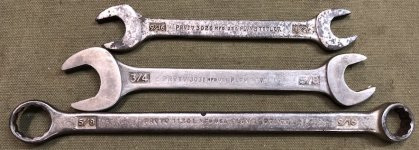
Alloy Artifacts says this name format began early 1948 and persisted only into early 1950, because of violating a court settlement. But then they show a couple combos like this one confidently dated 1948, without any “8” that I can see in the photos. So maybe there’s additional cause to believe it was only made this way in 1948. That would make this variation less numerous than those produced for longer stretches of time.
My understanding was that wrenches bearing both the Plomb and the Proto names were only made for about a year. I've only handled one, which I sold some months ago.
Here is the exact timeline: http://toolarchives.com/?q=Plomb-Company-timeline
Scroll down until you get to 11/1948.
twertsy
Well-known member
Twertsy
I may be obtuse, but I still don’t see evidence to be more specific than 1948-1950? How do the court dates bear on what was rolling off the production lines? School me, please!
simply by the fact that it clearly states they shut down for to retool for the Proto changeover. One would have to assume that meant no more Plomb markings.
Private Lugnutz
Well-known member
LS,Alloy Artifacts says this name format began early 1948 and persisted only into early 1950, because of violating a court settlement. But then they show a couple combos like this one confidently dated 1948, without any “8” that I can see in the photos. So maybe there’s additional cause to believe it was only made this way in 1948. That would make this variation less numerous than those produced for longer stretches of time.
Note that AA dates all of their examples of dual-marked Proto-Plomb wrenches to 1948, contradicting their own summary in the Intro on page 1 saying it was used through March 1950. There is nothing about the markings on the wrenches in this period that would allow them to be dated to 1948 versus 1949 or early 1950. This is just AA being either sloppy (where it should read "1948-3/1950" in the captions) or ambiguous (where they actually meant "1948," specifically, in which case their summary on page 1 is wrong.) I think they’re wrong anyway, either way, since the re-tool to Proto-Plomb didn’t happen until over the holidays between 1948 and 1949. I think the dual Proto-Plomb wrenches are all 1949 and early 1950 wrenches. I don't see how any of them can be 1948 production. Unless I've been misreading this.
??? Now I am confused. When they shut down to re-tool in late 1948 to fix the first suit, re-opening in late January 1949, it resulted in the dual-marked Proto-Plomb dies. That was the lemonade Morris was referring to. It turned out to be poisonous lemonade. Plumb filed another suit, which resulted in Plomb having until March 1950 to remove the reference to Plomb. And your timeline reflects this, ending dual-marked tools on 2/28/1950. Or am I misreading?simply by the fact that it clearly states they shut down for to retool for the Proto changeover. One would have to assume that meant no more Plomb markings.
Last edited:
Private Lugnutz
Well-known member
LS,
I see the problem. AA uses the date that Plomb trademarked the Proto name (January 23, 1948) as the date of dual-marked Proto-Plomb production. The Time magazine and Duke University articles that underpin the TA timeline indicate that Plomb did not re-tool to the dual Proto-Plomb markings until they were threatened with a suit and a fine in December of 1948. Which took 6 weeks. Shortly thereafter, Plumb filed yet another contempt suit that gave Plomb until March 1950 to remove the Plomb marking. Again, according to the way I am reading the TA blurbs. I have not read the actual Time magazine or Duke University articles.
I see the problem. AA uses the date that Plomb trademarked the Proto name (January 23, 1948) as the date of dual-marked Proto-Plomb production. The Time magazine and Duke University articles that underpin the TA timeline indicate that Plomb did not re-tool to the dual Proto-Plomb markings until they were threatened with a suit and a fine in December of 1948. Which took 6 weeks. Shortly thereafter, Plumb filed yet another contempt suit that gave Plomb until March 1950 to remove the Plomb marking. Again, according to the way I am reading the TA blurbs. I have not read the actual Time magazine or Duke University articles.
Yeah, I like that interpretation. They were obviously resistant to dropping “Plomb” from their brand, and attempted with the “Proto...Plomb Tool Co” to evade the intention of the ruling. Sure seems 1949 into 1950 is the necessary time period of production.
twertsy
Well-known member
Your reduction of the timeline makes perfect sense Greg. I want to do one more check of the adverts though. Plomb did an advertising blitz in an effort to ensure everyone knew about the change.
Sent from my VS990 using Tapatalk
Sent from my VS990 using Tapatalk
Username already in use
Well-known member

d42jeep
Well-known member
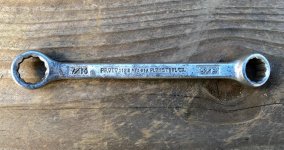
Since everyone is showing their dual marked wrenches I thought that I should take a picture of mine. While I was in the box I noticed that I had a DBE wrench that was short in the pebble department.
-Don
-Don
Attachments


Ole Slewfoot
Well-known member
twertsy
Well-known member
This google book search will bring up the 1949 advertising blitz promoting the name change. Unfortunately, they are all snippets so we can't narrow down when they started / ended. But, they're all 1949. That said, there's also no way to know if that meant no more Plomb marking or that they were now dual marked.
Ole Slewfoot
Well-known member
jan 1950
https://books.google.com/books?id=v...nepage&q=jan 1950 "popular mechanics"&f=false
this says its a new name
https://books.google.com/books?id=Z...pular mechanics"&pg=PA255#v=onepage&q&f=false
And here they've changed the font of the O to look even more like a PLUMB stamp
Jan '49
https://books.google.com/books?id=3...nepage&q=jan 1949 "popular mechanics"&f=false
sockurels?
June '49 I only found a PLUMB ad...
July '49, paydirt, big page five ad
return of round handle ratchet, pebble field wrenches both DOE and DBE
but the names have been ground
I've never seen a Plomb only pebble field wrench though....
https://books.google.com/books?id=G...&q=jul 1949 "popular mechanics" proto&f=false
So I guess we know what the art department was doing.
Hilarity formthe internet archive
June '48 pop sci
no mention of Proto, rats are clearly pebble, but I dont know ive seen that spinner knob.
https://books.google.com/books?id=a...onepage&q=1948"popular science" plomb&f=false
Oct '48 Proto MFD by Plomb
https://books.google.com/books?id=h...nepage&q=1948 "popular science" plomb&f=false
Oh and Google flagged me as a bot for doing too many weird searches.
https://books.google.com/books?id=v...nepage&q=jan 1950 "popular mechanics"&f=false
this says its a new name
https://books.google.com/books?id=Z...pular mechanics"&pg=PA255#v=onepage&q&f=false
And here they've changed the font of the O to look even more like a PLUMB stamp
Jan '49
https://books.google.com/books?id=3...nepage&q=jan 1949 "popular mechanics"&f=false
sockurels?
June '49 I only found a PLUMB ad...
July '49, paydirt, big page five ad
return of round handle ratchet, pebble field wrenches both DOE and DBE
but the names have been ground
I've never seen a Plomb only pebble field wrench though....
https://books.google.com/books?id=G...&q=jul 1949 "popular mechanics" proto&f=false
So I guess we know what the art department was doing.
Hilarity formthe internet archive
Apparently the confusion is real.AUGUST 1949
5
fflfrr •
o different name fer
your old friends'
In PROTO tools— formerly Plomb tools
—you get just what the name means,
PROfessionai TQols. They have the
designs, special steels, scientific heat
treating and over all quality that have
made them professionals' favorites for
42 years. Buy the best! Buy PROTO
from your dealer now.
Write for catalog to
PLUMB TOOL COMPANY
22 5 5P Santa Fe Ave, t Los Angeles 54, Calif.
June '48 pop sci
no mention of Proto, rats are clearly pebble, but I dont know ive seen that spinner knob.
https://books.google.com/books?id=a...onepage&q=1948"popular science" plomb&f=false
Oct '48 Proto MFD by Plomb
https://books.google.com/books?id=h...nepage&q=1948 "popular science" plomb&f=false
Oh and Google flagged me as a bot for doing too many weird searches.
Last edited:
Private Lugnutz
Well-known member
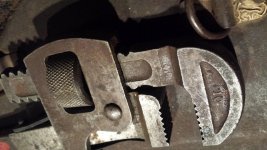
Slew,My dual marked pipe mangler seems to say June of '48, the dynamic jaw is a little older, but not branded.
If you're referring to the forged-in "6.4.8.", that may be a date code (not sure who made Plomb's pipe wrenches, but Walworth used forged-in date codes), but it's on the dynamic jaw. Because the dynamic jaws were also made and sold as replacements, it can't be used to date the static jaw and handle unit. (We have a similar issue with RIDGID pipe wrenches.) I'd like to see a photo of the dual marking, if you don't mind. Also, it looks like there is a forged-in date code on the static jaw as well, just under the jaw, just above the pin in the mechanism housing. What's that date? Almost looks like a "1.6.5.", which is more than a little odd. Can't make it out for sure.
Private Lugnutz
Well-known member
Thanks for the work involved in this, Todd.This google book search will bring up the 1949 advertising blitz promoting the name change. Unfortunately, they are all snippets so we can't narrow down when they started / ended. But, they're all 1949. That said, there's also no way to know if that meant no more Plomb marking or that they were now dual marked.
It seems irrefutable to me that the ads are introducing the PROTO name for the first time. To me that implies that it has not appeared in public before, and has not yet been applied to a tool, dual-marked or otherwise. And since the dual-marked PROTO-PLVMB tools preceded the PROTO only marked tools, it doesn't seem as if it's logical that dual-marked PROTO-PLVMB tool production would've preceded such an ad blitz, or that such an ad blitz would've been used to introduce PROTO only marked tools. It seems odd to me that text would say things like, "Remember the new name..." or "Now named..." if the name PROTO was introduced and put on tools (with PLVMB on the dual-marked PROTO-PLVMB tools) before these ads.
Private Lugnutz
Well-known member
^ This is a head scratcher, but it's the only exception we have so far to all the 1949 ads introducing PROTO as "new". It could be Plomb exercising the name in marketing and packaging only.Oct '48 Proto MFD by Plomb
https://books.google.com/books?id=h...nepage&q=1948 "popular science" plomb&f=false
Ole Slewfoot
Well-known member
OEM is J.P.Danielson, I think the dynamic is G 4 8.the static is I or J, but you can't tell its tail is buried under the frame, and it probably doesn't matter, I havent seen any serious theory of what the letters meant.Slew,
If you're referring to the forged-in "6.4.8.", that may be a date code (not sure who made Plomb's pipe wrenches, but Walworth used forged-in date codes), but it's on the dynamic jaw. Because the dynamic jaws were also made and sold as replacements, it can't be used to date the static jaw and handle unit. (We have a similar issue with RIDGID pipe wrenches.) I'd like to see a photo of the dual marking, if you don't mind. Also, it looks like there is a forged-in date code on the static jaw as well, just under the jaw, just above the pin in the mechanism housing. What's that date? Almost looks like a "1.6.5.", which is more than a little odd. Can't make it out for sure.
It seems 100% to be letter, month, year, and earlier wrenches are marked Danielson, mid are Plomb, then dual, then Proto No other changes, not even the paint. I can get some pics later, its one brand on each side of the handle.
I only looked at populars science and mechanics, and only where I could see full editions.
Last edited:
Private Lugnutz
Well-known member
Thanks. I haven't paid any attention to Plomb pipe wrenches and I didn't know J.P. Danielson also made them (in addition to the adjustable crescent wrenches). Interesting. Anyway, if that's a "5" on the same static jaw as a dual PROTO-PLVMB marking, it presents a real conundrum. 1945 is way too early; 1955 is way too late.OEM is J.P.Danielson, I think the dynamic is G 4 8.the static is I or J
Ole Slewfoot
Well-known member
I think it's n,6,8, but n,8,8 is also possible
Might be easier to read on a bigger wrench.
Might be easier to read on a bigger wrench.
RagTopTA
Well-known member
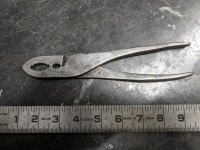
I got this pair of Pliers, I couldn't find them in the Plomb Catalogs I have. But I did find a pair of Proto 258 pliers that were listed at one time as Gas and Burner pliers.
Attachments
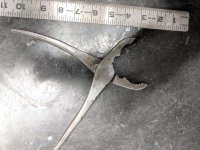
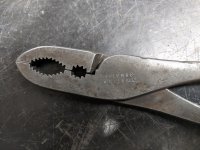
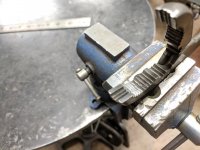
Private Lugnutz
Well-known member
If you're referring to the date code on the static jaw, that's more important than the date code on the dynamic jaw. Is the dual PROTO PLVMB branding on the handle of the static jaw forged-in or stamped?I think it's n,6,8, but n,8,8 is also possible.
Rileysan
Well-known member
Thanks. I haven't paid any attention to Plomb pipe wrenches and I didn't know J.P. Danielson also made them (in addition to the adjustable crescent wrenches). Interesting. Anyway, if that's a "5" on the same static jaw as a dual PROTO-PLVMB marking, it presents a real conundrum. 1945 is way too early; 1955 is way too late.
Out of curiosity, do you (or anyone else) know when production of WF tools stopped? Shortly after the war, perhaps, or several years later? I ask because I haven't seen a satisfactory explanation for the Proto WF-38 ratchets I have seen posted on GJ. Either the war contracts carried on until well after the war ended, or the Proto name was in use prior to being introduced to the public domain.
Brian
Rileysan
Well-known member
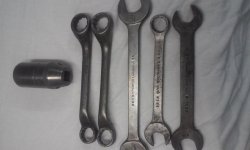
I have a few Plomb acquisitions I haven't posted before, and just got around to cleaning them up for photographing.
- Plomb "USN" N-A-F 110-13, 1" deep socket
- Plomb 3162 DBE wrenches acquired separately. One has USBPA (United States Bonneville Power Administration) stamped on the back. I know this because I acquired it with a large lot of tools being auctioned that previously belonged to the BPA. The second DBE is stamped "war finish" on the back. Else, they are identical in every other way.
- Plomb Los Angeles #3035 11/16" x 3/4" DOE with date code 2B. Not sure what year that is.
- Plomb "LA" #1218 9/16" combo wrench marked with date code 3D. Someone told me it was rare. Comments?
- Plomb "Made in USA" #3030-S 5/8" x 9/16" DOE wrench. This one is a head scratcher because of the model number. What's special about this one?
- Plomb "USN" N-A-F 110-13, 1" deep socket
- Plomb 3162 DBE wrenches acquired separately. One has USBPA (United States Bonneville Power Administration) stamped on the back. I know this because I acquired it with a large lot of tools being auctioned that previously belonged to the BPA. The second DBE is stamped "war finish" on the back. Else, they are identical in every other way.
- Plomb Los Angeles #3035 11/16" x 3/4" DOE with date code 2B. Not sure what year that is.
- Plomb "LA" #1218 9/16" combo wrench marked with date code 3D. Someone told me it was rare. Comments?
- Plomb "Made in USA" #3030-S 5/8" x 9/16" DOE wrench. This one is a head scratcher because of the model number. What's special about this one?
Attachments


Last edited:
d42jeep
Well-known member
Brian,
I believe that the 1" socket is actually marked NAF 1110-13 which is described in the catalog as a spark plug socket. I would be happy to trade you a certain Craftsman hand reamer for that socket so I could add it to my Navy NAF toolbox.
-Don
I believe that the 1" socket is actually marked NAF 1110-13 which is described in the catalog as a spark plug socket. I would be happy to trade you a certain Craftsman hand reamer for that socket so I could add it to my Navy NAF toolbox.
-Don
Attachments


Last edited:
d42jeep
Well-known member
It looks like your combo wrench was made in the first year that they were being dated (1933) so I assume that would make it rare. I think that the shorty DBE wrench marked War Finish was a wartime wrench destined for the civilian market. The 3035 was made in 1932, as far as I know.
-Don
-Don
Last edited:
Private Lugnutz
Well-known member
Out of curiosity, do you (or anyone else) know when production of WF tools stopped? Shortly after the war, perhaps, or several years later? I ask because I haven't seen a satisfactory explanation for the Proto WF-38 ratchets I have seen posted on GJ. Either the war contracts carried on until well after the war ended, or the Proto name was in use prior to being introduced to the public domain.
Brian
As far as I know, nobody has found anything to explain the PROTO marked WF ratchets. I don't agree that possible explanations boil down to only one of those two alternatives though.
All historically documented evidence points to first use of PROTO in late 1948, and I don't think the "WF" marked PROTO ratchets are enough to undermine all that by themselves, on the theory that the "WF" makes them wartime or immediate post-war/pre-1948.
As for "Wright Field" contracts, the last wartime contract Plomb had with the US Army Air Corps, part of the US Army Air Forces at the time, was awarded in April 1945 and terminated in January 1946. It's possible that the US Army Air Forces awarded contracts in 1946. In 1947, it would have been the US Air Force. And note that Wright Field and Patterson Field became Wright-Patterson Air Force Base in January 1948. The former Wright Field became Area B of the combined installation. I haven't found any records of any US Air Force contracts with Plomb, but it's certainly possible. And it certainly seems like the best explanation. And they could've continued using "WF" as a legacy term even though "Wright Field" no longer technically exited. The snag for me is the oddity and low numbers of the PROTO WF ratchets. Of the one-hundred and thirty six (136) other tools in the "WF" set of tools, why do we only see that ratchet show up with a PROTO mark on it? The idea of the now US Air Force continuing the "Wright Field" system with Plomb and only ordering 1/2-inch drive ratchets is strange.
EDIT: I still think it's some weird thing. Almost like they used it like a model number, or a commemorative run.
Last edited:
RagTopTA
Well-known member
Out of curiosity, do you (or anyone else) know when production of WF tools stopped? Shortly after the war, perhaps, or several years later? I ask because I haven't seen a satisfactory explanation for the Proto WF-38 ratchets I have seen posted on GJ. Either the war contracts carried on until well after the war ended, or the Proto name was in use prior to being introduced to the public domain.
Brian
No clue, but I found 3/8 ratchet, marked PROTO at top, and WF21s at bottom with a Speed master body/handle.
Private Lugnutz
Well-known member
Rag,
What do you mean by "a Speed master body/handle"? Post photos when you get a chance. EDIT: Disregard. You mean the Ward's brand; I've seen those. I'm trying to remember where we had this conversation last. Someone else, perhaps lgradwell, had a different ratchet. When they show up, it's always and only a ratchet, apparently. There's gotta be something to that.
EDIT: I found the prior dialogue, buried in the middle of an "[S.R.]" sockets thread. Not much there, but there are some good examples of a few variations of the PROTO WF-38 and PROTO WF-21 ratchets. Posts #23-30, and #41 in this thread.
What do you mean by "a Speed master body/handle"? Post photos when you get a chance. EDIT: Disregard. You mean the Ward's brand; I've seen those. I'm trying to remember where we had this conversation last. Someone else, perhaps lgradwell, had a different ratchet. When they show up, it's always and only a ratchet, apparently. There's gotta be something to that.
EDIT: I found the prior dialogue, buried in the middle of an "[S.R.]" sockets thread. Not much there, but there are some good examples of a few variations of the PROTO WF-38 and PROTO WF-21 ratchets. Posts #23-30, and #41 in this thread.
Last edited:
Rileysan
Well-known member
Brian,
I believe that the 1" socket is actually marked NAF 1110-13 which is described in the catalog as a spark plug socket. I would be happy to trade you a certain Craftsman hand reamer for that socket so I could add it to my Navy NAF toolbox.
-Don
Deal! Send me a pm with your address (I know I previously had it, but I no longer have it).
Brian
d42jeep
Well-known member
PM sent!
-Don
-Don
Username already in use
Well-known member
As far as I know, nobody has found anything to explain the PROTO marked WF ratchets.
Of course, it's not just ratchets. Did you see the 5" Proto WF-34 extension that I posted on the previous page HERE?
RubiconJK
Well-known member
As far as I know, nobody has found anything to explain the PROTO marked WF ratchets. I don't agree that possible explanations boil down to only one of those two alternatives though.
All historically documented evidence points to first use of PROTO in late 1948, and I don't think the "WF" marked PROTO ratchets are enough to undermine all that by themselves, on the theory that the "WF" makes them wartime or immediate post-war/pre-1948.
As for "Wright Field" contracts, the last wartime contract Plomb had with the US Army Air Corps, part of the US Army Air Forces at the time, was awarded in April 1945 and terminated in January 1946. It's possible that the US Army Air Forces awarded contracts in 1946. In 1947, it would have been the US Air Force. And note that Wright Field and Patterson Field became Wright-Patterson Air Force Base in January 1948. The former Wright Field became Area B of the combined installation. I haven't found any records of any US Air Force contracts with Plomb, but it's certainly possible. And it certainly seems like the best explanation. And they could've continued using "WF" as a legacy term even though "Wright Field" no longer technically exited. The snag for me is the oddity and low numbers of the PROTO WF ratchets. Of the one-hundred and thirty six (136) other tools in the "WF" set of tools, why do we only see that ratchet show up with a PROTO mark on it? The idea of the now US Air Force continuing the "Wright Field" system with Plomb and only ordering 1/2-inch drive ratchets is strange.
EDIT: I still think it's some weird thing. Almost like they used it like a model number, or a commemorative run.
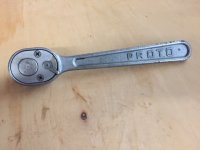
Here is a picture of my Proto WF-38. Also shown are some of my other 1/2 drive Plomb / Proto variants. In the group pic, from right to left, first rat is a Plomb WF-38 oval head, next up is a Plomb WF-38 "figure 8" (not sure what else to call it!) head, next is the Proto WF-38, next is the BOG version of WF-38, then a Proto 5449, then a Plomb 5449, then a Plomb pebble 5449. I also have a couple of the Plomb WF38T ratchets I forgot to include.
Attachments


Last edited:
Private Lugnutz
Well-known member
Rube,the BOG version of WF-38.
Just to make sure it's not a variant we haven't seen before, you mean made by Bog (Cragin), but marked "WF-38 Plomb", correct? (Hard to see in the photo)
I've been following the recent discussions with naming conventions and dates with fascination. There's a lot of knowledge being presented, and lots of good questions posed. It occurred to me to step back for a moment and try to envision the forest instead of the trees to see if any pattern emerges, and I believe there is, even though it's rather nebulous. I see at least four phenomena discussed concerning this time period from sometime during the war until perhaps the early 1950s:As far as I know, nobody has found anything to explain the PROTO marked WF ratchets. I don't agree that possible explanations boil down to only one of those two alternatives though.
All historically documented evidence points to first use of PROTO in late 1948, and I don't think the "WF" marked PROTO ratchets are enough to undermine all that by themselves, on the theory that the "WF" makes them wartime or immediate post-war/pre-1948.
As for "Wright Field" contracts, the last wartime contract Plomb had with the US Army Air Corps, part of the US Army Air Forces at the time, was awarded in April 1945 and terminated in January 1946. It's possible that the US Army Air Forces awarded contracts in 1946. In 1947, it would have been the US Air Force. And note that Wright Field and Patterson Field became Wright-Patterson Air Force Base in January 1948. The former Wright Field became Area B of the combined installation. I haven't found any records of any US Air Force contracts with Plomb, but it's certainly possible. And it certainly seems like the best explanation. And they could've continued using "WF" as a legacy term even though "Wright Field" no longer technically exited. The snag for me is the oddity and low numbers of the PROTO WF ratchets. Of the one-hundred and thirty six (136) other tools in the "WF" set of tools, why do we only see that ratchet show up with a PROTO mark on it? The idea of the now US Air Force continuing the "Wright Field" system with Plomb and only ordering 1/2-inch drive ratchets is strange.
EDIT: I still think it's some weird thing. Almost like they used it like a model number, or a commemorative run.
--Use of Plomb/Plomb-Proto/Proto naming conventions on tools
--Use of WF marks
--Pebble field wrenches with strong/weak/no pebbles (more or less determined to be intentional die variations and not die wear/defects/etc
--Pear/racetrack/teardrop head ratchets of virtually the same designs bearing Plomb/Proto/Penens/Fleet/Challenger/private brands/no name markings.
I'm sure the more knowledgeable Plomb collectors could add even more anomalies to this list.
It reminds me of something some years ago in the computer business with the mfr PCChips. One fellow who set up a website for folks to help figure out what's what called it the PCChips Lottery. I feel a similar way with all this, and to echo that sentiment I'd call it the Plomb Empire Lottery. Every time you try to draw the numbers, they all look different. Truly a moving target.
Having been involved in corporation management, I sometimes try to see things from that perspective. What I see when looking at all this evidence is a company in a state of flux and perhaps even internal confusion. A company that was doing lots of business but in almost a chaotic manner with no clear path and direction toward the future. Too busy making today's meals to even figure out what was going to be on tomorrow's menu. I also see a lot of evidence of upper management delegating important decisions to lower management in various departments, further muddying the waters. Much of it seems to be shooting from the hip, perhaps making major changes at each production run of an item, trying to feel its way in the dark, probing here, testing there in an effort to reconcile everything into a clear and concise production model having the greatest, most sustainable benefits. There also may have been some lower management shuffling so that at each production run, key decisions were being made by whomever was in charge at that moment, each run seeing a different supervisor.
Stuff flows downhill as we all know--I think the reason why it can be so confusing for us down at the bottom of the hill is because of the apparent confusion at the top. I believe the evidence shows that, for at least a handful of years, these boys and girls were flying by the seat of their pants. In the greater picture, the Plomb/Plumb lawsuit seems only to be but a single act in a larger three-ring circus.
Now, some of the phenomena can be reckoned with outside-looking-in external reasoning. But it's also clear that some phenomena are the result of internal reasoning, which on the surface is counter-intuitive because we're not privy to the internal dynamics at play. And from the evidence there seems to have been a good portion of that. I've seen instances where over-presumptuous sales teams have sold customers on an item that did not yet exist, then hands the specs to the engineering/production team with "Here's what we sold, and for this much--make it" with no thought as to what might be involved. I've seen other corporate instances where sales, engineering and production departments had such poor communication that one hand really didn't know what the other was doing. I've seen mfg production to where one standard was on paper, but the actual product was made according to the 'tribal knowledge' of those working out on the production floor who made it however they saw fit regardless to the 'official' specs. We also have the added factor of temporary women workers during the war, some in key positions making critical decisions about which they had little practical experience, then all disappearing after the war to have their places taken by new people. I see the evidence of these kind of internal dynamics in the artifacts we have from that time period. However, unlike some other companies, Plomb appears to have been very prolific during that time, and so we have many, many artifacts over which to scratch our heads.
Unless we were able to actually speak with the individuals working in the company at the time (and by the questions we'd asked, that would be more than just a few persons), we'll probably never know some of the answers. They've been lost in time. Lucky for us! For the Plomb Empire Lottery will continue to provide us with fascinating and lively discussion (fun!) as historically-minded folks persistently ply their puzzle-solving chops on this huge menagerie of artifacts.
I recently suggested a third nomenclature for these ratchet head shapes beyond the usual 'teardrop' and 'pear' descriptions as a 'racetrack' shape head, borrowed from the office furniture industry where it is a universal term for any item shaped this way.Here is a picture of my Proto WF-38. Also shown are some of my other 1/2 drive Plomb / Proto variants. In the group pic, from right to left, first rat is a Plomb WF-38 oval head, next up is a Plomb WF-38 "figure 8" (not sure what else to call it!) head, next is the Proto WF-38, next is the BOG version of WF-38, then a Proto 5449, then a Plomb 5449, then a Plomb pebble 5449. I also have a couple of the Plomb WF38T ratchets I forgot to include.
RubiconJK
Well-known member
Yes, exactly. Sorry I didn't make that more clear in my post.Rube,
Just to make sure it's not a variant we haven't seen before, you mean made by Bog (Cragin), but marked "WF-38 Plomb", correct? (Hard to see in the photo)
RubiconJK
Well-known member
What I am describing as "figure 8", for lack of a proper term, is the variant which has the small protrusions on the head at the half way point of the oval. You'll see both versions in the pictures of the straight oval and those with the protrusions.I recently suggested a third nomenclature for these ratchet head shapes beyond the usual 'teardrop' and 'pear' descriptions as a 'racetrack' shape head, borrowed from the office furniture industry where it is a universal term for any item shaped this way.
RubiconJK
Well-known member
IMHO the variants are probably as much due to normal product evolution over many, many years of production and heavy sub-contracting for capacity. As I have found when trying to order a replacement part for any recently made electrical appliance, there are industries out there where product variances are even more prevalent and troublesome! Lol!I've been following the recent discussions with naming conventions and dates with fascination. There's a lot of knowledge being presented, and lots of good questions posed. It occurred to me to step back for a moment and try to envision the forest instead of the trees to see if any pattern emerges, and I believe there is, even though it's rather nebulous. I see at least four phenomena discussed concerning this time period from sometime during the war until perhaps the early 1950s:
--Use of Plomb/Plomb-Proto/Proto naming conventions on tools
--Use of WF marks
--Pebble field wrenches with strong/weak/no pebbles (more or less determined to be intentional die variations and not die wear/defects/etc
--Pear/racetrack/teardrop head ratchets of virtually the same designs bearing Plomb/Proto/Penens/Fleet/Challenger/private brands/no name markings.
I'm sure the more knowledgeable Plomb collectors could add even more anomalies to this list.
It reminds me of something some years ago in the computer business with the mfr PCChips. One fellow who set up a website for folks to help figure out what's what called it the PCChips Lottery. I feel a similar way with all this, and to echo that sentiment I'd call it the Plomb Empire Lottery. Every time you try to draw the numbers, they all look different. Truly a moving target.
Having been involved in corporation management, I sometimes try to see things from that perspective. What I see when looking at all this evidence is a company in a state of flux and perhaps even internal confusion. A company that was doing lots of business but in almost a chaotic manner with no clear path and direction toward the future. Too busy making today's meals to even figure out what was going to be on tomorrow's menu. I also see a lot of evidence of upper management delegating important decisions to lower management in various departments, further muddying the waters. Much of it seems to be shooting from the hip, perhaps making major changes at each production run of an item, trying to feel its way in the dark, probing here, testing there in an effort to reconcile everything into a clear and concise production model having the greatest, most sustainable benefits. There also may have been some lower management shuffling so that at each production run, key decisions were being made by whomever was in charge at that moment, each run seeing a different supervisor.
Stuff flows downhill as we all know--I think the reason why it can be so confusing for us down at the bottom of the hill is because of the apparent confusion at the top. I believe the evidence shows that, for at least a handful of years, these boys and girls were flying by the seat of their pants. In the greater picture, the Plomb/Plumb lawsuit seems only to be but a single act in a larger three-ring circus.
Now, some of the phenomena can be reckoned with outside-looking-in external reasoning. But it's also clear that some phenomena are the result of internal reasoning, which on the surface is counter-intuitive because we're not privy to the internal dynamics at play. And from the evidence there seems to have been a good portion of that. I've seen instances where over-presumptuous sales teams have sold customers on an item that did not yet exist, then hands the specs to the engineering/production team with "Here's what we sold, and for this much--make it" with no thought as to what might be involved. I've seen other corporate instances where sales, engineering and production departments had such poor communication that one hand really didn't know what the other was doing. I've seen mfg production to where one standard was on paper, but the actual product was made according to the 'tribal knowledge' of those working out on the production floor who made it however they saw fit regardless to the 'official' specs. We also have the added factor of temporary women workers during the war, some in key positions making critical decisions about which they had little practical experience, then all disappearing after the war to have their places taken by new people. I see the evidence of these kind of internal dynamics in the artifacts we have from that time period. However, unlike some other companies, Plomb appears to have been very prolific during that time, and so we have many, many artifacts over which to scratch our heads.
Unless we were able to actually speak with the individuals working in the company at the time (and by the questions we'd asked, that would be more than just a few persons), we'll probably never know some of the answers. They've been lost in time. Lucky for us! For the Plomb Empire Lottery will continue to provide us with fascinating and lively discussion (fun!) as historically-minded folks persistently ply their puzzle-solving chops on this huge menagerie of artifacts.