Lugz:
OK, the dog is winded and the potatoes are in the oven. I have a few minutes, so here goes.
I noted in another post that my Grandfather was essentially a government contractor during World War II. American manufacturing in the first half of the 1940's was geared to the war effort, so a company like J O had one customer during that period. We have a picture of Grandfather around here somewhere showing him proudly receiving his "E For Excellence" award in 1943 from someone with a lot of scrambled eggs on the bill of his hat and a lot of action decorations on his chest. He was proud of that award long after the war was over.
Anyway, he found himself in the position of needing new customers beginning in the fall of 1945. The military had all the micrometer torque wrenches it was going to need for a while in peacetime. Further, most of his natural customers were converting from wartime production to civilian, peacetime production. Car companies, shipbuilding companies, and aircraft companies had made nothing but tanks, jeeps, Victory ships and landing craft, and warplanes for 5 years or so at that point. Car dealers and gas stations had been pinched by the unavailability of new cars and trucks to sell/work on, and parts with which to repair them. On the other hand, he faced a tremendous opportunity. He had sold a ton of micrometer torque wrenches to car, shipbuilding and aircraft companies during the war. Many more had been shipped overseas for use in repairing things that had gotten busted up in the war. A whole generation of engineers and mechanics had seen what they could do and were used to them. On yet a third hand, none of these potential customers had a lot of loose change banging around in their pockets. It wasn't that these potential customers were poor; in many cases, far from it. The problem was that the financial cost and physical effort to convert from wartime to peacetime production was nothing short of daunting. There was SO much to do, SO little time in which to do it, and SO much cost involved in getting it all done that getting managers at potential customers to focus on micrometer torque wrenches was a real task.
On top of that, my Grandfather was an inventor and a mechanic at heart, not a businessman. He got to California starting from Missouri in (I think) 1912, at the age of 16 by using all the money he had to buy a train ticket for as far west as he could get. That turned out to be Boulder, Colorado. He got employed by a wealthy man in Boulder who was an early adopter of one of those things called an automobile. Grandfather's job was to keep the darn thing on the road, and to drive his employer around in it. After a couple of years on the Western Front as a motorcycle messenger (see the thread of motor vehicles developing?) where he was gassed, he returned to Boulder, married my Grandmother (she wasn't "Grandma," either) and drove her, crying most of the way and pregnant with my father, to the outskirts of Los Angeles, then Huntington Park. He started what became J O in the 1930's.
In case it's of interest to you, J O's (and Jo-Line's) address in South Gate was 8442 Otis Street, South Gate, California. That's a skip and maybe a jump-and-a-half from Huntington Park, so the commute for Grandfather was good. That building was old, and was not an efficient place in which to manufacture torque wrenches. I remember narrow passageways through a dark and dank enclosed space that smelled deeply of decades of oil and grease. The offices where my dad worked were upstairs. The rubber pads on the wooden stairs were worn smooth and all the wood floors creaked. My Dad moved the business to 4225 East La Palma Avenue, Anaheim in 1968, and there it remained until its buyer moved it back east in the early 1980's. The building that appears at the Anaheim address on Google is the one my Dad built, but the owners since 1979 have changed the front so much as to be unrecognizable to me. The parking lot that appears on Google at 8442 Otis certainly doesn't resemble the building I remember....
But I digress. I think Grandfather tried to survive in the dislocations following World War II by giving in to his natural inclinations - inventing, designing, and manufacturing stuff that someone (he hoped) would buy. He continued to manufacture and sell micrometer torque wrenches. But he also built and tried to sell other things in the off-times, when he had sold all the micrometer torque wrenches the market would bear. Unfortunately, these other products just didn't sell. My Dad had to rescue the business a few times.
My Dad put together a wall display of my Grandfather's inventions. He hung it in the Anaheim front office just behind reception. It may have had your 9/32nds socket on it -- I can't recall. What I do recall (remember, I was a teenager at this time), was the most barbaric-appearing eyelash curler I could ever imagine, much less had ever seen. Each of the pair (there were two) were maybe two inches across, and looked like an instrument of torture.
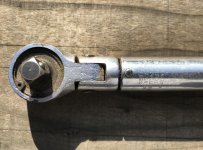
I remember seeing a couple of old Joars, gathering dust in a storage room in the plant. Same with the Joels. I don't recall the Joex. The Jote was very popular, primarily for tightening the lugs on the fittings that joined together PVC piping for plumbers. In my era - 1969-79 - Ridgid bought a lot of these under private label. I do recall Jote's under the Jo-Line brand being shipped, but they were kind of unusual. As I noted to Barry, my Dad knew where his bread was buttered.
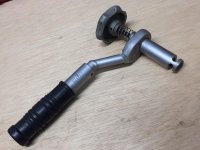
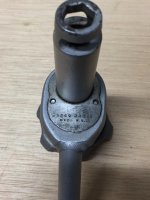
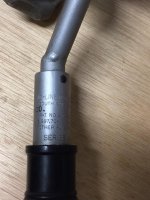
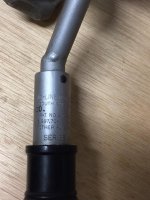
Your Jote is unusual to me, but that may be because the market had shifted since yours were manufactured. They were all preset, because they were all intended for a single purpose. I recall the Ridgid tools being preset at 46 ft/lbs for plumbing uses, but that's a recollection that goes back nearly fifty years. Further, unlike all the other torque wrenches Jo-Line (or J O ) produced, these were tested and calibrated on preset testing machines, so that the assembly team didn't even have to pay attention to the calibration. So long as the wrench "broke" when the testing needle was between two lines, you were good. I don't know what industry your Jote was intended to be used in. It predates me.
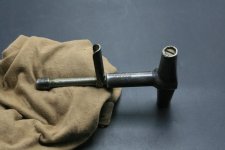
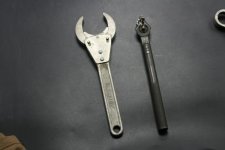
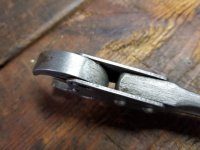
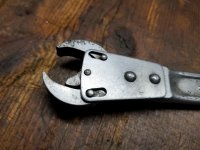
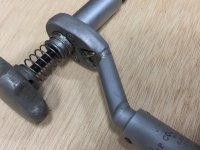
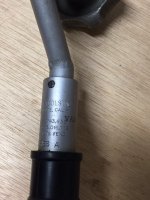
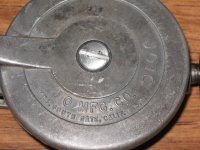
I don't recall your Joda. It REALLY looks like one of my Grandfather's pipe dreams to become a big-time manufacturer of all sorts of tools. It is unquestionably a J O product. JO was spelled with either "Manufacturing" or "Mfg.," as here. I would date your Joda to the 1950's, probably the first half. My Grandfather would make this kind of stuff all the time. My Dad got more involved at a senior level as the 1950's wore on, and he wouldn't stand for investing in the tools and jigs to manufacture stuff that just didn't sell.
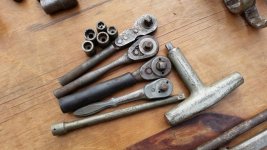
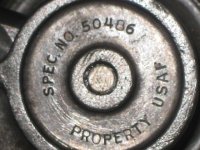
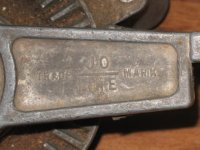
I am not familiar with your 9/32 inch drive pieces. But the fact that you found them in a box marked USAAF with other tools from the war era sounds right. Clearly J O products, as well.
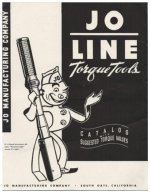
One last digression. I have an ad from the January 1946 edition of Air News with Air Tech. The ad is for the Jomi, of which there was an inch-pound and a foot-pound model. The character that appears on the front of your catalog also appears in the ad, but here he has a name. It is "GI (Good InTENSIONS) JO." The capitalized TENSIONS was lower case and italicized in the original. GI JO is dressed in a hat with a shirt having buttons that really resemble (OK, they're nuts, but they are arranged in a manner that would be familiar) an enlisted man's uniform in World War II. It isn't hard to see the market to which Grandfather was trying to sell - the young men returning from the war, hanging up but deeply remembering the khakis they had worn in the conflict - and, or so Grandfather hoped, their micrometer torque wrenches.
I wonder if we can sue Habro for a cut of their "G.I. Joe" profits. I mean, Grandfather came up with it first!
Just kidding......
Bill