To avoid these ads, REGISTER NOW!

Panasonic ERV review (FV-04VE1)

Denwood

Well-known member
Joined
Sep 22, 2014
Messages
4,192
Location
Thunder Bay, Ontario, Canada
If you're looking for efficient fresh air ventilation for a small home or shop, Panasonic has a pretty cool product which does the job while recovering energy from the air it's exhausting from your home. The Panasonic ERV exhausts "stale" from your home/shop, and pulls in fresh air from outside, recovering about 65% of heat and 35% of moisture from the inside conditioned air. In a well insulated/tight garage, this product would work well, with the provision that you would need to clean the inside air screen frequently if dust was being generated.

In our case, the shop is already pretty leaky, and only heated when in use, so this was not a garage project. Rather, our 100 yr old house though turns out to be too tight, after extensive insulation, new windows with inner acrylic air sealing panels, and attic spray foam. The Panasonic unit offered a solution, although because it's sold as a "spot" ERV, I wasn't sure how well it would work in our home. The results were surprising, given that it's only 40 CFM, and not tied into the existing HVAC system at all.

FV-04VE1_400.png1666620961747.png

In this pdf brochure, you can see that the Panasonic ERV has a small heat recovery core and intake filters. Both are easily removed for cleaning. The unit picks up stale air from one side of the cover plate grill, and returns fresh air through the triangular opening on the other side of the cover plate. You might think that cross contamination would be an issue, however read on.

The system is 14.5 inches wide, so fits in between standard stud spacing for wall, or ceiling installation. Power consumption is 23 watts to deliver 40CFM. It's very, very quiet so from 10-15ft away, all you hear is a slight hum.

The home it's installed in is a retrofitted 100yr old house, that has become too "tight" after all the retrofits. It is two stories, with a finished basement, about 2300 sq/ft of conditioned space. Tying an HRV into the 95% efficient furnace would be very difficult due to the central furnace location and tight space. The old brick chimney that went up the house core is no longer used, and in fact has been removed entirely from the attic.

To baseline, I've been monitoring C02 concentrations in the air for the last 3 weeks. Levels have consistently been high, in the 1100 to 1300 ppm range on all but very windy days where infiltration has lowered levels somewhat. Outside "fresh" air has about 400ppm of C02 for reference. My wife has commented at times that the house seems "stuffy" after all the energy retrofits.

Install location at the top of our basement stairwell on the south side of the house. I'll be building an intake air solar heater to reduce energy loss, so the south side was a requirement.
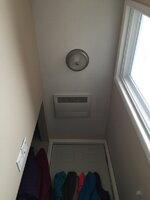
panerv1.jpg

Intake / Exhaust. The intake hood has its back draft flap removed. The ERV has an electronically operated damper that closes if the unit is off or in defrost mode.

panerv2.jpg

The unit has an on/off switch onboard, but I elected to wire in a Z-wave controlled switch to allow both manual and automated control. The ERV has a high/low speed control, so I'm using an LFM20 isolated relay (also z-wave controlled) to toggle 20 vs 40CFM modes.

panerv3.jpg

You can see the ERV on/off and speed control here in the Smarthings automation hub interface. The ERV can be managed from an iphone and/or automated so it's off when on one is home etc.

panerv4.jpg

These are lowest CO2 numbers (about 10 hours after install) that we've seen this winter. This despite the C02 sensor being on the 2nd floor, (ERV is on the first floor) with zero tie in of the ERV to the HVAC system. The Lennox furnace has an ECM motor which is set to 400 CFM circulating air at all times in the house. This might suggest that fresh air mixing from a point source ERV is more effective than one might think, providing the furnace fan is running..which it would be anyway, if the HRV/ERV was tied into it.

panerv5.jpg

CO2 levels seem to now run between 600 ppm (just the family cat at home!) and 850 with all four family members at home. Temps outside have been just around freezing for the last few days, with low/no winds. To be honest, I was not expecting the ERV to be adequate for the whole house, but it certainly appears to be. If you go by ASHRE 6.22, the house "needs" from 45 to 50 CFM of continuous ventilation. The C02 sensor readings though would suggest that the Panasonic ERV at 40CFM and zero HVAC tie-in is actually adequate.
 
Last edited:
To avoid these ads, REGISTER NOW!

Brian_WK

Well-known member
Joined
Jun 30, 2015
Messages
1,177
Location
NE South Dakota
Looks nice and could definitely be beneficial to those who don't/can't install one into there HVAC system. (I know someone with a hot water system that is going to be all over this) Couple of questions though:
1. How is this recovering moisture? Most Heat recovery units with a stationary core allow no cross contamination of air.
2. Is there any balancing dampers on this to allow for pressurizing/equaling pressure in a space?
3. I see you used vents on the outlet side that are different then in the brochure. was there a reasoning behind this? (I like your way better as I think it would do a better job of separating cross contamination)
4. How are you liking the Smart things Hub?

Brian
 
OP
D

Denwood

Well-known member
Joined
Sep 22, 2014
Messages
4,192
Location
Thunder Bay, Ontario, Canada
Brian, great questions.

1. Panasonic uses an "Exchange Capillary Core" in the ERV which is removable for cleaning. It looks exactly like a little HRV core, but I"m guess some moisture transfers over via capillary action. In terms of how much moisture...good question. They don't provide numbers but I'd guess 30% max.

In winter, dryness is an issue in our climate so the ERV transferring moisture is a good thing. It also removes the need for a condensate drain which is a big deal if you're looking to make the install easier.

2. The unit has a motorized intake flap, and gravity exhaust flap. You would need to install balancing dampers if you wanted them in the 4" intake/exhaust piping. I used the flexible aluminum 4" pipe, and pull over insulation "socks" from HD. At 40 CFM though..given what I've learned about stack effect, wind infiltration etc, unless you have a super tight house, there'd be little value in trying to balance the unit.

3. I'd agree on the cross contamination potential. For my application the 5" split styrofoam tube (so intake and exhaust are contained in one 5" tube, with one 5" hole in the wall) would not have worked due to the tight spacing. I also felt that 4" dedicated pipe for both exhaust and intake would be less restrictive than combining both into a split 5" tube.

71QmGsyJHGL._SX522_.jpg


The other big reason to separate the intake/exhaust is to allow ERV air pre-heat with a solar heater. I'll be adding this on after so at -25C (we get a lot of sun in winter here), the intake air is at or above zero. This will keep the ERV in turn out of defrost mode.

The south wall is perfect for something like this, a solar heater built from aluminum downspouts:

img9.gif


4. I've been getting under the hood with both a Vera Edge hub, as well as the SmartThings system. In both I've had to resort to some code to make things work. SmartThings makes this very easy in that you can log in to their developer web site and publish code, "Smart Apps", to yourself. I was also able to get some HD "Ecosmart" 6 watt downlights (awesome lights!) working by pasting in some generic code so SmartThings would recognize them. Once you figure it out, it's easy.

Vera Edge (unlike ST) is 100% local processing so for our Cinevate automation needs, is preferable for reliability. To get things working correctly between our security system, Ecobee3 stats and building items, I've had to do a lot of reading and post a few forum questions. Smarthings' lighting automation app is super easy to use..and does things you would need to resort to code or PLEG (a programming logic plugin) on the Vera Edge.

For most folks looking to automate lights etc. SmartThings will be a lot easier to use. All of the bulbs I've been using are ZigBee, meaning Vera will not work out of the box with these lights, but ST does. If you have more complex automatons and don't mind doing some reading, the Vera Edge product is better. Vera's new product VeraPlus does have a Zigbee radio, but it's new...meaning wait a bit.

I've found that automating lights with an older house is pretty impossible from the switches as none of them have a neutral at the box. Zigbee enabled LED lights like the Philips Hue (white, $14 CAD) and GE-Link ($20 CAD) are much easier to automate, and with a manual switch can be turned off completely if desired. The fact that CREE, GE, Philips etc. are all using Zigbee lights means a hub with a Zigbee radio (like SmartThings) is going to be a lot easier to work with. The Zigbee motion and contact sensors from SmartThings are excellent. They respond instantly, and have been 100% reliable so far. Again, their lighting automation app is excellent in that you can do things like turn off lights if there is no motion for x minutes. I also have entry lights turning on when the Missus arrives based on iPhone presence and that has worked very well. The entry lights turn on when she is 1/2 block away, and then off after 5 minutes). SmartThings is likely going to do quite well with their model. You'll have to get used to the app, which is not very well organized..but doable once you figure it out.
 
Last edited:

BoostAddiction

Well-known member
Joined
Jan 23, 2006
Messages
885
Location
Western North Carolina
Great post. Interesting to see a 100 year-old house being described as "too stuffy" after a retrofit. You must have done a great job with air-infiltration methods.

I wonder if these are as useful in hot, humid climates where the main task is to remove humidity?
 
OP
D

Denwood

Well-known member
Joined
Sep 22, 2014
Messages
4,192
Location
Thunder Bay, Ontario, Canada
Thanks Boost :)

The home updates/retrofits have resulted in less and less air exchange as we've implemented them over the last few years. Nothing uses inside air for combustion, and there are no open flues. I was a bit surprised when we started C02 monitoring to see how low the air exchange actually was.

1. Walls were all drilled internally and insulated with dense pack cellulose.
2. Plaster and lathe attic was spray foamed from above to air seal, then added cellulose to R60.
3. Foam injection on a few problem areas in the upper story.
4. New windows and internal magnetic acrylic storm inserts..near zero air leakage.
5. On demand water heater (no flue, chimney removed, uses outside combustion air)
6. Condensing furnace (uses outside combustion air)
7. High efficiency wood fireplace with outside combustion air.
8. Upper story HardiBoard siding and Tyvek wrap (less infiltration).
9. Central brick chimney has been removed to attic ceiling and sealed off.

All of these has reduced stack effect/infiltration to the point that my wife has noticed it, wanting a window open, even at -25C. She has also definitely noticed the difference this week. I feel a lot better that my girls are getting much better air too. Yesterday the C02 meter had dropped to 550 ppm at around 4pm...so it appears the we're still dropping. Happy wife...

In humid climates, I'm thinking ERV is what you want (not HRV) as your dry conditioned exhaust air is going to remove some inbound moisture...so limiting the amount of humidity entering. National Research Council did a study on ERV vs HRV on their twin house project in Ottawa. The ERV saved 12% in AC costs in one week of use compared to the same house using an HRV: http://www.nrc-cnrc.gc.ca/ci-ic/article/v17n4-13
 
Last edited:

Brian_WK

Well-known member
Joined
Jun 30, 2015
Messages
1,177
Location
NE South Dakota
ERV I think this is the first I have seen in this small of a unit. Most ERVs I deal with are the size of school buses for whole building supply of fresh air and pool complexes for dehumidification. I will now be searching for a ERV that can be connected to my high efficiency furnace.

I want to get into the home automation that doesn't have the cost and complexity of the large building automation I deal with on a daily basis. Stringify looks interesting once they get a Android version.

Thanks for the in depth reviews I like hearing these from a real stand point.

Brian
 
OP
D

Denwood

Well-known member
Joined
Sep 22, 2014
Messages
4,192
Location
Thunder Bay, Ontario, Canada
Brian, I find "real" reviews quite helpful too, so have been attempting to add my findings in turn to the web :)

The Zehnder ComfoAir and Venmar E15 ECM both rank up there for cross flow ERVs with ECM motors and very high efficiency. Having done the simple CO2 sensor control route for the commercial Venmar unit in our building, I would definitely go that route with a larger ERV. This small Panasonic ERV needs to run continuously at 40 CFM if anyone is home, so no point in anything elaborate to control it.
 

jquail

Member
Joined
Feb 3, 2016
Messages
18
Location
Western Canada
Dennis

Thanks for posting the review. I'd be interested in further info on solar heating the air intake side. We have grid tied Pv And solar hot water on our house but in winter it's usually cloudy. Solar Heating the air intake may work during the shoulder seasons though.

John
 
OP
D

Denwood

Well-known member
Joined
Sep 22, 2014
Messages
4,192
Location
Thunder Bay, Ontario, Canada
John, I'll definitely post up the end result. All we're looking to do is get -25C closer to 0C,

Grid tied PV and solar hot water is where we should all be! I'd love to hear your thoughts on your system via pm if you're willing.

Zehnder has a very slick HRV air preheat system for their systems which uses a pretty basic 400ft or so ground loop with glycol and a very low wattage pump. One of the test homes in Anchorage with telemetry is taking -20F air closer to 40F with that system. Tempering warm summer air this way also makes sense...and it works regardless of weather. For new construction in a Pasivhouse, the Zehnder HRV system ground loop pre-heat and electric post heat is all that many homes would need for heat and ventilation...no furnace. One of the Pasivhouse homes in Saskatoon is using a similar all-electric system and takes itself to net zero with grid tie rooftop PV.

Adding a solar pre-heater will limit preheat to sunny days only, but it should add a few BTUs in shoulder seasons as you suggested. Because we're on Lake Superior, (avg temp 40F!) winters are a bit warmer and summer is cooler. I'll have to be careful not to cook the ERV, so will need a summer bypass for sure :)
 
OP
D

Denwood

Well-known member
Joined
Sep 22, 2014
Messages
4,192
Location
Thunder Bay, Ontario, Canada
Just a quick update..on returning from a week's holiday the C02 levels in the house were down to 360 ppm. This was after leaving the unit running at 20CFM while we were away. It was definitely nice to return to a "fresh" house after being closed up for 8 days.
 
OP
D

Denwood

Well-known member
Joined
Sep 22, 2014
Messages
4,192
Location
Thunder Bay, Ontario, Canada
After a year, I'm happy to report that the ERV and control with Smartthings has been working very well. We keep the USB Co2 sensor upstairs in our home and plug it in from time to time to check on CO2 levels. I'm quite impressed with how a "spot" ERV has addressed the issue (at least in this case) with our entire house ventilation with four family members and two cats :)

I've done zero on the solar preheat front, but I will post here when/if we add this in.
 

kwschumm

Well-known member
Joined
Feb 13, 2016
Messages
1,220
Location
Olympia, WA
Nice write up. It looks like a nice unit. Not the most efficient but easy to install.

I'm completely sold on ERVs, have had UltimateAir Recoupaerator units in two houses and really like them. We're now building a new house + shop and they are each getting one. Heat recovery efficiency is in the 96% range.
 
Last edited:
To avoid these ads, REGISTER NOW!
OP
D

Denwood

Well-known member
Joined
Sep 22, 2014
Messages
4,192
Location
Thunder Bay, Ontario, Canada
Toyota, you're welcome :)

Kws, the Panasonic is definitely not the best choice for new construction in this climate (zone 4). Below -6C this unit spends a lot of time in exhaust only mode. It also does not use an ECM motor. The core is small, so not as efficient as a larger unit.

Units like the Recoup are definitely more efficient. I really like the Zehnder units using a brine ground loop to preheat intake air. They've demonstrated a delta T of 1-2 degrees between intake and exhaust air with ambient in the -20C range..pretty amazing.
 
OP
D

Denwood

Well-known member
Joined
Sep 22, 2014
Messages
4,192
Location
Thunder Bay, Ontario, Canada
I figured I'd update this old thread with a few observations after checking operation at extreme cold temps. The little ERV has been running with zero issues now for almost five years...this is from my build thread:

TJ, you got me thinking about the duty cycle of the FV-04VE1 "spot" ERV ventilator in cold weather. If you look at the manual it's not 100% clear what happens below -7 C. The literature states that the unit opens the OA (outside air) damper to check temperature for 10 minutes every hour, then goes into low speed (20CFM) exhaust mode, but it looks like there is no fresh air exchange if you look at the diagram in the manual. I threw a SmartThings sensor in the exhaust (where fresh air enters the room after going through the ERV) as it occurred to me that with only 1 motorised damper on the outside air intake, and a single fan, that the unit must be exchanging air during this test. Indeed it is. So at temps below -7C, you are getting 10 minutes of fresh air per hour. That is actually not terrible if compared with a full size ERV/HRV which will spend much of that hour in recirc mode to defrost.

The temp out side right now is -27 C (-16 F). At 9:55 pm the SmartThings temp sensor on the ERV started dropping from 64 F (meaning the OA damper must have opened), dropped further to 48 F at 10:00 pm, and reached a low of 35 F at 10:06 pm. Then the temp started to climb, meaning the OA damper was closed. Clearly the unit still exchanges air for 10 minute each hour, but it is pretty cold air after 5 minutes! That said, the unit at its worst was still increasing outside air temps by 51 F, which is surprising for such a small ERV core.

I mentioned before that even a tight building is likely doing enough air exchange (with no HRV/ERV running) at very cold temps due to both wind and stack effect on the structure. This is based on a logging over several weeks using a CO2 sensor and laptop, both in our older retrofitted home, and also on our hyper efficient commercial property (now sold). I'm finding now with this extreme cold/wind that the upper floor of our home CO2 level ranges from 700 ppm to a high of 1000 ppm CO2 (morning, with four adults and 2 cats upstairs) with no ERV running, and about 550 ppm to 850 ppm with the small ERV (which is on the main floor) at it's cold weather duty cycle.
 
OP
D

Denwood

Well-known member
Joined
Sep 22, 2014
Messages
4,192
Location
Thunder Bay, Ontario, Canada
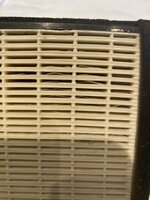
This ERV is still doing fine, however I think I damaged the ERV core by rinsing it with water. The permeable core membranes are paper-like and ya, you should not rinse them with water, ever..unlike an HRV core which is plastic. You can see some edge delamination in this close up pic of the ERV core.


IMG_8361.JPG
I've had a few questions on efficiency, so decided to use a few temp sensors on the fresh/stale air outlets to monitor things a bit. It's not that cold yet, but very cold weather performance (under -7C) is something lacking in this small ERV. I'm trying to assess if intake air preheat is worth doing to extend the full cycle operation of the unit (continuous ventilation).

ERV/HRV efficiency is calculated as follows (from https://www.engineeringtoolbox.com/heat-recovery-efficiency-d_201.html )

μt = (t2 - t1) / (t3 - t1)

1664829132555.png

This is my "spare" temp sensing setup that was used previously in the pool heat control setup. It's basically 3 zWave door sensors (FGK-10X, each with a DS18B20 (cheap) remote temperature probe. I've removed the lithium cells from the door sensors (which die pretty fast when you're capturing temps every 2 minutes) and power them instead with 3 x AA rechargeable batteries connected to a 5V solar cell. It's basically a wireless temperature sensing rig that is happy at -35C. I'm capturing the data to a Hubitat automation hub, which is in turn sending data to the Hundredgraphs website. I've sorted a "live" efficiency calculation based on the data and equation for efficiency above.

Not pretty, but here is the temperature sensing setup attached to the ERV intake hood with a big magnet.

IMG_8362.JPG

and a wider shot showing a temp probe in the ERV fresh air intake and stale air exhaust hoods. I've got similar sensors inside.


IMG_8363.JPG

and finally, the public facing dashboard that you can check out with live data...click the pic for the live data.

1664829981825.png
 

worxman02

New member
Joined
Oct 8, 2005
Messages
1
Location
NJ
Denwood, that is a really awesome monitoring setup and appreciate you sharing the data. I'm an architect who specializes in sustainable design, Passive House, and building science. I'm glad to see that there is a positive sentiment towards HRV/ERVs here. I'm glad that you are testing the Panasonic with probes. I stumbled across this thread while trying to find a better filter for my Panasonic ERV due to the wildfire smoke in Seattle right now. I'm a big fan of Zehnder HRVs and I would recommend those over anything else. Or at least a ERV/HRV that can have a better outdoor air filter installed in it.
 
OP
D

Denwood

Well-known member
Joined
Sep 22, 2014
Messages
4,192
Location
Thunder Bay, Ontario, Canada
Thanks @worxman02 :) I have an external hood/filter for this little ERV that does help with smoke. I can post a pic or two if you'd like.

I'm experimenting with a new setup now (to replace the Panasonic) which will have a 14x14x4 MERV13 inline filter, and a larger charcoal setup for when wildfire or back yard fire smoke is an issue. I'll post about it shortly...but the charcoal setup was surprisingly effective at removing my test smoke (4 small pieces of cardboard burning right at the intake). The unit is showing 90% efficiency (which I find hard to believe, but the data is solid) and is only using about 20 watts with two EC fans. I am experimenting with an AC infinity carbon filter (they sell it for grow tent folks mostly)...but it works very nicely for smoke.

The Panasonic FV-04VE1 is not very efficient, particularly in low temps (and they advise against use in my climate zone...). At around 32F, efficiency is under 50%...not so great with air entering the home at 42 F :-(

This is the experimental replacement unit data snapshot which is returning around 80 CFM of air, with just a 3 F drop...pretty amazing efficiency. The duty cycle of this unit at -27C will also deliver about 40 minutes of fresh air/hour which should be fine for our needs. Efficiency is approaching the specs of a much more expensive Zhender type unit.
 

Attachments

  • 48443_1666021547_IMG_8407.PNG.png
    48443_1666021547_IMG_8407.PNG.png
    480.5 KB · Views: 5

JMURiz

Well-known member
Joined
Dec 6, 2005
Messages
1,483
Location
NoVA
Re: The Panasonic FV-04VE1 …
Just seeing this after being a few years late to the party.

I started looking at the newer Panasonic unit after getting an Airthings air monitor and saw surprisingly high CO2 levels (a bit of not-quite-high radon too) on our small 1940 house. I wish I had readings before having 1/4 of the house insulated as part of a reno and aerosol on the ducts.

The small size of this unit are enticing in a house this small, and I was skeptical of it working w/o hoses everywhere, but your results are good to see.

Hopefully it’s still chugging along.
 
OP
D

Denwood

Well-known member
Joined
Sep 22, 2014
Messages
4,192
Location
Thunder Bay, Ontario, Canada
I have removed the Panasonic and replaced it with a fairly sophisticated setup using a modified HRV, with two ECM 6” fans which are automated on the supply and return side. Pretty long thread here:

I would not use the small Panasonic as a single ERV for a small home as it’s only 30 cFM supply which is not enough unless you are the sole occupant and the total ventilated area is under 900 sq/ft.

We have an IAQ sensor on each of 3 floors which the automation system uses to control the fans. For a family of four, the system is often calling for 75 to 90 CFM. We’d need 3 of the Panasonic ERVs to do this. The system ramps up or down based on CO2, VOC and radon. It’s also integrated into the kitchen exhaust automation to provide about 60 CFM of extra supply air with the kitchen induction cooktop/fan in use.

The small ERV core in the Panasonic unit is better suited for climates where temps are very moderate as it is not too efficient, and in temps below freezing is very often in exhaust only mode.

Hope that helps. Panasonic has a compact ERV in 100CFM flavor which might be a better choice. Boost mode is nice to have on this unit if you have company over or just need a higher vent rate.
 

JMURiz

Well-known member
Joined
Dec 6, 2005
Messages
1,483
Location
NoVA
Thanks for the info, I’ll look at their new 60 and 100 units. I like the between the joists possibly of the 60 is nice for me. I’ll do some more experimenting to see if small cfm changes using a bathfan and windows. First try worked just to see, still do a longer test.

Lucky for me, in the DC area it doesn’t get really cold that often.
 

drboom

Well-known member
Joined
Nov 16, 2014
Messages
74
I recently added the 100cfm panasonic erv to our house (~3600 sqft on 3 levels). I have airthings view plus in several rooms around to measure the radon and c02 before/after and we've set the 3 central AC units to recirc air at least 30% of the time to help move the fresh/stale air around. Denwood's solution is far superior but not what we chose to use. Feel free to ask ma any questions about the 100cfm Panasonic. We're in NH so it does get cold.
 
OP
D

Denwood

Well-known member
Joined
Sep 22, 2014
Messages
4,192
Location
Thunder Bay, Ontario, Canada
I recently added the 100cfm panasonic erv to our house (~3600 sqft on 3 levels). I have airthings view plus in several rooms around to measure the radon and c02 before/after and we've set the 3 central AC units to recirc air at least 30% of the time to help move the fresh/stale air around. Denwood's solution is far superior but not what we chose to use. Feel free to ask ma any questions about the 100cfm Panasonic. We're in NH so it does get cold.
Pany’s 100 CFM unit is a nice unit, trading off a small footprint in exchange for efficiency. Their 200 CFM unit has a much larger core and if run at a lower CFM (say 90 CFM) is very efficient. At some point I’m going to swap in a larger ERv core in my system. It’s been performing flawlessly now for the last 2 years.
 
To avoid these ads, REGISTER NOW!
Top Bottom