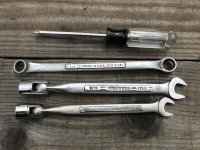
First off it wouldn't be first gen since it isn't zinc plated or plain steel, at least it doesn't look like it is. But I have done some thinking (uh oh) and came up with 3 theories:
1. Your V series wrench was close to when they widened the beam and increased head thickness, but yours is some kind of transitional hybrid. As for the mystery wrench, it could be an unmarked MDF or the forged in V has worn off.
2. Your mystery wrench was made by Wilde. The problem with this theory is that the font of the numbers don't match Wilde's font.
3. Your wrench was made by another manufacturer Sears tried out. The problem with this theory is that there isn't any proof.
There are a number of variations within the Craftsman double-line "heritage" or "modern" design tools for which there is no available information from which we can arrive at conclusive answers today. Sometimes the best we can do is to apply the scientific method:
1. Observe that the variation does indeed physically exist. Since it varies from the mainstream established pattern, it's called an anomaly.
2. Accept that there is indeed an intentional reason for the anomaly's existence beyond mere coincidence. You can't simply say the anomaly doesn't merely because
a. One has never seen it before
b. it shouldn't exist based on the currently accepted model
(I've seen these two extolled far too often in this and other fields of study)
3. Offer a hypothesis that embraces the anomaly's existence based on available evidence. If the hypothesis fits all the evidence and answers the relevant questions posed to it without making exceptions to its own rules for anomalies, it graduates to a theory.
In this, the demand of "proof" is not always possible. But lack of "proof" alone is not necessary for a theory, only that it answers all the relevant questions while being consistent with itself. This is why Einstein's relativity is still called a "theory"--it is yet physically impossible to fully test it. Yet it works, and subsequent additional observations appear to increasingly confirm it. Physicists use it all the time for many things, including calculating the path of our interplanetary probes. Were we able to fully test it, it could be elevated to the final step of being a "law", like the 'laws' of motion.
In the tool collecting field, we often have nothing better than a theory to go by. This is no truer than in the realm of Craftsman. Even the identity of V as Moore Drop Forging has been discovered by investigation and deduction. Sears itself was, and still is, not forthcoming in any of this kind of information, which would provide absolute 'proof'. Barring that, we rely on theories, although we have some really good ones.
My reason for writing all this is that just because there is no "proof" does not in itself invalidate a theory, nor does it prevent us from employing a given theory as the best explanation we have to date until a new observation invalidates it and forces us to formulate a better one.
Back to leg17's "mystery" wrench, which draws us into the realm of what I call the
Craftsman Dating Lottery.
I've handled hundreds of examples of pointed-A double-line heritage wrenches. Although that's a relatively small sampling in the greater scheme of things, it has provided some meaningful observations. Alloy Artifacts (AA) is also an excellent source of information. While it's not 100% accurate in every instance, I've found it to be amazingly accurate in most cases. I'm not going to start on my
Craftsman Catalog Carnival rant here, but suffice it to say that the catalogs are not entirely reliable, especially when it comes to the tool images presented.
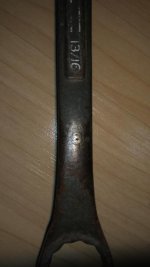
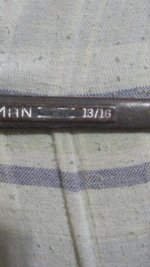
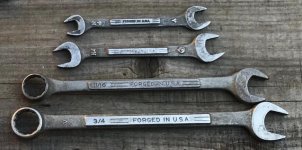
leg17’s mystery wrench has several distinct characteristics. It has the ‘skinny’ geometry; it has the narrow open end fork that is called by collectors of another brand wrench a ‘sharpie’ or something like that; it has no maker code.; it appears to be chrome plated based on what I can see.
Geometry: The skinny shank and the sharpie fork are completely consistent with the earliest of the Heritage double-line logo or what AA calls the Modern Era.
As for the other characteristics, let’s talk a moment about AA’s “Modern Era” section, which is what most of us use as the authoritative reference for this time period. First, AA offers a theory that in this earliest period, as may as three different mfrs were competing for the modern era tools—MDF, Wilde and an unknown. I find that to be a good theory because it seems to fit the facts. AA did not have enough evidence to identify the third maker. But the implications are distinct: wrenches marked with V or P-Circle codes are positively identified as either MDF or Wilde respectively. This means the third, unidentified maker has to be for those wrenches having no maker code, n’est pas? After all, it’s the very lack of a code that makes the mfr unidentifiable. That to me is sufficient “proof” that the third maker actually existed. These codes were fundamental and vitally important to the customer’s (Sears) requirements, so it’s unlikely that a mfr merely ‘forgot’ to implement them, especially if they were in a contest to win the Sears contract. We can be confident Sears knew exactly who this un-coded mfr was. There are too many examples of unsigned wrenches from this early era to consider them as just mistakes.
So, why doesn’t AA show more of them? This is where AA sometimes has an agenda behind what artifacts it shows. First, it defines the Modern Era as the creation by Sears of the Heritage design. But wait….why then does it present its early artifacts as a “prelude” to the modern era when all the examples are clearly modern era? This is contradictory, so one has to read the introduction to find out why. It states that with the examples it chose that it’s trying to prove its ‘mfr tryout’ thesis, and so it chose the earliest examples—it states it looked for circa 1945 examples—to prove its position. Apparently, it’s attempting to define the trial period as a ‘prelude’, even though that’s inconsistent with its ‘modern era’ definition.
This ‘conflict of interest’ approach creates several misnomers. First, since it’s focusing almost exclusively on the circa 1945 examples to prove its premise, it doesn’t show us how long this trial period lasted. It also implies that the trial period was characterized by tools having cadmium or plain steel finishes instead of chrome. It’s a well-established fact that the use of chrome was restricted during war time, and was lifted afterward, when most mfrs went back to chroming. If one were to deduce that this trial period perhaps lasted through to 1947, it would be unrealistic to assume that all the tools during this two-year period were cadmium or plain steel, especially in the face of the competition’s chromed production. So its focus on proving its mfr-test theory by displaying only non-chromed examples leads to an erroneous conclusion about a lack of chromed examples from this period. There are sufficient early examples found in the wild with either forged-in codes or un-coded that are also chrome-plated to show this false impression is brought about by AA’s agenda.
Why is AA focusing on the war-time non-chromed examples? Because it can more easily show that its theory of the contest between Wilde and MDP started at the very beginning of the modern era. By the same token, why does it skimp on the un-coded examples? Because it can’t prove its theory with them as well as it can with the coded wrenches.
Fortunately, AA tossed in a couple of bones to give us examples of later chromed wrenches from this early test period. On the AA page, Fig. 6 shows an early contest-period wrench with a forged-in V but also in chrome, and it designates it as a post-war wrench. I personally have encountered a number of examples of these. The implication to AA’s study is that once the ‘contest’ was won by MDP. The V code was then stamped on the panel and the forged-in codes eliminated—we can conclude this by the lack of any examples of a P-Circle being stamped on the panels, which suggests the contest was over.
Another interesting variation is found in Fig. 4, one of these earliest un-coded wrenches. The open end fork is not the “sharpie” type, indicating that our mystery mfr didn’t always conform to spec.
In conclusion, be aware that the AA presentation is not really a ‘prelude’ to the modern era, but the artifacts are indeed modern era design; that AA is presenting primarily war-time non-chromed examples to prove its mfr-trial theory rather than showing a broader selection of examples showing more post-war chrome; and that it’s limiting its un-coded examples because they are not the best examples to clearly show the contest in the earliest modern-era cadmium/plain steel war-time years. I believe leg17’s un-coded mystery wrench is from our ‘mystery’ mfr contestant, post-war circa 1946-47.