This was the correct answer. A thousandths reading dial indicator will get you good information on what is where. A tenths indicator is going to give you information about your surface finish. It will find scratches. You might need both for some operations. I think you will find a thousandths indicator easier to use and read, less jumpy. Invest is good holders, like a Noga arm with a mag base. I also use cheap eBay Starrett surface gauges as indicator bases.For some one assembling engines .001” is fine and .0001” is a detriment.


You are using an out of date browser. It may not display this or other websites correctly.
You should upgrade or use an alternative browser.
You should upgrade or use an alternative browser.
0.001 vs 0.0001
- Thread starter bradthefixer
- Start date
bpwoodworking
Well-known member
- Joined
- Jul 6, 2023
- Messages
- 254
I’ve checked my mitutoyo calipers with A grade gauge blocks, they’re accurate to better than .001” at every length I’ve checked them at.
Obviously a mic is more accurate, but I wouldn’t put the calipers at .002”
Obviously a mic is more accurate, but I wouldn’t put the calipers at .002”
dnschmidt
Well-known member
I'll echo the statements about Plastigauge. Pro engine builders hate this stuff because they have the proper tools but for the common man it's pretty damn good. I use it just to check my work and have found it to be quite accurate and relatively foolproof. If you have magic micrometer fingers that can tighten micrometers just right you're golden but most people don't. The amount of error introduced by over or under tightening a micrometer can easily exceed a couple of tenths.
I use plastigauge for quick measuring but I've been told by a few different high performance engine builders they don't use plastigauge especially on connecting rods. I ran across that on a stroker build. The rods would twist just a hair making it appear that the crank wasn't square. I measured an assembled rod and the crank separately and it was exactly where it needed to be with no taper.
I like to double my work and especially other people's work. An old time tractor puller I know says he just assembles but trust his crank guy 100%. He's pulled for decades and never had an issue on his motors so I guess he's right about his crank guy.
I like to double my work and especially other people's work. An old time tractor puller I know says he just assembles but trust his crank guy 100%. He's pulled for decades and never had an issue on his motors so I guess he's right about his crank guy.
Unless I missed something, I think they’re talking about dial indicators not calipers.. If I were building an engine, I’d also be looking for a borematic. Standard telescoping hole gages and a decent set of micrometers (and a mic stand) can also go a long long way.I’ve checked my mitutoyo calipers with A grade gauge blocks, they’re accurate to better than .001” at every length I’ve checked them at.
Obviously a mic is more accurate, but I wouldn’t put the calipers at .002”
You may have been thinking like me. The tool that measures the hole gauges needs to be pretty decent. I could see some guys being attracted to digital calipers for that. Like you said, as good as they are, as good as I am with them (not that good), they aren’t good enough for checking bearing surfaces, cylinder diameters etc.
OP
bradthefixer
Active member
- Joined
- Nov 2, 2022
- Messages
- 29
Brother you said all! I have decent mics, dial bore gage, but no authority on use. I can get a different reading on the same part if I measure it several times. My fat carpel tunnel fingers are not precious tools anymore! I also use plasti gauge, since 1982 to check before and after machine work and find it pretty damn good too.I'll echo the statements about Plastigauge. Pro engine builders hate this stuff because they have the proper tools but for the common man it's pretty damn good. I use it just to check my work and have found it to be quite accurate and relatively foolproof. If you have magic micrometer fingers that can tighten micrometers just right you're golden but most people don't. The amount of error introduced by over or under tightening a micrometer can easily exceed a couple of tenths.
OP
bradthefixer
Active member
- Joined
- Nov 2, 2022
- Messages
- 29
I agree, thank youKeep in mind that engines expand/contract many tenths every time they heat cycle...so it's not like being that precise on anything but rotating parts is really any benefit.
OP
bradthefixer
Active member
- Joined
- Nov 2, 2022
- Messages
- 29
Thank youKeep in mind that engines expand/contract many tenths every time they heat cycle...so it's not like being that precise on anything but rotating parts is really any benefit.
OP
bradthefixer
Active member
- Joined
- Nov 2, 2022
- Messages
- 29
Most modern engines are not going to be rebuilt with a mill and a lathe. They are just assembling the engine. You still need some measuring tools for assembly however.
They are paying an engine shop to do the machine work Its all done with specialized equipment. They are having a machine shop use an cylinder boring bar and hone to do the cylinders and a line boring machine to do the main journals if needed. Even the facing is done on specialized machines.
The only standard machine tool my engine builder has is a Bridgeport. It has a special fixture that is motorized to turn a crank and accelerometers measure unbalance of the crank and tell you where and how much to remove to achieve balance. Again, not a home shop piece of equipment. Its is literally being used as a drill press with precision X axis moves, No really milling done.
Thank youHaving assembled engines as a young man I would measure parts with a .001" mic and that was to make sure that the machine shop did not sent me .010" bearings to fit a .020" under crank pin. When I started machining and having to hold parts to a tolerencence I learned that the measuring tool used had to have a resolution 10x the measurement you were trying to measure. That is basic metrology. With my thinking I was not checking that the machinist hit tolerance, just that the part was not grossly out. If I question the machine work then I take it back to the machine shop and have them check it for me. No reason for me to set up a metrology room at home for occasional work.
lg
no neat sig line
Willie Makeit
Well-known member
- Joined
- Dec 30, 2013
- Messages
- 937
i suppose some of us are better machinists than others. try harder, you'll get there lil' buddyYou must be a heck of machinist to hold .0001mm tolerances, since by your own admission, you don't work in inches...
For the rest of us, ten-thousandth of an inch is a respectable goal.
bpwoodworking
Well-known member
- Joined
- Jul 6, 2023
- Messages
- 254
I agree, I was commenting on 908Jim's post WRT calipers. He's accurate that they should not truly be trusted for better than .002" but, Ive checked my mitutoyo calipers against gauge blocks and have found them to be better than .001" in every area except for inside diameter which they were .002". That's only one set of calipers but I was impressed by how accurate they were.Unless I missed something, I think they’re talking about dial indicators not calipers.. If I were building an engine, I’d also be looking for a borematic. Standard telescoping hole gages and a decent set of micrometers (and a mic stand) can also go a long long way.
You may have been thinking like me. The tool that measures the hole gauges needs to be pretty decent. I could see some guys being attracted to digital calipers for that. Like you said, as good as they are, as good as I am with them (not that good), they aren’t good enough for checking bearing surfaces, cylinder diameters etc.
As you mention, they aren't a reliable tool for ID of a cylinder for a couple reasons.
I like indicating gauges for bores, it's nice to see the sweep and know that you're parallel and getting a good result. I've never used a Mitutoyo borematic but they look like a top tier tool for the task.
Last edited:
OP
bradthefixer
Active member
- Joined
- Nov 2, 2022
- Messages
- 29
3) yes very cumbersome! I have considered the go/no go for future builds. Great info thanksYour question is a bit too broad to really be answered well. Which machine shop work are you wanting to measure? Connecting rod resizing? Bore and hone? Crank grinding?
For home engine work, I'd recommend:
1) I quality 0.0001" resolution micrometer set enough to cover up to 3" or so. This is for diameters-- crank pins, main bearing journals, valve stem diameter, etc. You'll want a depth mic companion to go with it.
2) A digital indicator also capable of 0.0001". This was formerly the domain of only test indicators that has very little total travel, but you can now get Mitytoyo digital indicators with a whopping inch of travel that will hold 0.0001". These are super useful as they can replace a test indicator for most purposes, so everything from flatness checks, runout, etc can be measured with a single indicator and a variety of bases and attachments. Not cheap, but considering how many tools it replaces it is likely a great investment.
3) Telescoping bore guage set. If you are skilled, you can make a telescoping gauge set and your micrometer work pretty well, but it's cumbersome compared to a two point dial or digital bore gauge. Expect sticker shock for a real bore gauge that will make the telecscoping setup look very appealing. A cheaper bore guage will cost less than a good micrometer and quality telescoping guage set, but you'll be glad to have the quality of the latter and with practice it will be surprisingly consistent.
If you are consistently working with any particular size hole (say SB Chevy rod big ends or small ends) I'd recommend large diameter plug gauges of the appropriate size. Easy way to go/nogo with high precision and they're surprisingly cheap. $12-$15 will get you a gauge of the stock piston pin size that's within 0.0002" of true nominal. This only works for hole small enough to find a ready made gauge, but plug gauges are a super cost-effective tool in terms of price vs precision.
Also, a caution about using 2d data to generate 3d conclusions. If you measure a bore in 3 or four places to "check the bore size" you have NOT measured the cylinder. You have measured circles that are slices from that cylinder. You measurements are not guaranteed to be concentric/coaxial to each other. With enough measurement locations you can have some confidence that this is mostly moot.
Cruzan80
Well-known member
Really want to see someone who is US based never work in inches whatsoever.i suppose some of us are better machinists than others. try harder, you'll get there lil' buddy
Attachments

OP
bradthefixer
Active member
- Joined
- Nov 2, 2022
- Messages
- 29
Thank you, for "which tool" reminder. I use a dial bore gauge and a mic for measuring before and after machine shop service, I'm not a machinist and. I believe .001'' is fine just as others have said too.Ya'll are missing the point; the OP asked "which tool?" and the only acceptable GJ answer is "Yes. All the tools."
That said: in the OP's situation (a hobby shop, NOT a clean room in a metrology lab) it's doubtful the OP would ever be able to get useful, repeatable data from something that measures tenths.
Sure would be shiny, though, and they cost a lot and usually come with impressive cases that look great on the shelf.
OP
bradthefixer
Active member
- Joined
- Nov 2, 2022
- Messages
- 29
Not disagreeing here but the old saying "Trust but verify" comes into play here. I've not assembled a lot of engines but one time was shipped the wrong bearing inserts for the crank size. So checking saved me a lot of work in that situation.
lg
no neat sig line
Thanks for the gauge block suggestion! My finesse with a mic has never been great, I'm not a machinist, I do restoration work most of the time. I really don't trust the standards that came with my mics so ill get some blocks too. I had a bad experience very recently with a well-known machine shop, I "trust but verify" and found they polished the crank not to required spec.A lot of great advice has already been given but I will add three things.
First, .001 resolution and .001 accuracy are not the same. Calipers are perfect when +/- .002 is acceptable. Yes you can theoretically get better results but many people don't in practice. If you truly need +/- .001, get a micrometer. 0-1" and 1-2" should take care of everything you need that level of precision for.
Second, get a couple gauge block of micrometer standards and learn how tight/loose to screw the micrometer thimble to get a reading that matches the gage block or standard.
Third, get some plastigage and learn to use it. It's perfectly fine for general automotive repair.
Lassen Forge
Well-known member
Just to keep pot smok, er, stirring...
A "tenth" (.0001") is .02 mm...
.0001 mm is .0000039". When you think about it, that's really sloppy tolerances on a sub-atomic level. Try that on a Mk.14 Hyperdrive warp field generator, you'll end up in Andromena, and your artificial gravity generators will be fluxing all over the place, never mind Anti-Gravity... Beh!
To quote Roger Waters... "This... will... not... DO!"
A "tenth" (.0001") is .02 mm...
.0001 mm is .0000039". When you think about it, that's really sloppy tolerances on a sub-atomic level. Try that on a Mk.14 Hyperdrive warp field generator, you'll end up in Andromena, and your artificial gravity generators will be fluxing all over the place, never mind Anti-Gravity... Beh!
To quote Roger Waters... "This... will... not... DO!"
OP
bradthefixer
Active member
- Joined
- Nov 2, 2022
- Messages
- 29
Hah! good one! Yes, but lots of good info here from guys that have much experience. I'm not a machinist. I'm a firm believer in "trust but verify" I got jerked around by a machine shop very recently, I mic my crank to find they didn't polish it to give me .003 clearance, 3x back and forth to get the correct dia. Never again will I be back there.By the time we're finished the OP will be on the hook for purchase of a lightly used machine shop, with a metrology lab, and all of its contents. At which point, our job is done.
Unfortunately for the OP, interest rates are high.
OP
bradthefixer
Active member
- Joined
- Nov 2, 2022
- Messages
- 29
By the time we're finished the OP will be on the hook for purchase of a lightly used machine shop, with a metrology lab, and all of its contents. At which point, our job is done.
Unfortunately for the OP, interest rates are high.
The things your measuring have a tolerance. You need a tool that can measure that. Watch some machining videos like "Cutting Edge Engineering" from Australia. You will see the machinist use various instruments to measure. Everything from a ruler to a set of calipers to micrometer. It all depends on what your measuring. If the specification is 5.375" +/-0.003" a good set of calipers will do the job. If the spec is 1'+/- 1/8" a ruler might work. For 0.1258" +/- 0.0002 you might need a good micrometer. The service manual for your engine should give the specifications. In the case of the dial indicator, check the spec and see if it's accurate enough. That being said, you can get a disk indicator that reads ten thousandths for a price that's not entirely unreasonable. I would want to spend my money on one that has more functionality. Its a tool that often comes in handy. I don't think your going to save enough to warrant the loss of functionality.Hello, which resolution measurement is acceptable to measure pre machine shop work and post machine shop work? Small block chevy mild build weekend driver. Just trying to get input for an ongoing debate between a couple of friends. One says .001 dial indicator is just fine for a hobby builder, the other says you must use .0001 dial indicator.
One last post from me on this one with specifics.
If I was building an engine, this is the minimum I’d go in with:
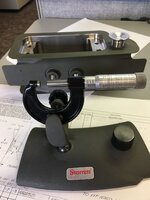
Starrett 436 in an old school mic stand hard at work.
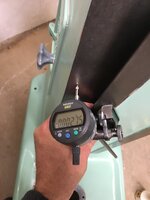
That’s a bunch of decimal places! Measuring the depth of flaking on my Bridgeport’s column. This modern indicator is mounted in an ancient Starrett #57 surface gauge. Starrett has been making these for over 100 years virtually unchanged. You can buy them for a few bucks on eBay, dirty, rusty, missing components, but can be cleaned up easily. They are good to use as non magnetic indicator holders.
If I was building an engine, this is the minimum I’d go in with:
- Good straight edge
- Decent digital calipers
- Telescoping gauges big enough for cylinders, and small enough for crank bearings (these come in sets)
- Hole gauges for valve bearings
- feeler gauges
- Digital mics to measure the gauges! These are expensive. Venerable Starrett 436 mics can be had for cheap on eBay. But honestly, you might need metric. You can do the math, but that’s kind of a pain as you are not really checking a single value but a range. I think in inches. Helps me to directly read in mm, because I can’t convert in my head easily. It’s not intuitive.
- Dial indicator with a long stroke if possible. Again, digitals give you the ability to quickly change units. I have been lucky finding used Mitutoyos on eBay for about $50. These are accurate enough to use for many tasks.
Starrett 436 in an old school mic stand hard at work.
That’s a bunch of decimal places! Measuring the depth of flaking on my Bridgeport’s column. This modern indicator is mounted in an ancient Starrett #57 surface gauge. Starrett has been making these for over 100 years virtually unchanged. You can buy them for a few bucks on eBay, dirty, rusty, missing components, but can be cleaned up easily. They are good to use as non magnetic indicator holders.
Last edited: