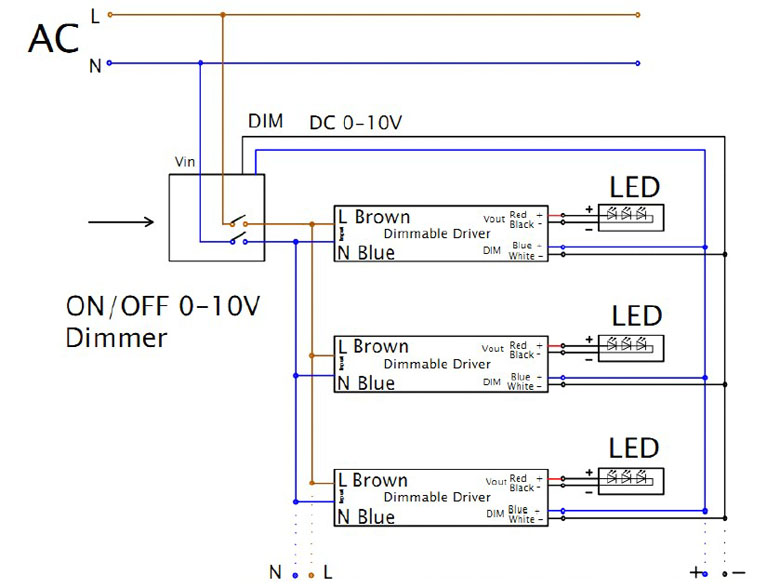
Ok, so I researched the requirements on the dimming cabling since I need to install it soon.
Electrically, the 0-10v dimming spec requires the lamp driver to source no more than 2mA - and of the few I looked at it ranged from 50micro amps to 1mA...so conservatively I will use 2mA per light
Conversely, the dimmers out there are specified to sink from 30-50mA, giving a range of 15-25 fixtures per dimmer for the control output ( the power switching portion is another issue)
The other issue is the NEC requirement that cables in conduits or assemblies must be rated to the highest voltage present, so either 150 or 300v which are cl2,cl3 respectively when run with 120 or 240 house wiring.
The app notes from one of the suppliers recommends 18ga wire up to 300 feet or 16ga up to 400 feet. The suppliers also recommend wiring the signal separate from the power, but indicate it is acceptable to run in the same conduit. The issue is electrical noise on the control signal.
As far as I can see, the most readily available cable for this is sold as "thermostat" cable which is 18-2 and available at the big box stores it is 150v rated and about $14/100ft . 18ga wire is 6.3ohms per 1000feet, so if for example we use 12 fixtures at 2mA each, 24mA total, the drop will be 15mV further assuming a 100' cable - .15% which is negligible. This type of cable is not a twisted pair so should be kept as far away from power or other sources of electrical noise as possible.
Electronics specialty suppliers and alarm companies do carry sheilded and twisted cables in this size - but they are hard to find and in the $50+/100ft range.
I looked some more into the use of Cat cable for this use. The main attraction is that these cables are twisted pair for better noise immunity and very inexpensive. The downside is that they are thin 24 or 23ga wire. 24ga wire is 25.7ohms/1000' so about 4 times as much as 18ga wire. These cables also contain 4 pairs of wire which could be joined making the loss about the same as 18ga and certainly acceptable for our 12 fixture 100 foot example performance wise. As far as the NEC, typical Cat5,6 cable is rated CMR or CMP, both of which are higher specifications than CL2,3 so it looks like it can be run acceptably to light fixtures.
Having said all that, the simplest thing to do is to use the 18-2 or 16-2 wire available at the home centers. If you are concerned about noise causing your dimming to pulse, try to use a twisted or shielded cable. As far as Cat cable, that will come down to your ability to join and connect fine wires reliably.