To avoid these ads, REGISTER NOW!

1-10v signal cable for led panel lights

MrChips

Member
Joined
May 23, 2015
Messages
14
Slightly boring question but can anyone confirm what cable we could use for the control signal for some 1-10v dimming led panels?

Ideally to fit in the same channel as the main power cables, although some research indicates that it might cause voltage interference?
 
To avoid these ads, REGISTER NOW!

nehog

Well-known member
Joined
Jan 2, 2010
Messages
7,935
Location
Jaffrey, NH
...

Ideally to fit in the same channel as the main power cables, although some research indicates that it might cause voltage interference?

Low voltage cable should not be in the same conduit as high (line) voltage cable.
 

dacuda

Well-known member
Joined
Aug 22, 2016
Messages
130
Location
st cloud ,fl
to be ul certified low voltage cannot be in the same conduit as primary power as mentioned above
 

Radix2

Well-known member
Joined
May 28, 2014
Messages
1,853
Location
the thumb!, MI
to be ul certified low voltage cannot be in the same conduit as primary power as mentioned above

so what do you make of the UL listed MC cable made for the purpose posted above ?

I'm pretty sure that the intent of the fixtures is to bring both power and signal down one conduit and into the the assembly through one knock out.
 

cybrdyke

Well-known member
Joined
Sep 9, 2014
Messages
3,444
Location
USA
so what do you make of the UL listed MC cable made for the purpose posted above ?
There's also dimming switches that have both black & white leads for on/off operation and purple & gray leads for 0-10v dimming operation. So, both line voltage and low voltage have to be in the same box connected to one device.
 

Radix2

Well-known member
Joined
May 28, 2014
Messages
1,853
Location
the thumb!, MI

alfredeneuman

Well-known member
Joined
Mar 3, 2011
Messages
4,580
Location
Fullerton, CA
to be ul certified low voltage cannot be in the same conduit as primary power as mentioned above

2011 NEC Article 300.3 (C)(1)

(C) Conductors of Different Systems.
(1) 600 Volts, Nominal, or Less. Conductors of ac and dc
circuits, rated 600 volts, nominal, or less, shall be permitted
to occupy the same equipment wiring enclosure, cable, or
raceway.
All conductors shall have an insulation rating
equal to at least the maximum circuit voltage applied to any
conductor within the enclosure, cable, or raceway.

UL doesn't certify anything. UL lists items for use.
The inspector certifies or approves it for its use
 

6PTsocket

Well-known member
Joined
Mar 12, 2014
Messages
4,593
Thanks for this thread. I learned something. I had never considered this situation before and just thought you had to keep them separate

Sent from my SM-G900V using Tapatalk
 

Muzzy

Well-known member
Joined
Jun 20, 2015
Messages
335
Location
Northeast PA
Twisted pair 16 ga with a shield. Ground the shield at one end only.
This will be overkill for a residential application...
 
Last edited:

Radix2

Well-known member
Joined
May 28, 2014
Messages
1,853
Location
the thumb!, MI
Twisted pair 16 ga with a shield. Ground the shield at one end only.
This will be overkill for a residential application...

You know of a readily available and decently priced source? The electrical houses look like they are at .50+ per foot and hard to get.

What are the pros using..or doesn't anyone connect the dimming?

I am liking the cat cable idea, you can parallel up the 4 sets of 24ga twisted pair for more robustness.
 

Muzzy

Well-known member
Joined
Jun 20, 2015
Messages
335
Location
Northeast PA
You know of a readily available and decently priced source? The electrical houses look like they are at .50+ per foot and hard to get.

I do not.

The twist and shield give you protection against induced or 'phantom' voltages. Without knowing the switch, dimmer, environment or distances its tough for much more than off the cuff suggestions. I would not personally use ethernet cable for this application. However I am not an electrician or EE.
 
Last edited:

ishiboo

Well-known member
Joined
Oct 27, 2010
Messages
9,481
Location
Oshkosh, WI
You know of a readily available and decently priced source? The electrical houses look like they are at .50+ per foot and hard to get.

What are the pros using..or doesn't anyone connect the dimming?

I am liking the cat cable idea, you can parallel up the 4 sets of 24ga twisted pair for more robustness.

I would use 18/2 or 16/2 in-wall speaker/intercom/etc. wire... should be pretty easy to find and cheap, and rated for 150v or 300v (CL2/CL3).

10 cents a foot: https://www.amazon.com/dp/B00614H10Q/?tag=atomicindus08-20
 
Last edited:

dacuda

Well-known member
Joined
Aug 22, 2016
Messages
130
Location
st cloud ,fl
2011 NEC Article 300.3 (C)(1)

(C) Conductors of Different Systems.
(1) 600 Volts, Nominal, or Less. Conductors of ac and dc
circuits, rated 600 volts, nominal, or less, shall be permitted
to occupy the same equipment wiring enclosure, cable, or
raceway.
All conductors shall have an insulation rating
equal to at least the maximum circuit voltage applied to any
conductor within the enclosure, cable, or raceway.

UL doesn't certify anything. UL lists items for use.
The inspector certifies or approves it for its use

your info is 5 yrs old and all codes can be interpreted differently,building,electrical,etc.. . what i can say is in the sign indusrtry we wire all the time and no inspector will pass any raceway,junction box,conduit ,etc,, where low voltage and primary power occupy the same space.it only makes sense if nothing else.
 

alfredeneuman

Well-known member
Joined
Mar 3, 2011
Messages
4,580
Location
Fullerton, CA
your info is 5 yrs old and all codes can be interpreted differently,building,electrical,etc.. .

2014 NEC 300.3 (C)(1)

(1) 1000 Volts, Nominal, or Less. Conductors of ac and dc circuits, rated 1000 volts, nominal, or less shall be permitted to occupy the same equipment wiring enclosure, cable, or raceway. All conductors shall have an insulation rating equal to at least the maximum circuit voltage applied to any conductor within the enclosure, cable, or raceway.

You're right. The newest Code says that the voltage threshold is increased to 1000V from 600V.
 

Muzzy

Well-known member
Joined
Jun 20, 2015
Messages
335
Location
Northeast PA
Mixing voltages is a signal quality / noise issue, not a safety issue.
Whether or not it is good practice depends on the application.
 

reader2580

Well-known member
Joined
Dec 31, 2014
Messages
14,520
Location
Minneapolis, MN
your info is 5 yrs old and all codes can be interpreted differently,building,electrical,etc.. . what i can say is in the sign indusrtry we wire all the time and no inspector will pass any raceway,junction box,conduit ,etc,, where low voltage and primary power occupy the same space.it only makes sense if nothing else.

My electrical inspector said I could place the low voltage control wires for my generator in same conduit as the power as long as insulation rating is the same. I used some THHN wire that was way overkill as far as AWG.

Like you said, what inspectors will allow varies.
 

Radix2

Well-known member
Joined
May 28, 2014
Messages
1,853
Location
the thumb!, MI
Ok, so I researched the requirements on the dimming cabling since I need to install it soon.

Electrically, the 0-10v dimming spec requires the lamp driver to source no more than 2mA - and of the few I looked at it ranged from 50micro amps to 1mA...so conservatively I will use 2mA per light

Conversely, the dimmers out there are specified to sink from 30-50mA, giving a range of 15-25 fixtures per dimmer for the control output ( the power switching portion is another issue)

The other issue is the NEC requirement that cables in conduits or assemblies must be rated to the highest voltage present, so either 150 or 300v which are cl2,cl3 respectively when run with 120 or 240 house wiring.

The app notes from one of the suppliers recommends 18ga wire up to 300 feet or 16ga up to 400 feet. The suppliers also recommend wiring the signal separate from the power, but indicate it is acceptable to run in the same conduit. The issue is electrical noise on the control signal.

As far as I can see, the most readily available cable for this is sold as "thermostat" cable which is 18-2 and available at the big box stores it is 150v rated and about $14/100ft . 18ga wire is 6.3ohms per 1000feet, so if for example we use 12 fixtures at 2mA each, 24mA total, the drop will be 15mV further assuming a 100' cable - .15% which is negligible. This type of cable is not a twisted pair so should be kept as far away from power or other sources of electrical noise as possible.

Electronics specialty suppliers and alarm companies do carry sheilded and twisted cables in this size - but they are hard to find and in the $50+/100ft range.

I looked some more into the use of Cat cable for this use. The main attraction is that these cables are twisted pair for better noise immunity and very inexpensive. The downside is that they are thin 24 or 23ga wire. 24ga wire is 25.7ohms/1000' so about 4 times as much as 18ga wire. These cables also contain 4 pairs of wire which could be joined making the loss about the same as 18ga and certainly acceptable for our 12 fixture 100 foot example performance wise. As far as the NEC, typical Cat5,6 cable is rated CMR or CMP, both of which are higher specifications than CL2,3 so it looks like it can be run acceptably to light fixtures.

Having said all that, the simplest thing to do is to use the 18-2 or 16-2 wire available at the home centers. If you are concerned about noise causing your dimming to pulse, try to use a twisted or shielded cable. As far as Cat cable, that will come down to your ability to join and connect fine wires reliably.
 
Last edited:
To avoid these ads, REGISTER NOW!
OP
M

MrChips

Member
Joined
May 23, 2015
Messages
14
Thanks all! I should have mentioned that i'm UK based so will double check our own regulations however I believe they are similar to the US ones in that so long as the signal cable insulation is rated to the same as the main power cables.

The switch we're using is a combination dimmer so it has on/off and also dimming within the same switch.

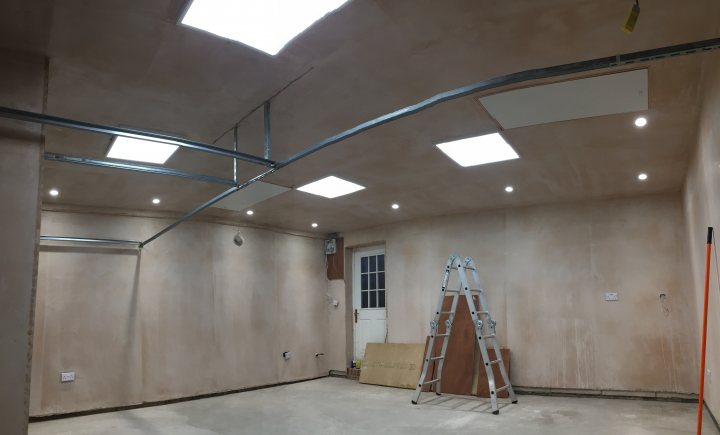
The original installer didn't realise the led panels used 1-10v dimming so the power cables and conduit are already in place, plasterboarded (drylining is the US term i think?) and plastered over. It's going to be a pain to retrofit if we can't use the same channel as the power but it sounds like it's achievable with the right cable.

As a picture is always nice... here's the lighting set up.
rrY2MHM5.jpg
 

Muzzy

Well-known member
Joined
Jun 20, 2015
Messages
335
Location
Northeast PA
Radix2 that's an excellent write up. Have you decided what you're planning on using for your installation?

If you're friends with any industrial electricians, controls, or commercial HVAC types it may be worth asking if they have any analog signal cable left over from a job? My experience is that leftovers are given to the apprentices to scrap, but I'm sure every team is different.
 

Radix2

Well-known member
Joined
May 28, 2014
Messages
1,853
Location
the thumb!, MI
Radix2 that's an excellent write up. Have you decided what you're planning on using for your installation?

If you're friends with any industrial electricians, controls, or commercial HVAC types it may be worth asking if they have any analog signal cable left over from a job? My experience is that leftovers are given to the apprentices to scrap, but I'm sure every team is different.

AFAIK the electricians and HVAC guys are using the 18ga stuff sold as thermostat wire, available in 2,4,6,8 strands everywhere. I think it would work fine with just a little care not to staple it right on top of the power lines.

I am doing 12 fixtures in a 40x50 , so I think it will take right about 150' of wire. After that is the workshop and it looks like a ton of fixtures in there..maybe they wont be dimmable..

Of course I AM TRYING TO CURB my perfectionist streak that wants twisted pairs...etc.. I hope I don't have any spare cat wire laying about...:shocking:
 

Muzzy

Well-known member
Joined
Jun 20, 2015
Messages
335
Location
Northeast PA
Nice.

I'm willing to bet that flat lamp cord or speaker wire would be fine in a home shop. I would use thermostat wire without hesitation if it were me.
 

Bmwsyc

Well-known member
Joined
Dec 1, 2013
Messages
49
Article 725.126 talks about how class 1 and class 2 circuits cannot be run in the same conduit or raceway. Class 1 being lighting or power circuits and class 2 being current limited low voltage circuits. Conductor insulation voltage rating is not a factor, the rating of the power supply is.

IMG_0134.jpg
 
Last edited:

Radix2

Well-known member
Joined
May 28, 2014
Messages
1,853
Location
the thumb!, MI
Article 725.126 talks about how class 1 and class 2 circuits cannot be run in the same conduit or raceway. Class 1 being lighting or power circuits and class 2 being current limited low voltage circuits. Conductor insulation voltage rating is not a factor, the rating of the power supply is.

IMG_0134.jpg

Hmm every description of that section I find says the opposite...here is a specific app note and code cite for 0-10v dimming

http://www.cooperindustries.com/con...s/Application Notes/0-10v_class1_2_wiring.pdf
 

Jack D

Well-known member
Joined
Nov 3, 2015
Messages
68
Location
Southwest Connecticut
AFAIK the electricians and HVAC guys are using the 18ga stuff sold as thermostat wire, available in 2,4,6,8 strands everywhere. I think it would work fine with just a little care not to staple it right on top of the power lines.

I am doing 12 fixtures in a 40x50 , so I think it will take right about 150' of wire. After that is the workshop and it looks like a ton of fixtures in there..maybe they wont be dimmable..

Of course I AM TRYING TO CURB my perfectionist streak that wants twisted pairs...etc.. I hope I don't have any spare cat wire laying about...:shocking:

I just did two 330w HiBays on a 14' ceiling in a small garage and I used 18/2 thermostat wire and two distinct switches. I used a 15a twist lock in the ceiling with a standard luminary disconnect plug for the dimmer so I could take the fixture down without cutting cables. Inside the fixture the 0-10v dimming wire was smaller gauge but stranded wire so the 18/2 was more than adequate. I used a cable stapler to staple the thermostat wire to the rafters and tie-wraps on the 16-3 power cable, that I used with the twist lock.

The only noise I would think you need to worry about is probably from lighting and noise on that cable would be the least of your concerns at that moment. If you have local noise that is causing the lights to flicker you probably would want to track that down before there is other damage.
 

cybrdyke

Well-known member
Joined
Sep 9, 2014
Messages
3,444
Location
USA
To connect the 0-10VDC contollability of their ballasts and drivers, Philips recommends using solid wire, 20awg if less than 320', 18awg up to 500', and 16awg up to 800' max. Industry standard colors for this are are purple and gray.
CD
 

Smoker

Well-known member
Joined
Sep 4, 2009
Messages
167
Location
San Antonio
If your feeling super OCD look up Belden 1266a. That's twisted, shielded and has a drain wire.
 
OP
M

MrChips

Member
Joined
May 23, 2015
Messages
14

Muzzy

Well-known member
Joined
Jun 20, 2015
Messages
335
Location
Northeast PA
Question now.. is do i need to earth the shielding?

Yes. At one end only. Using the silver drain wire which is attached to the foil shield. Grounding both ends of the cable can create a 'ground loop' and introduce noise.

If it were me, I would ground at the light as the current source, not that it should matter.
 
Last edited:

r_olson_06

Well-known member
Joined
Feb 12, 2012
Messages
4,094
Location
SD
Slightly boring question but can anyone confirm what cable we could use for the control signal for some 1-10v dimming led panels?

Ideally to fit in the same channel as the main power cables, although some research indicates that it might cause voltage interference?
Belden 8760. Use it all the time for 0-10vdc and 4-20mA.. 1 pair twisted shield with drain.

Sent from my XT1030 using Tapatalk
 
OP
M

MrChips

Member
Joined
May 23, 2015
Messages
14
Have bought this cable. http://www.maplin.co.uk/p/webro-950...&ranSiteID=je6NUbpObpQ-bgP2GhuxjqAlLPTUiOfHfw

£18 for 100m seemed ok.

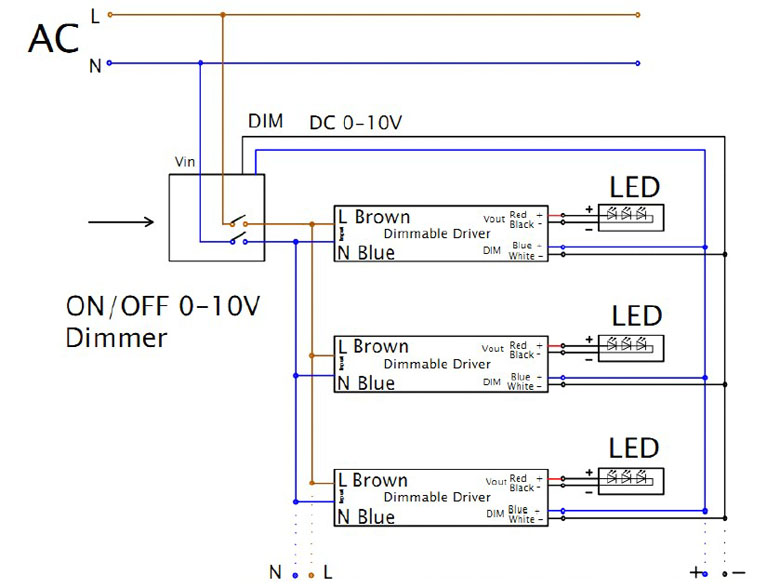
Just gotta connect it all up now, and chase the cables into the wall (grrr!). I'll get my electrician to come back and sign it all off, but assume that this circuit looks ok?

0-10v-dimmalbe-wiring-diagram-2.jpg


We've actually got 1 dimmer, one normal switch plus another intermediary switch but i don't think that changes how the 0-10v feed needs to go.
 
OP
M

MrChips

Member
Joined
May 23, 2015
Messages
14
Just an update to say thank you to all for the advice on here. Cable worked a treat, dimming spot on, no flickering etc!
 
To avoid these ads, REGISTER NOW!
Top Bottom