Schurkey
Well-known member
There are several ways to bleed brakes. Here are some methods I DON'T recommend:
1. Vacuum bleeding. If you aren't pulling air around the bleeder-screw threads, you're pulling air past a rubber seal somewhere--Usually happens with drum-brake wheel cylinders. Vacuum bleeding is best done on small jobs at the wheel cylinder--replacing caliper, replacing brake hose. Major jobs take too long. The last bit of brake bleeding you do will be via gravity, to assure that the wheel cylinder doesn't have a perpetual bubble in it.
2. Phoenix or similar "Reverse Injection" bleeding, using dedicated tooling. The wheel cylinder is designed to be bled in the normal direction. If you don't do a final-bleed OUT the bleeder screw, there will be an air bubble trapped in each wheel cylinder. In addition, the worst, most-contaminated fluid in the system is typically in the old wheel cylinder, pushing contaminated fluid through an ABS system is...expensive. The only time "reverse injection" bleeding makes sense is when the system is completely clean and empty, and you still need to bleed in the normal direction when you're done "reverse bleeding" to eliminate that air pocket in each wheel cylinder. I admit I have "reverse bled" brakes by first filling the caliper with clean fluid, bleeding the normal direction to eliminate an air pocket, then pushing the piston fully into the caliper bore. Be sure there's room in the master cylinder to accept all the fluid without overflowing.
3. 2-person pump. Unless your helper is a Victoria's Secret model, in which case I wouldn't be pumping the brake pedal. There's nothing really wrong with this, it works, and it can be a great parent-child, husband-wife bonding experience. There's reasons to do this that don't include effectiveness. I never have the Victoria's model as a helper.
4. Motive Products or other "garden sprayer" pressure bleeders. Because there's no diaphragm in the pressure vessel to separate the compressed air from the fluid...the first thing a "garden sprayer" pressure bleeder does is to contaminate the fluid with the humidity in the air.
5. Fabricating a "pressure bleeder" using the top of a master cylinder, or a flat plate across the master cylinder so only the fluid in the master cylinder is pressurized. The master cylinder doesn't hold enough volume--you'll be refilling your "pressure chamber" (the master cylinder) every few seconds of bleeding time.
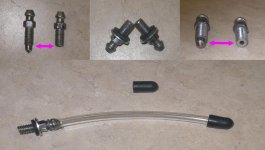
6. "Speed Bleeders" or similar check-valve bleeder screws. By the time you **** with them, you might as well just gravity bleed. I'm not outright opposed to these "special" bleeder screws, like I am to "Reverse Injection" special tools, I just don't see the need for them.
There are two methods of bleeding brakes I recommend. One method for major work, flushing the system, or for work at the master cylinder, and one method for work at the wheels.
7. Real, live, professional-grade pressure bleeder that has a diaphragm to separate the brake fluid from the compressed air, along with the appropriate attachment for your master cylinder. I have a Brannick G300, although mine is old enough that it came with different master cylinder adapters that what is being shown now. I've purchased additional adapters, some of them at a "surplus store", but in general the adapters are expensive, too.
https://www.amazon.com/dp/B000RT8GUK/?tag=atomicindus08-20
Advantage: Bleeding is F-A-S-T and THOROUGH.
Disadvantage: Cost of the equipment, Set-up and Take-Down time.
Perfect for major work or complete system flushes.
It would take almost nothing to weld/braze/epoxy a bleeder screw to an air quick-coupler, which would create an adapter to connect a "real" pressure bleeder to the wheel cylinder bleeder-screw port for those of you who still can't get reverse-injection bleeding out of your thought-process. I haven't bothered. This is not a recommendation, it's an acknowledgement that a real pressure bleeder could be used to reverse-bleed with minimal effort and expense.
8. Gravity bleeding. Crack open a (clean, not plugged) bleeder screw, keep the master cylinder reasonably filled. Fluid drips out of the bleeder screw. Air bubbles are gently removed. I usually tap on the wheel cylinder and brake tubing, and wiggle the brake hose to encourage the tiny air bubbles to detach from the internal surfaces
Advantage: Very little set-up and take-down time. No expensive tooling--drain pan, bleeder-screw wrench, drill bit to clean out the screw, hammer to tap on the cylinder.
Disadvantage: Slower process than pressure bleeding. Not suitable for major work, flushing, or work at the master cylinder. Not real efficient when the master cylinder is located low on the vehicle--Antiques where the master is below the brake pedal, for example.
Perfect for work at the wheels--replacement of wheel cylinder/caliper, and brake hose.
1. Vacuum bleeding. If you aren't pulling air around the bleeder-screw threads, you're pulling air past a rubber seal somewhere--Usually happens with drum-brake wheel cylinders. Vacuum bleeding is best done on small jobs at the wheel cylinder--replacing caliper, replacing brake hose. Major jobs take too long. The last bit of brake bleeding you do will be via gravity, to assure that the wheel cylinder doesn't have a perpetual bubble in it.
2. Phoenix or similar "Reverse Injection" bleeding, using dedicated tooling. The wheel cylinder is designed to be bled in the normal direction. If you don't do a final-bleed OUT the bleeder screw, there will be an air bubble trapped in each wheel cylinder. In addition, the worst, most-contaminated fluid in the system is typically in the old wheel cylinder, pushing contaminated fluid through an ABS system is...expensive. The only time "reverse injection" bleeding makes sense is when the system is completely clean and empty, and you still need to bleed in the normal direction when you're done "reverse bleeding" to eliminate that air pocket in each wheel cylinder. I admit I have "reverse bled" brakes by first filling the caliper with clean fluid, bleeding the normal direction to eliminate an air pocket, then pushing the piston fully into the caliper bore. Be sure there's room in the master cylinder to accept all the fluid without overflowing.
3. 2-person pump. Unless your helper is a Victoria's Secret model, in which case I wouldn't be pumping the brake pedal. There's nothing really wrong with this, it works, and it can be a great parent-child, husband-wife bonding experience. There's reasons to do this that don't include effectiveness. I never have the Victoria's model as a helper.
4. Motive Products or other "garden sprayer" pressure bleeders. Because there's no diaphragm in the pressure vessel to separate the compressed air from the fluid...the first thing a "garden sprayer" pressure bleeder does is to contaminate the fluid with the humidity in the air.
5. Fabricating a "pressure bleeder" using the top of a master cylinder, or a flat plate across the master cylinder so only the fluid in the master cylinder is pressurized. The master cylinder doesn't hold enough volume--you'll be refilling your "pressure chamber" (the master cylinder) every few seconds of bleeding time.
6. "Speed Bleeders" or similar check-valve bleeder screws. By the time you **** with them, you might as well just gravity bleed. I'm not outright opposed to these "special" bleeder screws, like I am to "Reverse Injection" special tools, I just don't see the need for them.
There are two methods of bleeding brakes I recommend. One method for major work, flushing the system, or for work at the master cylinder, and one method for work at the wheels.
7. Real, live, professional-grade pressure bleeder that has a diaphragm to separate the brake fluid from the compressed air, along with the appropriate attachment for your master cylinder. I have a Brannick G300, although mine is old enough that it came with different master cylinder adapters that what is being shown now. I've purchased additional adapters, some of them at a "surplus store", but in general the adapters are expensive, too.
https://www.amazon.com/dp/B000RT8GUK/?tag=atomicindus08-20
Advantage: Bleeding is F-A-S-T and THOROUGH.
Disadvantage: Cost of the equipment, Set-up and Take-Down time.
Perfect for major work or complete system flushes.
It would take almost nothing to weld/braze/epoxy a bleeder screw to an air quick-coupler, which would create an adapter to connect a "real" pressure bleeder to the wheel cylinder bleeder-screw port for those of you who still can't get reverse-injection bleeding out of your thought-process. I haven't bothered. This is not a recommendation, it's an acknowledgement that a real pressure bleeder could be used to reverse-bleed with minimal effort and expense.
8. Gravity bleeding. Crack open a (clean, not plugged) bleeder screw, keep the master cylinder reasonably filled. Fluid drips out of the bleeder screw. Air bubbles are gently removed. I usually tap on the wheel cylinder and brake tubing, and wiggle the brake hose to encourage the tiny air bubbles to detach from the internal surfaces
Advantage: Very little set-up and take-down time. No expensive tooling--drain pan, bleeder-screw wrench, drill bit to clean out the screw, hammer to tap on the cylinder.
Disadvantage: Slower process than pressure bleeding. Not suitable for major work, flushing, or work at the master cylinder. Not real efficient when the master cylinder is located low on the vehicle--Antiques where the master is below the brake pedal, for example.
Perfect for work at the wheels--replacement of wheel cylinder/caliper, and brake hose.
Last edited: