To avoid these ads, REGISTER NOW!

1" Natural Gas riser install

Driven1

Member
Joined
Dec 3, 2020
Messages
8
Location
MN
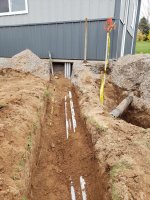
Greetings. New to The Forum. I am installing natural gas from my home to a detached 2 car garage and then on to a shop. Each building will use a 1" Pro-Poly riser. (Sorry, so new here that I can't include link)

Should the riser be attached/anchored to the foundation? If so how?

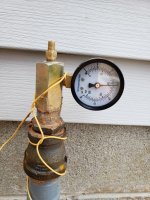
Recommendations on pressure gauge to pressure test line before covering?

I have the trench dug and hoping to get it in the ground and covered before it turns into winter here.
Sorry...In Minnesota, wife concerned about giving up too much info in cyber world.

Thanks for your help!
 
To avoid these ads, REGISTER NOW!

HoosierBuddy

Well-known member
Joined
May 9, 2006
Messages
2,918
Location
Southern Indiana
If you are bringing your riser up next to the house or building, I personally would not anchor it. Only exception would be if you were placing the horizontal portion of the riser in loose fill and were worried it would settle.

Any half-way decent pressure gauge should work. If you are testing the line disconnected from everything, I would test it to 25 PSI or so....so maybe look for a 30 psi gauge so you'll have almost full scale on your test. Pressurize....wait and allow pressure to stabilize (might take an hour or so for air in line to cool)....record starting pressure for test. Give it a couple of hours on test. Any noticeable pressure drop is a fail.

Good luck!

Phil
 
OP
D

Driven1

Member
Joined
Dec 3, 2020
Messages
8
Location
MN
Thank you Phil and D45. I eventually found a pressure gauge in Menards buried among the CSST fittings. Not where I expected to see them. Total line run of about 180ft. 24x28 unattached garage, 20x26 unattached shop. HVAC friend to determine heater BTU's later. He doesn't trench/install gas line. Said to error on the larger side.
 

latebreak

Well-known member
Joined
Oct 7, 2011
Messages
276
Location
Cedarburg, WI
Thank you Phil and D45. I eventually found a pressure gauge in Menards buried among the CSST fittings. Not where I expected to see them. Total line run of about 180ft. 24x28 unattached garage, 20x26 unattached shop. HVAC friend to determine heater BTU's later. He doesn't trench/install gas line. Said to error on the larger side.

I just completed this myself too.

28x28 detached garage, well insulated. I had about 75' of run with about 10 elbows in it. My heater is a 50k BTU unit heater and my math came out to run 3/4". I did not attach the risers to the house or foundation. Don't forget your tracer wire before you backfill.

I pressure tested from my 3/4" stub for the heater connection back to the valve I installed in the house where I tee'd off the main 1" line. I let sit for 24 hours and observed no pressure drop. I also bubble tested. Once I bled off the pressure and opened the valves to test my heater I used my NG sniffer at every connection.
 
OP
D

Driven1

Member
Joined
Dec 3, 2020
Messages
8
Location
MN
I just completed this myself too.

28x28 detached garage, well insulated. I had about 75' of run with about 10 elbows in it. My heater is a 50k BTU unit heater and my math came out to run 3/4". I did not attach the risers to the house or foundation. Don't forget your tracer wire before you backfill.

I pressure tested from my 3/4" stub for the heater connection back to the valve I installed in the house where I tee'd off the main 1" line. I let sit for 24 hours and observed no pressure drop. I also bubble tested. Once I bled off the pressure and opened the valves to test my heater I used my NG sniffer at every connection.


Thanks for the reply. Sounds like a great project.
I've got a few days of nice weather to finish up, so looking forward to this all coming together!

RS
 

like2wheel

Well-known member
Joined
Oct 29, 2014
Messages
1,693
Location
On an as needed basis
I just did this wondered the same thing. Then I read something on this fourm about using a "swing joint".
So I googled it & decided it was a good idea to add them at each end.
 

strutaeng

Well-known member
Joined
Dec 12, 2011
Messages
2,257
Location
Dallas, TX
Yep, I was thinking about what that funny joint is called:


It has to do with frost heave. I added gas to my garage about 2 years ago, and did not do this, or attach the riser it to the foundation. Our frost line here is only like 6" though, so I've never seen it here.
 
OP
D

Driven1

Member
Joined
Dec 3, 2020
Messages
8
Location
MN
Yep, I was thinking about what that funny joint is called:


It has to do with frost heave. I added gas to my garage about 2 years ago, and did not do this, or attach the riser it to the foundation. Our frost line here is only like 6" though, so I've never seen it here.

I just did this wondered the same thing. Then I read something on this fourm about using a "swing joint".
So I googled it & decided it was a good idea to add them at each end.

Thanks for your replies. I talked with a Pro-Poly tech rep today and he said that I could do it (swing joint) if I thought it necessary, but didn't seem to think that it was that important. My main goal right now is to get the pipe in the ground and tested, etc. outside as the weather is so nice here now (high of 56 deg. today and same tomorrow!) Then in the buildings and connect to supply a little later.

I'll have some time to consider the swing joint. Would certainly appreciate any and all opinions!

RS
 
To avoid these ads, REGISTER NOW!

rlitman

Well-known member
Joined
Oct 18, 2010
Messages
24,583
Location
Long Island
Yep, I was thinking about what that funny joint is called:


It has to do with frost heave. I added gas to my garage about 2 years ago, and did not do this, or attach the riser it to the foundation. Our frost line here is only like 6" though, so I've never seen it here.

Swing joints are used any time you need to deal with movement. The same geometry keeps lawn sprinklers from breaking their connections with their lines when run over by a mower.
 

line guy

Active member
Joined
Nov 9, 2015
Messages
41
Location
upstate ny
when you bring up the gas pipe riser dont have it tight to wall. The fittings to go inside or just to put on gauge will not clear wall when you try to install them.
 

Attachments

  • 20200422_120612.jpg
    20200422_120612.jpg
    147.8 KB · Views: 51
  • 20200417_124952.jpg
    20200417_124952.jpg
    146.6 KB · Views: 56
  • 20200417_130532 (1).jpg
    20200417_130532 (1).jpg
    145.4 KB · Views: 55
OP
D

Driven1

Member
Joined
Dec 3, 2020
Messages
8
Location
MN
Swing joints are used any time you need to deal with movement. The same geometry keeps lawn sprinklers from breaking their connections with their lines when run over by a mower.

rlitman, I would assume that you would be in favor of the swing joint then. As I think of it I know that depending on the winter, sidewalks, etc can raise 1/2" to 1" often here in MN. Black pipe is cheap. Proper design and implementation of the swing joint would then be the concern.

RS
 
OP
D

Driven1

Member
Joined
Dec 3, 2020
Messages
8
Location
MN
when you bring up the gas pipe riser dont have it tight to wall. The fittings to go inside or just to put on gauge will not clear wall when you try to install them.

Thanks, I'll be trying to find a happy medium between enough clearance and being out there in a position where it can be hit or kicked, etc. Also having the space to properly do the swing joint is a concern for me.

RS

Thanks for the photos as well. I know that over on MyTractorForum in the John Deere section if you don't do photo's you get razzed about it. (I think that I have enough posts now that I can actually share photos!)
 

Lost Pup

Well-known member
Joined
Apr 14, 2005
Messages
95
Location
Garage
Just a few thoughts on this install.

Your local gas provider might have requirements for these items.

Common issues , line anchor to structure, testing pressure requirements, trench depth, markings, backfill, shut off valves required and such.

One of the best reasons to follow such guidelines is the applicability of your insurance coverage of that structure and it contents.

Check with your gas provider for the info and see if any inspections are needed or required.
 
OP
D

Driven1

Member
Joined
Dec 3, 2020
Messages
8
Location
MN
Just a few thoughts on this install.

Your local gas provider might have requirements for these items.

Common issues , line anchor to structure, testing pressure requirements, trench depth, markings, backfill, shut off valves required and such.

One of the best reasons to follow such guidelines is the applicability of your insurance coverage of that structure and it contents.

Check with your gas provider for the info and see if any inspections are needed or required.

Excellent points. In process with this as well.

RS
 

TurnipTruck

Well-known member
Joined
Aug 28, 2005
Messages
1,554
Location
Southcentral Alaska
Here in Alaska we have significant movement due to frost heave, so the gas company mandates a two-foot-long hose connected to the riser.
This summer I buried 250’ of 1-1/4” gasline to my new shop feeding an 80kbtu furnace and a backup 80k maxx.
 
OP
D

Driven1

Member
Joined
Dec 3, 2020
Messages
8
Location
MN
Here in Alaska we have significant movement due to frost heave, so the gas company mandates a two-foot-long hose connected to the riser.
This summer I buried 250’ of 1-1/4” gasline to my new shop feeding an 80kbtu furnace and a backup 80k maxx.

I sometimes refer to my location as the "frozen tundra" but I guess I'll have to cede that term to you at this time. Quite a run for the line. Enjoy your heated shop!
 
To avoid these ads, REGISTER NOW!
Top Bottom