To avoid these ads, REGISTER NOW!

12V DC microswitch amperage rating.....

lund

Well-known member
Joined
Nov 2, 2019
Messages
768
Location
Michigan
It certainly wasn't my intention to be snarky. You wrote a lot of stuff and I simply don't know what you were trying to say. Is it me? Is it you? I don't know. All I can tell you is that I didn't understand what you were trying to convey in that paragraph.
Sorry. I took the part on being through with replying to be a bit snarky like it was below dignity to ask why. Online is not the best medium to gauge.
I agree that the article is on the lightweight side, but it did make some key points. Here is a different quote for something that you were questioning before: "When the switch is closed, the two contacts actually separate and reconnect, typically 10 to 100 times over a period of about 1ms." ("The Art of electronics", Horowitz & Hill, Second edition, pg 506.)" So the switch bounce period is much longer than the uS that you expected before.
Yes. I think that is the key point. I will say a bit on this in a reply to another guy below who linked a nice video. But obviously the transition from closed to open is slow and the initial gap as opening/closing could be microns or sub-micron scale. Probably arcs are always hit at that level (giving rise to slow accumulated contact degradation) and 60 Hz could be enough for more polarity sweep effect to keep the initial arcs from becoming persistent as the gap opens and doing larger damage. I put more in the other reply.

I think the circuit connected will matter bit time also (see also other reply). The specs are probably on anticipation of usual usages and experience. Motors and inductors will be problematic.

Sure. I'm not telling you that there is a hard and fast rule that AC current is always higher than DC current in a switch. What I am telling you is that switch manufacturers do rate their switches for what they expect that switch will handle over a certain number of operations with a certain reliability. There is not some special huge margin for what they specify. So if a switch is rated for 10A AC and 2A DC then I expect that is what it will work correctly too. If it could do 10 A DC then it would be rated that way, and since it isn't rated for that current isn't it won't work, or it will work for a bit and then fail.
The switch you note is interesting. My take would be that they are trading off DC voltage - which will obviously reduce the internal arcing - in the interest of keeping the current the same. I expect that what they say about the rating is correct, and you that could run 10 A DC through it reliably - but not at say 100V DC. So it's trading off voltage for current for what they presume is an important spec. for their customers.

In general, if you run a part outside the manufacture's specs then you are completely on your own if there are issues.

I have a little less faith than you in manufacturer specs. That may be because I am an R&D guy making one off stuff and we often use parts out of intended range. It is a case by case situation on specs. But when you call about components, the manufacturers often put you in contact with their engineers (if you are lucky at least). The engineers will discuss what they know and do not know and the basis they used. It is pretty rare there is that much testing, and more often accumulated knowledge in context of applications had is given. You often find they do not know what will happen in many ranges and situations. Also, quite often you will find specs are not modified when materials and fab techniques change (sometime leading to problems ... subtle or not). I doubt switch manufacturers are uniformly virtuous in their testing and evaluation relative to other stuff.

I am not a materials engineer nor am I a physicist. I can't explain to you the details about a DC or AC arc at 60 Hz that would convince you on how they work. What I can tell you is that it's in a manufacturer's best interests to specify a part as broadly as they can as it will increase sales. So if a switch spec says 2A for DC and 10 for DC then that is what it is.

I don't think that anyone is dumb here. Like I said, I've got no idea what your long paragraph said whereas one of your peers may have just nodded his head and said "sure".


I think our difference is that you are looking for a fundamental physical explanation in detail whereas I am talking about believing the manufacture's specs and understanding the very basic principles as to why the specs can be different. If you want the detailed theory you'll have to start going through old IEEE papers and textbooks.
Yes I want to understand why limits occur and what are the fundamental process. If reasons why are better understood, it can give ideas on what one can get away with and not. Yes, back of the envelope type "theories" and logic can often be broken and you realize that simple arguments are wrong. But if possible, it is best to understand the processes vs blind faith that their is a firm basis for a spec. Hopefully specs and estimates converge and a cohesive picture emerges.

But arcs are definitely not simple. Initial breakdown and sustained arcing can be very different. Once arcs start they can sustain for other reasons (example: first emission first from high fields and surface roughness, this generates a cascade of electrons and x-rays if high energy that knock out much more electrons and gases from the metallic surfaces to sustain a larger discharge via collective interactions).
 
Last edited:
To avoid these ads, REGISTER NOW!

lund

Well-known member
Joined
Nov 2, 2019
Messages
768
Location
Michigan
When you have a switch, typically they DC voltage rating will be much lower than the AC voltage rating, but the current rating will be the same or similar. For your switch, the AC and DC voltage ratings are the same, so the DC current rating is much lower.

At 12vDC, the switch will likely work okay at 10-15A of current.


You're really over-thinking this.

Switch contacts start closed. When the switch turns off, the contacts start moving away from each other. An arc always forms no matter what. Mechanical switches are pretty slow devices, as is AC mains frequency. Once the AC sinewave hits a 0 crossing, any arc that forms will generally self extinguish (with normal inductive loads). With DC, there is no 0 crossing, and any arc that establishes is far more likely to continue burning. So switches typically have a huge voltage or current de-rate on DC.

Here's a good video:
Thanks.

I think I may understand now after thinking about what you wrote and linked. When a switch makes contact, the mechanical motion closing the gap is very slow (relative to AC cycle or DC) and initial separation gaps of the switch opening or closing will be micron or even sub-micron (and irregular) scale. There are likely Always limited arcing in such small gaps (probably from field emission breakdown) in those situations. On such very limited arcs over such small openings, the arcs likely can be snuffed out with AC voltage variation sweeping the gap with polarity changes -- even at relatively slow 60 Hz since the gap dimensions are so small. The small arcs will still be there initially (60 Hz slow), but they will probably not persist as the gap gets wider in the mechanical opening. The small arcs will still accumulate some degree of damage (giving switch contact life). However, the damage will become much larger if they persist significantly in the opening cycle (destroy switch and/or give a short life) and it is reasonable that will happen for very small gaps in DC fields vs relatively slowly varying AC (60 Hz).

The load is probably critical in this. If one switches inductive-component loads, you will generate more of a voltage spike on opening contacts. That may sustain arcs stronger and cause larger damage. That issue is going to be hard to lump into a simple voltage and current spec. If they might put values they expect to be ok with resistive loads and the power supply switched voltage of such circuits, those could be unintentionally exceeded in the applications with energized inductors being switched (such as turning off a motor) leading to exceeding safe values and switch damage.

Thanks for the video too. That was fun. But a comment on it. The guy's heater likely has a significant inductive component in the switched load since usually filaments are spiraled. Notice that he gets much more arc in the opening of the switch than closing it. He should have put an oscilloscope across the gap and trigger it close to the closing time (maybe hard to catch transient well though with how he is closing). He is also using a rough contact and poor metal surface in a crude switch in air, which is a bad case situation for such a switch ... but that makes a nice demo. He should repeat with a power resistor made such that it does not have a significant inductive component.
 
Last edited:

Max

ALLIANCE MEMBER
Joined
Jun 16, 2018
Messages
3,329
Location
Georgia
In previous posts, a relay was recommended. Now that we know this is for a forward/reversing application, what type of snubbing circuit would be recommended to protect the relay contacts? A single diode across the motor will not work more than once When reversed.
So far as the motor is concerned the relay is just a switch. I would expect that a mechanical switch or relay would not need protective diodes. In this case, at least for me, I would not add any diodes.

But hey, this is GJ and overkill is our middle name. :) So if you wanted to add diode snubbers, you add two reverse connected zener diodes across the motor:
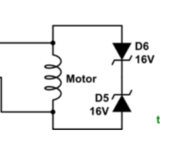
1724342630296.png
The way this works is no matter what polarity of voltage is applied one diode is forward biased and one diode is reversed biased. The forward biased zener will conduct if the voltage across is more than roughly .7V. But the reverse biased zener won't conduct until the voltage across it is greater than 16V, so at very roughly 17V the diode will snub (or short) any transient voltages above that voltage.

The diode voltage chosen is a couple of volts above the normally expected voltage.
 
OP
T

tlmartin84

Well-known member
Joined
Apr 23, 2012
Messages
1,085
Location
West Virginia
With a motor that big, I would pick up a 40A automotive relay in a socket. That way, when the relay contacts fail, it'll be easy to swap out.

Interesting thing is manufacturer recommends a 10 amp circuit so, they must not expect much current.

Each "switch" has two micro switches, when button is pushed up, microswitch 1 is engaged and motor goes one way, when down, microswitch 2 is engaged and motor goes the opposite.
 

rlitman

Well-known member
Joined
Oct 18, 2010
Messages
24,600
Location
Long Island
Interesting thing is manufacturer recommends a 10 amp circuit so, they must not expect much current.

Each "switch" has two micro switches, when button is pushed up, microswitch 1 is engaged and motor goes one way, when down, microswitch 2 is engaged and motor goes the opposite.
A separate switch for each direction helps I guess. But 10A on a fuse or circuit breaker is very different than 10A on a switch, as should be obvious from how this thread has progressed. I only mentioned 40A automotive relays, because in my experience they're generally the same socket (and form factor) and coil current as 30A relays, but have beefed up contacts for a tiny step up in price.
 
To avoid these ads, REGISTER NOW!

Wrench97

Well-known member
Joined
Jun 23, 2018
Messages
12,091
Location
Southeastern Pa
In previous posts, a relay was recommended. Now that we know this is for a forward/reversing application, what type of snubbing circuit would be recommended to protect the relay contacts? A single diode across the motor will not work more than once When reversed.
No automotive power relay in use today has a diode in it on the motor side, they usually out last the car.
 

American Locomotive

Well-known member
Joined
Jan 8, 2017
Messages
10,957
Location
Rhode Island
Honestly I think my recommendation would be to just try it with the switches they provided. If they wear out, those are simple generic microswitches and easy enough to get.
 

RPH

Well-known member
Joined
Dec 17, 2006
Messages
4,190
Location
Michigan Thumb
Worst case scenario? Sticks closed, motor continues to run. Fuse will catch this, maybe. That switch could flame before the fuse blows. But switch is now open due to fire. Never less, you have a flaming component inside your door. Free wheeling diodes should be used on any inductive load. If not, the voltage spike will bite when needed the most.
Please, remember Murphy.
 

LukeOresk

Well-known member
Joined
Mar 20, 2016
Messages
183
Strange, I would test it a bunch outside the car, any pictures or link to the instructions?
 
To avoid these ads, REGISTER NOW!
Top Bottom