Sorry. I took the part on being through with replying to be a bit snarky like it was below dignity to ask why. Online is not the best medium to gauge.It certainly wasn't my intention to be snarky. You wrote a lot of stuff and I simply don't know what you were trying to say. Is it me? Is it you? I don't know. All I can tell you is that I didn't understand what you were trying to convey in that paragraph.
Yes. I think that is the key point. I will say a bit on this in a reply to another guy below who linked a nice video. But obviously the transition from closed to open is slow and the initial gap as opening/closing could be microns or sub-micron scale. Probably arcs are always hit at that level (giving rise to slow accumulated contact degradation) and 60 Hz could be enough for more polarity sweep effect to keep the initial arcs from becoming persistent as the gap opens and doing larger damage. I put more in the other reply.I agree that the article is on the lightweight side, but it did make some key points. Here is a different quote for something that you were questioning before: "When the switch is closed, the two contacts actually separate and reconnect, typically 10 to 100 times over a period of about 1ms." ("The Art of electronics", Horowitz & Hill, Second edition, pg 506.)" So the switch bounce period is much longer than the uS that you expected before.
I think the circuit connected will matter bit time also (see also other reply). The specs are probably on anticipation of usual usages and experience. Motors and inductors will be problematic.
Sure. I'm not telling you that there is a hard and fast rule that AC current is always higher than DC current in a switch. What I am telling you is that switch manufacturers do rate their switches for what they expect that switch will handle over a certain number of operations with a certain reliability. There is not some special huge margin for what they specify. So if a switch is rated for 10A AC and 2A DC then I expect that is what it will work correctly too. If it could do 10 A DC then it would be rated that way, and since it isn't rated for that current isn't it won't work, or it will work for a bit and then fail.
The switch you note is interesting. My take would be that they are trading off DC voltage - which will obviously reduce the internal arcing - in the interest of keeping the current the same. I expect that what they say about the rating is correct, and you that could run 10 A DC through it reliably - but not at say 100V DC. So it's trading off voltage for current for what they presume is an important spec. for their customers.
In general, if you run a part outside the manufacture's specs then you are completely on your own if there are issues.
I have a little less faith than you in manufacturer specs. That may be because I am an R&D guy making one off stuff and we often use parts out of intended range. It is a case by case situation on specs. But when you call about components, the manufacturers often put you in contact with their engineers (if you are lucky at least). The engineers will discuss what they know and do not know and the basis they used. It is pretty rare there is that much testing, and more often accumulated knowledge in context of applications had is given. You often find they do not know what will happen in many ranges and situations. Also, quite often you will find specs are not modified when materials and fab techniques change (sometime leading to problems ... subtle or not). I doubt switch manufacturers are uniformly virtuous in their testing and evaluation relative to other stuff.
Yes I want to understand why limits occur and what are the fundamental process. If reasons why are better understood, it can give ideas on what one can get away with and not. Yes, back of the envelope type "theories" and logic can often be broken and you realize that simple arguments are wrong. But if possible, it is best to understand the processes vs blind faith that their is a firm basis for a spec. Hopefully specs and estimates converge and a cohesive picture emerges.I am not a materials engineer nor am I a physicist. I can't explain to you the details about a DC or AC arc at 60 Hz that would convince you on how they work. What I can tell you is that it's in a manufacturer's best interests to specify a part as broadly as they can as it will increase sales. So if a switch spec says 2A for DC and 10 for DC then that is what it is.
I don't think that anyone is dumb here. Like I said, I've got no idea what your long paragraph said whereas one of your peers may have just nodded his head and said "sure".
I think our difference is that you are looking for a fundamental physical explanation in detail whereas I am talking about believing the manufacture's specs and understanding the very basic principles as to why the specs can be different. If you want the detailed theory you'll have to start going through old IEEE papers and textbooks.
But arcs are definitely not simple. Initial breakdown and sustained arcing can be very different. Once arcs start they can sustain for other reasons (example: first emission first from high fields and surface roughness, this generates a cascade of electrons and x-rays if high energy that knock out much more electrons and gases from the metallic surfaces to sustain a larger discharge via collective interactions).
Last edited:
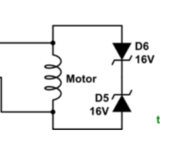
 So if you wanted to add diode snubbers, you add two reverse connected zener diodes across the motor: