To avoid these ads, REGISTER NOW!

13mm Socket Contact Points

OP
D

DavidB

Well-known member
Joined
Feb 6, 2010
Messages
734
Location
Navarre, FL
Please review post 3. Give aways to non contributors doesn't start until tonight. Thanks!
good point, but the koken with the lobed pattern doesn't look any thicker than either their standard design sockets or one from a different manufacturer. how about a quick diameter measurement of the koken and say, the snap-on?

and i'm game for the hazet socket.
 
To avoid these ads, REGISTER NOW!

lwlobo

Well-known member
Joined
Mar 23, 2010
Messages
1,076
Location
Colorado Springs, CO
Once again I'm impressed at Metrinch. who knew?

Me. :bounce:

I told DavidB I expected the Metrinch lobed design to do very well.

I'm glad I was right. I haven't used them much, but a guy at work (my buddy the twice-retired janitor) says all his buddies always call him to bring his metrinch stuff to remove bolts they've rounded off. One thing to be aware of is that they don't "fit" as tight. They feel sloppier. They have a lot of backlash and need to be held straight, but it's an extremely strong interface.

DavidB, any chance I could get the Hazet and Gedore sockets? Thanks.
 

bchee

Well-known member
Joined
Aug 20, 2007
Messages
6,148
Location
Texas

Attachments

  • wright1.JPG
    wright1.JPG
    108 KB · Views: 339
  • wright2.JPG
    wright2.JPG
    56.6 KB · Views: 272

Bolster

Well-known member
Joined
Jul 8, 2008
Messages
4,056
Location
Mexifornia
The Wright design is interesting...appears to be a conventional type socket with a "sloppy" fit that allows flats to contact, rather than corners...!
 

lwlobo

Well-known member
Joined
Mar 23, 2010
Messages
1,076
Location
Colorado Springs, CO
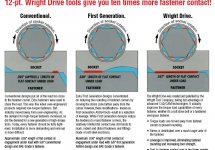
Here are some pictures I stole from the Wright Tools online catalog.
They have cool thermal images

Thanks for sharing those, that's cool.

Not be be a smart*ss, but I'm pretty sure those are stress distribution images, not thermal. Same idea, except it's stress (lbs/sq. inch or equivalent) not temperature.
 

MattT

Well-known member
Joined
Feb 20, 2010
Messages
3,201
Not be be a smart*ss, but I'm pretty sure those are stress distribution images, not thermal. Same idea, except it's stress (lbs/sq. inch or equivalent) not temperature.

Says on the image that it's finite element analysis. Basically a computer generated model of the stress level and distribution. Facom published similar images when they introduced their OGV profile back in the '90's.
 

bonneyman

Well-known member
Joined
Apr 22, 2010
Messages
8,781
Location
Desert SW
Thanks for the effort, Dave. Really informative, alot of stuff to chew on.

No rush in getting the Bonney back to me. I have a few spares, so sometime in Sept is fine.

It's really too bad that research like this doesn't reach the ears of the company that bought out Granco - they still have all the Bonney dies and pull broaches. You'd think they could reissue the tools with minimal effort and cash outlay (since they already have the tooling!) and sell them like hotcakes. The Bonney design is just that good.
Plus, they'd be putting some Americans back to work!
 

bchee

Well-known member
Joined
Aug 20, 2007
Messages
6,148
Location
Texas
Not be be a smart*ss, but I'm pretty sure those are stress distribution images, not thermal. Same idea, except it's stress (lbs/sq. inch or equivalent) not temperature.

The photos were taken through the eyes of the Predator:bounce:
 

nate379

Banned
Joined
Feb 2, 2009
Messages
7,279
Location
Palmer, AK
Do you have WAY too much time on your hands or do you do this type of stuff for work?

It's it's the first, swing by my way I can use an extra set of hands! Have enough going on to keep me busy for the next 4 or 5 years!
 
To avoid these ads, REGISTER NOW!

kc-steve

Well-known member
Joined
Jun 22, 2010
Messages
4,240
Location
Kansas City
Dumbest question ever: where does one WANT the contact points to be, ideally? Knowing that will help me interpret the data.

I will add this to the stickies folder with the rest of your test threads.

. . . That's actually an excellent question. As you move away from the nut's edges, you also lose leverage.

And do you want the contact point wide or narrow? Wouldn't wide be gentler on the nut?

I'm not an engineer, but I'd imagine you'd want it as wide as possible, as close to the edge as possible, for maximum torque and maximum distribution.

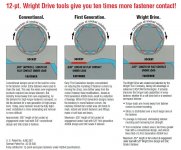
Actually there are several other people in this thread that have an opinion of what is the best method for sockets to make contact. I read through this thread yesterday and by a strange fluke I was also reading the Wright Tool catalog for unrelated information when I stumbled across Wright's own information on this subject.

A copy of the page #5 or #6 from the current Wright catalog online is posted below. The PDF catalog is way too big to post. BTW, they patented their "opinion," #4,882,957. :)

Thanks DavidB, :beer:

Steve
 

Attachments

  • socket_contact.jpg
    socket_contact.jpg
    125.9 KB · Views: 150
Last edited:

bonneyman

Well-known member
Joined
Apr 22, 2010
Messages
8,781
Location
Desert SW
Due to the results of this testing, I now grab any 6-lobed Metrinch sockets I come across in my travels.
The indentation pattern of the Metrinch socket tested is very close to actual patterns I've seen with Bonney wrenches in the field. I have an old lawn mower that needed the blade replaced. Not knowing if it was reverse thread or not, I turned it the normal loosening direction. Barely budged. Really had to torque on it the opposite direction with a Bonney box wrench to get it off. Upon cleaning and inspecting the bolt for any damage, I noticed pronounced curved indentations on the bolt flats - an appreciable distance away from the edge. I'm thinking any normal wrench would have rounded the fastener.
Again, great thread!
 

superautobacs

Well-known member
Joined
Oct 31, 2008
Messages
3,997
Location
Vancouver, BC
Some more musings on this ;) Tolerances and design of the drive area and the finish of the insides of the sockets are where it's at, and what you pay for. A good design of the gripping profile will make the socket. The processes applied in its finishing and the tolerances achieved on individual sockets (precision if you like) and the overall tolerances across the various batches (repeatability of process) is where the cost lies. It takes longer to test more to closer tolerances, and also takes longer to replace tooling more frequently.

Closely controlling the hardening process is more costly, subsequent treatment to close tolerances also. We can imagine that cheaper tools may use less expensive steels, skip a few steps in the manufacturing processes or make em to looser tolerances or any combination of the above. Also the design engineer and his logic, experience and train of thought comes into this, big time.

Rgrds

What Sarel wrote deserves to be quoted and read again. :thumbup:


I'll also quote myself:
Keep this in mind folks:
Manufacturers have a miniumum standard that they have to abide by (or otherwise exceed it), whether it's DIN, ANSI or JIS. These standards have an acceptable tolerance range. What that means is that a 13mm socket coming from the same manufacturer, from the same plant, can broach a 13mm socket with different dimensions (within the allowable tolerance range).

All the literature from manufactures is only as good as their level of manufacturing tolerance--whether they want to stick with some predetermined minimum industry standard, where the tolerance range is wide, or far exceed the tolerance range by minimizing that variance.
 

kc-steve

Well-known member
Joined
Jun 22, 2010
Messages
4,240
Location
Kansas City
What Sarel wrote deserves to be quoted and read again. :thumbup:

I'll also quote myself:

All the literature from manufactures is only as good as their level of manufacturing tolerance--whether they want to stick with some predetermined minimum industry standard, where the tolerance range is wide, or far exceed the tolerance range by minimizing that variance.

Thanks, . . . again? I'm curious though, since bonneyman and I are the only recent posts mentioning manufacturers above, why are you posting the same information once again?

I could be wildly wrong but you seem to imply or have a bone to pick with one or the other manufacturers discussed. I don't read 'between the lines' very well. :) Could you be more specific? If you reread my post I was only answering the question initially posed by Bull, via Wright's literature. I wasn't making any judgments about Wright's production qualities. But I do think they gave some great info concerning this same subject while answering Bull's question.

:headscrat
Steve
 
Last edited:

superautobacs

Well-known member
Joined
Oct 31, 2008
Messages
3,997
Location
Vancouver, BC
Thanks, . . . again? I'm curious though, since bonneyman and I are the only recent posts mentioning manufacturers above, why are you posting the same information once again?

There's certainly other people who are just starting to read this thread today, and that's partly why I quoted them as I think those are points to keep in mind. Many times, when threads start to get long, people start to skim through the thread or go to the last page to read the most up-to-date response, etc., and they miss important information. So, I just wanted to reiterate those points. Perhaps it wasn't neccessary, given that this thread isn't 30 pages long, yet. :p

I could be wildly wrong but you seem to imply or have a bone to pick with one or the other manufacturers discussed. I don't read 'between the lines' very well. :) Could you be more specific?

Not picking on any particular manufacturer at all. I'm just saying that we need to keep in mind that two separate 13mm sockets from the same manufacturer could be measured at 13.04mm up to and including 13.3mm across flats. That's just an example of an ISO tolerance range; I'm not sure what other standards have for a range though. If you took those two sockets and did the same test, the results would be different.

If you reread my post I was only answering the question initially posed by Bull, via Wright's literature. I wasn't making any judgments about Wright's production qualities. But I do think they gave some great info concerning this same subject while answering Bull's question.

There's nothing wrong with providing Wright's literature in relation to Bull's question. It's a good informative read. :thumbup:
 

otanica

Member
Joined
Oct 7, 2009
Messages
13
Ive been using Metrinch 1/4 and 1/2 in socket sets for over 14 years now. Im no pro but i have worked on heaps of old Mini's and other pre 1970 cars. Plenty of rust nuts and bolts, most of which either come undone with the metrinch stuff or snap. Very rarely do i round off a nut or are unable to undo one. The do move around alot and require 2 hands sometimes to keep them from not clicking the ratchet over in tight situations. Now that i have snapon fine tooth ratchets its much better.

Brad
 

Hetman

Well-known member
Joined
Jul 3, 2012
Messages
128
I'd like to see similar test only much more torque - simulating emergency nut removal.
 

Mohawk Dave

Well-known member
Joined
Oct 7, 2012
Messages
5,068
Location
SoCal
I'm going to go ahead and bump this thread, as 6 vs 12 pt comes up a lot... for the new ones on GJ...
 

losvre

Well-known member
Joined
Dec 13, 2011
Messages
1,199
Location
UK
Very nice and informative test making a note for future reference

Sent from my SM-A510F using Tapatalk
 

M6erfan

Well-known member
Joined
Dec 6, 2014
Messages
10,170
Location
'Merica!
Is it fair that 12 point sockets were used for certain brands and 6 point all the rest?


In short, yes it's fair IMO. This is about how the socket contacts the fastener, number of "points" or style of socket is (to me) inconsequential...

I just read through this whole thread. Very interesting and thanks OP for putting the time in. So it looks like Metrinch and Ko-ken are the winners?

Truth be told, I'm not sure how to interpret the results.
 

dutchgray

Well-known member
Joined
Sep 28, 2014
Messages
6,465
Location
Dorset. England.
The Bonney loc rite 12 point is as good as most of the modern 6 point sockets, you would have to try hard to round a bolt with those. This test actually shows how similar sockets really are, there are plenty of really good options out there.
 
OP
D

DavidB

Well-known member
Joined
Feb 6, 2010
Messages
734
Location
Navarre, FL
Truth be told, I'm not sure how to interpret the results.

"Older" sockets contacted the nuts and bolts on the corners which could cause it to round. Current socket design contacts the the nuts and bolts a short distance from the edge reducing the chance of rounding. That's the main difference I saw. One could look a little closer at contact areas and sizes but I think I'd be getting into splitting hairs based on the limited tests.

IMHO 6 pt vs 12 pt doesn't compared to where the contact areas are for standard hex fasteners.

Glad people are still finding the info useful. I've thought about doing another "test" to measure ratchet back drag but ratchets are a bit more expensive than sockets which would limit the ones "tested".
 
Last edited:
To avoid these ads, REGISTER NOW!
Top Bottom