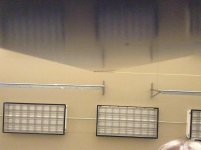
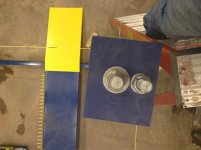
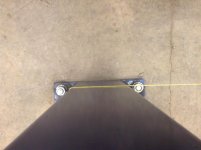
I just bought a 2 post from bendpak. Let me start by saying I built a 32x50 with 6" floor with 4500lb mix and DOT wire which adds 500lb psi to the floor. I told my concrete guy what I intended to do and that the floor in these areas(where I planned on putting the lifts) had to be as flat as possible. He did a great job and when I stood up the columns they where plumb and parallel. Now the fun part, I install the arms and slide them to the center and low and behold, all the arms meet in the center except for the left rear. It is 3/4" lower than the other three! I call THEM and explain my discovery. They say "oh that's not much at all". Shim the post that's off. Here's MY problem. In the instructions they specifically state that both columns should be parallel to each other. I have a real problem with moving a column OUT of plumb in order to make the lift pads equal. In doing so, one carriage would go up straight while the other(after being shimmed) would go up at an angle! I called and emailed with pics then dead silence. I can fix the problem by adding a 3/4" thick block with a 1.3" hole in the middle attached to the drooping arm but I don't think I should have too! On a side note I also picked up a gently used Rotary 10k 2 post and installed it right next to the OTHER one. No shims or anything needed!! So I guess from their silence I'm on my own with this. No big deal, I'll just NEVER buy anything form THEM again. AND this is the 2nd lift as the first one looked liked they dropped it from a plane! The lift I have now isn't AS beat up as the first one but beat up all the same. They did send out some touch-up paint in short order. I guess they think that fixes everything! Their "free shipping" is a joke. The old saying goes, "You get what you pay for". Just my 2 cents for whatever it's worth! This forum is AWESOME!
Sorry your lift arrived scraped up.
The lift shipped from our facility in pristine condition. Shipping companies care less and less these days - no accountability.
If you plumb your columns to a sloped floor, your pads are going to be un-level. The columns need to be parallel and the pads should be as close to level with one another as they can be.
To correct uneven pads, loosen the anchors on both columns then shim the high side column so that it leans INWARD slightly to lower the higher pads HALF THE DIFFERENCE. Next, shim the low side column so that it leans slightly OUTWARD to elevate the lower pads.
• Shim the columns until you get the pads level with one another.
• Check to see how plumb the columns are but don’t be too critical as long as they are PARALLEL.
• To double check that they are parallel, lower the lift to the floor, spread the front arms to full extension so that they are pointing directly at each other. Take a measurement from the center of the left front pad to the center of the right front pad. Let’s call it 12”. Raise the lift to full height and check to make sure the 12” is retained.
THIS IS NOT RECOMMENDED FOR FLOORS THAT HAVE CONSIDERABLE PITCH AND/OR REQUIRE MORE THAN ONE-HALF INCH OF SHIMS.
Let’s assume a subject floor has a one-inch slope east to west with the high side being on the right (east) column. We’ll assume the overall width on our subject floor is 12-feet at outside of base plate for the floor plan. That would be less than 1/8” of slope every foot - easily perceived as a normal floor.
To compensate for the minor slope, there are three options…
• Install the lift directly on the surface and shim only as necessary to plumb the columns. In this case, your lift pads would be one-inch off – right to left. Assuming where your arms are positioned on the vehicle and the distance between pads, that one-inch could translate to dramatically sloped loading.
• Install the high side (right) column directly on the surface and elevate the low side (left) column an additional one inch with steel shim plates and Quikrete. Plumb both as required. In this case, even though the floor is sloped one inch, the columns would be installed plumb and the lift pads would be equal. This may be considered the “correct” way to do it however you now would have 25% less embedment on the anchor bolts assuming longer ones were not purchased, and you would have different pad heights relative to floor surface with respect to vehicles sitting on the floor. You may squeak a lift pad under the right side of the car, but find out the left side pad is too high for your ground hugger.
• Third way as described above – the final outcome being level pads and parallel columns.
Let’s review some engineering calculations assuming a 12,000-pound capacity two-post floor-plate model (with no top beam) – a worst case. A ½” shim on the outside edge (or inside edge) of the base plate would cause the base plate to be at a 1.35-degree angle with respect to the floor. Lifts with smaller base plates more – maybe 1.75 degrees. A shim that thick would adjust the pad height position considerably - at least 2” of vertical movement just on the one column side. That is why in most cases, shims no thicker than 3/16” are all that is ever required to adjust pad height.
Assume a 12K two-post floor-plate model has been shimmed ½” on just one edge of the base plate only. It would be angled about 1.35 degrees based on the dimension of the typically sized base plate. Assume it has an arm that measures 45.1” to the center of the lift pad from the main column centerline when loaded. NOTE: The arm may be longer, but when positioned as it would be during vehicle lifting, the pad would be approximately 45.1” from the main column centerline. The column will also be tilted 1.35 degrees with respect to the vertical. When fully raised, the lift head is 75.6” above the floor and the arms move horizontally 1.78" from their original position. The moment arm has increased from 45.1” to 46.9” which is an increase of 4.0%. Due to the moment arm increasing 4%, the column bending moment arm will also increase by 4 %. Therefore, the moment applied to the column and transmitted to the base plate will increase 4%. A 4% additional moment load would increase the anchor bolt tension load from 2772 lbs to 2882 lbs. A single Wej-It 3/4” anchor bolt embedded 5” deep in 3000PSI concrete would have a rated tension capacity of 12,000 pounds or more. Two post lifts with a top beam would have less of a bending moment penalty due to shimming. Main lift structural components will have be virtually unaffected by this slight increase in moment loading.
Bottom line, raising vehicles not perfectly centered between your columns will add more stress on the column, base plates, and anchors, than shimming out of plumb a degree or two. Either case, the stresses are very minimal. At least on ETL certified lifts or those designed with similar criteria. Two-post lifts rarely need shims greater than 1/4" thick, but you would be surprised what affect even the slightest shimming has on pad height adjustment.
Send me an email.
Like always, we take care of our customers.
[email protected]