
You are using an out of date browser. It may not display this or other websites correctly.
You should upgrade or use an alternative browser.
You should upgrade or use an alternative browser.
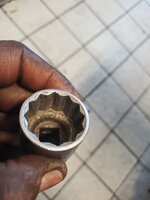
15/32 Drive Snap-On? your thought’s or knowledge
- Thread starter SOCKETS
- Start date


Ricky Joe
Well-known member
First time I have seen that. I have a Snap-On 15/32 line wrench from 1956.
Ricky Joe
Well-known member
Just realized my mistake.First time I have seen that. I have a Snap-On 15/32 line wrench from 1956.
thehorse13
Well-known member
I've never heard of 15/32 drive. The typical odd ball drive sizes that you hear about are 9/32, 5/8 and 7/16.
I took a look through a few Snap-On catalogs from the mid 1920s. I can't find any reference to 15/32.
I took a look through a few Snap-On catalogs from the mid 1920s. I can't find any reference to 15/32.
3baygarage
Well-known member
Cleanly hammered down maybe?
Mintgrun
Well-known member
Cleanly hammered down maybe?
That gets my vote. It looks like there is a sharp lip around the top of the opening from someone beating on the socket. If you file that 1/64" off of the edges of the hole, I'll bet you have a 1/2" opening.

RTM
Well-known member
If you put a 1/2” extension in from the other end, does it fit? Might give credence to the hammered down / file it open theory
Mintgrun
Well-known member
You could also check it with one of these and a dial caliper.

Although you might not need that tool, since dial calipers usually have a notch on the ID side that would clear the little hammered lip.

Although you might not need that tool, since dial calipers usually have a notch on the ID side that would clear the little hammered lip.
Farmer J.
Well-known member
The interior of the square drive hole looks rough, unworn and unfinished.
IDK but the square drive holes in sockets normally look like they are broached or at least finished to exact size and also have those little recess dimples for the springy ball to go in to, or at least a hole through one side of the socket.
Has this socket ever been used? It looks to me like one where the stage of finishing the inside of the square drive hole was missed out in the manufacturing.
It's a 8 point, for driving a square fastener. Likely nobody needed it anyway!
IDK but the square drive holes in sockets normally look like they are broached or at least finished to exact size and also have those little recess dimples for the springy ball to go in to, or at least a hole through one side of the socket.
Has this socket ever been used? It looks to me like one where the stage of finishing the inside of the square drive hole was missed out in the manufacturing.
It's a 8 point, for driving a square fastener. Likely nobody needed it anyway!
Last edited:
Ricky Joe
Well-known member
I am filing the opening to my Snap-On Chrysler ball joint socket as we speak. It doesn’t look buggered, but the ratchet or extension doesn’t fit. It happens.
Private Lugnutz
Well-known member
J, this socket is from the early 20s, when they were cold broached, which could be ugly inside, with no detent ball....the square drive holes in sockets normally look like they are broached or at least finished to exact size and also have those little recess dimples for the springy ball to go in to, or at least a hole through one side of the socket.
It certainly does. The opposite happens, too. I'm sure we all have a vintage handle with a drive stud that just won't fit all sockets. Just a tad too large, seemingly somehow mysteriously deformed or never quite right....but the ratchet or extension doesn’t fit. It happens.
Walkers
Well-known member
That appears to be an 8 point (square nut) socket. What was the tapered square drive, like used for square drive drills, called? I wonder it that is what was supposed to drive that.

Private Lugnutz
Well-known member
Snap-on was very late to switch from cold-broaching to hot-broaching. Just before WWII. In contrast, Duro-Chrome switched in 1935, Herbrand in 1937. That's why there's a ledge and a recess under the broaching and those chatter bumps between the points.
Farmer J.
Well-known member
Thanks Lugz. I will have to read up about the hot and cold broaching thing. I don't have any 1920's era sockets, just the older pressed steel ones and more modern WW2 ones.J, this socket is from the early 20s, when they were cold broached, which could be ugly inside, with no detent ball.
Private Lugnutz
Well-known member
This innovation occurred precisely in between! Early hot-forged sockets were like solid little plugs, left to cool, then machined, including the nut-engaging openings. The scalloped openings were literally cut out. Later hot-forged sockets were put into a retainer and pilot when they were still hot and a hot, scalloped-shaped broach was pressed inside, displacing the molten steel material more cleanly. Manufacturers who were fond of proclaiming the benefits of the process printed some handy pages in their catalogs. Below is from page 22 in the Duro-Chrome 1940 catalog. Herbrand does a very similar comparison in their 1937 catalog.I will have to read up about the hot and cold broaching thing. I don't have any 1920's era sockets, just the older pressed steel ones and more modern WW2 ones.

Oldtuleguy
Well-known member
- Joined
- Nov 4, 2017
- Messages
- 10,486


Farmer J.
Well-known member
Thank you chaps, I see it now. Not surprising the hot broached were more popular, great improvement!
Lesserstore
Well-known member
I've got a few that seem to be hybrids I think. Like this 1960s-70s SK 1/4" drive 1/4" socket with rough walls, but with a ring of displaced metal.
As for hot broaching, it seems that most US manufacturers went back to cold broaching, forging, extrusion, formed, etc. by the 1980s. Wright and Proto/MAC are still hot forged, but they say nothing about the broaching.
As for hot broaching, it seems that most US manufacturers went back to cold broaching, forging, extrusion, formed, etc. by the 1980s. Wright and Proto/MAC are still hot forged, but they say nothing about the broaching.

