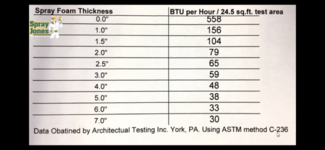
One thing I learned in stats class in college was to always pay attention to what the "reference" value is. In this case, the reference in that chart is a completely bare un-insulated wall which has an absurdly high heat loss. This really distorts the data.
But when you look at the actual test data on the right, 2.0" of foam has a 79 btu/hr loss (at given test size), and 3.0" has a 59 btu/hr loss. When switching the reference to the 2" of foam, we see that
3" of foam has a 25% reduction in heat loss compared to 2".
So whatever your heating/cooling costs would be with 2" of foam, they will be 25% lower with 3".
If that still doesn't make sense, let's put some values to it:
- Let's someone has a giant completely uninsulated shop that costs $10000/year to air condition.
- Going to 2" of spray foam will reduce your cooling costs to $1400/year
- Going to 3" of spray foam will reduce your cooling costs to $1000/year
So for the guy who was paying $10k/year, any insulation at all will make a big difference, and the $400/year difference between 2" and 3" is meaningless compared to the nearly $9000/year he'll be saving. But for you, it isn't a no-insulation-vs-2" or no-insulation-vs-3" sort of thing. It's a 2" vs 3". In which case, you'd be going from a baseline of $1400/year to $1000/year, which is pretty significant.
For you, I think it the extra insulation would probably pay for itself in around 5-6 years, assuming you use the shop a lot.