To avoid these ads, REGISTER NOW!

2 system house question

sleek98

Well-known member
Joined
Aug 9, 2016
Messages
687
Location
Kansas City, MO
Alright guys I am building a 2 story 3100 sq foot house and I the builders HVAC company screwed up and I want to see what some other guys thoughts are.

The specs per our contract call for 2 systems 92% for both heat and AC. However when I got there the other day after the duct work was ran I came across a single 80% system. I know swapping out the 80 for the 92% is easy.

However my question comes from what is the CORRECT way to run the return air for a second system that feeds only the upstairs?

Currently it is running from every room upstairs through the floor into the wall and ties into the main floor return. (like every other single system).

I think the upstairs returns should be ran into a single return duct in the attic and then drop down into the basement to feed the system.
 
To avoid these ads, REGISTER NOW!

yeldogt

Well-known member
Joined
Jan 2, 2012
Messages
18,184
Your post is confusing?

You should stop him and make sure he did a proper load calculation -- this is the time to make it correct. How is the attic insulated .. what the heat load? .. cooling load?

Is this NG or propane. What's the rebates for VS equipment?

I would never build a new house with one unit without the proper calculations so the ductwork will feed the rooms on the second floor properly. With the new two stage and VS equipment with VS air handlers -- I would zone. You don't want an 80% unless you have no heat load .. like northern FL. Sounds like the builder is using the low bidder.
 

Radix2

Well-known member
Joined
May 28, 2014
Messages
1,853
Location
the thumb!, MI
Is your question on the returns the height in the room (floor vs wall) or is it really the duct location?

It is better to avoid running the upper return duct in the unconditioned attic - if the can get the flow with the main return duct below, that is a better design.

With the return duct low, the return registers can still be run up the walls for good high A/c return positioning.
 
OP
S

sleek98

Well-known member
Joined
Aug 9, 2016
Messages
687
Location
Kansas City, MO
Sorry, I was having a hard time getting out what I wanted. Living in Kansas City we have both heating and cooling to deal with, some times in the same week. Was a high of 70 one day last week and 24 a couple days later.

Main question is about return duct routing. Should the upper level have its own separate return to the upstairs furnace? (both furnaces are located in the basement) OR is normal for them to run one return to the basement and then split it between the two furnaces? I have not gotten the proposed change yet but since its already ran into one return line I have a feeling they are going to want to split it in the basement.

The house plan before we modified it was a 2,200 sf spec home. We liked the overall layout but wanted another bedroom on the main floor, made this and that room x an y bigger, added a couple bathrooms, thus ending up at 3,100 sq feet. The contract was written as 2 separate systems. 1 to handle the second floor 1 to handle the first floor. The HVAC company (United Heating and Cooling) I am guessing saw the floor plan and went lazy and just put in what they would have with the spec home, instead of actually looking at the specs. This is the largest HVAC company locally.

I did not want a zoned single furnace with electric dampers.

It will be natural gas, Ceiling is R48 I believe.

They currently have all of the feed ducts on the second floor in the ceiling and the return ducts in the floor.

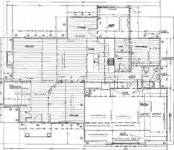
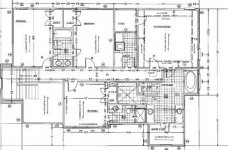
I have attached pics of the layout, the Yellow box is the main floor furnace, the green is the second floor furnace.

Basement
https://postimage.org/

Main Level
https://postimage.org/

2nd Story
https://postimage.org/
 

Attachments

  • 2017-03-13 11_13_58-.jpg
    2017-03-13 11_13_58-.jpg
    20.9 KB · Views: 17
  • 2017-03-13 11_14_49-house plans.jpg
    2017-03-13 11_14_49-house plans.jpg
    19.5 KB · Views: 11
  • 2017-03-13 11_15_02-house plans.jpg
    2017-03-13 11_15_02-house plans.jpg
    20.4 KB · Views: 13
Last edited:

Radix2

Well-known member
Joined
May 28, 2014
Messages
1,853
Location
the thumb!, MI
If the furnaces are located together as shown, while it might be more ideal to have completely separate returns, as a practical matter you probably don't have the space...

If you wanted to let part of the house go cold, it would be a big issue, if you are planning on conditioning the whole space, not so much.

What is driving the second furnace? Are you really above the capacity of one based on an analysis? With today's tight building and insulation, you should be able to easily handle 3100 with one unit. If not, take a hard look at what the insulation and sealing plan is. A good tight building will pay you in the end.

Putting in two units is more for logistics or hard zoning. Consider going to one unit and getting a savings to deploy elsewhere.
 

Falcon67

Well-known member
Joined
Jun 11, 2009
Messages
18,371
Location
Merkel, TX
Not sure about MO but here in TX the 2500 sq/ft 2 story mark is about where everyone goes to dual systems. Had a 2400 sq/ft in Houston with a single system - very expensive to run especially in summer and not so even on comfort.
 

tomroblee

Well-known member
Joined
Jan 11, 2006
Messages
446
Location
Indiapolis, IN
If you want separate systems you need to separate both the supply and return. If you don't, your stairway is going to function as a return air "duct" to some degree.

Air is going to follow the path of least resistance (with warm air tending to rise and cold air tending to fall). When the upstair bedroom doors are open to the hallway, the hallway and stairway MAY be the path of least resistance.
 
OP
S

sleek98

Well-known member
Joined
Aug 9, 2016
Messages
687
Location
Kansas City, MO
If the furnaces are located together as shown, while it might be more ideal to have completely separate returns, as a practical matter you probably don't have the space...

If you wanted to let part of the house go cold, it would be a big issue, if you are planning on conditioning the whole space, not so much.

What is driving the second furnace? Are you really above the capacity of one based on an analysis? With today's tight building and insulation, you should be able to easily handle 3100 with one unit. If not, take a hard look at what the insulation and sealing plan is. A good tight building will pay you in the end.

Putting in two units is more for logistics or hard zoning. Consider going to one unit and getting a savings to deploy elsewhere.

Ok, to me I would assume that the upstairs needs its own separate duct. But I dont claim to know enough and wanted to defer to someone that knows better than I do.

Main reason was our last house that we built in 2012 was a very similar layout, but 2175 sq feet. R48 in the ceiling R18 in the walls (Bib type) and the up stairs was always 4-5* hotter than the main level. It was the same 95% furnace and 16 seer ac, house was sealed tight. Per our electric company we were always either 2nd or 3rd most energy efficient. We could just never get the temperature difference under control.

Had dual systems in my parents 3200 sq 2 story and figured that would be the best route to go. Never had personally experience with zoning a single system, but have been told to stay away from it by a couple people. Could be they just had issues and are the odd ball out.
 
OP
S

sleek98

Well-known member
Joined
Aug 9, 2016
Messages
687
Location
Kansas City, MO
Not sure about MO but here in TX the 2500 sq/ft 2 story mark is about where everyone goes to dual systems. Had a 2400 sq/ft in Houston with a single system - very expensive to run especially in summer and not so even on comfort.

We were under that with our last house at 2,175 sq feet and even then when it was hot out (for us atleast), 90+ the temp difference from the first to the second could get as much as 8*.

Luckily it was only a few weeks or so out of the year but I want to not have that problem with the new place.
 

Radix2

Well-known member
Joined
May 28, 2014
Messages
1,853
Location
the thumb!, MI
We were under that with our last house at 2,175 sq feet and even then when it was hot out (for us atleast), 90+ the temp difference from the first to the second could get as much as 8*.

Luckily it was only a few weeks or so out of the year but I want to not have that problem with the new place.

The sizing issue in hot climates is getting the air flow for cooling, so I will have to defer to the local experiences of what the cut off is for air handlers. But if you cant balance out 2100 feet in Mo with one system in a decent modern house, it seems to me the issue is not in the main equipment.

My point is putting in two complete systems is an expensive fix if the total capacity is not the limitation. Zoning would be simpler or you will have to seasonally adjust dampers to force the proper balance by season.

But to your specific here - it just may not be possible to get all that main return into a small area to co-locate both units. So you gotta pick your poison.
 

brewchief01

Member
Joined
Nov 18, 2015
Messages
14
Each furnace needs it's own separate return duct system, they should not be connected at all, if they are when one is running and the other is not you can end up pulling air through the furnace that is sitting idle. When this happens it can spin the blower in reverse, that can kill a blower motor if it tries to start when spinning in reverse.

Sent from my XT1254 using Tapatalk
 

yeldogt

Well-known member
Joined
Jan 2, 2012
Messages
18,184
You can't have the two systems interconnected -- they have to be independent of each other.

What's the total heat load? cooling load ?

Unless the roof is insulated -- you don't want any ducts in the hot/cold attic.

I have zoned three houses .. and I'm building my forth. Done correctly it works great -- The two speed and newest variable speed compressors make zoning a no brainer in any two story new build that under 5T ... it requires some planning and thought .. most HVAC people don't want to do either .. they just want to get the job done and get the check.

Being the largest does not = best. Good Luck
 
OP
S

sleek98

Well-known member
Joined
Aug 9, 2016
Messages
687
Location
Kansas City, MO
Each furnace needs it's own separate return duct system, they should not be connected at all, if they are when one is running and the other is not you can end up pulling air through the furnace that is sitting idle. When this happens it can spin the blower in reverse, that can kill a blower motor if it tries to start when spinning in reverse.

Sent from my XT1254 using Tapatalk

Never thought about that. Sounds like I should be persistent about them running its own return air.

From the looks of it they can run the return duct either through the front bedroom closet, making it basically nothing, into the garage then back into the basement

second option would be through the back closet in the master, then through the closet on the main floor into the basement. but it would be pretty far away from the furnace.

Or third option put the furnace in the attic. Which would **** when it comes to replacing it and changing the air filter.

The sizing issue in hot climates is getting the air flow for cooling, so I will have to defer to the local experiences of what the cut off is for air handlers. But if you cant balance out 2100 feet in Mo with one system in a decent modern house, it seems to me the issue is not in the main equipment.

My point is putting in two complete systems is an expensive fix if the total capacity is not the limitation. Zoning would be simpler or you will have to seasonally adjust dampers to force the proper balance by season.

But to your specific here - it just may not be possible to get all that main return into a small area to co-locate both units. So you gotta pick your poison.

Thank you for the help. I dont know enough about this area, and its showing.

I did always change the dampers manually each spring and fall and that helped a lot but just couldn't shake the warmer feeling when you walked up stairs.

I agree that it is an expensive fix, but we plan on living here until the grave (only 30 now) so I was willing to pay a bit more now.
 
OP
S

sleek98

Well-known member
Joined
Aug 9, 2016
Messages
687
Location
Kansas City, MO
You can't have the two systems interconnected -- they have to be independent of each other.

What's the total heat load? cooling load ?

Unless the roof is insulated -- you don't want any ducts in the hot/cold attic.

I have zoned three houses .. and I'm building my forth. Done correctly it works great -- The two speed and newest variable speed compressors make zoning a no brainer in any two story new build that under 5T ... it requires some planning and thought .. most HVAC people don't want to do either .. they just want to get the job done and get the check.

Being the largest does not = best. Good Luck

I assumed 2 smaller units would handle it better than 1 larger unit zoned out but I guess I was mistaken. I wonder if they will propose an option for zoning it out so they dont have to redo the return air side.

I have requested the proposed layout with the calculations. Once I receive them I will post.

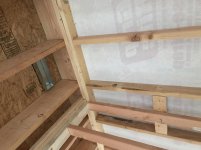
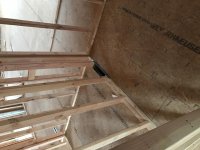
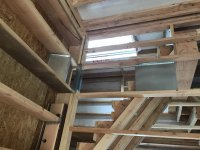
Here are a couple of the feed side runs in the attic currently.

front bedroom closet (the feed from the basement)
https://postimage.org/

Master bathroom
https://postimage.org/

just after the stairs splits two the back two bedrooms
https://postimage.org/

Back bed room, first door after the stairs
https://postimage.org/app.php

Master bedroom (back far bedroom) looking into the bathroom
https://postimage.org/
 
Last edited:
OP
S

sleek98

Well-known member
Joined
Aug 9, 2016
Messages
687
Location
Kansas City, MO
Well I got off the phone with the HVAC company. He said they always use a common return unless there is a variable speed blower being used by either unit. Said that as long as there is enough air to feed the unit it will be sufficient and that I dont really need to pull air only from upstairs as the system will pull the air down either way. I am guessing it would be through the stairwell like a previous poster said.

Said it has 5 tons of cooling between both units.
 
Last edited:

75gmck25

Well-known member
Joined
Jul 21, 2014
Messages
1,317
Location
Alexandria, VA
The reason you want two systems in a two story house is that its usually very hard to design a single system that effectively balances the heat/cool between the two floors for all seasons. Its almost always much warmer in the 2nd story when you have a single system. Zoning of the system can only go so far in equalizing heat when you are fighting convection.

My suggestion would be to use two systems, with all ducts either inside conditioned space, or at least down within the upper floor insulation. If there are any long duct runs they should be hard duct with insulation, not flexible duct that snakes all over the attic. The air flow is much better in a hard duct because it is smooth, and they should duct adjust sizing if they have to run long flexible ducts.

Bruce
 
OP
S

sleek98

Well-known member
Joined
Aug 9, 2016
Messages
687
Location
Kansas City, MO
The reason you want two systems in a two story house is that its usually very hard to design a single system that effectively balances the heat/cool between the two floors for all seasons. Its almost always much warmer in the 2nd story when you have a single system. Zoning of the system can only go so far in equalizing heat when you are fighting convection.

My suggestion would be to use two systems, with all ducts either inside conditioned space, or at least down within the upper floor insulation. If there are any long duct runs they should be hard duct with insulation, not flexible duct that snakes all over the attic. The air flow is much better in a hard duct because it is smooth, and they should duct adjust sizing if they have to run long flexible ducts.

Bruce

Thanks Bruce, that is the problem I was having with our last place.
 

yeldogt

Well-known member
Joined
Jan 2, 2012
Messages
18,184
Placing and air handler or furnace in an attic is fine as long as it is in what is called "conditioned space". Making an attic conditioned space requires the roof rafters to be insulated .. not the floor. It's normally best to use foam. If they are planning to use regular insulation on your attic floor -- all those ducts in the attic are basically outside of your house. The insulation around them is only about R4

Normally when this is done properly the filter is at the return -- so you remove the grill (in the upstairs hall) and replace the filter I would never design a system to share a return.

This is a new house that you are going to be in for a long time -- do it correctly .. once. The better equipment is not only less expensive to operate ... more importantly .. it is quiet and will make the space much more comfortable .. you may get much of it back in rebates

5 tons of cooling is a lot -- who determined this ... did they do a manual J at least?

Zoning works -- and it really works with the newest equipment that's able to send just what is needed to different parts of the house. The reason your other house did not work is because the system was not designed correctly. Ductwork is not guesswork. A properly zoned system sends more AC upstairs when needed ... by closing down the lower level and ramping up the blower. Modern zoning systems are always circulating air and the vent dampers are always opening and closing -- its all silent. That's not to say a one system can't do a whole house -- but it must be designed by someone who knows what they are doing .

Too often -- it's guess work ..........you end up with oversized equipment blowing into undersized ductwork.

I hate flex also.
 

brewchief

Well-known member
Joined
Sep 20, 2008
Messages
2,370
Location
Michigan
Well I got off the phone with the HVAC company. He said they always use a common return unless there is a variable speed blower being used by either unit. Said that as long as there is enough air to feed the unit it will be sufficient and that I dont really need to pull air only from upstairs as the system will pull the air down either way. I am guessing it would be through the stairwell like a previous poster said.

Said it has 5 tons of cooling between both units.

While you can buy a furnace with a PSC motor now they are getting fewer and fewer, 95% of what we install has either a variable speed or a constant torque motor, when the equipment they install now needs to be replaced in 10 years you may not be able to find anything that has a PSC motor.
 

Ohmthis

Well-known member
Joined
Jan 20, 2013
Messages
3,001
Location
Outside of Louisville KY
Placing and air handler or furnace in an attic is fine as long as it is in what is called "conditioned space". Making an attic conditioned space requires the roof rafters to be insulated .. not the floor. It's normally best to use foam. If they are planning to use regular insulation on your attic floor -- all those ducts in the attic are basically outside of your house. The insulation around them is only about R4

Normally when this is done properly the filter is at the return -- so you remove the grill (in the upstairs hall) and replace the filter I would never design a system to share a return.

This is a new house that you are going to be in for a long time -- do it correctly .. once. The better equipment is not only less expensive to operate ... more importantly .. it is quiet and will make the space much more comfortable .. you may get much of it back in rebates

5 tons of cooling is a lot -- who determined this ... did they do a manual J at least?

Zoning works -- and it really works with the newest equipment that's able to send just what is needed to different parts of the house. The reason your other house did not work is because the system was not designed correctly. Ductwork is not guesswork. A properly zoned system sends more AC upstairs when needed ... by closing down the lower level and ramping up the blower. Modern zoning systems are always circulating air and the vent dampers are always opening and closing -- its all silent. That's not to say a one system can't do a whole house -- but it must be designed by someone who knows what they are doing .

Too often -- it's guess work ..........you end up with oversized equipment blowing into undersized ductwork.

I hate flex also.[/QUOTE

This is a great response. It hits all of the issues that you will have with your set up. Never use a connected return, the air for one system needs to stay with only that system. The sizing will be off and return air and filtration will be affected. Zoning is an excellent way to do two story homes. It's already been explained why and no reason to waste your time. It sounds like the builder, HVAC contractor or both are taking you for a ride. Before a tool is used there should be a manual j calculation done. This will tell what size the equipment needs to be. It also tells what each room needs. Then you design the duct work (manual D) to maximize the equipment. There seems to be NO design in this system. With today's building technologies, it common to have 1000-1200 sqft per ton. Being built tight, 3.5 tons would be more than enough. 5 tons is grossly over kill.With two systems, think twice the equipment price, twice the maintenance, twice the possible repair. Good luck.
 
To avoid these ads, REGISTER NOW!

DC73

Well-known member
Joined
Dec 27, 2014
Messages
1,627
Location
Lubbock TX
I know swapping out the 80 for the 92% is easy.

Maybe. Keep in mind that a 92% furnace requires a condensate drain whereas the 80% unit does not. Unlike AC condensate, furnace condensate is very acidic and some locales will not allow it in the city sewer system without installation of a condensate neutralizer.

DC
 

Junkman

Well-known member
Joined
Dec 18, 2006
Messages
6,606
Location
Northeastern CT
For the past 30 years, I lived with a system that you described in your first post. This year, we got rid of the hot air furnace in the cellar that supplied both the first and second floors, and the same with the air conditioner. In the winter, the first floor was always cold, and in the summer, the second floor was always warm. The HVAC company came up with a dual thermostat, that both had to be satisfied for the furnace or ac to go off. It didn't work any better, but it was more expensive. Lived with that for about 10 years.
This past fall, it all went away, and we put a air handler in the cellar for the first floor, and separated out the ductwork for the second floor, and put a air handler on the second floor. This past winter, we spent less money on heating, and the home was more comfortable that ever in the past. The air handlers are supplied with hot water from a propane boiler in the cellar. The AC units have yet to be installed, since it is still winter here in CT.
The ductwork in the attic is in a cold space, and even with this, we haven't had any complaints. I am planning on having the underside of the roof spray foamed in the next year or so. Once that happens, I expect that we will see even more savings.
I suggest that you force the builder to do it the way that you had originally contracted for. Just remember, both the builder and the HVAC company will say anything that will justify what they have done. Believe me, I had to stay home and watch to make sure that everything was done the way that I wanted it done this past fall. The workers must have thought that I was a pain, but I still remember the carpenter that was working on framing the home 30+ years ago. He said to me, "I won't see it from my home", and then he followed up with, "lots of people have been living with his mistakes for many years". I told him that it was either going to be done my way, or he could find another job to work, and I would find another carpenter. He finished the job, and did everything my way. If you are not willing to stand up for yourself, the trades will walk all over you. I don't doubt that there are a lot of really good trades people out there, but there some that just do it the easiest way for themselves, and could care less about the customer.
 

eddieK

Well-known member
Joined
Mar 2, 2017
Messages
695
Location
Nampa Idaho
The upstairs and downstairs gain and release heat at completely different rates.

Two story house should always have separate systems (zones). That is twice the cost to install in most instances. I can promise you that the General got those figures...and chose the bid that (or negotiated it with the common "sharpen your pencil - thats too expensive response) he prefferred, not the WORK he prefferred.

Ive been installing HVAC since the late 70s...

Flex duct is inferior, but few people I know can afford a hard pipe system today.

92% equipment is great out the door, but future repairs will break the bank, secondary heat exchangers in 90 + equipment (heat extractors that create acid liquid are highly problematic, only when you need them most though...)

Typical blower motors are split capitor type, when they fail, replacement cost ranges between $350.00 and $500.00...Commutated motor replacements (92% Fau's) usually MUST include replacing the circuit board (s) - these replacements TODAY cost about $1,600.00 on average. In 15 -20 years triple that figure.

Manual J calcs usually oversize...and contractors (fear of having to upsize on their dime) usually do as well. A good heating and A/C contractor can size a comfort system, or separate zoned comfort systems in just a short time after ON SITE visual inspection.

Manual J will not calculate excessive duct runs required because "that ceilng must be vaulted" it does not figure joists running in a direction you cannot chase, beams blocking areas that need conditioning , it does not figure cross room loads.

Air movement is critical, single returns (per zone) do not compromise systems, unreasonable locations due to the limits of a design or structure DO). Your system should operate on .05 static pressure, it should have accessable air volume control (manual ) dampers installed in ducts for separate spaces...ie: M bdrm kitchen, living rm, etc

A Properly installed heating system should be one that takes time to warm up the structure, long enough to allow the walls, floors, furniture etc... to absorb heat and hold it. Your insulation will help limit heat infiltration and heat loss. Your fenestration (todays) )limits heat gain and heat loss. Ventilation (proper) will limit moisture issues, humidity. The homes orientation (to the rising and setting) also factors into final sizing.

Finally, be careful what you force and how you force it. These are people trying not to LOSE money taking on a project, few people ourside the contruction business can comprehend that yes...there are projects contractors end up with where in the end that contractor either broke even...just keeping people employed until the next project and/or they lose money providing a service for someone, Because todays costs are so "up there" people tendvto think that profits are up there as well...this isva myth.

I say this because if you really think about it...why on earth would anyone want someone building something for them, that they want for a lifetime...built by someone forced to limit as much labor and materials as possible just to get through the project. Instead of freedom (based upon making the proper value for your trade knowledge and abilities) to do what they are good RIGHT because they take great pride in their work and are properly rewarded for doing so.
 
Last edited:
OP
S

sleek98

Well-known member
Joined
Aug 9, 2016
Messages
687
Location
Kansas City, MO
The upstairs and downstairs gain and release heat at completely different rates.

Two story house should always have separate systems (zones). That is twice the cost to install in most instances. I can promise you that the General got those figures...and chose the bid that (or negotiated it with the common "sharpen your pencil - thats too expensive response) he prefferred, not the WORK he prefferred.

Ive been installing HVAC since the late 70s...

Flex duct is inferior, but few people I know can afford a hard pipe system today.

92% equipment is great out the door, but future repairs will break the bank, secondary heat exchangers in 90 + equipment (heat extractors that create acid liquid are highly problematic, only when you need them most though...)

Typical blower motors are split capitor type, when they fail, replacement cost ranges between $350.00 and $500.00...Commutated motor replacements (92% Fau's) usually MUST include replacing the circuit board (s) - these replacements TODAY cost about $1,600.00 on average. In 15 -20 years triple that figure.

Manual J calcs usually oversize...and contractors (fear of having to upsize on their dime) usually do as well. A good heating and A/C contractor can size a comfort system, or separate zoned comfort systems in just a short time after ON SITE visual inspection.

Manual J will not calculate excessive duct runs required because "that ceilng must be vaulted" it does not figure joists running in a direction you cannot chase, beams blocking areas that need conditioning , it does not figure cross room loads.

Air movement is critical, single returns (per zone) do not compromise systems, unreasonable locations due to the limits of a design or structure DO). Your system should operate on .05 static pressure, it should have accessable air volume control (manual ) dampers installed in ducts for separate spaces...ie: M bdrm kitchen, living rm, etc

A Properly installed heating system should be one that takes time to warm up the structure, long enough to allow the walls, floors, furniture etc... to absorb heat and hold it. Your insulation will help limit heat infiltration and heat loss. Your fenestration (todays) )limits heat gain and heat loss. Ventilation (proper) will limit moisture issues, humidity. The homes orientation (to the rising and setting) also factors into final sizing.

Finally, be careful what you force and how you force it. These are people trying not to LOSE money taking on a project, few people ourside the contruction business can comprehend that yes...there are projects contractors end up with where in the end that contractor either broke even...just keeping people employed until the next project and/or they lose money providing a service for someone, Because todays costs are so "up there" people tendvto think that profits are up there as well...this isva myth.

I say this because if you really think about it...why on earth would anyone want someone building something for them, that they want for a lifetime...built by someone forced to limit as much labor and materials as possible just to get through the project. Instead of freedom (based upon making the proper value for your trade knowledge and abilities) to do what they are good RIGHT because they take great pride in their work and are properly rewarded for doing so.

Fee like I need a drink to soak all that in and its only 8:30 in the morning.

I am not sure if the builder or the HVAC company is eating this one. My proposal was for the entire house. I did not get a breakout for each trade. I am guessing they will be a split between the two and the HVAC company is not going to be making any profit and the builder is losing some profit as well.

Yesterday they took the 80% unit back and said they would be dropping both of the 92% units today. I talked with the HVAC manager for about 15 minutes, him and another worker were there part of the day pulling out the old unit, running a new thermostat for the upstairs, etc. The only item I am still unsure on is running one common return for the whole house and then having it split between the two units in the basement. He said that is how they always do it on their houses but I dont know if he is just blowing smoke or if that really is a normal way to do it.

I get the not wanting to lose money aspect of the job, I am a CPA and work with business all the time. But it is not my fault that their lack of detail on the bid caused them to underbid. I have eaten my share of hours on preparing tax returns that I bit out at ** hours based on their prior years returns but they forgot to tell me about xyz that they invested in this year and it takes me 3x the original estimated time. I dont get to bill them 3 times.

The one reason I went with this builder is he has 2 framing crews, 2 electricians, 1 plumber, 1 drywall crews, 1 tile guy. etc. He uses the same HVAC company on every job. He was not the cheapest of the bids we got to build and he doesn't bid out to the cheapest sub. He is a "every home you go into is the same standards since it is the same guys doing all the finish work" builder. I think someone at the HVAC company saw the floor plan, maybe it was a Friday at 3, said oh we have done this 20 times already its the same as always without actually looking at it.

End the end they are going to give me my two systems, I just hope the common return is ok and that we dont have to go back and fix it later.

To be honest I meant to ask them when we were doing to the planning to have them build a solid system using no flex, I however forgot to. I think at this point it will be too expensive to have them go back and change it now.
 

eddieK

Well-known member
Joined
Mar 2, 2017
Messages
695
Location
Nampa Idaho
Fee like I need a drink to soak all that in and its only 8:30 in the morning.

I am not sure if the builder or the HVAC company is eating this one. My proposal was for the entire house. I did not get a breakout for each trade. I am guessing they will be a split between the two and the HVAC company is not going to be making any profit and the builder is losing some profit as well.

Yesterday they took the 80% unit back and said they would be dropping both of the 92% units today. I talked with the HVAC manager for about 15 minutes, him and another worker were there part of the day pulling out the old unit, running a new thermostat for the upstairs, etc. The only item I am still unsure on is running one common return for the whole house and then having it split between the two units in the basement. He said that is how they always do it on their houses but I dont know if he is just blowing smoke or if that really is a normal way to do it.

I get the not wanting to lose money aspect of the job, I am a CPA and work with business all the time. But it is not my fault that their lack of detail on the bid caused them to underbid. I have eaten my share of hours on preparing tax returns that I bit out at ** hours based on their prior years returns but they forgot to tell me about xyz that they invested in this year and it takes me 3x the original estimated time. I dont get to bill them 3 times.

The one reason I went with this builder is he has 2 framing crews, 2 electricians, 1 plumber, 1 drywall crews, 1 tile guy. etc. He uses the same HVAC company on every job. He was not the cheapest of the bids we got to build and he doesn't bid out to the cheapest sub. He is a "every home you go into is the same standards since it is the same guys doing all the finish work" builder. I think someone at the HVAC company saw the floor plan, maybe it was a Friday at 3, said oh we have done this 20 times already its the same as always without actually looking at it.

End the end they are going to give me my two systems, I just hope the common return is ok and that we dont have to go back and fix it later.

To be honest I meant to ask them when we were doing to the planning to have them build a solid system using no flex, I however forgot to. I think at this point it will be too expensive to have them go back and change it now.

When you lose a profit...do you take on ten to twenty years liability as well? One thing about the HVAC trade, you sweat and bleed to earn your money, real sweat, real blood.

It's not an under bid. It's simply a mistake.

Common return is not a problem, not ENOUGH return is a serious problem. Interior doors throughout should be under cut, if not make certain they are, much better pass through thru the entire structure and the system won't cause doors to move because system started up. Is the common return at least central in the structure? If not I suggest paying a small amount to have them additional work in a few additional small returns...more returns can be added right to the return plenums or trunk ducts at any point in the project.

I always make sure the system filter(s) are extremely easy to access because changing filters often is the most efficient aspect, more so than the equipment's original AFUE. If possible I also recommend Filter return grilles because it keeps the return duct clean (if you change filters often). It also keeps the furnace from ever over temping and the cooling system from icing.

If the guy I'm hiring can't do his trade well when he's paid what he asked for, I get concerned about what kind of work am I going to get if he's doing things for no profit.
 
OP
S

sleek98

Well-known member
Joined
Aug 9, 2016
Messages
687
Location
Kansas City, MO
When you lose a profit...do you take on ten to twenty years liability as well? One thing about the HVAC trade, you sweat and bleed to earn your money, real sweat, real blood.

It's not an under bid. It's simply a mistake.

Common return is not a problem, not ENOUGH return is a serious problem. Interior doors throughout should be under cut, if not make certain they are, much better pass through thru the entire structure and the system won't cause doors to move because system started up. Is the common return at least central in the structure? If not I suggest paying a small amount to have them additional work in a few additional small returns...more returns can be added right to the return plenums or trunk ducts at any point in the project.

I always make sure the system filter(s) are extremely easy to access because changing filters often is the most efficient aspect, more so than the equipment's original AFUE. If possible I also recommend Filter return grilles because it keeps the return duct clean (if you change filters often). It also keeps the furnace from ever over temping and the cooling system from icing.

If the guy I'm hiring can't do his trade well when he's paid what he asked for, I get concerned about what kind of work am I going to get if he's doing things for no profit.

I do take on 7 years liability, but I have professional insurance that I pay dearly for to cover myself.

I will take pictures and map out the return routing from the upstairs. I cannot remember off the top of my head exactly where it all runs. I know they are not running a main duct from the upstairs to the down stairs but rather using the interior walls as their runs from the first floor down to the main return line in the basement. IE the back bedroom by the stairs has the return in the floor that drops down into the first floor wall cavity then down in the basement there is a 90 from the 1st floor, floor over to the return duct. So they are using the interior walls as the return ducts from the second floor to the basement, with one main return hard duct running from side to side of the house in the basement. I will get some pictures later to help explain it better.

I do want to say thank you for helping me understand the theory behind why this is all ran the way it is.

You touched on something this last round. At our last place every time the blower kicked on if the basement door was open or even cracked it would slam it shut. However the upstairs doors would never move. We had a finished basement with 3 return ducts down stairs. What would the door slamming mean? Too much return in the basement causing the stairwell to be the "main shaft" for the upstairs air? Not enough return volume for the main and upper floor? something else I haven't thought of?
 

Junkman

Well-known member
Joined
Dec 18, 2006
Messages
6,606
Location
Northeastern CT
Force the issue, and make them split the return. It is bad enough trying to push cold air to the second floor, but all efficiency will be lost if they don't split the returns. He is blowing smoke, and you are caving in. Tell him that is the only way that you will accept this home. Get a lawyer, if they balk. You will be living there a lot longer then it will take to correct this mistake. It can be done easily and inexpensively now, but next to impossible later on.
 

eddieK

Well-known member
Joined
Mar 2, 2017
Messages
695
Location
Nampa Idaho
Chasing walls for returns is fabulous...no longer allowed in CA (mold fears - unfounded in my opinion.) This creates extremely quiet returns.

EDIT : we can use walls, but to do so we would have to line the entire cavity with a non porous product. The air cannot pass over any electrical, plumbing nor can it pass over exposed lumber.

Too much draw...negative pressure causes the doors to do that. Simple fix, either undercut door more or install a pass through in any wall, you simply cut a hole low in the wall on one side and hi on the other and install grilles. That way light does not pass thru.
 
Last edited:

eddieK

Well-known member
Joined
Mar 2, 2017
Messages
695
Location
Nampa Idaho
A central system does not push return air...it simply draws from it and conditions it.

One can simply add additional returns from the existing return system if one desires return inlets in certain areas...

When either system starts it is taking in air from the enclosed envelope (unless it is commercial where you must also take in a small percentage of outside air - fresh air) and either warming that air or pulling the heat out of that air and delivering it to the desired areas.

The biggest mistake in return air is NOT DRAWING ENOUGH...not about from where it is taking it.
 

yeldogt

Well-known member
Joined
Jan 2, 2012
Messages
18,184
It's your house.

Guess what .. I'm a professional. I'm not always correct and I make mistakes -- that's part of life. I fix them .. my cost.

Picking a builder is so important -- because so many of them are bad. I have had to stop more then one project and say -- sorry fellas ... something not correct. You may have to hire someone to figure it out and pay more to do it -- and your builder will be pissed. Too bad.

But -- you will have a system that works and be happy for X years.

And -- while I'm not an HVAC expert the fluid engineer in me says that an shared return is a bad idea with modern equipment -- it may work -- but its going to draw from the least resistance and that going to be the lower floor as it close to the equipment .. pulling air down from the stairway versus a system with returns in 2nd each room (best) or a few central in the area.

I have built many houses -- they are always a pain .. some more vs others. Good luck
 
Last edited:

Junkman

Well-known member
Joined
Dec 18, 2006
Messages
6,606
Location
Northeastern CT
A central system does not push return air...it simply draws from it and conditions it.

The cold air that I was referring to was the cold air from the air conditioner on the supply side. Hot air rises, and cold air falls. It is more difficult to move the cold air conditioned air to the second floor than it is to move the warm air to the second floor. In an ideal system, the heat registers are at the floor, and the air conditioning registers are on the ceiling. There is nothing worse than a poorly designed HVAC system in a home, because it effects you every day of the year. I have known people to move because the HVAC system was so poorly designed, and to correct it was going to cost more than they could afford to do. Moving to another home was the solution, and they learned what to look for from their experience of the past home. On a new home being built, it is a lot less expensive to correct it now, then it will be later on. Ideally, I would suggest that he give up some living space on the second floor and put the second unit on the second floor, so it is more efficient.
 
OP
S

sleek98

Well-known member
Joined
Aug 9, 2016
Messages
687
Location
Kansas City, MO
Ran back by the house. Currently the bedroom by the stairs and the master are the only two rooms upstairs that have returns that are wall chased to the basement.

They have the middle back bedroom and the front bedroom with just transoms to the hallway.

None of the bathrooms have return air vents or transoms.

I feel like I need to have them add a return duct through the same closet that they have the supply going through and connect it to the front bedroom, middle back bedroom, and all bathrooms.

Bathrooms and the laundry room and even the two master closets all have supply registers but no return.

Pics won't all load from my phone. Will add more tomorrow from the office.
 

Attachments

  • IMG_8201.jpg
    IMG_8201.jpg
    134.5 KB · Views: 8
  • IMG_8197.jpg
    IMG_8197.jpg
    141.1 KB · Views: 9
  • IMG_8184.jpg
    IMG_8184.jpg
    143.6 KB · Views: 7
  • IMG_8187.jpg
    IMG_8187.jpg
    148.6 KB · Views: 8
  • IMG_8191.jpg
    IMG_8191.jpg
    140.6 KB · Views: 7
  • IMG_8189.jpg
    IMG_8189.jpg
    140.1 KB · Views: 11
  • IMG_8202.jpg
    IMG_8202.jpg
    143.5 KB · Views: 9

eddieK

Well-known member
Joined
Mar 2, 2017
Messages
695
Location
Nampa Idaho
Hot air rising and cold air falling is when an environment is static. Not so when you are using a forced air system. You are forcing it do what you want. The most important aspect in a central system is the available room to install and route ducts.

Supply air registers need to be over doors or windows (or below them) high or low is irrelevant (it's forced air)...because that is where heat loss and heat gain occur. Near or across sky lights is even better. Sometimes the best you can do is "throw" air towards these heat gain and loss areas.

Poor HVAC systems are not so much poorly designed, it is that they are poorly installed (and /or the strucure is such that it does not allow proper room for a proper air delivery system) Frank Lloyd Wright Homes are a perfect example of this type structure. Everyone seems to think they can just slap one together. Duct sealing is another factor most miss and do not address...wyes that are fiber triangles just create great duct loss... also troublesome.

One thing about people during construction, most just expect things to work without taking other factors into consideration...when you are in the building phase begging for any kind of drop so you can get air to the other side of a large room...generally, the aesthetics wins until the client is uncomfortable...

I had an architect that demanded we install Reggio brand supply outlets in a large room where I was attempting to throw air across the room, because there was only space on one side of the room to provide two 10" supply outlets...This was an expensive pair of grilles, over $200.00 each (in the 90's) and I told the homeowner after the additional work order was signed that my quote included returning with two bar type supply outlets later when she decided the room was not cool enough (heat is easy, it just builds upon itself, cooling must overcome heat gain to cool a room). She had me come back and take the pretty grilles down and install the bar type registers...improved the throw of the air dramatically.

You cannot address these issues until the home is framed, no plans anywhere tell you exactly how you will be able to route ducting.

Now if I have a client that has had a poor delivery system I find now they are willing to drop some things or create chases...because they experienced the uncomfort before.

It's not like plumbing a house, nor is it like routing electrical. SPACE is limited, vaulted and 10, 12 20 foot ceilings are not rare and they cause serious air movement restrictions.

If you can do a perfect system you would always have a central return (not a return in every room) and a perimeter supply air set up.

I've been doing custom homes since the eighties...custom homes with as many as 12 - 20 zones (Separate split systems) in them.

What is the predominant theme? Aesthetics First and foremost, more space, more storage, more volume. Less room to properly deliver air. Do system still work, YES. If you provide adequate return air, properly locate T stat (or remote sensor)AND include volume control dampers for separate rooms (areas). After all is said and done and even with a certified balance, you find individuals vary VASTLY as to what they think is adequate comfort in particular rooms. That is why you need enough return air, a quality delivery system, clean coils (keep filters clean) AND volume control dampers.

Some clients hate ceiling grilles or registers...some hate floor registers, some hate side wall...the only real problem is when the structure will not let you do that without altering or cutting into joists or other structurally important members.

AND you just learn to accept most everyone seems to think you are a low life scam artist (okay not everyone) and that you are most likely a hack at your trade.
 
Last edited:

eddieK

Well-known member
Joined
Mar 2, 2017
Messages
695
Location
Nampa Idaho
In the wall they are chasing a plaster ground can be installed say 14 x 6 and it will become another return air inlet...if the system has a filter access at the unit. I recommend either 10" from floor or ceiling (room for trim or crown molding).


You never want a return in the laundry (chemicals) the kitchen or bathrooms (odors). And of course shops, garages etc without specific filter requirements.
 
Last edited:
OP
S

sleek98

Well-known member
Joined
Aug 9, 2016
Messages
687
Location
Kansas City, MO
You never want a return in the laundry (chemicals) the kitchen or bathrooms (odors). And of course shops, garages etc without specific filter requirements.

That's what I need to know.

So really i am down to just the two bedrooms that only have transoms through the wall. Bedroom side is about 10-12" off the floor and hallway side is 10" off the ceiling.
 

eddieK

Well-known member
Joined
Mar 2, 2017
Messages
695
Location
Nampa Idaho
I say that sounds good. Duct sizing is determined by CFM of air delivery per ton (400) to attain a .05 static system.

A 5 ton system requires two 14" round ducts or their equivalent rectangular, we use ductulator's to figure rectangular sizing. Larger (to a point) is better. You cannot deliver the air if you do not give it the air.

A 3 ton requires at least one 14" return duct.
 
Last edited:

SiGmA_X

Well-known member
Joined
Aug 13, 2005
Messages
1,111
Location
Portland, OR
Well I got off the phone with the HVAC company. He said they always use a common return unless there is a variable speed blower being used by either unit. Said that as long as there is enough air to feed the unit it will be sufficient and that I dont really need to pull air only from upstairs as the system will pull the air down either way. I am guessing it would be through the stairwell like a previous poster said.

Said it has 5 tons of cooling between both units.
I'm neither an HVAC expert nor a physicist (just an accountant, soon a CPA ;)), but that sounds like cutting corners and blowing smoke. You have a contract you can hold them to - do so. Time to get a second opinion.
 

eddieK

Well-known member
Joined
Mar 2, 2017
Messages
695
Location
Nampa Idaho
It's not cutting corners.

it makes perfect trade sense to use as large a return as you can pulling from anywhere inside the envelope, except areas where you don't want to pick up odors.

The contract will not have any notes about where returns are pulled, anymore than it would say which wall a main ground for the electrical will be ran through.

Personally, I want people that are working on projects for me to be willing to talk with me, if I constantly become the squeeky wheel questioning everything, especially with a litigation mind set...I would expect they would do all they could to avoid dealing with me and probably do as little as possible (not do those extra measures good tradesman do out of trade pride) hoping to get done, get out and hope they don't call back for any reason.
 
Last edited:
OP
S

sleek98

Well-known member
Joined
Aug 9, 2016
Messages
687
Location
Kansas City, MO
I'm neither an HVAC expert nor a physicist (just an accountant, soon a CPA ;)), but that sounds like cutting corners and blowing smoke. You have a contract you can hold them to - do so. Time to get a second opinion.

As eddiek states below, contracts like this dont go into the detail like your thinking. It does state a 2 system HVAC is to be installed and that it is to be 92% but that is all. The guy was nice and apologized for the mixup. I just wanted a second opinion about how the return air should be ran.

Good luck on the CPA exam, it was not too bad if you have a review course to help you get through it. I took it 5 years ago so maybe I have blacked out the bad.

It's not cutting corners.

it makes perfect trade sense to use as large a return as you can pulling from anywhere inside the envelope, except areas where you don't want to pick up odors.

The contract will not have any notes about where returns are pulled, anymore than it would say which wall a main ground for the electrical will be ran through.

Personally, I want people that are working on projects for me to be willing to talk with me, if I constantly become the squeeky wheel questioning everything, especially with a litigation mind set...I would expect they would do all they could to avoid dealing with me and probably do as little as possible (not do those extra measures good tradesman do out of trade pride) hoping to get done, get out and hope they don't call back for any reason.

Exactly. Being in the public side of things it is amazing at how many of my clients with in lawsuits over stupid stuff. Most were between family members because they thought that their brother/sister or cousin got to much of the estate.

I just couldnt wrap my head around the envelope aspect of the home. I have only seen it ran where each was entirely separated, they are older homes though so theories have changed over the past 20 years it seems.
 

tomroblee

Well-known member
Joined
Jan 11, 2006
Messages
446
Location
Indiapolis, IN
There has been a lot of information in this tread. Most of it seems to be accurate, but accuracy often need to be tempered with a little common sense.

Many people site smell as the reason for not having return air ducts in bathrooms and kitchens. Just about all bathrooms and kitchens have supply ducts. If you push air into a room, an equal amount of air has to leave the room. In typical bathroom, air can exit either through a bathroom vent (which is normally run for only short periods of time) or through an open door. Most kitchens don't seem to have doors these days, and only a small percentage seem to have vents to the outside. Even though these rooms don't have return air ducts, the air and the smells are being returned in some fashion.

Supply ducts are often placed above or below windows in an effort to maintain an even temperature in a room. However, some houses (like mine) are designed (by the location of light switches, electric outlets, cable outlets, etc.) so that the only logical place for a bed in a bedroom is directly in the path of a draft from the supply duct. A different type diffuser could direct the supply air in a different direction, but it doesn't make much sense to run a longer duct to an outside wall, then install a diffuser that directs the airflow to the other side of the room.

Having separate return ducts for each room makes the most sense in situations where the rooms are "sealed" off (most often by doors). Transom grills can be effective air returns, but are more prone to transmitting light and/or noise between adjoining areas. This may be more of a problem with bedrooms.

In my humble opinion, having a separate system entirely located on the second floor would give you the "best" HVAC. However, I doubt that your floorplan was designed so that HVAC was given the highest priority.

As a side note, now would be a great time for you to think about where you may want to install curtain rods, towel rods, etc. and install some wood blocking behind where they will be mounted.
 
To avoid these ads, REGISTER NOW!
Top Bottom