To avoid these ads, REGISTER NOW!

2005 Honda Odyssey A/C not very cold after compressor replacement

Hohn

Well-known member
Joined
Aug 25, 2016
Messages
2,668
Location
Diesel Central, Indiana
LIke many of you, I'm pretty handy. But unlike many of you, I've heretofore always hired out HVAC work.

Alas, the $2800 estimate from the one local shop I trust to fix my van got me pricing out the DiY option for the previous uncharted territory of A/C work. Since a new compressor kit, manifold gauges, and vacuum pump could all be had for $800, I decided to DiY it.


The compressor swap mostly went fine, other than the usual serpentine tensioner struggle on a 20 year old J35. Dang they run them tight.

However, since I replaced the compressor, the A/C just seems not very cold. During the peak heat of the day recently, after 30 minutes on recirculate, the main vents were still discharging at temps in the low 60s while the vehicle was in motion and airflow across the condenser was sufficient. When set to pull in outside air, the delta T i between ambient and vent temps is not even 20F. That seems pretty weak.


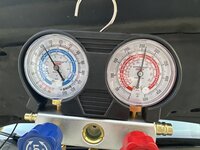
I feel like I did it all "right", very conscientiously ensuring the correct 7oz of PAG46 and 32oz of R134a were in the system. Low side pressures are between 40 and 50psi when it's set to maximum output (lowest temps setting, highest fan speed) in ambient temps in the mid 80F range. I don't recall what high side pressures were, but I want to say 130-150?

There's no evidence of abnormal cycling. The clutch is engaging perfectly and staying engaged. The temperatures across vents are pretty consistent, as is the airflow, so there's no evidence of anything awry there.


When I charged the system, it passed a 45 minute vacuum leakdown check and I pulled it down for another 45min with a pump rated to 28 microns before admitting any refrigerant.

The compressor was the only element of the system I replaced.


Did I do something wrong? Do I need to be patient and wait and see? My other vehicles have MUCH colder air conditioning, and before the compressor failure, it seemed quite a bit colder.

Best theory I can come up with is that the prior compressor failure actually generated debris in the refrigerant section and that this debris is now creating a low flow condition at the evaporator. I have no idea how I could check for this. I'm REALLY trying to avoid throwing a ton of money into a 20 year old van.

It's humbling to have to ask for advice on this, but I am quite out of my wheelhouse in doing A/C work.

What's a "normal" vent temperature? I can't get mine to go below 55F under any conditions seen in the last 24 hours, including in the cooler ambients of dusk.
 
To avoid these ads, REGISTER NOW!

DaChev

Well-known member
Joined
Dec 10, 2015
Messages
60
Don't forget to clean your condenser. It is the bug catcher for your automobile. Look for a the Radiator Genie. It might fit between the radiator and the coil to spray the water from the back to the front. Might as well clean your radiator while you are in there. 20 years of road grime add up.
 
OP
H

Hohn

Well-known member
Joined
Aug 25, 2016
Messages
2,668
Location
Diesel Central, Indiana
What failure happened to old compressor? Most need a new condenser coil, expansion device, drier and lines flushed. Are the radiator fans running with the ac on?
I think honestly only the clutch was bad. There's no debris in either the send or return ports. I figured with a 15+ year old compressor that I'd have to physically remove anyway to swap the clutch, I might as well swap the assembly.
 
OP
H

Hohn

Well-known member
Joined
Aug 25, 2016
Messages
2,668
Location
Diesel Central, Indiana
Don't forget to clean your condenser. It is the bug catcher for your automobile. Look for a the Radiator Genie. It might fit between the radiator and the coil to spray the water from the back to the front. Might as well clean your radiator while you are in there. 20 years of road grime add up.
Good advice, but not really relevant to this particular case, as the condenser didn't suddenly get dirty in the last week. So it isn't the reason the new setup cools much worse than the old one.
 

chinboys

Well-known member
Joined
Jun 20, 2011
Messages
434
Something seems to be not correct on the pressures being mentioned.
The R134a temperature pressure standard chart expects the high side pressure to be 175 to 210 PSI relative to the low side pressures of 40-50 PSI reading.
You also want a 10 to 12 degree subcooling during a max cooling and high blower fan event for the capillary tube expansion to fully make efficient use of the high pressure liquid refrigerant.
It looks like you need more refrigerant.
And make sure the condensor is clean and air flow is working.
 
OP
H

Hohn

Well-known member
Joined
Aug 25, 2016
Messages
2,668
Location
Diesel Central, Indiana
Something seems to be not correct on the pressures being mentioned.
The R134a temperature pressure standard chart expects the high side pressure to be 175 to 210 PSI relative to the low side pressures of 40-50 PSI reading.
You also want a 10 to 12 degree subcooling during a max cooling and high blower fan event for the capillary tube expansion to fully make efficient use of the high pressure liquid refrigerant.
It looks like you need more refrigerant.
And make sure the condensor is clean and air flow is working.
The high side I have no directly measured under those conditions, I'm guesstimating that. I did measure the low side, but high side I won't know until tonight.
 

Snapped-off

Well-known member
Joined
Feb 22, 2012
Messages
4,802
Location
Indiana
Bounce your numbers off the chart once you get your high side pressure. Did you weigh in the 32oz?
1000026075.png
 
OP
H

Hohn

Well-known member
Joined
Aug 25, 2016
Messages
2,668
Location
Diesel Central, Indiana
Bounce your numbers off the chart once you get your high side pressure. Did you weigh in the 32oz?
1000026075.png
I weighed the Freon.

Here’s where it sits at about 80-85 ambient at idle.

image.jpg
The high side seems a bit higher than it should relative to the low side but I think this is a good happy medium and I’m gonna leave it like it is.
 
Last edited:

Snapped-off

Well-known member
Joined
Feb 22, 2012
Messages
4,802
Location
Indiana
Might be a little overcharged. Maybe some non condensibles in it.

Did you valve out the vacuum pump before shutting it off? Did you purge your hoses and manifold before adding refrigerant?

Are you able to recover any of it?

Is there a sight glass on your receiver?
 
OP
H

Hohn

Well-known member
Joined
Aug 25, 2016
Messages
2,668
Location
Diesel Central, Indiana
Might be a little overcharged. Maybe some non condensibles in it.

Did you valve out the vacuum pump before shutting it off? Did you purge your hoses and manifold before adding refrigerant?

Are you able to recover any of it?

Is there a sight glass on your receiver?
Yes, valved out and full line purge before valve opening.

Manifold set has sight glass.
 
OP
H

Hohn

Well-known member
Joined
Aug 25, 2016
Messages
2,668
Location
Diesel Central, Indiana
If you did not flush the system completely before adding 7 oz. of oil, you may have 3 or 4 ozs. of excess oil in the system.
I think it has slightly excessive oil but everything is running smoothly and pressures are reasonable.

There’s probably too much oil in it but I got lucky that it was enough to hurt anything. Hydrolock is not a slow acting fail mode and it’s run hours quite well and safely.
 

Relax

Well-known member
Joined
Nov 22, 2011
Messages
449
Location
GTA, Ontario
Subscribing to see what the issue turns out to be in case I run into the same problem. Coincidentally, I replaced both Hi and Lo schrader valves on two of my cars today that have been slowly leaking refrigerant during the freezing winter months when parked outside. Subaru doesn't specify refrigerant weight for my 2012 Impreza, just a vague pressure chart that's a little different from the standard charts I've seen out there and posted above. I followed that and so far so good with that car. The other car is a 2007 Acura MDX, so probably similar to your Odyssey. So far I've only vacuumed the system and will be leaving it overnight to make sure it holds before wasting two cans of R134a. The last time I did a vac test for 30 mins, it held fine so I thought everything was good, but then I didn't realize I never tested the schrader valves by leaving them all open, and I think doing that might have done them in finally, because the R134a completely leaked out within a week.
 
Last edited:
OP
H

Hohn

Well-known member
Joined
Aug 25, 2016
Messages
2,668
Location
Diesel Central, Indiana
Well, we’re nearing the peak heat of summer and the A/C is keeping up so I’m not going to get greedy. I have tendency to embody the “if it ain’t broke, fix it ‘til it is” sometimes, and and up making things worse going for the last little bit.

I’m going to leave it as it is based on the high side pressure being in range.
 

Relax

Well-known member
Joined
Nov 22, 2011
Messages
449
Location
GTA, Ontario
Vac held overnight after changing the schrader valves, so I added one can of R134a (half the system capacity). The AC compressor kicked in and cool air was blowing, enough to monitor for degradation over the next week before adding the second can. When I was done filling, the low pressure was around 32 PSI, and high around 145.

After closing both schrader valves and depressurizing the lines before removing them, I noticed a lot of liquid coming out of the red/high hose. So I fed it back into the low side and there was enough to fill the sight glass for a good few few seconds at least, and increased the low pressure to 35 PSI and high to 155. Maybe I was feeding in the R134a too quickly and the liquid was getting pumped straight through the compressor and up the red hose. In any case, I'll have to remember to always depressurize the red hose into the low side before removing.
 
To avoid these ads, REGISTER NOW!

American Locomotive

Well-known member
Joined
Jan 8, 2017
Messages
10,969
Location
Rhode Island
You low side pressures look good, and indicate that you should have an evaporating temperature of around 45-50 degrees. Are you sure the recirculate is working, and that the blend door is actually going fully "cool"?
 

djbmw

Well-known member
Joined
Jun 20, 2013
Messages
1,143
Location
Ottawa, Ontario, Canada
You only need to monitor pressures if you were unsure of the weight of refrigerant that you put in.
How accurate is your scale?
I use a scale specifically for AC work and, with the bottle sitting on the scale, i watch exactly how much is going in.
Charge to the proper weight and you're done. You shouldnt need to bother with pressures on a known system/values.
 
OP
H

Hohn

Well-known member
Joined
Aug 25, 2016
Messages
2,668
Location
Diesel Central, Indiana
You only need to monitor pressures if you were unsure of the weight of refrigerant that you put in.
How accurate is your scale?
I use a scale specifically for AC work and, with the bottle sitting on the scale, i watch exactly how much is going in.
Charge to the proper weight and you're done. You shouldnt need to bother with pressures on a known system/values.
Agreed, I used a food scale with 0.1oz resolution to charge 32oz.
 

djbmw

Well-known member
Joined
Jun 20, 2013
Messages
1,143
Location
Ottawa, Ontario, Canada
Agreed, I used a food scale with 0.1oz resolution to charge 32oz.
You should be good then.
You put your system under vacuum and it held for several hours. You then fed in the exact weight of refrigerant, using the vacuum to draw in the initial charge, and then using the vehicles compressor to **** in the remaining amount. You watched the scale to ensure the exact weight was added.

The only thing left is if your dryer absorbed too much moisture while your system was being repaired (generally you should immediately cap off the lines when working on AC systems to minimize the introduction of moisture. You might want to swap out your AC dryer.

Also... the quality of R132a that you're using matters. A lot of "off the shelf" stuff is a blend and not pure. Here in Canada its tricky to come by as it has been banned for new sale since 2019. A 30lb. tank will run a Canadian shop between $600 to $1,000 CAD. Those little 32oz cans are usually a blend of 132a and propane.
 
OP
H

Hohn

Well-known member
Joined
Aug 25, 2016
Messages
2,668
Location
Diesel Central, Indiana
The only thing left is if your dryer absorbed too much moisture while your system was being repaired (generally you should immediately cap off the lines when working on AC systems to minimize the introduction of moisture. You might want to swap out your AC dryer.
I don’t think moisture can withstand an hour at a 28 micron vacuum. At such a hard vacuum, all the moisture would vaporize, wouldn’t it?

I have the desiccant pack/orifice still in the box. I didn’t feel like removing the condenser to swap, that was probably a mistake.
 

Snapped-off

Well-known member
Joined
Feb 22, 2012
Messages
4,802
Location
Indiana
I don’t think moisture can withstand an hour at a 28 micron vacuum. At such a hard vacuum, all the moisture would vaporize, wouldn’t it?

I have the desiccant pack/orifice still in the box. I didn’t feel like removing the condenser to swap, that was probably a mistake.
Did you actually pull the system down to 28 microns? Sounds like you had it on vacuum long enough for that small system. I'm sure nobody throws a micron gauge on a MVAC system.

Not quite apples to apples, but we just had to triple evac and N2 purge a system to get the vacuum decay test to pass, with less than a 100 micron rise in 15 minutes.

The system was open for a day or so before we could cap it off for repairs.
 

gmcgeo

Well-known member
Joined
Mar 11, 2019
Messages
3,701
Only thing i have to mention is vacuum to 500 microns. At 28 you could still have water stuck in the system in areas.

Ideally you want around 300 microns when vacuuming the system. My guess is there is water in the system that mixed with the Refrigerant?

While Most will not Put Micron gauges on this type of system, it could help in your case.

Here is an older thread of some explaining about pulling to 500 microns. https://www.garagejournal.com/forum/threads/looking-to-get-a-micron-gauge-for-auto-a-c.519832/

Maybe i may not be thinking this through correctly. However, i believe water may have not all boiled off in this case due to being trapped from not pulling further vacuum ?

Other than that, great job on the write up and the work thus far. Very detailed!
 
OP
H

Hohn

Well-known member
Joined
Aug 25, 2016
Messages
2,668
Location
Diesel Central, Indiana
28 microns is a much stronger vacuum than 500. “Microns” are a tiny column of mercury as a unit of pressure. Atmospheric pressure is 760mm of mercury.

In other words, 28 microns is 28/759,692nd of atmospheric pressure. That’s ~99.98% vacuum.
 

Snapped-off

Well-known member
Joined
Feb 22, 2012
Messages
4,802
Location
Indiana
Only thing i have to mention is vacuum to 500 microns. At 28 you could still have water stuck in the system in areas.

Ideally you want around 300 microns when vacuuming the system. My guess is there is water in the system that mixed with the Refrigerant?

While Most will not Put Micron gauges on this type of system, it could help in your case.

Here is an older thread of some explaining about pulling to 500 microns. https://www.garagejournal.com/forum/threads/looking-to-get-a-micron-gauge-for-auto-a-c.519832/

Maybe i may not be thinking this through correctly. However, i believe water may have not all boiled off in this case due to being trapped from not pulling further vacuum ?

Other than that, great job on the write up and the work thus far. Very detailed!
28 microns is far below 500. You may be thinking of 28"Hg. But he mentioned his pump is rated to 28 microns. Likely won't pull the system down that far though.
 
OP
H

Hohn

Well-known member
Joined
Aug 25, 2016
Messages
2,668
Location
Diesel Central, Indiana
Did you actually pull the system down to 28 microns? Sounds like you had it on vacuum long enough for that small system. I'm sure nobody throws a micron gauge on a MVAC system.

Not quite apples to apples, but we just had to triple evac and N2 purge a system to get the vacuum decay test to pass, with less than a 100 micron rise in 15 minutes.

The system was open for a day or so before we could cap it off for repairs.
No way to verify actual vacuum strength, I’m just going by the claimed spec of the two stage vacuum pump I used.

On the manifold gauges, it was pegged at 30” hg almost immediately on startup.
 

American Locomotive

Well-known member
Joined
Jan 8, 2017
Messages
10,969
Location
Rhode Island
I don’t think moisture can withstand an hour at a 28 micron vacuum. At such a hard vacuum, all the moisture would vaporize, wouldn’t it?

I have the desiccant pack/orifice still in the box. I didn’t feel like removing the condenser to swap, that was probably a mistake.
It's almost impossible to hit a 28 micron vacuum on an actual system, and you will not know without a micron gauge hooked up to the vehicle. In the HVAC industry, most systems typically call for a vacuum of at least 500 microns as being good enough. 500 microns is probably pretty difficult to achieve on an old/used automotive AC system, and I wouldn't worry too much if you couldn't quite get there.

With the blower on high, after a few minutes the temperatures and pressures should be very steady. Look at the high side pressures, if there are non-condensables (i.e., air, water) in the system, the high side pressures will be fluctuating in a cyclic-matter. So for example, over period of 45 seconds you might see the pressure move from 200 PSI up to 250 PSI, then back down to 200 PSI and over again. If the condenser fan, engine speed and blower speed are all steady, the high side pressures should be pretty steady. If they are steady, you're probably fine.
 

TRWham

Well-known member
Joined
Aug 11, 2017
Messages
1,961
Location
East Cobb County, Georgia
No way to verify actual vacuum strength, I’m just going by the claimed spec of the two stage vacuum pump I used.

On the manifold gauges, it was pegged at 30” hg almost immediately on startup.
With a large pump on a small system, you can pull down so quickly that moisture in the system will freeze. It will look like you have removed all non-condensables and moisture, but once the ice thaws you have moisture again.
 
OP
H

Hohn

Well-known member
Joined
Aug 25, 2016
Messages
2,668
Location
Diesel Central, Indiana
It’s not that large a pump. Besides, looking at a phase diagram for water suggests this is VERY unlikely. Even if the pressure dropped fast enough to freeze the water, the presence of a hard vacuum for 45 minutes in a hot environment means that the ice will sublimate to vapor in short order.

You can’t sustain ice at -29.8” Hg and ambient temp of 80F, which is right around 300K. Looking at the phase diagram you’ll see there’s no home-achievable pressure or vacuum condition in which ice exists at 300k. 45 minutes in such temperature conditions is plenty of time to assure that temporary cold flash warm up to ambient enough to sublimate any ice.

1751768472679.png
 

WillRead

Well-known member
Joined
Apr 22, 2016
Messages
100
Location
MD
If you added 7oz of oil while only changing the compressor it is over oiled simple as that. You probably have 12+ ounces in a system that holds a maximum of 7 of course performance is going to be poor.

My first step would be to flush the evaporator and condenser and oil balance the system.
 
OP
H

Hohn

Well-known member
Joined
Aug 25, 2016
Messages
2,668
Location
Diesel Central, Indiana
If you added 7oz of oil while only changing the compressor it is over oiled simple as that. You probably have 12+ ounces in a system that holds a maximum of 7 of course performance is going to be poor.

My first step would be to flush the evaporator and condenser and oil balance the system.
I think that’s where we’re at. It’s well over-oiled because I didn’t account for residual oil.
 
OP
H

Hohn

Well-known member
Joined
Aug 25, 2016
Messages
2,668
Location
Diesel Central, Indiana
It's almost impossible to hit a 28 micron vacuum on an actual system, and you will not know without a micron gauge hooked up to the vehicle. In the HVAC industry, most systems typically call for a vacuum of at least 500 microns as being good enough. 500 microns is probably pretty difficult to achieve on an old/used automotive AC system, and I wouldn't worry too much if you couldn't quite get there.

With the blower on high, after a few minutes the temperatures and pressures should be very steady. Look at the high side pressures, if there are non-condensables (i.e., air, water) in the system, the high side pressures will be fluctuating in a cyclic-matter. So for example, over period of 45 seconds you might see the pressure move from 200 PSI up to 250 PSI, then back down to 200 PSI and over again. If the condenser fan, engine speed and blower speed are all steady, the high side pressures should be pretty steady. If they are steady, you're probably fine.
Thanks, pressure is rock solid stable.
 

mikey03

Well-known member
Joined
May 17, 2024
Messages
2,107
I think that’s where we’re at. It’s well over-oiled because I didn’t account for residual oil.
I’m guessing the new compressor might also have been pre oiled. I just did mine and it came preoiled. Now the question is how do you get the extra oil out? Honestly idk because I don’t think the vacuum pump is strong enough to **** the oil

otherwise when you connect the pre oiled compressor to the vac pump it would **** all of the oil out that it came with
 
To avoid these ads, REGISTER NOW!
Top Bottom