To avoid these ads, REGISTER NOW!

200a subpanel for new large garage

encantofred

Well-known member
Joined
Dec 1, 2012
Messages
238
Location
Arizona
howdy,

i am building a 4500 sq foot shop out back of the house. i want to put in 200a service to it. i have a 400a main panel on the main house.

i know it is a big subpanel, but there will be a 50a rv hookup, high bay lights, hot water heater, welder, door opener, 220v compressor and outlets. and a split system aircon in a small office.

once i know the length of the run to the subpanel (will be between 150-200') i can size the wire for it.

i have done a bit of wiring, but am still just a novice for code. my questions are this.

1. coming out of the 400a main and into the ground and out of the ground at the subpanel to the panel, can sch 80pvc conduit be used by code?. i know sched 40 is ok for the underground portion.

2. where i would like to put in the panel inside the shop is a few feet from the hot water heater. how close can the panel be to the hot water panel and a utility sink?

3. i am assumming i need a 200a main breaker both in the 400a main panel AND the 200a sub in the shop? is that correct?

4. the neutral and ground is tied together in the 400a main panel, but will be separate in the 200a shop subpanel, is that right?

5. what do i need to do for grounding at the shop. do i need to put metal rods in the ground and if so how many and what size rod and wire to the subpanel.

6. i am going to run 1" conduit under the slab to each side and corner of the shop and stub it up at the subpanel. is it ok to use sched 40 coming out of the cement inside?

7. how deep does the conduit need to be for the run from the house to the shop?

8. am i missing anything big?

thank you so much for your help

regards,

tom
 
To avoid these ads, REGISTER NOW!

2ManyProjects

Well-known member
Joined
Jul 18, 2013
Messages
757
howdy,

i am building a 4500 sq foot shop out back of the house.

Sounds ambitious. What exactly are you going to use all that space for?

i want to put in 200a service to it. i have a 400a main panel on the main house.

i know it is a big subpanel, but there will be a 50a rv hookup, high bay lights, hot water heater, welder, door opener, 220v compressor and outlets. and a split system aircon in a small office.

I have little argument with the desire for 200A service to the shop, even it is is very probably overkill. Even so, I doubt you'll really NEED more than perhaps 90-100A, as long as you're not running everything in the RV at the same time you're using all your power tools at once.

More to the point, the presumption that you would do this via a sub-panel fed from the home's main distribution panel carries with it some SERIOUS issues. Read on..

once i know the length of the run to the subpanel (will be between 150-200') i can size the wire for it.

Be prepared for some MAJOR sticker shock when you do. I just did a quick "back of the envelope" calculation on this.... At 200 Amps, over a 200-ft. (one way) run, you would need AT LEAST AWG 3/0 copper to keep voltage drop within acceptable limits. And if you try going to aluminum to "save money", even AWG 4/0 will prove inadequate -- you'd need at least 250MCM. At that point, it becomes questionable as to whether you could even find a breaker for your main panel which will properly support that size wire.

Have you considered contacting your local PoCo, to see what it would take for them to install a completely separate service to the shop building?

 
OP
E

encantofred

Well-known member
Joined
Dec 1, 2012
Messages
238
Location
Arizona
thanks for the response.

i have done the load calcs and it is potentially could be above 100a, so i am going to do 200.

so a few answers to your questions. i have a bus RV. i will have it in the shop. it can be very power hungary if i have the A/C on or the heater. i am also going to have a bay for a friends bus. i will also have a lift for working on cars.

in a addition a 400 sq foot man cave with a bathroom that is air conditioned. (hey i live in the phoenix area).

the sticker shock has already hit me and i am numb to it now. i priced it out at 3/0.

as for a second meter, it is not going to be any cheaper as i would have to pay for the run from the transformer to the second service and they would require it to be billed as a commercial account. so no go on that.

it funny that i thought it would be huge, but when i lay it out it is tight....ha.

the other question i have that i could answer myself if i was at the house now is if a sub panel breaker off of the main 400a will take a 3/0 wire?

does anyone have any answers to my other questions?

thanks all and i totally understand the username toomanyprojects.....describes me too.

tom
 

Norcal

Well-known member
Joined
Mar 16, 2008
Messages
13,754
Sounds ambitious. What exactly are you going to use all that space for?


I have little argument with the desire for 200A service to the shop, even it is is very probably overkill. Even so, I doubt you'll really NEED more than perhaps 90-100A, as long as you're not running everything in the RV at the same time you're using all your power tools at once.

More to the point, the presumption that you would do this via a sub-panel fed from the home's main distribution panel carries with it some SERIOUS issues. Read on..


Be prepared for some MAJOR sticker shock when you do. I just did a quick "back of the envelope" calculation on this.... At 200 Amps, over a 200-ft. (one way) run, you would need AT LEAST AWG 3/0 copper to keep voltage drop within acceptable limits. And if you try going to aluminum to "save money", even AWG 4/0 will prove inadequate -- you'd need at least 250MCM. At that point, it becomes questionable as to whether you could even find a breaker for your main panel which will properly support that size wire.

Have you considered contacting your local PoCo, to see what it would take for them to install a completely separate service to the shop building?


You need to start at 3/0 CU, or 250 MCM AL, it's a garage, undersizing conductors ain't allowed like it is for a residence.
 
OP
E

encantofred

Well-known member
Joined
Dec 1, 2012
Messages
238
Location
Arizona
thanks. sizing the conductors is the easy part and i had counted on 3/0. can you help with my other questions?

tom
 

allanjs

Member
Joined
Oct 26, 2013
Messages
8
Tom, Codes vary greatly across the country and change almost yearly. With a project this large I suggest you get the proper permit(s) if you're not planning to already. The inspector can guide you and answer your questions specific to your location. At least that's the way it works in my area.
 

2ManyProjects

Well-known member
Joined
Jul 18, 2013
Messages
757
thanks for the response.

i have done the load calcs and it is potentially could be above 100a, so i am going to do 200.

There are perfectly reasonable intermediate "stops" between 100A and 200 A. If you can reasonably get by with, say, 125A or even 150A, that would go a LONG way toward making the entire project more feasible. Which brings us to...

so a few answers to your questions. i have a bus RV. i will have it in the shop. it can be very power hungary if i have the A/C on or the heater. i am also going to have a bay for a friends bus. i will also have a lift for working on cars.

All well and good. But realistically, how often will you be running the RV's HVAC while the RV is effectively in storage? That just doesn't make a lot of sense to me. About the only time I can envision this happening is if you are working on / troubleshooting said HVAC system; and even then, you could fire up the RV's own generator (or even its main propulsion engine, if need be) to enable that troubleshooting. I daresay, the "typical" load that RV would put on the shop/garage's electrical system during normal storage would be downright trivial -- a couple of amps for the battery charger, and maybe another amp or two for any lighting you might happen to use while futzing about inside (such as to pack/prepare for a trip)... what else could there be?

Much the same logic applies to the lift and various other power tools: You may well have a lot of "stuff" in there; but you aren't going to be using all of it at the same time. What matters is the maximum concurrent load, which will surely be nowhere near the total of all possible loads.

in a addition a 400 sq foot man cave with a bathroom that is air conditioned. (hey i live in the phoenix area).

Even so, at 200A, I think you are grossly overestimating your power requirements. From the above, I take it that the main part of the shop is NOT air conditioned? That lightens the load even moreso. Assuming decent insulation, the "Man Cave" HVAC could not possibly need be more than perhaps 15-20,000 BTU or so, probably less (yes, even in Phoenix -- my father used to live there). Just to throw a dart, this 18,000 BTU model: http://www.lg.com/us/air-conditioners/lg-LW1811ER-window-air-conditioner draws only about 7.3 Amps when running (the start-up surge would be somewhat higher; but that can be safely ignored for our purposes). A typical "mini-split" system would be still more efficient.

the sticker shock has already hit me and i am numb to it now. i priced it out at 3/0.

as for a second meter, it is not going to be any cheaper as i would have to pay for the run from the transformer to the second service and they would require it to be billed as a commercial account. so no go on that.

So all the more reason to sharpen your pencil with regard to your REAL power requirements. For example, at 125A, AWG 1/0 ("single ought") copper would be more than adequate; you could even use AWG 3/0 aluminum. Either way, this difference is going to have an immense impact not only on the overall costs, but also on such things as finding a suitable breaker for your main panel, etc.

the other question i have that i could answer myself if i was at the house now is if a sub panel breaker off of the main 400a will take a 3/0 wire?

I presume this will depend (at least in part) on exactly what make/model panel(s) you have. But it's a safe bet that a 125A breaker that can handle AWG 1/0 will be both easier to find and a lot less expensive.


theoldwizard1

Well-known member
Joined
Feb 22, 2011
Messages
43,166
Location
SE MI
howdy,
.
.
.
3. i am assumming i need a 200a main breaker both in the 400a main panel AND the 200a sub in the shop? is that correct?
NO ! The breaker in the main protects the wire to the sub and therefore is sized according the ampacity of the wire. You may decide to install wire that can only handle 120-180A. The breaker in the main is sized for that.

Despite your load analysis, I don't think you will exceed 100A unless you have the water heater, welder, compressor AND A/C running all at the same time.

4. the neutral and ground is tied together in the 400a main panel, but will be separate in the 200a shop subpanel, is that right?
Yes, you will have to run 4 wires, unless you can run directly off of the meter. That depends on the power company and local codes.


You can buy direct burial cable which means you don't need conduit except where it comes up above ground. I would install a conduit for low voltage
wiring
 

Charles (in GA)

Well-known member
Joined
Jan 11, 2006
Messages
12,489
Location
50 mi south of Atlanta
Not sure why everyone fights someone over a decision to go with 200 amps vs 100 or 150. Its adds to the cost, and somewhat to the difficulty of doing the job, but in a 4500 ft building, I would think 200 amps is all well and good. I have 3600 sq ft and have a 200 amp panel and would not consider less. My lighting alone draws about 54 amps when it is all turned on, the compressor draws another 33 running and 190 for a split second on startup and this coupled with other potential draws (welder, heater running, water heater, etc) I just did not want to cut it close.

I can easily see running a RV power system in the building, especially if the building is not air conditioned and you want to have it cool while you are loading it with groceries, clothes, etc preparing for a trip.

Charles
 

theoldwizard1

Well-known member
Joined
Feb 22, 2011
Messages
43,166
Location
SE MI
Not sure why everyone fights someone over a decision to go with 200 amps vs 100 or 150. Its adds to the cost, and somewhat to the difficulty of doing the job, but in a 4500 ft building, ...
I lost sight of that fact !

I would still check into coming right off the meter.
 
Last edited:

shamrock12

Well-known member
Joined
Dec 26, 2007
Messages
959
Location
South Dakota
1. coming out of the 400a main and into the ground and out of the ground at the subpanel to the panel, can sch 80pvc conduit be used by code?. i know sched 40 is ok for the underground portion.

Yes, you can use schedule 80 the entire length if you want to but that would be unnecessary. I would just do schedule 40 underground and use schedule 80 for anything that stick above the ground.

2. where i would like to put in the panel inside the shop is a few feet from the hot water heater. how close can the panel be to the hot water panel and a utility sink?

I do not believe there is any rule about placement near hot water heater or the utility sink; however, you will want to maintain 3 feet of open space from left to right of the panel, front and back. I actually believe the code is 30" from left to right but I would use 3 feet instead.

3. i am assumming i need a 200a main breaker both in the 400a main panel AND the 200a sub in the shop? is that correct?

200amp circuit breaker in your 400amp main panel, yes, but not the "main" breaker since it would be a sub-feed. This would be your disconnect mean to the garage. Since your garage is detached, you are required to have another disconnect there as well. You can use a 200amp panelboard with a 200amp breaker built-in as your disconnect mean at the garage.

4. the neutral and ground is tied together in the 400a main panel, but will be separate in the 200a shop subpanel, is that right?

Yes, you will need a separate grounding bar for your 200amp panelboard. Keep the grounding and neutral separate. Do not install the large green grounding screw inside the panelboard (which would bond the neutral and grounding). You will need to run a grounding conductor from your 400amp main which would be part of 4-wire feeder.

5. what do i need to do for grounding at the shop. do i need to put metal rods in the ground and if so how many and what size rod and wire to the subpanel.

edited ... please see post below

6. i am going to run 1" conduit under the slab to each side and corner of the shop and stub it up at the subpanel. is it ok to use sched 40 coming out of the cement inside?

Not sure what you are planning here but if there is a chance that the conduit would be exposed to any physical damage then you will need to use schedule 80 once it extrude above the ground/slab.

7. how deep does the conduit need to be for the run from the house to the shop?

In a residential location, 18" minimum from the TOP of the conduit; however, I prefer to bury at least 24" for 200amp and larger.

8. am i missing anything big?

It sounds like you are on the right page. One of my advice would be to run the conduit next size larger than the minimum required by code. Trust me, it is no fun pulling large conductors across a distance. You will need at least 4/0-4/0-2/0 aluminum along with a grounding conductor (not sure what size for that but I think it's 4 gauge minimum ... don't have the book next to me at the moment) but you will need to figure out the total length of subfeed conductors, not just the length of the trench. You'll need to add the length for going up above the ground and into the panels.

NEC allows a maximum of 3% voltage drop but I personally would limit that to 2%. So it should be fine for you to run 4/0 aluminum if your total run is within 120 feet. If you go past that, then you should look into pulling 250 MCM aluminum instead. There really is no reason to pull copper conductors as a subfeed at this size (200A) ... they are heavier and stiffer, thus more difficult to pull and terminate. Not to mention they are quite expensive. I would not want to think how much they would run for :shocking:

Good luck with everything ... I hope you find these to be helpful :beer:
 
Last edited:

shamrock12

Well-known member
Joined
Dec 26, 2007
Messages
959
Location
South Dakota
After doing a bit of checking, I would like to correct myself on your question number 5. Yes, it is required to have a separate grounding electrode system (GES) in additional to equipment grounding conductor (EGC). Things has changed since the 2008 code cycle which is why I was uncertain.

A grounding electrode system can be just a pair of grounding rods driven at a minimum distance of 6' between them at the garage. The equipment grounding conductor would be part of the 4-wire feeder between the main and the garage. I'm attaching a photo just to be clear.
 

Attachments

  • art 250 grounding and bonding 1.jpg
    art 250 grounding and bonding 1.jpg
    96.5 KB · Views: 84

wyliesdiesels

Well-known member
Joined
Aug 14, 2012
Messages
20,013
Location
Modesto, CA
NO ! The breaker in the main protects the wire to the sub and therefore is sized according the ampacity of the wire. You may decide to install wire that can only handle 120-180A. The breaker in the main is sized for that.

However, if he puts in a 200a breaker in the main and only a 100a breaker in the sub, he WILL be limited to 100a. That would be a waste of money and equal to shooting oneself in the foot. So the correct answer would be YES, IF he wants 200a available in the shop.

After doing a bit of checking, I would like to correct myself on your question number 5. Yes, it is required to have a separate grounding electrode system (GES) in additional to equipment grounding conductor (EGC). Things has changed since the 2008 code cycle which is why I was uncertain.

A grounding electrode system can be just a pair of grounding rods driven at a minimum distance of 6' between them at the garage. The equipment grounding conductor would be part of the 4-wire feeder between the main and the garage. I'm attaching a photo just to be clear.

IF the OP is pouring a slab, then the required GES would be a UFER ground so forget the ground rods.

Also, if theres going to be water service to the shop, then the water line needs to be bonded, within 5' of it entering the structure, to the subpanel as well.
 

Charles (in GA)

Well-known member
Joined
Jan 11, 2006
Messages
12,489
Location
50 mi south of Atlanta
Tapping off your panels will be the most difficult part. If you had a 400 amp meter but only a 200 amp disconnect, you could add a second 200 amp disconnect for he shop (400 amp meters typically have two sets of taps) but if you already have a single 400 amp tap, you cannot tap any more off the meter.

You can use a feed thru kit on your house panel, feed off the bottom of the bus bars with cable that is 400 amp capable (as it is protected by the 400 amp main in the house, and run that feed thru to a separate box with a 200 amp breaker in it, to supply the garage.

You cannot get 200 amps off the stabs of a typical panel.

Charles
 
OP
E

encantofred

Well-known member
Joined
Dec 1, 2012
Messages
238
Location
Arizona
thanks to all of you for your thoughtful answers.

1. i am still sure i want 200amp. i am going to put in a tankless hot water heater and not a normal electric tank job.

2. i can see lots of times running the coach Air conditioning. it has 4 basement airs, together drawing about 50amps 110v alone. and i plan on having spots for 2 coaches. i have friends that come by quite often. along with a guest spot on the side. these are all electric very power hungry coaches.

3. i would hate myself if i would save a grand or so on wire and not have enough power. i agree that my load calcs are primitive and very aggressive on power usage.

4. it seems to me the biggest issue is hooking into the main house panel. i will be out at the house tomorrow and will check the inside of the panel. we are just getting this house (had to look for a while to find a place to fit the shop i wanted near enough to the grandkids...ha)

5. so, a conduit fill question. i think nec allows up to a 60% fill, if i keep it down to a 2.5" pvc and 3 3/0 conductors and a #2 for ground, that is 20% fill. will that be to hard to pull? and for 180' will i need a power puller? what about laying the conduit on the ground and the wires too and gluing it together after sliding it on the wires one section at a time? if i use copper that would be over 500lbs of wire i think.

how long do the 2 grounding rods need to be? 8'?

thanks again to all of you

tom
 

Charles (in GA)

Well-known member
Joined
Jan 11, 2006
Messages
12,489
Location
50 mi south of Atlanta
Laying out the conduit and gluing as you go sounds great.......... EXCEPT, it is forbidden by the NEC (elect code). You are required to install the wire in a completed, installed, conduit system. Main reason, with PVC, you are likely to get solvent on the wire insulation, and damage it. It also proves, if you can pull it in, you can pull it out and pull new in later if needed.

Max fill is 40% for more than two wires in a conduit. 60% is for ******* less than 24 inches in length.

Ground rods are standard 8 ft. If you have not poured the slab yet, you need to do a UFER ground (tie in to slab rebar) as this is mandatory by the code. Your inspection should not have given you an OK to pour without seeing the UFER connection in place. If you do not have it, two rods, 6 ft or more apart, connected to the panel and to each other by one continuous, un-interrupted, NOT spliced, #6 solid copper wire. You are allowed certain other types of wire, but most are required to be in conduit for protection, the #6 solid won't need protection, and is the ground wire of choice. Use proper approved connectors on the rods. Only way to splice the ground wire is with a permanent splice such as Exothermic Cad Weld or other approved method.

I suggest you get two books if you plan on doing the wiring yourself. One is the National Electric Code. Probably get the 2014 edition, but if your state is using an earlier version, get it. Second is "Illustrated Guide to the National Electric Code" by Charles Miller. Illustrated, very plain language, easy to understand, with code section/paragraph references for everything it shows you.

April release of the Illustrated Guide to NEC 2014 is $78, little less for the 2011 edition. Find it on Amazon.

Nec also can be found on Amazon, get the complete paperback version or the spiral bound version, don't get the "handbook".

Charles
 
OP
E

encantofred

Well-known member
Joined
Dec 1, 2012
Messages
238
Location
Arizona
charles. you are definitely the man on this stuff.

ok, lets say i have put in 2.5" conduit, and it is ~30 percent filled.

and i use 4/0 alum.

how do i pull that wire through 185 feet. do i do one wire at a time? can i pull that without a pulling machine?

it would have 3 90's and 2 45's. what is the limit on how many turns in the conduit?

i duno if i will do it myself or pay someone.

thanks again

tom
 

shamrock12

Well-known member
Joined
Dec 26, 2007
Messages
959
Location
South Dakota
Is there a reason why you are so set on pulling a set of copper feeder? I have never seen a 200A copper feeder in a residential setting. Aluminum does have a bit more resistance which is why you will have to upsize a bit more than copper but not significantly much more. Usually it is just one or two sizes up. Aluminum conductors are lighter, easier to pull, easier to bend, and easier to terminate. The only extra step with running aluminum feeder is applying alum oxide compound at the exposed ends before terminating into the lugs. Of course, you could run copper if you want to but why make it harder on yourself physically and financially? :dunno:
 

shamrock12

Well-known member
Joined
Dec 26, 2007
Messages
959
Location
South Dakota
At 180 feet, you definitely will want to run 250 MCM aluminum, especially if there will be some heavy loads in the building.

40% conduit fill is the maximum per code, and you cannot exceed 360 degrees in a conduit run without a pull box in between.
 
OP
E

encantofred

Well-known member
Joined
Dec 1, 2012
Messages
238
Location
Arizona
i think you are right. i was just looking at the cost and weight of alum 4/0 and it is 1/4 the weight and much cheaper.

what is the limit on numbers and degrees of bends in the conduit?

hey, i am learning a ton from you guys.

thanks

tom
 
To avoid these ads, REGISTER NOW!

Norcal

Well-known member
Joined
Mar 16, 2008
Messages
13,754
i think you are right. i was just looking at the cost and weight of alum 4/0 and it is 1/4 the weight and much cheaper.

what is the limit on numbers and degrees of bends in the conduit?

hey, i am learning a ton from you guys.

thanks

tom

Where are you getting that 4/0 AL is a acceptable size for 200A? The install is not residential.
 
OP
E

encantofred

Well-known member
Joined
Dec 1, 2012
Messages
238
Location
Arizona
i just assumed it was one size bigger than the 3/0 that is needed for copper.

what size aluminum should i use then?

thanks,

tom
 

pattenp

Well-known member
Joined
Jun 4, 2008
Messages
10,175
Location
Virginia - USA
The number of bends X the degree of bend can equal no more than 360 degrees between pull points. Example - no more than four 90 degree bends between boxes.

i think you are right. i was just looking at the cost and weight of alum 4/0 and it is 1/4 the weight and much cheaper.

what is the limit on numbers and degrees of bends in the conduit?

hey, i am learning a ton from you guys.

thanks

tom
 

shamrock12

Well-known member
Joined
Dec 26, 2007
Messages
959
Location
South Dakota
The OP indicated that he is running a subfeed from his house, so he must be in a residential setting and can use 4/0 aluminum if he wish to but as I have stated earlier, the OP would want to use 250 kcmil aluminum instead because of the distance.

Just want to clear that up for anyone else that might be reading this for their future projects.

BTW, the 4/0 aluminum is rated for 205 amps.
 

pattenp

Well-known member
Joined
Jun 4, 2008
Messages
10,175
Location
Virginia - USA
4/0 AL cannot be used for 200A sub feed, it's rated at 180A not 205A. You are using the 90 degree C column and that is only used for derating purposes. You need to size it by the 75 degree C column. So 250 kcmil is required for 200A.

The OP indicated that he is running a subfeed from his house, so he must be in a residential setting and can use 4/0 aluminum if he wish to but as I have stated earlier, the OP would want to use 250 kcmil aluminum instead because of the distance.

Just want to clear that up for anyone else that might be reading this for their future projects.

BTW, the 4/0 aluminum is rated for 205 amps.
 

shamrock12

Well-known member
Joined
Dec 26, 2007
Messages
959
Location
South Dakota
4/0 AL cannot be used for 200A sub feed, it's rated at 180A not 205A. You are using the 90 degree C column and that is only used for derating purposes. You need to size it by the 75 degree C column. So 250 kcmil is required for 200A.

No, it depend on the insulation type of conductor. A typical 4/0 aluminum underground feeder at this size would have RHW-2 rating on it which falls under the 90 degree C column, thus it is rated for 205 amps.

However, as I have stated earlier, because of long distance, the OP would want to run 250 kcmil aluminum to compensate for voltage drop.

Again, I just wanted to point this out for anyone else that might be reading this and not think they automatically need 250 kcmil aluminum to run a 200amp feeder.
 

pattenp

Well-known member
Joined
Jun 4, 2008
Messages
10,175
Location
Virginia - USA
That's all good and fine that the insulation is rated 90 degree C but it goes against NEC to install 4/0 as a branch feeder protected by a 200A breaker. The breaker itself is only rated at 75 degrees C. That's why the wire needs to be sized from the 75 degrees C column regardless that the insulation type falls in the 90 degree C column. And the NEC states that the 90 degree C column is to be used for derating purposes only.

Edit: Additional info - http://www.mikeholt.com/mojonewsarc...C-Conductor-Ampacity-for-Feeders~20040914.php

No, it depend on the insulation type of conductor. A typical 4/0 aluminum underground feeder at this size would have RHW-2 rating on it which falls under the 90 degree C column, thus it is rated for 205 amps.

However, as I have stated earlier, because of long distance, the OP would want to run 250 kcmil aluminum to compensate for voltage drop.

Again, I just wanted to point this out for anyone else that might be reading this and not think they automatically need 250 kcmil aluminum to run a 200amp feeder.
 
Last edited:
OP
E

encantofred

Well-known member
Joined
Dec 1, 2012
Messages
238
Location
Arizona
i have conceded that i will do 250kcmil.

i have done my reading and it appears i cannot downsize the neutral. so i will run 3 250kcmil for 2 hots and neutral and a #4 or #2? for ground?

thanks again,

tom
 

pattenp

Well-known member
Joined
Jun 4, 2008
Messages
10,175
Location
Virginia - USA
#4 is the minimum by NEC for the ground, but I would use #2.

i have conceded that i will do 250kcmil.

i have done my reading and it appears i cannot downsize the neutral. so i will run 3 250kcmil for 2 hots and neutral and a #4 or #2? for ground?

thanks again,

tom
 

Norcal

Well-known member
Joined
Mar 16, 2008
Messages
13,754
The OP indicated that he is running a subfeed from his house, so he must be in a residential setting and can use 4/0 aluminum if he wish to but as I have stated earlier, the OP would want to use 250 kcmil aluminum instead because of the distance.

Just want to clear that up for anyone else that might be reading this for their future projects.

BTW, the 4/0 aluminum is rated for 205 amps.


Show me where in the NEC where it is OK to use 4/0 AL for a subfeed.

There are VERY specific rules on where it is permitted, and a subfeed does not comply. BTW, the place will not burn down because of using 4/0, but is still wrong, & using the 90 degree column for sizing conductors is the bad advice the local Home Depot gives.
 
OP
E

encantofred

Well-known member
Joined
Dec 1, 2012
Messages
238
Location
Arizona
once again, i am going to use 250kcmil for the hots and neutral. and per suggestion will use #2 for ground.

i looked at the panel today and i am not sure how i am going to feed 200a sub off the 400a main. i think i will run the wire, dig the hole and let an electrician connect it at both ends....

tom
 

Charles (in GA)

Well-known member
Joined
Jan 11, 2006
Messages
12,489
Location
50 mi south of Atlanta
Do you have one single 400 amp panel? with one 400 amp main breaker? For years, panels were limited to 42 breakers max, no matter the amps. If yours has any age on it (before the 2011 code cycle) then it falls under this rule. Most houses with more than 200 amps of service have multiple panels, many times two 200 amp 40 space panels.

Do you have an outside disconnect? or only a main breaker in the inside panel?

If you have an outside disconnect that is 400 amp, it may have a second set of lugs unused that you can tap off of.. If you have a main breaker inside only, none outside, then it becomes more difficult, as you will need to tap off the panel some how. Usually this is done with a set of feed thru lugs on the bottom of the bus bars. They make kits for various panels, for doing just this. You can run wire rated fir 400 amp from these lugs to a 200 amp breaker in its own box next to your panel, then run the 250 kcmil from there to the garage.

You need to plan this out, probably with an electrician, BEFORE you go running wire.

Charles
 

shamrock12

Well-known member
Joined
Dec 26, 2007
Messages
959
Location
South Dakota
Show me where in the NEC where it is OK to use 4/0 AL for a subfeed.

There are VERY specific rules on where it is permitted, and a subfeed does not comply. BTW, the place will not burn down because of using 4/0, but is still wrong, & using the 90 degree column for sizing conductors is the bad advice the local Home Depot gives.

Honestly, I don't need to take out the stinkin' book to prove it to you. If NEC will allow you to run 4/0 AL to a residential unit for 200amp service (I know the OP has 400amp, but I'm just setting an example), and if you want to run a 200amp subfeed to another building by using something such as a feed-thru panel or a large breaker that takes up four spaces in the panel, then why the hell would the subfeed conductor need to be 250 Kcmil if the main feeder from the pole is 4/0? :dunno: Remember, the OP has a service at his house, so it is in essence a residence.

I have seen 4/0 subfeed being used all of the times, and also have used them as well without any problem. All of them passed inspection with flying colors. It's not like there will be 190 amps of juice flowing continuously and if that is the case, then a larger service than 200amp would seriously need to be taken into consideration.

Also, the NEC book is a GUIDELINE, not the law. It does not mean you must comply to everything 100% in the book unless the local jurisdiction demands it. It's not like the electrons flowing to the garage is gonna be like "WAIT, this subfeed conductors ain't 250 kcmil, turn around!" Just use common sense and everything should be fine. :beer:
 

pattenp

Well-known member
Joined
Jun 4, 2008
Messages
10,175
Location
Virginia - USA
The best we can do in a forum such as this is to provide information as to what the NEC requires because a lot of jurisdictions adopt and enforce the requirements of the NEC. The requirements for sizing service conductors that supply the total power to a dwelling and the requirements for branch feeder conductors are different. 4/0 can be used as a dwelling service feed for 200A but not for a 200A branch feeder. Technically it makes no sense, but it is what it is. If your jurisdiction doesn't enforce NEC requirements then you can use your common sense.

........and if you want to run a 200amp subfeed to another building by using something such as a feed-thru panel or a large breaker that takes up four spaces in the panel, then why the hell would the subfeed conductor need to be 250 Kcmil if the main feeder from the pole is 4/0? :dunno:
 

Charles (in GA)

Well-known member
Joined
Jan 11, 2006
Messages
12,489
Location
50 mi south of Atlanta
I think NEC makes an assumption that in a residence, the loads will not be that great, nor for that long. Fridges running, stoves cooking, water heating, is all rather intermittent, while in non-residences, anything can go.

Power company can undersize because they are not affected by NEC, and they make their own rules. The also know that aerials will cool, out in the open and not bundled in a mass or in conduit, etc.

I know the POCO undersized my underground service to the shop. I mentioned that it was kinda small looking for 200 amps and the guy said "it'll be alright". They did, however, upsize the transformer on the pole. It was put there originally just to power a yard light (the house gets its power from a different transformer) and they went from a "5" to a "10". The shop service comes off a pole transformer, down the pole, and underground to the shop.

Charles
 
Last edited:

shamrock12

Well-known member
Joined
Dec 26, 2007
Messages
959
Location
South Dakota
i looked at the panel today and i am not sure how i am going to feed 200a sub off the 400a main. i think i will run the wire, dig the hole and let an electrician connect it at both ends....

tom

A photo of your 400amp main would be helpful before we could go on further with our suggestions/advices.
 

Norcal

Well-known member
Joined
Mar 16, 2008
Messages
13,754
Honestly, I don't need to take out the stinkin' book to prove it to you. If NEC will allow you to run 4/0 AL to a residential unit for 200amp service (I know the OP has 400amp, but I'm just setting an example), and if you want to run a 200amp subfeed to another building by using something such as a feed-thru panel or a large breaker that takes up four spaces in the panel, then why the hell would the subfeed conductor need to be 250 Kcmil if the main feeder from the pole is 4/0? :dunno: Remember, the OP has a service at his house, so it is in essence a residence.

I have seen 4/0 subfeed being used all of the times, and also have used them as well without any problem. All of them passed inspection with flying colors. It's not like there will be 190 amps of juice flowing continuously and if that is the case, then a larger service than 200amp would seriously need to be taken into consideration.

Also, the NEC book is a GUIDELINE, not the law. It does not mean you must comply to everything 100% in the book unless the local jurisdiction demands it. It's not like the electrons flowing to the garage is gonna be like "WAIT, this subfeed conductors ain't 250 kcmil, turn around!" Just use common sense and everything should be fine. :beer:


Since you seem to use the ULC, Urban Legend Code here is what is allowed.

310.15(B)6

(6) 120/240-Volt, 3-Wire, Single-Phase Dwelling Services
and Feeders. For individual dwelling units of onefamily,
two-family, and multifamily dwellings, conductors,
as listed in Table 310.15(B)(6), shall be permitted as
120/240-volt, 3-wire, single-phase service-entrance conductors,
service-lateral conductors, and feeder conductors
that serve as the main power feeder to each dwelling unit
and are installed in raceway or cable with or without an
equipment grounding conductor. For application of this section,
the main power feeder shall be the feeder between the main disconnect and the panelboard that supplies, either by
branch circuits or by feeders, or both, all loads that are part
or associated with the dwelling unit.
The feeder conductors
to a dwelling unit shall not be required to have an allowable
ampacity rating greater than their service-entrance conductors.
The grounded conductor shall be permitted to be
smaller than the ungrounded conductors, provided the requirements
of 215.2, 220.61, and 230.42 are met.

The above does not apply to a subfeed unless it supplies the entire load of a dwelling unit, nor will it apply to a outbuilding.

I too have seen 4/0 used as a feeder, still does not make it right.

When a jurisdiction adopts the NEC, it is law.
 
OP
E

encantofred

Well-known member
Joined
Dec 1, 2012
Messages
238
Location
Arizona
hi gang,

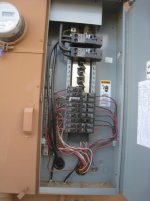
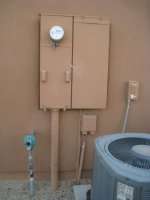
here are my panels. the main panel outside has 2 200a breakers in it.

one feeds that main panel breakers and the other feeds a 200a subpanel inside the house.

from you guys who are experienced at pulling big wires through conduit, is 2 1/2" pvc conduit enough to pull 3 250kcmil and 1 #2 ground 185 feet.

gee, maybe 3-4 of you guys could come over and do it for me, eh? ha

tom
 

Attachments

  • IMG_1996.JPG
    IMG_1996.JPG
    138.7 KB · Views: 44
  • IMG_1998.JPG
    IMG_1998.JPG
    123.4 KB · Views: 47
  • IMG_2006.JPG
    IMG_2006.JPG
    144.3 KB · Views: 160
  • IMG_2007.JPG
    IMG_2007.JPG
    134.4 KB · Views: 49
  • IMG_2030.jpg
    IMG_2030.jpg
    48.7 KB · Views: 58
  • IMG_2031.JPG
    IMG_2031.JPG
    133.1 KB · Views: 41

Norcal

Well-known member
Joined
Mar 16, 2008
Messages
13,754
Looks like your 200A subfeed is already in use. Your panel is a typical 400A all in one, 200A main for a distribution section, & a 2nd 200A main for a sub, not sure if 200A sub feed lug kit could be added as there is a limitation on the maximum amperes per bus stab in most loadcenters, & the print on the label does not display clearly enough to say it's OK or not.
 
Last edited:
To avoid these ads, REGISTER NOW!
Top Bottom