

You are using an out of date browser. It may not display this or other websites correctly.
You should upgrade or use an alternative browser.
You should upgrade or use an alternative browser.
2014 Garage sale thread!
- Thread starter Outlawmws
- Start date
- Status
- Not open for further replies.
Flatintoone
Well-known member
Nice stuff, guys! I can see the season is picking up all over the country.
Balane, what brand are the two pear-head ratchets in front of the anvil?
I had to leave work early this afternoon anyway, which just happened to let me hit an estate sale on the way home!
Was a pretty cool sale. The guy was apparently into old small engines and had them (and the machines they powered) of all kinds all over the place.
I'm not a vise expert by any means, but there was a Bico bolted to a workbench in the garage. Is this a good brand? I couldn't see any other markings on it. (Besides, it was out of my price range and I had no way of transporting the bench it was bolted to.)
What I did buy:

It's obviously incomplete, but for what I paid, I figured I could make something on its parts. At least the fence, miter gauge, and (not visible in the pic) the extension roller.
It's a 103.23831:

Found a manual online dated 1949; that's all the info I have on it at the moment.
Also got a BSA manual for 250s and 350s, but no pics yet.
The rest of the weekend looks pretty quiet...
Balane, what brand are the two pear-head ratchets in front of the anvil?
I had to leave work early this afternoon anyway, which just happened to let me hit an estate sale on the way home!
Was a pretty cool sale. The guy was apparently into old small engines and had them (and the machines they powered) of all kinds all over the place.
I'm not a vise expert by any means, but there was a Bico bolted to a workbench in the garage. Is this a good brand? I couldn't see any other markings on it. (Besides, it was out of my price range and I had no way of transporting the bench it was bolted to.)
What I did buy:

It's obviously incomplete, but for what I paid, I figured I could make something on its parts. At least the fence, miter gauge, and (not visible in the pic) the extension roller.
It's a 103.23831:

Found a manual online dated 1949; that's all the info I have on it at the moment.
Also got a BSA manual for 250s and 350s, but no pics yet.
The rest of the weekend looks pretty quiet...
G_P
Well-known member
Why would you say that? Many motors are listed for 50-60 cycle use. You get a different speed, but...
I was told by an electrician not to plug in an antique fan that was labeled 115v 50hz because it would damage the motor. Something about excess heat.
On anything that old you need to inspect all the wiring before plugging it in anyways. There is almost always cracked/missing insulation.
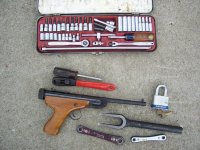
Dang you guys find some good stuff cheap. T4 I'm drooling on the flare nut crows feet and vise grips.  I don't post much in here, but thought I would share this. Had to go to the other side of town today for a training seminar, two sales down the street and $15 later, I can finally join the craftsman RHFT ratchet club. Not pictured is a stack of ~500, official 100 yard small bore rifle targets, to windy to get them in the pic.
I didn't specifically purchase the ratcheting wrenches or craftsman adjust a nut wrench. They were duct taped to the spinner and pickle fork.
I don't post much in here, but thought I would share this. Had to go to the other side of town today for a training seminar, two sales down the street and $15 later, I can finally join the craftsman RHFT ratchet club. Not pictured is a stack of ~500, official 100 yard small bore rifle targets, to windy to get them in the pic. I didn't specifically purchase the ratcheting wrenches or craftsman adjust a nut wrench. They were duct taped to the spinner and pickle fork.
Attachments
Last edited:
I was told by an electrician not to plug in an antique fan that was labeled 115v 50hz because it would damage the motor. Something about excess heat.
On anything that old you need to inspect all the wiring before plugging it in anyways. There is almost always cracked/missing insulation.
I'd agree with the second statement but not the first in most cases, (unless the motor is running to a major part of its HP capacity) and almost certainly not an issue in the case of your fan.
Motors: Changing between a 50 and 60Hz supply.
faq237-1224
Posted: 20 Mar 06 (Edited 9 Jul 06)
Due to the frequent questions about running motors at "the other frequency" this FAQ was created.
This FAQ is directed at other engineers and so will contain details the average user may not care about. You are invited to pay attention only to what is useful to you.
This FAQ applies to induction motors, both single, and polyphase. Single phase motors have an added aspect that will be discussed at the end of this FAQ.
AC motors are quite complex for all their functional simplicity - turn them on they spin.
There are a huge number of interacting relationships in a motor's design. There are first order, second order and probably even third order aspects that are all balanced to produce a dependable motor with the desired characteristics.
This FAQ will deal only with the First Order aspects.
These complexities include:
1) Rotational speed is a direct function of the power frequency.
2) Cooling is a direct function of rotational speed.
3) The magnetic capacity of the motor's magnetic(iron) circuit is designed to the relationship: voltage/frequency (V/f).
4) Back-emf decreases as a motor slows down.
5) Current increases with reduced back-emf.
Lets look at these complexities each in turn.
If you drop the frequency the motor will slow down.
If you raise the frequency the motor will speed up.
If the motor slows down it's cooling will drop (and at a faster rate then the slow down).
If the motor speeds up its cooling will increase rapidly.
If the frequency drops the V/Hz goes up. This means that the motor needs a larger magnetic circuit. Without it the magnetic circuit can saturate. This leads to a rapid increase in current draw and a corresponding large increase in temperature.(A motor's chief enemy)
If the frequency increases the V/Hz drops. This is not a first order consideration. [The motor may have a worse power factor.]
A motor is a device that 'wants' to turn at its designed speed, set by its designed operating frequency. It delivers the required horsepower(hp) the load needs when the load is spun at the motor's designed speed. Different loads change their hp demands in very different manners, depending on the type of load they are.
If a motor's load increases for some reason the motor will be slowed, this means the back-emf drops, this causes the motor to draw more current. More current is where the motor gets more power to turn the heavier load. Here the prudent motor user makes sure that the motor is pulling less current then the motor's full load amperage(FLA) rating.
If the load remains the same and the voltage is lowered the motor will draw more current to continue meeting the load's hp requirement. Remember the motor will still be running at the same speed since the frequency wasn't changed.
So looking at the case shifting a 50Hz motor to 60Hz duty.
a) It will turn 20% faster.
b) The cooling will increase dramatically.
c) The load's horsepower requirement will increase, possibly dramatically.
d) The V/f will drop which will not cause a current draw increase.
You should discuss what the load will do when sped up 20% with someone knowledgeable with that type of load. (Forum members are very knowledgeable in this aspect!)
If the load can take the speed increase then run the load and promptly check the motor's current draw. If it is under the FLA you should have no other problems.


madison069
Well-known member
I got some stuff today but it will be a little while before I post pictures! lol
Looking forward to everyone's purchases!
Looking forward to everyone's purchases!
davethorik
Well-known member
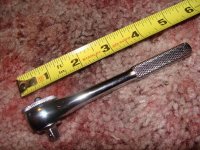
Picked these up yesterday. Reed #23-1/2 Utility Vise...of course I wanted a bigger vise but this one is just too cool. It weighs probably close to 30 lbs despite its small size, very beefy. Its like a big vise shrunk in the wash 
Proto Challenger 1060D 1/4 RHFT thumbwheel ratchet. I wasn't sure if this was USA made or not. From what I've found it is.
Proto Challenger 1060D 1/4 RHFT thumbwheel ratchet. I wasn't sure if this was USA made or not. From what I've found it is.
Attachments


I picked up these old greasy things this morning. I guess they are tools of some sort? Thinking of selling them and picking up some new things at harbor freight or sears.

I started to unload them


But I got tired and stopped.


Joking aside, I think both boxes are post war 1940s. One has the sticker and a slightly different tray than the other. I need to clean the heck out of both of them. Lots of grease and sawdust stuck to grease.

I started to unload them


But I got tired and stopped.


Joking aside, I think both boxes are post war 1940s. One has the sticker and a slightly different tray than the other. I need to clean the heck out of both of them. Lots of grease and sawdust stuck to grease.
davethorik
Well-known member
Dave, That's a nice vise! Usually that overall style has the exposed screw. That one has the Machinist's vise slide...
On your ratchet: how many teeth? That isn't what is usually associated with RHFT.
Thank you! That is why I bought the vise...the slide...it resembles my old Columbian 6" but the slide on that vise was 2 pieces, this is one forging...very HD, for its size. Here are a couple more pics of it to show the slide/bottom.
The ratchet I couldn't get an accurate count on clicks it makes but it is definitely a double pawl, 2 distinct clicks, somewhere above 80. I heard Stanley made this ratchet. It is NOS, never been used. I've read online it is 45 tooth but there are more clicks than that.
Attachments


Eight new stops this morning and went back to the one from yesterday that I got the Craftsman band saw for a few things, those pics later. Here is what I found this morning.
First stop that paid off, which was almost my last planned stop, go figure...I got the Holley fender cover, ziplock bag has Harley Davidson foot pegs in it, Klein nut driver set, Craftsman punches and extensions, carbide burr, Snap on punch, Williams wrench, tiniest Channel Lock hammer I have ever seen, tungsten electrodes, long Armstrong extension, the rest to the right is all Proto.

Next stop with anything was an Art Specialty Company lamp, heavy cast tape dispenser and a Montgomery Wards Western Field hunting jacket.

Wasn't satisfied so I went back to the estate sale from yesterday, pics coming.
First stop that paid off, which was almost my last planned stop, go figure...I got the Holley fender cover, ziplock bag has Harley Davidson foot pegs in it, Klein nut driver set, Craftsman punches and extensions, carbide burr, Snap on punch, Williams wrench, tiniest Channel Lock hammer I have ever seen, tungsten electrodes, long Armstrong extension, the rest to the right is all Proto.
Next stop with anything was an Art Specialty Company lamp, heavy cast tape dispenser and a Montgomery Wards Western Field hunting jacket.
Wasn't satisfied so I went back to the estate sale from yesterday, pics coming.
Well I am so excited the best is first!
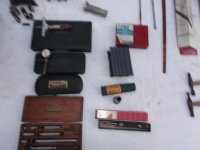
Gerstner 11 drawer leatherette machinists chest, I believe it is a model # 42 from the about 1950. Missing the front panel and the bottom drawer has issues. Belonged to Peter J. Ziegelmeier, Instrument Maker. FULL of machinists tools, mostly Starrett with some Brown and Sharpe, Lufkin, Fleming Machine Co micrometers that are apparently pre-1929, Lufkin, General Hardware and others. Many I have no clue what they are for. I will let the pictures do the talking!
Gerstner 11 drawer leatherette machinists chest, I believe it is a model # 42 from the about 1950. Missing the front panel and the bottom drawer has issues. Belonged to Peter J. Ziegelmeier, Instrument Maker. FULL of machinists tools, mostly Starrett with some Brown and Sharpe, Lufkin, Fleming Machine Co micrometers that are apparently pre-1929, Lufkin, General Hardware and others. Many I have no clue what they are for. I will let the pictures do the talking!
Attachments



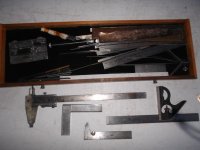
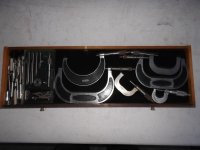

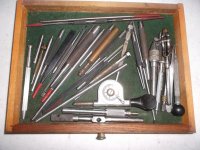
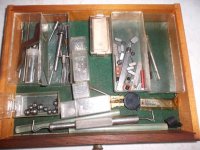
bigcaddy
Well-known member
Nice find, Bluebolt.
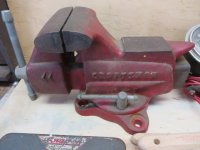
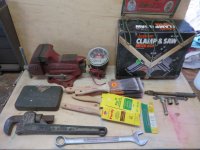
I haven't posted in this thread in a while but today i was finally able to get out and hit some sales. This is the result of 3 sales on the same cul de sac.
Craftsman vise
Jorgensen miter clamp, NIB
handful of Purdy paint brushes
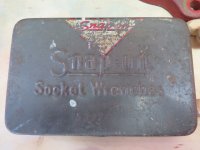
1939 Snap on Socket Wrench box set, complete with original decal. 5.00
Plomb wrench and socket
Snap on Ferret 3/8" ext
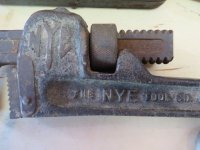
NYE pipe wrench, never seen that brand before
Craftsman combo wrench
screw extractor
old RPM gauge
Boot rack, on top of Jorgensen clamp, for rubber waders/boots
The snap on stuff came from a 90 year old lady that was getting rid of tons of neat stuff. The kit is in near mint condition! She also had old watches and a matched pair of Gillette TTO Fatboy razors, like new from the 60's.
I haven't posted in this thread in a while but today i was finally able to get out and hit some sales. This is the result of 3 sales on the same cul de sac.
Craftsman vise
Jorgensen miter clamp, NIB
handful of Purdy paint brushes
1939 Snap on Socket Wrench box set, complete with original decal. 5.00
Plomb wrench and socket
Snap on Ferret 3/8" ext
NYE pipe wrench, never seen that brand before
Craftsman combo wrench
screw extractor
old RPM gauge
Boot rack, on top of Jorgensen clamp, for rubber waders/boots
The snap on stuff came from a 90 year old lady that was getting rid of tons of neat stuff. The kit is in near mint condition! She also had old watches and a matched pair of Gillette TTO Fatboy razors, like new from the 60's.
Attachments



I went back to the estate sale from yesterday to see if the other band saw was there, luckily it was and I had more time/space to look it over. It's an Ohio Forge, came with the gear box for wood/metal and a couple miter gauges. It was 25% off today but I plugged it in and found out the switch was broke so I made a 50% off offer. The seller responded with a 33% off offer and I countered with "throw in the pliers" and we shook hands. I ended up buying the lab beaker stand after loading the band saw to repurpose as a paint gun holder.


Nice find, Bluebolt.
I haven't posted in this thread in a while but today i was finally able to get out and hit some sales. This is the result of 3 sales on the same cul de sac.
Craftsman vise
Jorgensen miter clamp, NIB
handful of Purdy paint brushes
1939 Snap on Socket Wrench box set, complete with original decal. 5.00
Plomb wrench and socket
Snap on Ferret 3/8" ext
NYE pipe wrench, never seen that brand before
Craftsman combo wrench
screw extractor
old RPM gauge
Boot rack, on top of Jorgensen clamp, for rubber waders/boots
The snap on stuff came from a 90 year old lady that was getting rid of tons of neat stuff. The kit is in near mint condition! She also had old watches and a matched pair of Gillette TTO Fatboy razors, like new from the 60's.
id have had the fat boys off ya if they were in useable condition
I have been busy with other stuff but yes I have picked up a few scores lately. And today I found something that Beatcad does recently!
Spent two hours catching up on this thread time to go unload todays finds!
Just to tease Nine4GMC LOL.
Delta grinder stand and Craftsman table saw stand.
Attachments

G_P
Well-known member
Did pretty good today for only finding one good garage sale. Rest were just junk and kick knacks.
Started off with a pair of 1/2" and 3/4" Viega Pureflow PEX crimpers. $5 for both!

A brand new Allen made in USA 3/8" drive metric set for $5

A used and orange spraypainted Cougar made in USA 1/2" drive set. The 9/16 has been replaced with an SK socket. Got it for $5 too.

And a Proto adjustable (other side is orange spraypainted) That was thrown in free with the socket sets

Not a bad day at all!
Started off with a pair of 1/2" and 3/4" Viega Pureflow PEX crimpers. $5 for both!
A brand new Allen made in USA 3/8" drive metric set for $5
A used and orange spraypainted Cougar made in USA 1/2" drive set. The 9/16 has been replaced with an SK socket. Got it for $5 too.
And a Proto adjustable (other side is orange spraypainted) That was thrown in free with the socket sets
Not a bad day at all!
Just to tease Nine4GMC LOL.
Delta grinder stand and Craftsman table saw stand.
Damn it
More finds.
From the same sale as the Gerstner
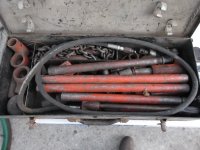
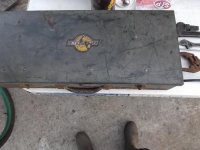
Hein Warner "Rescue Kit" porta power, the pump seems to be working, good enough for the price I paid.
Vintage Craftsman pipe wrench, Plomb adjustable wrench, Snap On flex allen driver probably for carburetor adjusting, Chicago Mfg plumbing adjustable wrench and Cal Hawk trim tool.
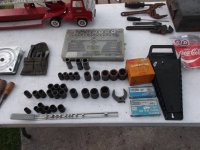
Estate sales finds that got mixed together LOL. 1960s Tonka hook and ladder fire truck, Union Carbide 6-12 "banned" insect repellent, 3-1 and WD-40, 2 USA lazy susan turntables, new air chisels in a 1945 ammunition pouch, Klein diagonal cutting pliers, Bruno circle cutter, Walden Spin Tite nut divers, Craftsman socket rack, Sears Taiwan metric and Craftsman USA SAE impact sockets, Craftsman complete tap and die set, Snap On 1 1/2" crowsfoot, Craftsman vintage glue sticks and Crown label staples and Craftsman wrench racks.
Yard sale Coca Cola, STP and other patches, can full of large ball bearings, Craftsman vintage soldering iron and two complete sets of Millers Falls A-Z letter stamps in different sizes.
Total outlay for the day was WAY over my limit with the Gerstner box purchase at about $400 total.
From the same sale as the Gerstner
Hein Warner "Rescue Kit" porta power, the pump seems to be working, good enough for the price I paid.
Vintage Craftsman pipe wrench, Plomb adjustable wrench, Snap On flex allen driver probably for carburetor adjusting, Chicago Mfg plumbing adjustable wrench and Cal Hawk trim tool.
Estate sales finds that got mixed together LOL. 1960s Tonka hook and ladder fire truck, Union Carbide 6-12 "banned" insect repellent, 3-1 and WD-40, 2 USA lazy susan turntables, new air chisels in a 1945 ammunition pouch, Klein diagonal cutting pliers, Bruno circle cutter, Walden Spin Tite nut divers, Craftsman socket rack, Sears Taiwan metric and Craftsman USA SAE impact sockets, Craftsman complete tap and die set, Snap On 1 1/2" crowsfoot, Craftsman vintage glue sticks and Crown label staples and Craftsman wrench racks.
Yard sale Coca Cola, STP and other patches, can full of large ball bearings, Craftsman vintage soldering iron and two complete sets of Millers Falls A-Z letter stamps in different sizes.
Total outlay for the day was WAY over my limit with the Gerstner box purchase at about $400 total.
more finds.
From the same sale as the gerstner
hein warner "rescue kit" porta power, the pump seems to be working, good enough for the price i paid.
Vintage craftsman pipe wrench, plomb adjustable wrench, snap on flex allen driver probably for carburetor adjusting, chicago mfg plumbing adjustable wrench and cal hawk trim tool.
Estate sales finds that got mixed together lol. 1960s tonka hook and ladder fire truck, union carbide 6-12 "banned" insect repellent, 3-1 and wd-40, 2 usa lazy susan turntables, new air chisels in a 1945 ammunition pouch, klein diagonal cutting pliers, bruno circle cutter, walden spin tite nut divers, craftsman socket rack, sears taiwan metric and craftsman usa sae impact sockets, craftsman complete tap and die set, snap on 1 1/2" crowsfoot, craftsman vintage glue sticks and crown label staples and craftsman wrench racks. Oh and a pennzoil made in usa counter stool.
Yard sale coca cola, stp and other patches, can full of large ball bearings, craftsman vintage soldering iron and two complete sets of millers falls a-z letter stamps in different sizes.
Total outlay for the day was way over my limit with the gerstner box purchase at about $400 total.
abcdefg
Attachments




Stihl 026 Powerhead - for parts ($30):

Baldor 1/2HP 7" Grinder - rough ($20):

5" Wilton Machinist Vise - has typical broken chunk under jaw ($100):

Mystery machine - it presses and heats up to 550 degrees. It might make a great hamburger ($5):

Large brass steam whistles ($10/ea):

NOS Weller D550 kit ($5):

20 ton bottle jack (Chinese) ($5) and little American Scale Vise ($5):

Diamond 15" and 18" set ($10), SK 1/4" ratchets ($1), MAC thumb ratchet ($1), SO pass thru ratchet ($3), old SK kit ($1), CM Pro screwdrivers ($2):

Chrome RR track ($1), Coleman Fuel (free), CM gear puller ($1), Large Wiss snips ($1), oil filter wrench ($1):

Trio of Master Heat Guns (one is DOA) ($12):

Robinair AC kit ($5):


1/2 a bucket of Borax (free) - needs declumpified:

Baldor 1/2HP 7" Grinder - rough ($20):
5" Wilton Machinist Vise - has typical broken chunk under jaw ($100):
Mystery machine - it presses and heats up to 550 degrees. It might make a great hamburger ($5):
Large brass steam whistles ($10/ea):
NOS Weller D550 kit ($5):
20 ton bottle jack (Chinese) ($5) and little American Scale Vise ($5):
Diamond 15" and 18" set ($10), SK 1/4" ratchets ($1), MAC thumb ratchet ($1), SO pass thru ratchet ($3), old SK kit ($1), CM Pro screwdrivers ($2):
Chrome RR track ($1), Coleman Fuel (free), CM gear puller ($1), Large Wiss snips ($1), oil filter wrench ($1):
Trio of Master Heat Guns (one is DOA) ($12):
Robinair AC kit ($5):
1/2 a bucket of Borax (free) - needs declumpified:
Well Bluebolt, since you aren't sure what all these are for, I be happy to take the assorted C clamps you have from 1" to looks like 6" off your hands, and those two tack hammers with the rounded ends, - don't know how those ever got past QC. also the specialized non-adjustable gear puller in pic 5...
I know what you mean about "over the limit" the past few weeks has been almost "normal" where I've averaged around $20 a week or so. My overall average had climbed the last year or so to nearly $50 (From some large buys of complete tool boxes, and a few high dollar tools), and now its tapering off under $40. This is over about a three year period.
I know what you mean about "over the limit" the past few weeks has been almost "normal" where I've averaged around $20 a week or so. My overall average had climbed the last year or so to nearly $50 (From some large buys of complete tool boxes, and a few high dollar tools), and now its tapering off under $40. This is over about a three year period.
Flatintoone
Well-known member
Three planned garage sales today. First one was a 'retired contractor's sale', couldn't find the second one, and I spent less than a minute at #3 when I realized it was typical garage sale junk.
Spent $30 for all this:

Starting from the upper left, 2 Craftsman 1/4" breaker bars (one =v=, one -v-), Craftsman 1/4" =v= sliding t-handle, <SK> speeder, 3/8" SK and 1/2" Craftsman =v= universals, Ward Master 1/2" extension, Klein crimping/splicing tool, Craftsman DOE, 1st of 2 Irwin Robertson drivers, Indestro Super 3/8" breaker bar, Diamond 8" adjustable, MasterPro USA ratchet, second Irwin driver, McKaig-Hatch DBE, SK Lectrolite DBE, MAC flex socket wrench, a ratcheting Rosco screwdriver, Armstrong speeder, 2 Wardmaster short DBEs (obviously Barcalo-made), and sockets by Armstrong, Powr-Kraft, and Craftsman.
Spent $30 for all this:

Starting from the upper left, 2 Craftsman 1/4" breaker bars (one =v=, one -v-), Craftsman 1/4" =v= sliding t-handle, <SK> speeder, 3/8" SK and 1/2" Craftsman =v= universals, Ward Master 1/2" extension, Klein crimping/splicing tool, Craftsman DOE, 1st of 2 Irwin Robertson drivers, Indestro Super 3/8" breaker bar, Diamond 8" adjustable, MasterPro USA ratchet, second Irwin driver, McKaig-Hatch DBE, SK Lectrolite DBE, MAC flex socket wrench, a ratcheting Rosco screwdriver, Armstrong speeder, 2 Wardmaster short DBEs (obviously Barcalo-made), and sockets by Armstrong, Powr-Kraft, and Craftsman.
Nine, are you picking out of my garage when I'm not looking? I have (had?) 2 of the Holley fender protectors: bought them new back in the day. Also the Tape dispenser, (great for 1" masking tape) and of course the Proto wrenches...
Possibly
Baldor 1/2HP 7" Grinder - rough ($20):
Mystery machine - it presses and heats up to 550 degrees. It might make a great hamburger ($5):
Trio of Master Heat Guns (one is DOA) ($12):
You **** on that Baldor! May not want to put hamburgers on that press just yet, check the listing.

http://www.ebay.com/sch/i.html?_sacat=0&_from=R40&_nkw=arbe+vulcanizer&=&rt=nc&LH_ItemCondition=4
Good score on those heat guns too, heavy duty and good for lots of things!
Everyone's hitting it big this weekend!
Everyone except me: I didn't even spend a whole $20 today...

Mostly the FM and one yard sale made the day. Everything else was a bust... Anyway, here are my little saves:
Fleamarket:
A Proto 3/4 drive 3/4" and SO 3/8 drive for a buck; Plvmb 3/8 extension cents fifty; SK socket cents fifty; and a buck on the Ford wrench.
Still the FM, and all one guy: A Proto LA pebble, an Armstrong, a Milwaukee Blue Point 12 oz BP, SO deep, a Unibit and a pair of Blackhawk radiator clamp pliers; $5
and the Yard sale:
I dug this stuff out of an fairly well thrashed red Kennedy carry box and it's tray
2 Indestro sockets, a Cornwell deep, a small magnet socket; this is different: an Chevron socket! 2 SK's, and a Proto socket. A Stanley No. 95 marking gauge made in Can., A Wood Chisel that came in tow parts, in two different areas of the tool box, and some no. 30 drills that I think may fit push drills, or small Stanley Yankee drivers.
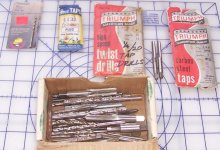
And Lastly a box full of drills and Taps, It's likely the drills are all tap drills for the sizes of the taps.
$7 for all at the one garage sale.
Attachments

jakemac
Well-known member
madison069
Well-known member
Today's deal, I stopped at two estate sales and both was pretty good! I ended up spending more then I wanted today but I got a good deal so I might shift through my collections and start putting some up for sell to get my money back later. All together I spent $80 for it all
First is the near perfect crown top toolbox Full of tool!!! In the box was a complete set of box end wrench! A Craftsman clamp plier and a fuller adjustable.

Hex wrench, crown top logo.

some Industro wrenches and socket sets that are USA made
and a Oximum? home tool kit, ( will have to double check the brand) and sears metric open end wrench.

Found a old map of Pittsburgh and two dollar in the pouch!

That was all in the tool box, gave $20 for it all.
Husky USA metric six point sockets, permanent markers red and blue just about full boxes, all of the spray items, Stanley wood chisel and Armstrong screwdrivers!

Roloc disc, and a star scotch brite pad kit looks to be unused for die angle grinders, gun cleaning solution and grease

CD's, wheel chock, Craftsman 1/2" drive ratchet, 1/2"to 3/8" adaptor, and a 10ft crown top logo tape measure

My first set of Armstrong tools I think, these are brand new it looks like.

I also go 3 fishing poles and 2 spinner reel for $20.
The sad thing about these two estate sales, was one was a older gentleman that had passed away it appears, possible 80-90 yrs old based on the paper that was in the toolbox. The other sell that had the roloc and star disc, Armstrong screwdriver, appears to have been a young guy that passed away. Just makes me realize time is short here no matter what anyone says.
First is the near perfect crown top toolbox Full of tool!!! In the box was a complete set of box end wrench! A Craftsman clamp plier and a fuller adjustable.
Hex wrench, crown top logo.
some Industro wrenches and socket sets that are USA made
and a Oximum? home tool kit, ( will have to double check the brand) and sears metric open end wrench.
Found a old map of Pittsburgh and two dollar in the pouch!
That was all in the tool box, gave $20 for it all.
Husky USA metric six point sockets, permanent markers red and blue just about full boxes, all of the spray items, Stanley wood chisel and Armstrong screwdrivers!
Roloc disc, and a star scotch brite pad kit looks to be unused for die angle grinders, gun cleaning solution and grease
CD's, wheel chock, Craftsman 1/2" drive ratchet, 1/2"to 3/8" adaptor, and a 10ft crown top logo tape measure
My first set of Armstrong tools I think, these are brand new it looks like.
I also go 3 fishing poles and 2 spinner reel for $20.
The sad thing about these two estate sales, was one was a older gentleman that had passed away it appears, possible 80-90 yrs old based on the paper that was in the toolbox. The other sell that had the roloc and star disc, Armstrong screwdriver, appears to have been a young guy that passed away. Just makes me realize time is short here no matter what anyone says.
jakemac
Well-known member
Geesh, you guys are killin' it today. All I found out of 3 sales was a big azz Lobsta Pot. (if you knew anything about New England - NOBODY sells a lobster pot !) I may have to travel to the flea markets tomorrow to console myself.
Mr. Brooks
Well-known member
- Joined
- Dec 11, 2012
- Messages
- 311
Couple community sales today. All stunk except one sale...guy had to downsize tools and wife was pushing him...
Jet 1.5 HP 20" DP with production table - barely used just dirty
Dewalt 7" angle grinde - brand new
Bosch 4.5" angle grinder - brand new
Bosch 1/2" VSR Hammer Drill - brand new
Bosch metal/wood digital detector - brand new
Delta 10" compound miter
100ish ft 12/2 Romex
Laser plumb/square/chalkline - brand new
All for $140..... It was a good day for a tool junkie.
Jet 1.5 HP 20" DP with production table - barely used just dirty
Dewalt 7" angle grinde - brand new
Bosch 4.5" angle grinder - brand new
Bosch 1/2" VSR Hammer Drill - brand new
Bosch metal/wood digital detector - brand new
Delta 10" compound miter
100ish ft 12/2 Romex
Laser plumb/square/chalkline - brand new
All for $140..... It was a good day for a tool junkie.
Last edited:
Jim_No_Garage
Well-known member
I spent yesterday and today at a number of sales in the area and picked up a bunch of stuff.
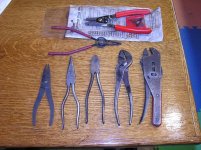
First up various pliers:
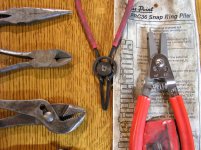
The pair on the right are BMC MFG CO No-9 Pliers - sort of similar to Vise Grips. Across the top are some BP Snap Ring Pliers and some pliers I don't recognize - they were in the pouch with the Snap Ring Pliers. They are marked FS T-1 - Piston ring pliers?
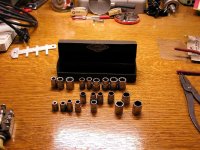
I grabbed this SK 1/4 set without realizing that it was where 8 points sockets went to die! Nice box though.
I picked up a cool old looking automotive pull switch.
I spent about 20 minutes talking to a WWII / Cold War veteran about some of his service and experiences. When we were done I asked him for the price on the Snappy Stubby and he said "No Charge" - I thanked him for talking to me and shook his hand. The greatest generation for sure.
I picked up a Indestro 1/2 ratchet, 2 Snap On sockets, 2 Chinese Vix bits, a Stanley spokeshave, a full Drill Index and a router bit depth gauge. I also picked up a 3Com hub and a sump pump float switch (not pictured).
I also grabbed a HEAVY articulated desk lamp - similar to a Dazor.
All in for $50 over the 2 days.
First up various pliers:
The pair on the right are BMC MFG CO No-9 Pliers - sort of similar to Vise Grips. Across the top are some BP Snap Ring Pliers and some pliers I don't recognize - they were in the pouch with the Snap Ring Pliers. They are marked FS T-1 - Piston ring pliers?
I grabbed this SK 1/4 set without realizing that it was where 8 points sockets went to die! Nice box though.
I picked up a cool old looking automotive pull switch.
I spent about 20 minutes talking to a WWII / Cold War veteran about some of his service and experiences. When we were done I asked him for the price on the Snappy Stubby and he said "No Charge" - I thanked him for talking to me and shook his hand. The greatest generation for sure.
I picked up a Indestro 1/2 ratchet, 2 Snap On sockets, 2 Chinese Vix bits, a Stanley spokeshave, a full Drill Index and a router bit depth gauge. I also picked up a 3Com hub and a sump pump float switch (not pictured).
I also grabbed a HEAVY articulated desk lamp - similar to a Dazor.
All in for $50 over the 2 days.
Attachments
-
 Sales_05_02_2014 (9) (Medium).jpg143.2 KB · Views: 47
 -
 Sales_05_02_2014 (8) (Medium).jpg151.1 KB · Views: 35
 -
 Sales_05_02_2014 (5) (Medium).jpg149.1 KB · Views: 36
 -
 Sales_05_02_2014 (4) (Medium).jpg142.8 KB · Views: 31
 -
 Sales_05_02_2014 (2) (Medium).jpg153.3 KB · Views: 1,109
 -
 Sales_05_02_2014 (1) (Medium).jpg150.7 KB · Views: 36
 -
 Sales_05_02_2014 (11) (Medium).jpg123.6 KB · Views: 36
t4runner
Well-known member
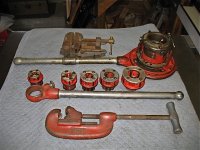
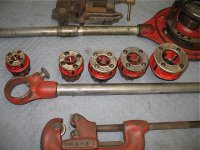
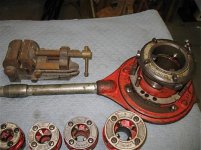
I usually don't buy plumbing tools. I have had a hard time reselling them in the past. But and theres always a but, I got all this for $25. I guess I couldn't pass them up. Thats a Craftsman machine vise in the back.
Attachments

jeffmoss26
Well-known member
Damn, some great finds guys! For 25 bucks I would not pass up all that Ridgid stuff either!
Well Bluebolt, since you aren't sure what all these are for, I be happy to take the assorted C clamps you have from 1" to looks like 6" off your hands, and those two tack hammers with the rounded ends, - don't know how those ever got past QC. also the specialized non-adjustable gear puller in pic 5...
I know what you mean about "over the limit" the past few weeks has been almost "normal" where I've averaged around $20 a week or so. My overall average had climbed the last year or so to nearly $50 (From some large buys of complete tool boxes, and a few high dollar tools), and now its tapering off under $40. This is over about a three year period.
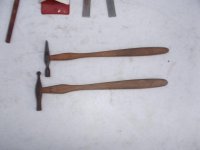
LOL the "C-clamps" are mostly Fleming Machine Works micrometers, the tiny hammers have "Watter" stamped on the heads and the "gear puller" happens to fit on the Starrett V-block in that picture.
mattblast
Well-known member
Two sales today at the end of the day. First sale didn't have much so I dug around in basement and garage to find something. Here is what I got for $7

Gallon of kerosene. Normally I wouldn't buy it out if original container but it was full and clean and smelled like kerosene.
Coffee can of marbles
Stack of large trash bags
Hammer head
PVC 1.5" fittings
7mm bonney wrench
Pile of lamp plugs
Toothbrushes (for cleaning) I went through 2 last week and was down to my last few.
Fisher scientific lab stand clamp
1/2" hole punch
Two copper bullets with lead tips. No clue on use.
5 tined "trident"
Some close ups.


Tip- don't transport liquids when bottle isn't upright! Trash bags got some kerosene on them.
Second sale was full of tools and this was an hour before closing on second day. After making a pile I realized why - the company conducting the sale were the no negotiations type. I've been to one of their sales before and left empty handed in anger vowing to never go again. Guess I didn't notice their name in the listing. Fortunately the seller was in a better mood and there was a little room to negotiate. I employed my favorite trick to reduce cost which was to make a big pile and get bundle price then ask for less. When they refuse I pull out the largest item and ask how much was this (it was $30). Then I remove it and pay $30 less. Here is what I got for $30. Would have been $60 with a grinder arbor which was worth $10.

Two hammers unknown brand
1.75" chisel can't make out brand
1.75" gouge can't make out brand


Bucket (for shopping at sale I always end up with a bucket)
http://img.tapatalk.com/d/14/05/04/by3y5epe.jpg[/IMG
[IMG]http://img.tapatalk.com/d/14/05/04/eheby3ys.jpg
General drill sharpener
3/4" pipe tap
4 craftsman punches
General 6" machinist rule

More lab clamps. Odd they turned up. Funny thing is other clamp I bought was missing attachment piece which I got at this sale.

Snap on 1/4" set

Red devil glass? Pliers
Utica duck bill pliers
Hand vise
Odd calipers

Self centering?

Pipe organ pipe.

Son asked seller what it was. He replied "musical instrument". I spent some time inside a grand pipe organ and recognized it immediately.

Dolly. Can never have too many. My other two are in use under heavy items.
And my favorite was this lamp. He was asking $20 for it so I was surprised when he took $30 for all.

Danzer articulating lamp with base. 6' tall
And an update on the drill press I bought a few months ago. Finally got around to the restoration. Here is progress.

Paint drying on second head

Parts degreased (in kerosene) awaiting wire wheel and assembly
First head back on press. I'll post separately about this project.
Gallon of kerosene. Normally I wouldn't buy it out if original container but it was full and clean and smelled like kerosene.
Coffee can of marbles
Stack of large trash bags
Hammer head
PVC 1.5" fittings
7mm bonney wrench
Pile of lamp plugs
Toothbrushes (for cleaning) I went through 2 last week and was down to my last few.
Fisher scientific lab stand clamp
1/2" hole punch
Two copper bullets with lead tips. No clue on use.
5 tined "trident"
Some close ups.
Tip- don't transport liquids when bottle isn't upright! Trash bags got some kerosene on them.
Second sale was full of tools and this was an hour before closing on second day. After making a pile I realized why - the company conducting the sale were the no negotiations type. I've been to one of their sales before and left empty handed in anger vowing to never go again. Guess I didn't notice their name in the listing. Fortunately the seller was in a better mood and there was a little room to negotiate. I employed my favorite trick to reduce cost which was to make a big pile and get bundle price then ask for less. When they refuse I pull out the largest item and ask how much was this (it was $30). Then I remove it and pay $30 less. Here is what I got for $30. Would have been $60 with a grinder arbor which was worth $10.
Two hammers unknown brand
1.75" chisel can't make out brand
1.75" gouge can't make out brand
Bucket (for shopping at sale I always end up with a bucket)
http://img.tapatalk.com/d/14/05/04/by3y5epe.jpg[/IMG
[IMG]http://img.tapatalk.com/d/14/05/04/eheby3ys.jpg
General drill sharpener
3/4" pipe tap
4 craftsman punches
General 6" machinist rule
More lab clamps. Odd they turned up. Funny thing is other clamp I bought was missing attachment piece which I got at this sale.
Snap on 1/4" set
Red devil glass? Pliers
Utica duck bill pliers
Hand vise
Odd calipers
Self centering?
Pipe organ pipe.
Son asked seller what it was. He replied "musical instrument". I spent some time inside a grand pipe organ and recognized it immediately.
Dolly. Can never have too many. My other two are in use under heavy items.
And my favorite was this lamp. He was asking $20 for it so I was surprised when he took $30 for all.
Danzer articulating lamp with base. 6' tall
And an update on the drill press I bought a few months ago. Finally got around to the restoration. Here is progress.
Paint drying on second head
Parts degreased (in kerosene) awaiting wire wheel and assembly
First head back on press. I'll post separately about this project.
- Status
- Not open for further replies.