To avoid these ads, REGISTER NOW!

20A or 30A circuit for small workshop area?

ImmDanny

Well-known member
Joined
Jan 9, 2020
Messages
61
Location
Arizona
Recently built a small structure on the back corner of my house near my 4 post lift that I intend to use as a workshop. It’s only about 100sqft so nothing crazy, just some place to store my tools, have a nice workbench to work on things and what not.

There are no outlets outside at all really, so nothing to tap into. I’ll have to add a new circuit to this area, and don’t know if I should go with 20A or 30A.

Really I don’t use much that plugs in. Only thing I use currently is a pancake compressor (rarely), shop vac (rarely) and mostly just charge my M18 batteries and have 2 cars on battery tenders. The shop will never be used for woodworking as it’s just too small to fit any sheet goods or to cut anything longer than 6’ or so. I use a circular so far all my wood cutting currently.

So should I go 20 or 30? My breaker box is on the exact opposite side of the house, so it’ll be a long run (planning on going through attic to save on wire) but regardless I’ll be getting 250’ of either 12 or 10 gauge depending on which amperage I go with. I know the general rule of thumb is to always go bigger if financially possible, I just don’t know if in my case it’s worth the extra cost. I have no plans to add any bigger equipment to this area just because there isn’t the room to do so.
 
To avoid these ads, REGISTER NOW!

brownbagg

Well-known member
Joined
Mar 20, 2006
Messages
5,208
15 for overhead light, 20 for plugin, 30 for light 240, 50 for heavy 240 like welders
 

Don1357

Well-known member
Joined
Apr 15, 2019
Messages
948
Location
Palmer, AK
Are you just wiring outlets or putting a small breaker box?

If just putting outlets 20 amps would do it. If you wanna future proof the area go with 10 gauge and a small breaker box. If you ever need 220v you'll be glad you did.

Heck on the cheap you could wire your main run with 10 gauge to a junction box and finish the outlets in 12 gauge. That way if need be you can upgrade to a breaker box later. You would have to use a 20 amp breaker.
 

WisJim

Well-known member
Joined
Dec 20, 2010
Messages
2,265
Location
Menomonie, WI
If the circuit is 250 feet, you need bigger than 10awg cable even for a 20 amp circuit. Also if you are running 240 volt a 30 amp circuit is lots of power for a small shop as described
 

nadogail

Well-known member
Joined
Jan 23, 2009
Messages
31,925
Location
Coronado, CA
IMHO, You might want lights and a small heater for those chill mornings. A coffee pot will be nice too, as I recall the Grand Canyon State gets Chilly in the Winter.

30 Amps if you can swing it.
 

infinkc

Well-known member
Joined
Jan 19, 2012
Messages
862
if you dont have plans to weld, or use more than hand power tools 20a is all i would do. Only issue i see is 250' is too long for 12ga for a 20a circuit, you are looking like 6ga i think to make it work.
 
OP
I

ImmDanny

Well-known member
Joined
Jan 9, 2020
Messages
61
Location
Arizona
It’ll really just be for a handful of outlets and lights in the shop. I don’t think the main breaker box amperage is enough to install a sub panel, really I only have enough to add one more circuit if it’s 20A, or I have 30A circuit that doesn’t currently go to anything (used to be stove top).

Also the run won’t be 250’, that’s just the amount of cable I’d be getting because I believe a 100’ roll wouldn’t be enough for the initial run plus all the routing I’d have to do to place outlets and lights. Sorry for the confusion on that part.
 

Don1357

Well-known member
Joined
Apr 15, 2019
Messages
948
Location
Palmer, AK
If it is sharing a wall with the house and said wall has an outlet it is not hard to install an outlet from that drop on the outside part of the wall.
 

MoonRise

Well-known member
Joined
Nov 5, 2010
Messages
4,028
Location
NJ
Gee, I wish I had installed a smaller electrical service/panel instead of the bigger one.

Said NO ONE.

EVER.

If all you have is a 20 amp 120V circuit, you can use some handheld type electrical devices. A corded drill, a plug-in fan, a few lights and you are pretty much already maxed out.

Think about it, your kitchen countertop outlets in the house are required to have TWO separate 20 amp 120V circuits just for the countertop appliances.

Put in a 30 amp 240V panel and now you can run some bigger types of tools. A small-medium welder maybe. A small-medium plasma cutter. A small-medium (about 11 CFM @ 90 psi) air compressor to run some air tools. Plus some lights, and a drill or sander, etc.

:beer:
 
OP
I

ImmDanny

Well-known member
Joined
Jan 9, 2020
Messages
61
Location
Arizona
Gee, I wish I had installed a smaller electrical service/panel instead of the bigger one.

Said NO ONE.

EVER.

If all you have is a 20 amp 120V circuit, you can use some handheld type electrical devices. A corded drill, a plug-in fan, a few lights and you are pretty much already maxed out.

Think about it, your kitchen countertop outlets in the house are required to have TWO separate 20 amp 120V circuits just for the countertop appliances.

Put in a 30 amp 240V panel and now you can run some bigger types of tools. A small-medium welder maybe. A small-medium plasma cutter. A small-medium (about 11 CFM @ 90 psi) air compressor to run some air tools. Plus some lights, and a drill or sander, etc.

:beer:


Ok this will probably make me sound like I have no clue what I’m doing, and I promise I know how to add a basic new circuit. However I do not know what the differences are when adding a sub panel.

Could I create a sub panel off of just a 30 amp or 40 amp breaker? How many circuits could I then have on that subpanel?

I guess part of the reason I was thinking of just adding one circuit is because that’s all I know how to do.
 

Stuart in MN

Well-known member
Joined
Sep 8, 2005
Messages
23,036
Location
Minneapolis
For the moment forget about the amperage - are you talking about running 120vac or 240vac to the workshop? That hasn't been mentioned yet.
 
OP
I

ImmDanny

Well-known member
Joined
Jan 9, 2020
Messages
61
Location
Arizona
For the moment forget about the amperage - are you talking about running 120vac or 240vac to the workshop? That hasn't been mentioned yet.


120V, really all I had in mind was plugs and lights and that’s it. I don’t have any 240V tools, I don’t know how to weld so don’t see my self getting a welder anytime soon, don’t do fabrication of any sort really. The shop is too small to do any sort of wood working so wouldn’t be getting a miter saw, table saw, planer or joiner. The only things I can see myself getting are small bench top drill press and bandsaw and possibly a sander. If anything at least the drill press because there have been plenty of times I could’ve used one.
 
OP
I

ImmDanny

Well-known member
Joined
Jan 9, 2020
Messages
61
Location
Arizona
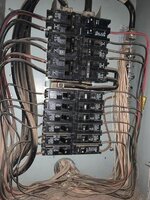
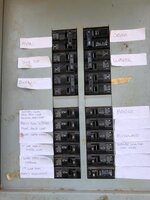
This is my current breaker box by the way. One thing I didn’t mention was I’d have to add a tandem breaker, I don’t have an open breaker slot currently. For the 30A, I’d use the existing one that was for the stove top. In this picture it’s still on but I’ve since turned it off as the stove didn’t work and the 50A breaker now powers the range.

f85d61fa7e829ba701652034e8d3489b.jpgfad00db43bc2df29aed0fcf0497f7f3e.jpg
 

Attachments

  • f85d61fa7e829ba701652034e8d3489b.jpg
    f85d61fa7e829ba701652034e8d3489b.jpg
    24.6 KB · Views: 0
  • fad00db43bc2df29aed0fcf0497f7f3e.jpg
    fad00db43bc2df29aed0fcf0497f7f3e.jpg
    42.6 KB · Views: 0

Denwood

Well-known member
Joined
Sep 22, 2014
Messages
4,183
Location
Thunder Bay, Ontario, Canada
My shop is on a 30amp sub and has been just fine. Lots of power. The only downside is that we just purchased an EV, which can charge 240V@28 amps. Not doable on a 30 amp panel. Not a biggy (we only need 2-3 hours at night on 120V@16amps to charge given our driving needs), but something to think about.
 
OP
I

ImmDanny

Well-known member
Joined
Jan 9, 2020
Messages
61
Location
Arizona
My shop is on a 30amp sub and has been just fine. Lots of power. The only downside is that we just purchased an EV, which can charge 240V@28 amps. Not doable on a 30 amp panel. Not a biggy (we only need 2-3 hours at night on 120V@16amps to charge given our driving needs), but something to think about.


So how many circuits do you have on your 30amp sub panel? What else do you have in your shop that’s hooked up to it?
 

Don1357

Well-known member
Joined
Apr 15, 2019
Messages
948
Location
Palmer, AK
Could I create a sub panel off of just a 30 amp or 40 amp breaker? How many circuits could I then have on that subpanel?
.

Yes you can and funny enough the number of circuits have little to do with the amperage that the box can handle. Within reason. It is easier to run out of slots than power.

If you are going to run power tools, you want to run your lights on a separate breaker. 15 amps/14 gauge would do just fine for that. This way when your power tool trips its breaker you are not going to be left in the dark holding a tool still spinning. Right there is one for lights, one for outlets. Then it would be smart to have 2 slots open in case you want to run a 240v circuit, for heater, or a welder, or a compressor, you name it.

So far that's 4 slots, so a six slot breaker box would do and if the price doesn't change much, no point on not getting the 8 or 10 slot box.
 
To avoid these ads, REGISTER NOW!

Moss

Well-known member
Joined
Dec 21, 2013
Messages
148
Location
Ontario Canada
Do you have any circuits that aren't using much mower on that side of the house? Maybe some lighting circuit that now uses all LEDs or something that isn't using anywhere near breaker capacity? You could just get power there and make an outside plug on house and run some cable from it to shed?

Of course running a real dedicated circuit is ideal but it seems like you are trying to keep it simple
 

Stuart in MN

Well-known member
Joined
Sep 8, 2005
Messages
23,036
Location
Minneapolis
120V, really all I had in mind was plugs and lights and that’s it. I don’t have any 240V tools, I don’t know how to weld so don’t see my self getting a welder anytime soon, don’t do fabrication of any sort really. The shop is too small to do any sort of wood working so wouldn’t be getting a miter saw, table saw, planer or joiner. The only things I can see myself getting are small bench top drill press and bandsaw and possibly a sander. If anything at least the drill press because there have been plenty of times I could’ve used one.

On a 120vac 30 amp circuit from the house to a subpanel in the workshop, you could safely have a couple 20 amp circuits in the subpanel.
 

510ebl

Well-known member
Joined
Jan 20, 2015
Messages
518
Location
Southern New Jersey
Not sure why you (we) are hung up on 30 amps.

Replace the 30a breaker that is unused in the main panel and install whatever you want. Go big or go home :) (J/K)

An 8 bay sub panel with a 60a breaker (or whatever the main will handle) gives you:

1- Lights in the room
2, 3, and 4- dedicated receptacles
5 and 6 for 240v for the future
7 for an exterior receptacle or two and lights facing the lift
8 is a spare for when you install the heater or air conditioner

This is overkill of course, but gives you loads of capacity for not a lot more money or work.
 
Last edited:

Denwood

Well-known member
Joined
Sep 22, 2014
Messages
4,183
Location
Thunder Bay, Ontario, Canada
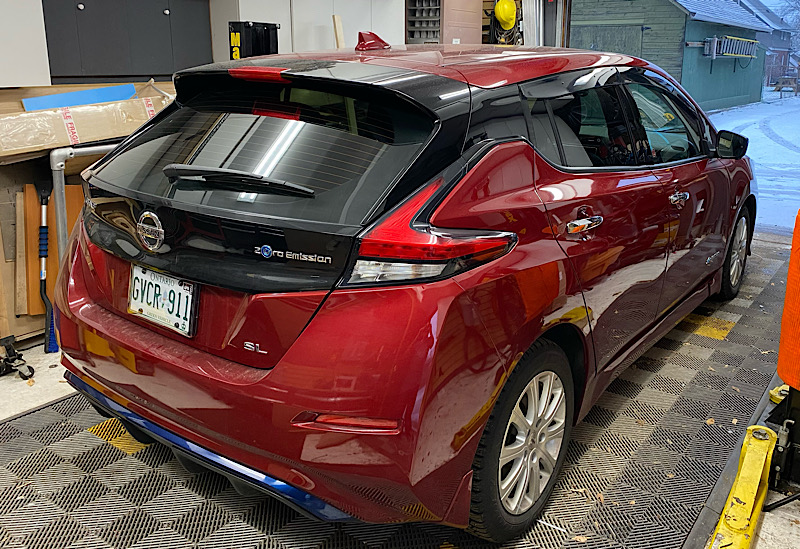
Denwood....Well....what kind of EV auto did you buy?

2018 Leaf SL..nothing **** but it works.

20201122_2.jpg


This is why you may want 50 amps to your shop. If you plan an EV anytime soon (and you should, cuz they're awesome), the EVSE power units (you plug the car in using them, but not all manufacturers/trim levels include them) will have 120V or 240V options. The Nissan OEM EVSE that came with my LEAF SL will add about 5 miles of range every hour at 120V@12 amps, or 35 miles of range every hour at 240V@28 amps. If you don't drive much, no problem. If you commute a lot, you'll likely want more juice.

You can also buy aftermarket EVSE units, so I've got one that will charge at 120V@16 amps, or 240V@16 amps. This works fine on my 30 amp feed, however at some point I may upgrade to 50 amps.
 

Terry D

Well-known member
Joined
Mar 25, 2015
Messages
2,202
Location
St. Louis, MO.
I havent read the whole thread, but it looks like you are out of space in your main panel. Unless you can free up some space or the panel accepts tandems, you are probably looking at a sub panel or a main panel replacement before you can do anything. The minimum circuits that you can have in a garage is 2. You have to have a 120 volt 20 amp dedicated circuit for the receptacles, lighting can not be on that circuit. I guess it all depends if this is considered a garage. Is this structure attached to the house?


Edit - just read you post. Looks like you have space. If you plan on heating and cooling this. I would go with a small sub panel
 
Last edited:

TractorJeff

Well-known member
Joined
Dec 8, 2013
Messages
3,309
Location
Elkhorn, WI
Recently built a small structure on the back corner of my house near my 4 post lift that I intend to use as a workshop. It’s only about 100sqft so nothing crazy, just some place to store my tools, have a nice workbench to work on things and what not.

There are no outlets outside at all really, so nothing to tap into. I’ll have to add a new circuit to this area, and don’t know if I should go with 20A or 30A.

Really I don’t use much that plugs in. Only thing I use currently is a pancake compressor (rarely), shop vac (rarely) and mostly just charge my M18 batteries and have 2 cars on battery tenders. The shop will never be used for woodworking as it’s just too small to fit any sheet goods or to cut anything longer than 6’ or so. I use a circular so far all my wood cutting currently.

So should I go 20 or 30? My breaker box is on the exact opposite side of the house, so it’ll be a long run (planning on going through attic to save on wire) but regardless I’ll be getting 250’ of either 12 or 10 gauge depending on which amperage I go with. I know the general rule of thumb is to always go bigger if financially possible, I just don’t know if in my case it’s worth the extra cost. I have no plans to add any bigger equipment to this area just because there isn’t the room to do so.

The problem is, NO ONE READ YOU INITIAL THREAD! :lol_hitti
If all the answers actually related to a 10ft by 10ft Shed, then you would have the answer you truly need! Go ahead and run a 30 amp circuit out there. Then split it into 2 circuits, One for Lights and One for the Outlets you want.
This is Garage Journal where you go big or go home! :thumbup:
 

Terry D

Well-known member
Joined
Mar 25, 2015
Messages
2,202
Location
St. Louis, MO.
The problem is, NO ONE READ YOU INITIAL THREAD! [emoji38]_hitti
If all the answers actually related to a 10ft by 10ft Shed, then you would have the answer you truly need! Go ahead and run a 30 amp circuit out there. Then split it into 2 circuits, One for Lights and One for the Outlets you want.
This is Garage Journal where you go big or go home! [emoji106]
You really cant just split a 30 amp circuit into 2 circuits. Plus trying to put # 10 around the screws on devices is just crazy. You would need a #12 MWBC or a sub panel. If this is a detached stucture, you would also need a disconnecting means out there

Sent from my SM-G960U using The Garage Journal mobile app
 
Last edited:

Denwood

Well-known member
Joined
Sep 22, 2014
Messages
4,183
Location
Thunder Bay, Ontario, Canada
You really cant just split a 30 amp circuit into 2 circuits. Plus trying to put # 10 around the screws on devices is just crazy. You would need a #12 MWBC or a sub panel. If this is a detached stucture, you would also need a disconnecting means out there

Sent from my SM-G960U using The Garage Journal mobile app

Sure you can. 30 amp 240V breaker in main panel feeds 30amp 240V subpanel (with another 30amp 240V breaker) in shed with 10/4 wire. Then you wire whatever you want on the subpanel to each leg as per code.
 

pattenp

Well-known member
Joined
Jun 4, 2008
Messages
10,175
Location
Virginia - USA
Sure you can. 30 amp 240V breaker in main panel feeds 30amp 240V subpanel (with another 30amp 240V breaker) in shed with 10/4 wire. Then you wire whatever you want on the subpanel to each leg as per code.

Thats what TerryD said when saying a subpanel is needed.
 

u2slow

Well-known member
Joined
Nov 20, 2011
Messages
3,584
Location
BC
I would run at least #10 to have 20A at a good distance. I would use 3 conductor to facilitate a MWBC and have 240V available.

Step down to #12 at your receptacles, or do it at a JB.
 

65ranchero

Well-known member
Joined
Dec 16, 2020
Messages
5,068
Location
Danville, VT left NJ forever
For convenience it make sense to me to have a breaker subpanel in the work shop area so when you pop a breaker just 2 steps and reset instead of walking all around the house to the main panel. IMHO
 

Terry D

Well-known member
Joined
Mar 25, 2015
Messages
2,202
Location
St. Louis, MO.
Sure you can. 30 amp 240V breaker in main panel feeds 30amp 240V subpanel (with another 30amp 240V breaker) in shed with 10/4 wire. Then you wire whatever you want on the subpanel to each leg as per code.

I dont believe he was talking about a sub panel. Sounds like he was talking about a taking a 30 amp 120 volt circuit and splitting it into to separate 15 amp circuits without separate overcurrent protection
 

Denwood

Well-known member
Joined
Sep 22, 2014
Messages
4,183
Location
Thunder Bay, Ontario, Canada
Ah, well no sense in that. Good tip on the wire..go a gauge or two bigger on your run to the shed, regardless of your decision. I wish the previous owner of my home/shop had done that as I’m locked into 30amps max unless I dig up and replace 80 feet of cable.
 

MikeF2316

Well-known member
Joined
Dec 29, 2012
Messages
9,605
Location
Thornhill, ON
You'll want at least 2 circuits. When you get a little aggressive with your drill press and lock it up and blow the breaker, you'll be in the dark. I'd try to go with at least 30 amps, 15-20 for the power tool you're using and the rest for the lights and whatever other incidentals (radio, internet).
 
To avoid these ads, REGISTER NOW!
Top Bottom