To avoid these ads, REGISTER NOW!

24 gauge wire stripper

bareass172

Well-known member
Joined
Aug 5, 2012
Messages
817
Location
N'awlins
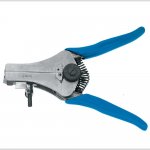
Quick question for anyone who might know... I build motorcycles and as things have shifted more and more towards LED lights wires have gotten smaller and smaller on certain electronic parts. I am finding more and more often that things have super tiny 24 gauge wiring and my strippers just don't get that small. I have a nice set of older Klein (pic below) that are excellent for most of what I do, but they just don't get down to this small of a size (IIRC they go to 22 AWG). I've done a lot of digging around online and most of what I find seems cheap or "gimmicky" for that size wire, what do you guys use or recommend from experience? :confused:

I'm currently using a sharp utility knife and being careful not to nick the wires, but this is getting more and more tedious...

Thanks in advance for suggestions. :thumbup:
 

Attachments

  • Klein.jpg
    Klein.jpg
    49 KB · Views: 9
To avoid these ads, REGISTER NOW!

JazRedGT

Well-known member
Joined
Aug 8, 2013
Messages
237
I just bought a bunch of wiring stuff. I will see if any of it goes down that small.
 

paranoid56

Well-known member
Joined
Dec 18, 2008
Messages
1,596
Location
San Diego, Ca
great question as i want to know also. how are you dealing with hooking those wires up to plugs and such? as most plugs dont seem to like to be used with such a small wire when it normally would have a 16or so ga.
 

Loscaldazar

Well-known member
Joined
Feb 23, 2013
Messages
2,385
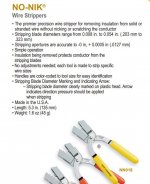
The ideal auto strippers you can buy several different dies so that you can do different sizes. Might be worth getting some of those in addition to the klein ones (they might even be interchangeable-they look identical)
 

Westly

Well-known member
Joined
Jan 17, 2014
Messages
294
Location
U.S.A.
What we use for wires that small, and much smaller, is like the one called "cheapo adjustable" in this link:

http://grathio.com/2012/11/tool-tips-guide-to-wire-strippers/

It's adjusted with that screw in the channel and size will adjust down to no hole at all. Radio Shack probably still sells them.

At the other end, for huge wires, we sometimes use the cutter part of normal strippers, rotating the stripper around the wire, and you can feel when it is though the insulation. Better though on huge wire is to whittle the insulation off with a sharp knife, as if you were sharpening a pencil.
 
Last edited:

Tyberius

Well-known member
Joined
Nov 26, 2013
Messages
312
Location
Wilmette, IL
The backside of my harris scizzors do 24 gauge just fine. Those are in my work case. At home in the automotive electric drawer I've got some newer Kleins that go that small.
 

jkwilson

Well-known member
Joined
Dec 5, 2012
Messages
758
Location
SW Indiana
You may be able to get a different cutter for your strippers to go down that small. I have a set that go to 22 and then another set that go 24-30, but my stripper isn't klein.
 

scaron

Well-known member
Joined
Aug 6, 2013
Messages
407
Location
ypsilanti, michigan
you can get a klein curve stripper or an ideal stripper both in the higher gauges. i use the 11057s as well and they're great with 24 and 26 gauge wire.
 
To avoid these ads, REGISTER NOW!

srmofo

Well-known member
Joined
Oct 15, 2009
Messages
6,161
Location
SW ohio
24 gauge? ....thats well into the teeth strippers

j/k ..I wouldnt want to use my teeth all day for stripping wires. everything would taste like pennies.
 

jeremy v

Banned
Joined
Jul 26, 2011
Messages
784
I also recommend the Klein 11057s, and if you never need to strip wire smaller than 24awg just cut off the last 1"+ of the strippers with a cutoff wheel (just make sure they stay cool while doing it so the strippers don't dull easily from losing any tempering). Then they will be able to work in very tight areas. I do that sort of thing quite often for tools that get used for the same job over and over.

As a side note, some of the people I used to work with used a lighter to strip tiny wires. They would burn the insulation off really quick, wipe it off, and then terminate. Their theory was that it was better, because there was less of a chance of nicking the wire and creating a weak spot.
 
Last edited:
OP
B

bareass172

Well-known member
Joined
Aug 5, 2012
Messages
817
Location
N'awlins
I have to admit that I'm embarrassed you guys found such commonly available options after I really did quite a lot of digging on a lot of different websites. :dunno:

I've long been aware of the "cheapo adjustable" style, but all the ones I'd seen in the past really were "cheapo" and they wouldn't hold the proper setting so eventually you'd start nicking the wires and have to reset it. I'm glad you mentioned the scissors though, I have 2 sets I use for phone/network work and I ALWAYS forget they have the stripper on them. I'd never tried a lighter before, but the lack of precision sounds like it'd be a turn off to me. I have used my teeth and my fingernails before, but those do get old fast.

I'm going to look hard at those Ideal and Klein models posted, I'm sure one of those will be what I go with. Thanks again, very much, for the input.

how are you dealing with hooking those wires up to plugs and such? as most plugs dont seem to like to be used with such a small wire when it normally would have a 16or so ga.
The way that I do it now, and it's not completely ideal or proper but it is as reliable as I can get right now... When I do LED lights I actually source small pins and plugs that are designed for 24 awg wire. When I'm just making individual connections with established wiring/connectors I only use high end terminals where the terminal and insulator are separate. You can see the type I'm talking about on my website here:

http://tech.bareasschoppers.com/resources/handy-motorcycle-tools/#oemterms

And I use the proper crimp tool like these here:

http://www.cycleterminal.com/crimp-tools.html

For the tiny wires I take the terminals and actually trim a small amount of the brass "tabs" that wrap around the wire when crimped. Shortening them makes them grab the wire better. Then I strip the wire back twice as much as I need, twist the strands together and fold it back over itself. It gives me a little more to grab with the crimp. Then I crimp the wire in the connector and solder it - without the solder I wouldn't trust the connection. After soldering the wire I do the second crimp, the part that grabs the wire insulation. If I do both crimps first the insulation is so small the soldering process melts it. After all that I take adhesive silicone and run it up the wire about 1/2" to give the wire a little more strength. This makes it so if the wire wants to bend it will typically bend over a small radius rather than a hard bend which could break the wire. Make sense?

It's a PITA process, but the vibration on motorcycles really plays hell with this stuff so this is the most bulletproof process I've found so far.

If you have any other questions you're welcome to PM me if I don't see it and reply here. :beer:

Thanks again to all who answered my question.
 

volleyball

Well-known member
Joined
Aug 29, 2011
Messages
4,127
Location
NY, not NYC
For that gauge, electronic tool suppliers are your best bet. I've used the pinch and pull apart method if the insulation is thin. If it's teflon, you need a good tool.
I have a pair of angled wire cutters that have a hole where the cutters meet to do small wire. The cutters are 4".
 

Westly

Well-known member
Joined
Jan 17, 2014
Messages
294
Location
U.S.A.

canbug

Well-known member
Joined
May 6, 2008
Messages
337
Location
Just North of Cow Town
The strippers are the way to go but we have used needle nose pliers before. Just pinch the insulation and pull. Insulation comes right off.

Tim.
 

t1r2u3s4t

Well-known member
Joined
Oct 30, 2011
Messages
250
Take a look at Klein 11046, 16-26awg stranded, $10.50 at Home Depot. It's 6" long and probably a good size for thin wires.
 
OP
B

bareass172

Well-known member
Joined
Aug 5, 2012
Messages
817
Location
N'awlins
Those Millers look awesome, but yeah, a little pricey! That one in the Wiki link is crazy! I'm all for precision, but what I'm doing doesn't need to be that close, lol. ;)
 

aptdweller

Well-known member
Joined
Apr 16, 2013
Messages
95
Location
Ottawa, ON
This (or the $15 klein version) are what electronics people use to strip small gauge wire. You close the appropriate location around the wire and do a 180 degree turn and the isulation should just pull right off. I have yet to find an adjustable stripper that does small gauge well.
 
To avoid these ads, REGISTER NOW!
Top Bottom