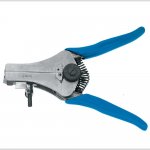
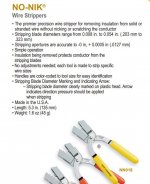
I have to admit that I'm embarrassed you guys found such commonly available options after I really did quite a lot of digging on a lot of different websites.

I've long been aware of the "cheapo adjustable" style, but all the ones I'd seen in the past really were "cheapo" and they wouldn't hold the proper setting so eventually you'd start nicking the wires and have to reset it. I'm glad you mentioned the scissors though, I have 2 sets I use for phone/network work and I ALWAYS forget they have the stripper on them. I'd never tried a lighter before, but the lack of precision sounds like it'd be a turn off to me. I have used my teeth and my fingernails before, but those do get old fast.
I'm going to look hard at those Ideal and Klein models posted, I'm sure one of those will be what I go with. Thanks again, very much, for the input.
how are you dealing with hooking those wires up to plugs and such? as most plugs dont seem to like to be used with such a small wire when it normally would have a 16or so ga.
The way that I do it now, and it's not completely ideal or proper but it is as reliable as I can get right now... When I do LED lights I actually source small pins and plugs that are designed for 24 awg wire. When I'm just making individual connections with established wiring/connectors I only use high end terminals where the terminal and insulator are separate. You can see the type I'm talking about on my website here:
http://tech.bareasschoppers.com/resources/handy-motorcycle-tools/#oemterms
And I use the proper crimp tool like these here:
http://www.cycleterminal.com/crimp-tools.html
For the tiny wires I take the terminals and actually trim a small amount of the brass "tabs" that wrap around the wire when crimped. Shortening them makes them grab the wire better. Then I strip the wire back twice as much as I need, twist the strands together and fold it back over itself. It gives me a little more to grab with the crimp. Then I crimp the wire in the connector and solder it - without the solder I wouldn't trust the connection. After soldering the wire I do the second crimp, the part that grabs the wire insulation. If I do both crimps first the insulation is so small the soldering process melts it. After all that I take adhesive silicone and run it up the wire about 1/2" to give the wire a little more strength. This makes it so if the wire wants to bend it will typically bend over a small radius rather than a hard bend which could break the wire. Make sense?
It's a PITA process, but the vibration on motorcycles really plays hell with this stuff so this is the most bulletproof process I've found so far.
If you have any other questions you're welcome to PM me if I don't see it and reply here.

Thanks again to all who answered my question.