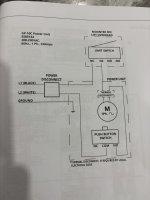
Mike - you have probably already figured it out. When the single phase lines come into the house, the two alternating current legs are essentially 180 degrees apart. Compared to the neutral wire, when one is positive 120V the other is negative 120V. This gives two legs that are 120V between each and the neutral wire. Between the two legs, since one is 120V positive at its peak, and the other 120V negative, so there is 240V difference between the two legs. A 240V device uses the difference between two legs, there is no neutral wire needed to do that. Some devices, like say an electric dryer or an electric range/stove, might also have a clock or timer built in. That clock, the electronics, and the timer etc,. are probably designed to use 120V. In that case the two legs come in which gives 240V between the two legs for the heating elements, and then a neutral and one leg are used for the electronics. Since there is very little load for that clock etc., there is no need to worry about unbalancing the two legs coming into the house.
In this country, we normally use a black wire for the hot wire, although sometimes red is used. White is used for the neutral. If white is used for one leg in a 240V circuit, normally the electrician will wrap a couple inches at the end of that white wire in red or black tape so someone else knows it is hot. Sometimes they will use paint or a sharpie, but using electricians' tape to color it is normal.
Any electrical device can short out. If this happens, sometimes the metal frame carrying the device can become energized with that leg that has shorted out. Someone touching that frame is standing on the ground, and they can get hurt badly from a shock between the shorted wire to the frame, and the ground they are standing on. As the years have gone by, there has been more and more of a push to ground everything to prevent people from being hurt. Wiring in the 1900's - 1950's might only have two wires - a hot and a neutral. Then a third wire, usually green was added to most appliances etc., as a ground. Appliances into the 1980's might only have three wires - two which are hot and a neutral for that timer or clock etc.. Because someone could still get shocked, a fourth wire was added - a ground. As such a late appliance might have two hot legs, a neutral for the clock, timer or electronics to get 120V, and a ground (green or copper). Sometimes when metal conduit is chosen to install a wiring run, the conduit acts as the ground.
The general rule in consumer electrical is that it rarely hurts to be overly cautious when installing something electrical. If the code allows multiple solutions, choosing the solution that is safest never hurts - except sometimes it costs more financially. When that happens, some people will just say use the cheapest approved solution. Others will say spend the extra couple bucks and do it to a higher standard. That becomes a personal choice.
Remember to put some black or red tape on the last few inches of that white wire you are using to carry a leg of the power to your 240V device so the next person who looks at it will know it is a hot wire and not a neutral.