To avoid these ads, REGISTER NOW!

3-way switch with a twist

Bert_

Well-known member
Joined
Dec 24, 2016
Messages
9,715
Location
NW Iowa
Looking close at those pictures I don't there is any conduit. It really looks like thhn or maybe tw wire just flying in though an open knockout. If that's the case then the whole thing is one big hack job after another.

I'm just going to repeat this in hopes the op notices it among all this extremely useful discussion...

I would really like him to take a closer look.
 
To avoid these ads, REGISTER NOW!

Terry D

Well-known member
Joined
Mar 25, 2015
Messages
2,202
Location
St. Louis, MO.
I suspect that none of the white wires are in fact a neutral. They are marked black indicating a hot traveler switched wire.

The actual neutral is probably terminated at the load. Only the hot wires and traveler returns are connected at the switch.

John

Sent from my SM-A102U using The Garage Journal mobile app

The neutrals do run through the switches, the hot and neutral at the load, reverse every time a switch is toggled
 

Terry D

Well-known member
Joined
Mar 25, 2015
Messages
2,202
Location
St. Louis, MO.
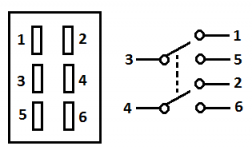
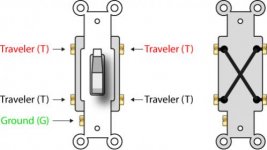
A "4-way" (intermediate) switch is a purpose built double pole, double throw (DPDT) switch, internally wired in manufacture to reverse the connections between the input and output and having only four external terminals. This switch has two pairs of "traveler" terminals that it connects either straight through, or crossed over (transposed, or swapped).

Above text From Wikipedia.


It is a modified dpdt that performs a "cross" function. This swaps the traveler power wire and allows multiple control locations.

Sent from my SM-A102U using The Garage Journal mobile app

So I guess everyone is right, the two switches are not the same switch. A 4-way switch is a modified DPDT, it is not a normal DPDT. Even though you can take a normal DPDT and get it to perform as a 4-way by adding external jumpers, I don't see a 4-way switch being able to perform every function a normal DPDT can do. If I went to my supply house and asked for a DPDT switch and a 4-way switch, they would give me 2 different switches.
 

Attachments

  • 4-way-switch-operation.jpg
    4-way-switch-operation.jpg
    17.5 KB · Views: 17
  • DPDT-toggle-switch-diagram.png
    DPDT-toggle-switch-diagram.png
    4.2 KB · Views: 10
Last edited:

Terry D

Well-known member
Joined
Mar 25, 2015
Messages
2,202
Location
St. Louis, MO.
Ok. Hmmmm. But why do it this way? And no safety ground?

I would fix it properly. But it's not mine.

Sent from my SM-A102U using The Garage Journal mobile app

I agree,I never meant it was right, I think it is one of the most craziest electrical things that I have ever seen. To me, there is a code violation there. The outer shell of a lamp screw socket is supposed to have the grounded conductor attached to it to avoid risk of shock. In this case, it could have the ungrounded or grounded conductor going to it depending on the position of the 3-ways. Has anyone ever said, is this in the US or somewhere else?
 
Last edited:

Bert_

Well-known member
Joined
Dec 24, 2016
Messages
9,715
Location
NW Iowa
Ok. Hmmmm. But why do it this way? And no safety ground?

I would fix it properly. But it's not mine.

Sent from my SM-A102U using The Garage Journal mobile app

It can save wire. Used to see it all the time with the old incandescent yard lights. Would have a switch in the house and one on the pole or other building. Instead of having to run travelers it only took one wire.

Probably hasn't been a code compliant method for 50 years
 

Alchymist

Well-known member
Joined
Mar 1, 2009
Messages
4,423
Location
Central PA
I agree,I never meant it was right, I think it is one of the most craziest electrical things that I have ever seen. To me, there is a code violation there. The outer shell of a lamp screw socket is supposed to have the grounded conductor attached to it to avoid risk of shock. In this case, it could have the ungrounded or grounded conductor going to it depending on the position of the 3-ways. Has anyone ever said, is this in the US or somewhere else?

Posted about this in 2014..... yes, it happens in the US.

https://www.garagejournal.com/forum/showpost.php?p=4463155&postcount=26
 
To avoid these ads, REGISTER NOW!

jayrush13

Well-known member
Joined
Dec 30, 2006
Messages
340
Location
Lebanon Oregon
It's a variation of what electricians call a California 3-way has not been legal since the 1920's but still gets used if the wrong wire is pulled. As stated in some other posts it switches the neutral which is a code violation per the NEC and will make the shell of the lamp socket hot sometimes which is also a code violation.
 

dogdog

Well-known member
Joined
Nov 15, 2011
Messages
12,711
It's a variation of what electricians call a California 3-way has not been legal since the 1920's but still gets used if the wrong wire is pulled. As stated in some other posts it switches the neutral which is a code violation per the NEC and will make the shell of the lamp socket hot sometimes which is also a code violation.

NEC is US code or Canadian Code ? Either case.

He say Mexico... not sure what they follow MEC ?
 

MikeF2316

Well-known member
Joined
Dec 29, 2012
Messages
9,605
Location
Thornhill, ON
This is common way to wire up the "AMP" light in automobiles. One wire is connected so it's got power (+12V) when the ignition is on. The other is connected to an alternator output, so there's power (+12V) when the alternator is generating power. With both wires at +12V, the light does not light. When the alternator is not turning, this wire is very close to ground potential due to the low resistance of the alternator wiring, turning on the light.

Of course having full potential at a bulb's terminals is very different when comparing 12 and 120 Volts!
 

frankush

Well-known member
Joined
Oct 23, 2011
Messages
1,156
Location
IL
Commonly referred to as a barnyard three way circuit in my neck of the woods. Not very common. I've run into a few in 40 years. Rip it out and do it right.
 

malibu101

Well-known member
Joined
Jul 1, 2005
Messages
3,908
Location
Walnutport PA
I have seen this type of circuit used in knob & tube wiring in old houses.
Since a hot and neutral were normally run from one end of the house to the other, this just required 1 wire between each switch (as was said by others).

Sure makes for some head scratching when troubleshooting.
Just like with K&T they often switched the neutral. Turn the switch off to work on the light but 120V is still present.
 
To avoid these ads, REGISTER NOW!
Top Bottom