BleedingGums
New member
- Joined
- Feb 17, 2015
- Messages
- 4
I recently acquired a Rockwell/Delta 37-220 that I tore down and am now reassembling. Not sure of the age, but I'm guessing 60's. The bearings on the cutterhead are different sizes, which according to the parts diagram I have this would indicate an "earlier model." The bearings that came with it were a mess, so I replaced those. The tables are in pretty good condition, with very little rust. It has a closed stand with a wheel kit, but not the cool one, just the plain Jane box. It also has a dual voltage ¾-hp motor.

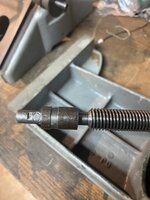
When I took it apart, I made sure to keep all of pieces grouped together so that when reassembled, they would all be matched up as they were before I took it apart. Now that I am ready to reassemble, I am having a bit of an issue. As isolated groups, the parts fit together just fine (ie the end of the adjusting screw fits into the bushing and moves freely), but when I insert the bushing and the adjusting screw into their corresponding bores, they bind up more than I would expect. It seems as if the bore holes in the table casting are ever so slightly out of alignment. I can get the parts back together as they should be, they just don't turn as freely as I would expect. I can turn the adjusting screw with the handle, but it is stiff, and I imagine it will be even worse once the tables are assembled back onto the base given the weight of the table will be an added factor. There was so much caked on saw dust before I cleaned it up, I didn't get a good feel for how well these parts moved before I took it apart. Also, this is my first jointer, so I'm not sure what to expect as far as how easy these tables should be to adjust, but I am a bit surprised at how stiff the adjustment is given that I have cleaned all the parts. Before I do anything drastic, I figured I would reach out and get some input from those who have experience with similar jointers. I was thinking about perhaps honing the inside of the bushing bore with some sandpaper wrapped around a pin of similar diameter, but I don't want to make the bore too loose. Any thoughts?
When I took it apart, I made sure to keep all of pieces grouped together so that when reassembled, they would all be matched up as they were before I took it apart. Now that I am ready to reassemble, I am having a bit of an issue. As isolated groups, the parts fit together just fine (ie the end of the adjusting screw fits into the bushing and moves freely), but when I insert the bushing and the adjusting screw into their corresponding bores, they bind up more than I would expect. It seems as if the bore holes in the table casting are ever so slightly out of alignment. I can get the parts back together as they should be, they just don't turn as freely as I would expect. I can turn the adjusting screw with the handle, but it is stiff, and I imagine it will be even worse once the tables are assembled back onto the base given the weight of the table will be an added factor. There was so much caked on saw dust before I cleaned it up, I didn't get a good feel for how well these parts moved before I took it apart. Also, this is my first jointer, so I'm not sure what to expect as far as how easy these tables should be to adjust, but I am a bit surprised at how stiff the adjustment is given that I have cleaned all the parts. Before I do anything drastic, I figured I would reach out and get some input from those who have experience with similar jointers. I was thinking about perhaps honing the inside of the bushing bore with some sandpaper wrapped around a pin of similar diameter, but I don't want to make the bore too loose. Any thoughts?