To avoid these ads, REGISTER NOW!

400A Service - Need to Run 200A to Workshop/Barn

traumadoc2b

Well-known member
Joined
Jun 17, 2014
Messages
104
Location
Indianapolis
So, we're building a house and I just finished my meter can/service entrance and passed inspection. Waiting for the POCO to drop the transformer and hook-up.

Next step is running a feeder from the 200A disconnect out to the barn. At some point, I hope to build a bigger workshop several feet away. I plan to install a 200A panel in the barn with subfeed lugs to supply the future workshop. The area between will essentially be a gravel drive. Given the gravel, traffic, and ability to pull wire later, I plan to install conduit between the current barn and future workshop location.

I don't see anywhere that says I can't put UF or USE in conduit. The diameter listed for the manufacturer has the twisted cable at 1.5" diameter. I figure 2-1/2" SCH 80 under areas where there will be some driveway traffic should be OK.

The run from the service entrance to the barn is about 200'.

Thoughts, suggestions?
 
To avoid these ads, REGISTER NOW!
OP
T

traumadoc2b

Well-known member
Joined
Jun 17, 2014
Messages
104
Location
Indianapolis
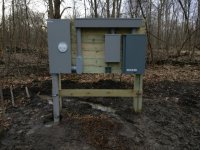
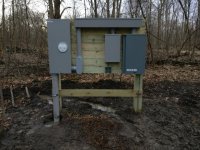
Here's a photo of the service entrance I installed. There is a 320 meter can, a 200A disconnect with space for 4 breakers (there is a 2 gang below for GFI's), and the Kohler enclosure is a combo service entrance/auto transfer switch for the house.

I left space to add a 3rd disconnect for future use - for exactly what, I'm not quite sure. The POCO said we could add a third set of lugs in the future.
 

Attachments

  • 400 amp.jpg
    400 amp.jpg
    152.2 KB · Views: 171

pattenp

Well-known member
Joined
Jun 4, 2008
Messages
10,175
Location
Virginia - USA
Number of conductors and conductor size determines the conduit size. Buried depth for no traffic areas vs, traffic areas such as under driveways are different. Also direct bury is more than if in conduit.
 
OP
T

traumadoc2b

Well-known member
Joined
Jun 17, 2014
Messages
104
Location
Indianapolis
Right, I calculated all that. The 2 1/2" SCH 80 has an internal diam of 2.3", for an area of 16.95 sq in. The 4/0-4/0-4/0-2/0 twisted cable has a diameter of 1.56", a cross sectional area of 7.65 sq in. That makes for a 45% fill, less than the NEC limit of 53% for a single cable.

I think as long as my sections of conduit are relatively short, I don't think I'll have any trouble pulling it through the 2 1/2". I'll direct bury the rest of the cable. I had planned on a depth of 24", should cover me if the cable is in conduit or not.

Looking to see if I'm missing anything or if anyone has advice from having done similar projects.
 

brewchief

Well-known member
Joined
Sep 20, 2008
Messages
2,370
Location
Michigan
My understanding is that the NEC allows you to use 4/0 aluminum to feed a dwelling at 200 amps but if it's a non dwelling 4/0 is only good for 180 amps, a shop would not be a dwelling so you would need to go up to 250 mcm wire to get 200 amps. That will probably increase your conduit size as well.
That said your local inspector may be fine with 4/0 and consider your shop no different than a dwelling.

Sent from my SM-G965U using Tapatalk
 

pattenp

Well-known member
Joined
Jun 4, 2008
Messages
10,175
Location
Virginia - USA
Right, I calculated all that. The 2 1/2" SCH 80 has an internal diam of 2.3", for an area of 16.95 sq in. The 4/0-4/0-4/0-2/0 twisted cable has a diameter of 1.56", a cross sectional area of 7.65 sq in. That makes for a 45% fill, less than the NEC limit of 53% for a single cable.

Nope. Doesn't calculate that way. That cable is not a single wire to meet the 53% fill. You need to meet the 40% fill. It is 4 conductors and you have to calculate the individual area of each conductor and sum them up. You will still come up with 2.5" conduit being okay.

And as a subfeeder 4/0 is 180A as said.
 
Last edited:

dscheidt

Well-known member
Joined
Apr 26, 2017
Messages
2,893
Right, I calculated all that. The 2 1/2" SCH 80 has an internal diam of 2.3", for an area of 16.95 sq in. The 4/0-4/0-4/0-2/0 twisted cable has a diameter of 1.56", a cross sectional area of 7.65 sq in. That makes for a 45% fill, less than the NEC limit of 53% for a single cable.
.

53% is for single *conductor*, not single cable. For three current carrying conductors, you are limited to 40%. 2 1/2 PVC schedule 80 will hold 3 250Kmil and one 1/0 XHHW-2 wires, so you'd be okay. 3" would be a bit easier to pull though, but 2.5 is doable. A barn is not a dwelling, you don't get to down size the service conductors.
 

alfredeneuman

Well-known member
Joined
Mar 3, 2011
Messages
4,580
Location
Fullerton, CA
The conduit fill requirements are only applicable to complete conduit systems only.
Short lengths (sleeves) aren't subject to those rules.
 
OP
T

traumadoc2b

Well-known member
Joined
Jun 17, 2014
Messages
104
Location
Indianapolis
I will definitely ask the AHJ about wire size. Since it's coming off a 320 meter can which is for residential service, and I don't plan to use over 180 amp in the shop continuously, I wonder if they would be OK with the 4/0 alum USE.
 
Last edited:
OP
T

traumadoc2b

Well-known member
Joined
Jun 17, 2014
Messages
104
Location
Indianapolis
Nope. Doesn't calculate that way. That cable is not a single wire to meet the 53% fill.

So, I went and did some more research. Thanks for correcting me on this.

Apparently NEC from Chapter 9 - 2014 contained the language:
"A multi conductor cable, optical fiber cable, or flexible cord of two or more conductors shall be treated as a single conductor for calculating percentage conduit area. For cables that have elliptical cross sections, the cross-sectional area calculation shall be based on using the major diameter of the ellipse as a circle diameter."

But was then updated to add the following in 2017:
"Assemblies of single insulated conductors without an overall covering shall not be considered a cable when determining conduit or tubing fill area. The conduit or tubing fill for the assemblies shall be calculated based upon the individual conductors."
 

pattenp

Well-known member
Joined
Jun 4, 2008
Messages
10,175
Location
Virginia - USA
Also USE only rated wire is not allowed to enter a structure. It needs to be terminated outside and you'll need to transition to a different wire type such as SER for entry into the barn.
 

wyliesdiesels

Well-known member
Joined
Aug 14, 2012
Messages
20,013
Location
Modesto, CA
So, we're building a house and I just finished my meter can/service entrance and passed inspection. Waiting for the POCO to drop the transformer and hook-up.

Next step is running a feeder from the 200A disconnect out to the barn. At some point, I hope to build a bigger workshop several feet away. I plan to install a 200A panel in the barn with subfeed lugs to supply the future workshop. The area between will essentially be a gravel drive. Given the gravel, traffic, and ability to pull wire later, I plan to install conduit between the current barn and future workshop location.

I don't see anywhere that says I can't put UF or USE in conduit. The diameter listed for the manufacturer has the twisted cable at 1.5" diameter. I figure 2-1/2" SCH 80 under areas where there will be some driveway traffic should be OK.

The run from the service entrance to the barn is about 200'.

Thoughts, suggestions?
single rated USE conductors are not rated for use indoors.

Not sure why you would use UF-b as its not made in gauges larger than #6. PLus pulling that in conduit is a real bare.

Youre making things harder on yourself when you choose wire that is not rated or designed for the application you would be using it in.
 
OP
T

traumadoc2b

Well-known member
Joined
Jun 17, 2014
Messages
104
Location
Indianapolis
It also looks like SCH 40 is plenty, buried at 24" based upon what I can find for crush strength. Looks like no need to waste money on SCH 80, except for where the feeders surface.
 

pattenp

Well-known member
Joined
Jun 4, 2008
Messages
10,175
Location
Virginia - USA
Because of using such large wire you may want to consider using individual conductors of XHHW-2. If you are planning on using conduit panel to panel the XHHW-2 is not as thick as direct bury URD/USE and is easier to pull because it is not a twisted assembly. Plus the XHHW-2 can enter the barn. If you want the heaver direct bury then use Mobile Home Feeder (MHF) 4/0-4/0-4/0-2/0 or 4/0-4/0-2/0-4 it is allowed to enter the barn.
 
Last edited:
OP
T

traumadoc2b

Well-known member
Joined
Jun 17, 2014
Messages
104
Location
Indianapolis
Because of using such large wire you may want to consider using individual conductors of XHHW-2. If you are planning on using conduit panel to panel the XHHW-2 is not as thick as direct bury URD/USE and is easier to pull because it is not a twisted assembly. Plus the XHHW-2 can enter the barn.

I was looking to maybe avoid a conduit run from panel to panel, in part to save some cash, but also because I am worried I will need a pull in the middle of the run. I am not necessarily opposed to conduit the entire way, but would need help designing/selecting an appropriate pull box (handhole, etc).

Looks like alum XHHN-2 in 4/0 runs about $1/ft (size TBD, for comparison sake) and the 4/0-4/0-4/0-2/0 MHF you mentioned runs about $3.80/ft. Probably not much difference in price, unless I save more on conduit and the pull box. I don't mind spending a little more for a cleaner and easier to pull set up, but that's partly where I'm looking for input from GJ.

If you want the heaver direct bury then use Mobile Home Feeder (MHF) 4/0-4/0-4/0-2/0 or 4/0-4/0-2/0-4 it is allowed to enter the barn.

This is what I was most recently looking at, the mobile home feeder. If I go this route, I plan to run it within conduit only in locations where I am worried about gravel and traffic from above, and gravel falling into the trench while the cable is being laid. Is that overkill?
 

wyliesdiesels

Well-known member
Joined
Aug 14, 2012
Messages
20,013
Location
Modesto, CA
I was looking to maybe avoid a conduit run from panel to panel, in part to save some cash, but also because I am worried I will need a pull in the middle of the run. I am not necessarily opposed to conduit the entire way, but would need help designing/selecting an appropriate pull box (handhole, etc).

Looks like alum XHHN-2 in 4/0 runs about $1/ft (size TBD, for comparison sake) and the 4/0-4/0-4/0-2/0 MHF you mentioned runs about $3.80/ft. Probably not much difference in price, unless I save more on conduit and the pull box. I don't mind spending a little more for a cleaner and easier to pull set up, but that's partly where I'm looking for input from GJ.


This is what I was most recently looking at, the mobile home feeder. If I go this route, I plan to run it within conduit only in locations where I am worried about gravel and traffic from above, and gravel falling into the trench while the cable is being laid. Is that overkill?

MHF, XHHW, and any conductors or bundled conductors that do not have an outer sheath are required to be in conduit indoors.

If you dont want to run conduit indoors, then you will need to transition to SER in a large junction box on both ends....
 
Last edited:
OP
T

traumadoc2b

Well-known member
Joined
Jun 17, 2014
Messages
104
Location
Indianapolis
MHF, XHHW, and any conductors or bundled conductors that do not have an outer sheath are required to be in conduit indoors.

Sorry, absolutely, I should have clarified conduit under traffic/gravel areas as well as risers to/from the service entrance and subpanel enclosures.
 

mm08822

Well-known member
Joined
Jan 13, 2012
Messages
5,925
Location
NJ
My understanding is that the NEC allows you to use 4/0 aluminum to feed a dwelling at 200 amps but if it's a non dwelling 4/0 is only good for 180 amps, a shop would not be a dwelling so you would need to go up to 250 mcm wire to get 200 amps. That will probably increase your conduit size as well.
That said your local inspector may be fine with 4/0 and consider your shop no different than a dwelling.

Sent from my SM-G965U using Tapatalk

53% is for single *conductor*, not single cable. For three current carrying conductors, you are limited to 40%. 2 1/2 PVC schedule 80 will hold 3 250Kmil and one 1/0 XHHW-2 wires, so you'd be okay. 3" would be a bit easier to pull though, but 2.5 is doable. A barn is not a dwelling, you don't get to down size the service conductors.

Although this is not a dwelling, 4/0 AL can be ocp’d at 200A. Since it is only rated at 180A, NEC 240.4(B) permits upsizing to the next standard size cb b/c a 180A cb does not exist.

At 200’ distance, 4/0 MHF is not going to work if loads get high. I suggest OP running 250-250-3/0-2 as individual AL XHHW conductors in conduit to compensate for voltage drop. You may never reach 200A, but now is the time to plan for it. Down-sizing the neutral and ground will provide additional ease in pulling through 2.5" PVC.

Since vehicle traffic is mentioned, I would at least run the sch 80 under the driveway area.
 
Last edited:

Norcal

Well-known member
Joined
Mar 16, 2008
Messages
13,754
As long as the calculated load is 180A or less, 4/0 AL can have a 200A breaker used, otherwise 250 Kcml would have to be used, but I would doubt a full 200A is needed for a 1 man shop.
 
OP
T

traumadoc2b

Well-known member
Joined
Jun 17, 2014
Messages
104
Location
Indianapolis
I suggest OP running 250-250-2/0-2 as individual AL XHHW conductors in conduit to compensate for voltage drop.

What is the reference and/or calculation for downsizing the neutral? I read somewhere 70% of the load.

Or is it based upon the max load calculated between either of the ungrounded feeders and neutral? So, 100% noncontinuous 120v load plus 125% continuous 120v load (240v loads apply to ungrounded feeders, but not to load for purposes of sizing neutral). Does that sound about right?

It would then follow, if my loads are balanced and I'm using up to 100A on each bus, all 120v branch circuits (which they won't be), then my max load b/w one ungrounded feeder and neutral is 125A. The 2/0 alum XHHW-2 conductor is rated for 150A. Then I suppose voltage drop over the 200' of wire comes into play somehow...

And couldn't I run a smaller ground? Would be equipment grounding conductor between the service entrance/disconnect and subpanel, correct?
 
To avoid these ads, REGISTER NOW!
OP
T

traumadoc2b

Well-known member
Joined
Jun 17, 2014
Messages
104
Location
Indianapolis
No you cant run a smaller ground.
Anything over 100A up to 200 requires a #6Cu or a #4Al

I meant smaller than #2 Al...

I suggest OP running 250-250-2/0-2 as individual AL XHHW conductors in conduit to compensate for voltage drop.

I assume you're saying that's OK to use #4 Al for this 200' run to a 200A subpanel? That's what I would gather from Table 250.122.

Of course it's a separate building, so the subpanel (neutral not bonded) will have its own GEC to 2 ground rods, in addition to the EGC back to the service entrance.
 

mm08822

Well-known member
Joined
Jan 13, 2012
Messages
5,925
Location
NJ
What is the reference and/or calculation for downsizing the neutral? I read somewhere 70% of the load.

Or is it based upon the max load calculated between either of the ungrounded feeders and neutral? So, 100% noncontinuous 120v load plus 125% continuous 120v load (240v loads apply to ungrounded feeders, but not to load for purposes of sizing neutral). Does that sound about right?

It would then follow, if my loads are balanced and I'm using up to 100A on each bus, all 120v branch circuits (which they won't be), then my max load b/w one ungrounded feeder and neutral is 125A. The 2/0 alum XHHW-2 conductor is rated for 150A. Then I suppose voltage drop over the 200' of wire comes into play somehow...

And couldn't I run a smaller ground? Would be equipment grounding conductor between the service entrance/disconnect and subpanel, correct?

I corrected my original neutral size - should be 3/0 (not 2/0) since all conductors would be upsized for vd considerations.

Read 215.2 (A)2 and 220.61(A) it refers to max net calculated imbalance but can't be smaller than the grounding conductor as sized in 250.122. 220.61(B) provides 70% factor but you won't have range/stove loads.

The grounding conductor for up to 200a ocp is #6 cu = #4 AL. Since feeder conductors are upsized, the #4 AL needs to be #2 AL.
 

mm08822

Well-known member
Joined
Jan 13, 2012
Messages
5,925
Location
NJ
I meant smaller than #2 Al...


I assume you're saying that's OK to use #4 Al for this 200' run to a 200A subpanel? That's what I would gather from Table 250.122.

Of course it's a separate building, so the subpanel (neutral not bonded) will have its own GEC to 2 ground rods, in addition to the EGC back to the service entrance.

#4 AL has to bump up to #2 since since all other conductors are increased to compensate for vd.
 
OP
T

traumadoc2b

Well-known member
Joined
Jun 17, 2014
Messages
104
Location
Indianapolis
OK, so at this point I plan to use XHHW-2 Al 250-250-3/0-#4 for 200' underground pull in conduit. Anyone see a problem with that, or have a better suggestion?

Next issue is the pull. I will have 2 sweeps and probably need 2 elbows at 45 each. I would like to put a handhole or pull box in the middle of the run. I can't seem to find much of anything about this or how to do it, other than that I need it to be 8x's the size of the conduit for a pull straight through the box - so I was thinking 24" for 2-1/2" conduit.

How does the wire enter the box? Does the conduit enter the box, or terminate below? Any considerations for drainage or ends of the conduit (other than reaming it)?

I'm thinking the handhole needs to be 24" long, marked electric on the lid, designed for underground use and to support the intended load, and removal of the cover must require tools, and assuming it will have an open bottom. Looks like I can use XHHW-2 in it because a box or conduit body is not required within the handhole, which is considered a wet location, and because I'm not connecting to any equipment in the handhole (just using for pull).

I still need to figure out what to do with the conduit at the handhole (questions 2 paragraphs above).
 
Last edited:

mm08822

Well-known member
Joined
Jan 13, 2012
Messages
5,925
Location
NJ
First things first.
How is it you arrived at needing 200A?
What are all of the loads?
What will run simultaneously?
 
OP
T

traumadoc2b

Well-known member
Joined
Jun 17, 2014
Messages
104
Location
Indianapolis
I know I will be chastised for not doing a load calc. Problem is I am planning for future use.

This pull will go to a new barn, which will be my (hopefully) temporary workshop until I get a bigger pole building up, adjacent to it. I plan to use subfeed lugs to reach the second building.

The larger pole building will likely have radiant heat (electric), welders, woodworking and metal/machine shop tools, perhaps an air conditioner, electric water heater, vehicle lift, and other creature comforts like TV, computer, printer, stereo, fridge, microwave, etc. Certainly a number of non-continuous load items.

We have quite a bit of farm property to expand and we have talked about possible ventures into things like aquaponics or small scale vertical farming. This would likely need some sort of climate conditioning and at least lots of lights.

Installing solar panels on the barn has also come up, so we may want to feed back into the grid if can put up enough panels to make it worth it.

That said, part of the lack of load calcs is because I don't have everything picked out with numbers available, partly because I'm not sure how much we'll expand over the next few years. I certainly don't want to re-do this because it will cross under the driveway/parking area 3 times.
 

wyliesdiesels

Well-known member
Joined
Aug 14, 2012
Messages
20,013
Location
Modesto, CA
Well bringing solar panels into the mix makes doing load calcs even more important.

Depending on size of system and loads, you may need to reduce the main breaker rating.
 

mm08822

Well-known member
Joined
Jan 13, 2012
Messages
5,925
Location
NJ
I suggest you come up with a multi-generation plan for all of these future adds first. Start making some load estimates -swags. This might just help you not get backed into a corner later.

You may find that the pullbox is better sized to serve as a splice box-maybe.
You may want to run another conduit or two out past the driveway/parking lot now. Cap it off and mark/record location for future use.
Vertical farming uses a lot of power for lighting and temp control.

What size solar system, where will it connect into, etc....

Also what does your current service look like? Does it have the ability to increase w/o ripping out everything put in today? Post a pic.
 
OP
T

traumadoc2b

Well-known member
Joined
Jun 17, 2014
Messages
104
Location
Indianapolis
Also what does your current service look like? Does it have the ability to increase w/o ripping out everything put in today? Post a pic.

Hopefully dropping transformer this week, adjacent to meter can.

200A disconnect for barns with breakers for GFI at panels and well pump
200A ATS from Kohler for the house, generator will be (near) future install
2/0 cu feeders from meter to disconnects in trough above
#4 bare cu GEC with some to spare in the trough to tie into any disconnect added in the future

Engineer from POCO said we can add a third set of lugs to the meter can to add a third disconnect in the future. Obviously we're still limited by the transformer and rating of the meter can.

The only problem with that is the transformer/meter is towards the back of the property, away from where we would potentially add to in the barn area. Thus, my thought on subfeed lugs in the existing barn to feed an adjacent (future) shop.
 

Attachments

  • 400 amp.jpg
    400 amp.jpg
    152.2 KB · Views: 30
OP
T

traumadoc2b

Well-known member
Joined
Jun 17, 2014
Messages
104
Location
Indianapolis
Transformer went in today, 3' from the meter, 37.5 kva. Won't be any other service connecting to this transformer as it's squarely in the middle of our property.
 

Bert_

Well-known member
Joined
Dec 24, 2016
Messages
9,729
Location
NW Iowa
Transformer went in today, 3' from the meter, 37.5 kva. Won't be any other service connecting to this transformer as it's squarely in the middle of our property.

Shows how much we usually oversize things. 37.5KVA is a 150A transformer, it would do 2x that for a few hours at a time.

I really like doing farm services with any of the local REC's. Anything over 200A they are usually willing to put a CT in the transformer and I can set a disconnect or two somewhere close by. Makes it extremely easy to grow in the future, just add another set of wires and another disconnect. Don't have to change the metering.
 

bjcouche

Well-known member
Joined
Sep 11, 2010
Messages
509
Location
Ohio
Are you sure that you will need a hand hole or pull box in the middle? XHHW-2 Al 250-250-3/0-#4 for 200' I would think you could simply have a LB at each end and be fine.. You mentioned two sweeps and two 45 degree bends... With that you're at 270 degrees and a maximum of 360 degrees required before needing a pull point... It would seem a less expensive and simpler pull to simply eliminate the pull box and instead use large radius sweeps and or try to eliminate the 45 degree bends by simply bending the conduit in a gradual arc. It's surprising how much of bend you can get even with 2.5" pvc over a 10 foot length...
I pulled 4/O, 4/O, 2/O 2awg through a combination of 2" and 2.5" PVC over 150 feet with 2 90's and a couple gradual bends without much trouble. The trick is to pull with a large diameter rope, I'd say 1/2-1" in diameter, not for the strength but the larger diameter will slide easier around the 90's. Two out of shape guys did my pull (myself included). Lube helps too.
Brian
 
OP
T

traumadoc2b

Well-known member
Joined
Jun 17, 2014
Messages
104
Location
Indianapolis
Are you sure that you will need a hand hole or pull box in the middle? XHHW-2 Al 250-250-3/0-#4 for 200' I would think you could simply have a LB at each end and be fine.. You mentioned two sweeps and two 45 degree bends...

No, I'm not sure I need a hand hole. I figured the sweeps were the way to go, but am now wondering where exactly you put the LB's at. I can't imagine that burying them is to code or makes sense, and I don't see how they would help if the sweeps are directed right up into the bottom of each enclosure.
 

bjcouche

Well-known member
Joined
Sep 11, 2010
Messages
509
Location
Ohio
If your conduit is coming up into the bottom of a panel at both ends, I guess you wouldn't have any LB's... I incorrectly assumed that you were having the conduit coming up out of the ground on the outside of the garage and then passing through the wall. If your conduit is coming up through your floor on the inside of the garage, you wouldn't have any LB's either. The feed I did to my shop, I came out of the side of the house, into an LB, down underground, and came back up inside the shop, directly into a panel. My point was that I don't think I'd bother with the buried pull box in your situation.
Brian
 

bergheger3

Active member
Joined
Oct 9, 2018
Messages
27
Location
Missouri
I didn't read all the responses but you have to remember if you pulled a cable assembly (romex, UF, etc) in conduit you have to de-rate the wire due to heat.
 

Slowgsr

Well-known member
Joined
Nov 14, 2014
Messages
610
Location
Southern ontario
All this conduit talk, no conduit, sizing, pulling why not just buy a piece of 3 conductor #000 cu teck90? Dig your trench, roll it in, backfill, terminate each end and energize! It moves good too if the frost moves the earth.

Time is money right.
 

Norcal

Well-known member
Joined
Mar 16, 2008
Messages
13,754
Teck cable is more of a Canadian thing, not common in the states.
 
To avoid these ads, REGISTER NOW!
Top Bottom