To avoid these ads, REGISTER NOW!

55 year old house, do I need to replace anything?

Glacial_Speed

Well-known member
Joined
Sep 15, 2012
Messages
7,023
Location
Massachusetts
>> But is this your last house forever and how old are you? If you're 35 and plan to live here full time,
>> different than 60 and a summer or part time place. Any plans to expand building?

Not my last house. Nor a present one. Just a beach house, no plans to expand.
I was going to say something about the windows in a 50 year old house, but a beach house that gets used a few weeks in summer......not really an issue.
 
To avoid these ads, REGISTER NOW!

reader2580

Well-known member
Joined
Dec 31, 2014
Messages
14,516
Location
Minneapolis, MN
Because if one decides to bury their service line I think they should consider possible future uses. We dont know the distance to the transformer for the OP but my sense is that its not very far. If so, there cant be much of a cost difference. I agree that if you are not going to bury the line that there is for now nothing broken to fix.
Doesn't the POCO usually bury the line from the street to the meter? I know they do here in the Minneapolis area. Some utilities charge for running the line and some don't. I find it hard to believe the POCO would not install new under service that can't be upgraded to 150 or 200 amps.
 

sparky 1971

Well-known member
Joined
Oct 9, 2018
Messages
7,967
Location
Central Iowa
Doesn't the POCO usually bury the line from the street to the meter? I know they do here in the Minneapolis area. Some utilities charge for running the line and some don't. I find it hard to believe the POCO would not install new under service that can't be upgraded to 150 or 200 amps.
I obviously can't speak for every area of the country, but that's not been the case anywhere I've worked. The POCO does install the initial service lateral, whether it be overhead or underground. If the home has an existing overhead service, or is new construction in an overhead area, underground is to be installed by others. It's on the customer to get someone to trench it in to the proper pole and leave enough wire coiled up at the base for the POCO to run it on up to the top and make the connections. They won't even install a new underground lateral when an existing UG goes bad. The find and fix the break.
 

reader2580

Well-known member
Joined
Dec 31, 2014
Messages
14,516
Location
Minneapolis, MN
I obviously can't speak for every area of the country, but that's not been the case anywhere I've worked. The POCO does install the initial service lateral, whether it be overhead or underground. If the home has an existing overhead service, or is new construction in an overhead area, underground is to be installed by others. It's on the customer to get someone to trench it in to the proper pole and leave enough wire coiled up at the base for the POCO to run it on up to the top and make the connections. They won't even install a new underground lateral when an existing UG goes bad. The find and fix the break.
Xcel Energy installs the underground line to the house for new construction for free. I believe the limit is 150 feet. Connexus Energy charges to install the underground feed, but they do it. In both cases the utility will repair underground feeds at no charge. My parent’s underground feed broke 25 to 30 years. NSP/Xcel Energy replaced the entire underground feed at no cost. Connexus Energy was willing to extend my underground feed at no cost if it didn’t reach my new meter base.

My previous house I tore down a condemned house that had overhead service and built a new house. Xcel put in underground service at no charge to the new house.

I considered several lots for anorthern new house so I researched costs for new underground service from both Xcel and Connexus.
 

sparky 1971

Well-known member
Joined
Oct 9, 2018
Messages
7,967
Location
Central Iowa
Xcel Energy installs the underground line to the house for new construction for free. I believe the limit is 150 feet. Connexus Energy charges to install the underground feed, but they do it. In both cases the utility will repair underground feeds at no charge. My parent’s underground feed broke 25 to 30 years. NSP/Xcel Energy replaced the entire underground feed at no cost. Connexus Energy was willing to extend my underground feed at no cost if it didn’t reach my new meter base.

My previous house I tore down a condemned house that had overhead service and built a new house. Xcel put in underground service at no charge to the new house.

I considered several lots for anorthern new house so I researched costs for new underground service from both Xcel and Connexus.
Yes, initial installs are usually free. Of course, there are greedy POCO's that will charge for the initial install, but that's the exception, not the rule. The house in question already has an overhead service, deductive reasoning tells me it's located in an overhead area. To make it an underground service, trenching to a pole will be required, probably to the pole that is currently being used for the overhead. I'd bet dollars to donuts that for that to happen, the owner will be on the hook for at least paying for it, and maybe even hiring someone to do the trenching and lay the wire. Then, the POCO will install the riser and there will be an additional charge for that. Maybe the POCO will do it all, trenching included, but it won't be for free.
 

mrbill55

Well-known member
Joined
Jun 23, 2016
Messages
1,262
Location
Greenville, SC
Check if the wiring is aluminum, if it is maybe replace them all. Except the SER of cause
Going through this now with a 1968 (seller stated 1978) built ranch home. Aluminum wiring and two prong outlets scattered around the house. A few three prong outlets thrown in, but none of them have actual grounds wired. Aluminum wiring is nothing to fool around with and best to replace when in question.

Bill S
 

wyliesdiesels

Well-known member
Joined
Aug 14, 2012
Messages
19,998
Location
Modesto, CA
Going through this now with a 1968 (seller stated 1978) built ranch home. Aluminum wiring and two prong outlets scattered around the house. A few three prong outlets thrown in, but none of them have actual grounds wired. Aluminum wiring is nothing to fool around with and best to replace when in question.

Bill S
Older old alloy small gauge aluminum wire for 15a and 20a branch circuits yes.

For larger branch circuits with aluminum wire there is no issue..
 

dogdog

Well-known member
Joined
Nov 15, 2011
Messages
12,711
Aluminum wires with no grounds…. Scares me. Not hard to replace, drywall and paint before moving in, it is a big project thought especially for diy by yourself. With a friend‘s help, it is easier. And easier when no furniture is moved in. Dunno about inspections.

If you are changing outlets only…You are suppose to used specific aluminum wire compatible outlets only plus antioxidant or pigtail with loads of antioxidant grease and aluminum compatible wire nuts. If you are just to leave it and upgrade plugs. Or check and make sure outlets are the correct type that is Al-Ca rated.

Also on old houses build around that time frame, the fiberglass insulations are very very easy to catch on fire.

The drains….
 

Norcal

Well-known member
Joined
Mar 16, 2008
Messages
13,753
In reading about the introduction of EC grade aluminum conductors used in NM cable it was a wild west, with no devices rated for use with aluminum conductors, even back wiring was OK for a while, things went from bad to worse when steel screws were substituted in place of brass, as metal prices rose in the sixties, I flat have no use for the stuff except as scrap metal. Larger aluminum alloy conductors are fine & I sleep well with every conductor in my house for 100A & larger is aluminum alloy.

BTW, the rating for aluminum & copper conductors for devices below 30A is CO/ALR, which did not come out until the early 1970's, 30A & above is AL/CU.
 

isb cornbinder

Well-known member
Joined
Nov 3, 2010
Messages
7,073
Location
Pacific South West, BC, Canada
The house we bought in 1978 was built in 1953. It is now 70 years old. We have replaced everything. This included a major renovation. I think a person should be prepared to replace most if not all of everything at some point.
On day one in the house, the ancient electric fuse box caught on fire. The telephone guy was there and he cut through the main power feed and put the fire out. We were at work. Our first xmas in this house, my parents were here from Alberta. The cast-iron DWV pipe fell down. Dad and I were able to make the repairs. The next week, I replaced all of the DWV cast-iron with plastic.
 

FredWanaker

Well-known member
Joined
Mar 27, 2021
Messages
1,470
Location
NorCal
late to the party but when we wanted to look at the existing wiring on this 44 year old house, I put together a spreadsheet of every receptacle in the house, every switch and what it went to. I put all the permits related to electrical with it. When the home insulation was sucked out for new insulation, I paid a local electrician $250 as a retainer to look over the spread sheet and permits, than another $250 to go thru the whole house on an inspection. He suggested upgrading 5 or 6 outlets to GCFI, corrected a couple small issues and billed me about $250 for labor and parts. He works most of his time building new homes and tract homes, and knows exactly what the inspectors look for. When the inspectors came out to look at some plumbing and the insulation we were doing at that time, I paid them to also look over all the electric to make any recommendations as to things that might concern them. Nada. Insulation, plumbing passed, and electrical looked fine. I don't think I would use the Internet as my means to make a decision. I did that on a ground wire for the shed sub-panel where people here said I had to have one. Both the electrician and the code inspector said it is Ok, we won't make you take it out, but we don't require or recommend it here due to lightning being so rare. Hire an electrician to make the inspection, and help him / her by doing the grunt work of putting together a spread sheet of what is on each circuit. Pull permits on the home since it appears the panel was replaced prior.
 

mike93lx

ALLIANCE MEMBER
Joined
Dec 9, 2013
Messages
37,481
Location
Richmond, VA
I did that on a ground wire for the shed sub-panel where people here said I had to have one. Both the electrician and the code inspector said it is Ok, we won't make you take it out, but we don't require or recommend it here due to lightning being so rare
Rules are rules. Follow them or not, your call.

Your inspector's opinion is irrelevant
 

sparky 1971

Well-known member
Joined
Oct 9, 2018
Messages
7,967
Location
Central Iowa
I don't think I would use the Internet as my means to make a decision. I did that on a ground wire for the shed sub-panel where people here said I had to have one. Both the electrician and the code inspector said it is Ok, we won't make you take it out, but we don't require or recommend it here due to lightning being so rare. Hire an electrician to make the inspection, and help him / her by doing the grunt work of putting together a spread sheet of what is on each circuit. Pull permits on the home since it appears the panel was replaced prior.

You didn't get bad advice here, you have an inspector that's an idiot, proving that, at times, permits and inspections are nothing more than a money grab. You should have asked the inspector first. He would have showed you his ignorance, but since you didn't know any better, you might have been able to avoid buying a couple of ground rods. If you, or the inspector that was probably a plumbers helper in a previous life, need a code reference, I'll point you to article 250.32(A) of the National Electric Code, 2020 edition.

"A building or structure supplied by a feeder(s) or branch circuit(s) shall have a grounding electrode system and grounding electrode conductor installed in accordance with part III of Article 250. Where there is no existing grounding electrode, the grounding electrode(s) required in 250.50 shall be installed."


There is an exception for single circuits, including multi wire branch circuits, but if you have a sub panel, you have a feeder.
 
Last edited:

mike93lx

ALLIANCE MEMBER
Joined
Dec 9, 2013
Messages
37,481
Location
Richmond, VA
You didn't get bad advice here, you have an inspector that's an idiot, proving that, at times, permits and inspections are nothing more than a money grab. You should have asked the inspector first. He would have showed you his ignorance, but since you didn't know any better, you might have been able to avoid buying a couple of ground rods. If you or the inspector that was probably a plumbers helper in a previous life need a code reference, I'll point you to article 250.32(A) of the National Electric Code, 2020 edition.

"A building or structure supplied by a feeder(s) or branch circuit(s) shall have a grounding electrode system and grounding electrode conductor installed in accordance with part III of Article 250. Where there is no existing grounding electrode, the grounding electrode(s) required in 250.50 shall be installed."


There is an exception for single circuits, including multi wire branch circuits, but if you have a sub panel, you have a feeder.
I love the part of them not recommending it. Like a grounding electrode can somehow pose a problem when there isn't enough lightning
 

sparky 1971

Well-known member
Joined
Oct 9, 2018
Messages
7,967
Location
Central Iowa
I love the part where the Internet electrician calls two local electricians and an inspector idiots rather than admit they didn't know everything.
How about the part where the actual code reference is posted by the internet electrician? Maybe you have an amendment deleting the requirement for a grounding electrode (rods) due to the infrequent lightning strikes, but since the possibility of lightning is always going to still be there, I doubt it. It would have to be in writing also, not just verbal. I stand by my initial claim that the inspector is an idiot and will add that so are the electricians that have no clue.

We don't have many earthquakes in Iowa, (none in my 52 years anyway) but we still have to use earthquake clips on troffers.

Are there testing and licensing procedures in your area?
 
Last edited:

reader2580

Well-known member
Joined
Dec 31, 2014
Messages
14,516
Location
Minneapolis, MN
I put in two grounding rods when I replaced the feed to my existing garage and put in a new subpanel. The electrical inspector came out for the final inspection and said I didn't need two grounding rods.
 

mike93lx

ALLIANCE MEMBER
Joined
Dec 9, 2013
Messages
37,481
Location
Richmond, VA
I put in two grounding rods when I replaced the feed to my existing garage and put in a new subpanel. The electrical inspector came out for the final inspection and said I didn't need two grounding rods.
You don't.

If it's detached, you need one and to prove 25ohm resistance, which essentially no homeowner has. So a second rod is the standard approach to work around that.
 
Last edited:

sparky 1971

Well-known member
Joined
Oct 9, 2018
Messages
7,967
Location
Central Iowa
I put in two grounding rods when I replaced the feed to my existing garage and put in a new subpanel. The electrical inspector came out for the final inspection and said I didn't need two grounding rods.
If the existing garage is attached and has a subpanel, it does not need the ground rods. Those should be at the main service. If it's separate building with a feeder, it needs some sort of grounding electrode. The easiest of which is rod(s) or a Ufer.

See 250.32(A) posted above.
 

wyliesdiesels

Well-known member
Joined
Aug 14, 2012
Messages
19,998
Location
Modesto, CA
I don't think I would use the Internet as my means to make a decision. I did that on a ground wire for the shed sub-panel where people here said I had to have one. Both the electrician and the code inspector said it is Ok, we won't make you take it out, but we don't require or recommend it here due to lightning being so rare. Hire an electrician to make the inspection, and help him / her by doing the grunt work of putting together a spread sheet of what is on each circuit. Pull permits on the home since it appears the panel was replaced prior.
This is totally wrong and shows how ignorant they are. not only is it required by code but NEWS FLASH grounding electrodes are not just for lightning. they have other purposes including limiting voltage potential to earth and shunting high voltage when primary lines contact secondary lines on the pole.

both your electrician and the inspector have no clue what theyre talking about. I dont think I would use them as your means to make a decision. BECAUSE ITS WRONG
 
To avoid these ads, REGISTER NOW!

mike93lx

ALLIANCE MEMBER
Joined
Dec 9, 2013
Messages
37,481
Location
Richmond, VA
This is totally wrong and shows how ignorant they are. not only is it required by code but NEWS FLASH grounding electrodes are not just for lightning. they have other purposes including limiting voltage potential to earth and shunting high voltage when primary lines contact secondary lines on the pole.

both your electrician and the inspector have no clue what theyre talking about. I dont think I would use them as your means to make a decision. BECAUSE ITS WRONG
Just another know it all internet electrician


;)
 

reader2580

Well-known member
Joined
Dec 31, 2014
Messages
14,516
Location
Minneapolis, MN
If the existing garage is attached and has a subpanel, it does not need the ground rods. Those should be at the main service. If it's separate building with a feeder, it needs some sort of grounding electrode. The easiest of which is rod(s) or a Ufer.

See 250.32(A) posted above.
Detached garage. Obviously I don't have a way to measure the ohms so I put in two ground rods. The inspector came for the inspection and said I only needed one ground rod.
 

LOW1

Well-known member
Joined
Jul 20, 2018
Messages
2,638
Location
ontario
If the existing garage is attached and has a subpanel, it does not need the ground rods. Those should be at the main service. If it's separate building with a feeder, it needs some sort of grounding electrode. The easiest of which is rod(s) or a Ufer.

See 250.32(A) posted above.
About ten years ago we rewired our Ontario cabin. It also has a “bunky” which is a small sleeping shed and a boathouse. At that time Ontario required a groundrod by the main service but strictly forbid any by the sub panels in the boathouse and bulky. Inspector said the theory is that in a lighting storm voltage could run in between multiple grounds and kill bystanders.

Sounded like BS to me and my electrician thought it was nuts.

I think Ontario has changed this by now.
 

sparky 1971

Well-known member
Joined
Oct 9, 2018
Messages
7,967
Location
Central Iowa
About ten years ago we rewired our Ontario cabin. It also has a “bunky” which is a small sleeping shed and a boathouse. At that time Ontario required a groundrod by the main service but strictly forbid any by the sub panels in the boathouse and bulky. Inspector said the theory is that in a lighting storm voltage could run in between multiple grounds and kill bystanders.

Sounded like BS to me and my electrician thought it was nuts.

I think Ontario has changed this by now.
Was it really an Ontario thing or did you get an inspector that was a cowboy? There are all kinds of inspectors out there that have no clue what they are looking at.
 

sparky 1971

Well-known member
Joined
Oct 9, 2018
Messages
7,967
Location
Central Iowa
This is totally wrong and shows how ignorant they are. not only is it required by code but NEWS FLASH grounding electrodes are not just for lightning. they have other purposes including limiting voltage potential to earth and shunting high voltage when primary lines contact secondary lines on the pole.

both your electrician and the inspector have no clue what theyre talking about. I dont think I would use them as your means to make a decision. BECAUSE ITS WRONG
But the guy that had Lektrishun spray painted on the side of his car said differently.
 

reader2580

Well-known member
Joined
Dec 31, 2014
Messages
14,516
Location
Minneapolis, MN
He's an idiot as well. The inspector in post 51 is a bigger idiot though.
I never liked the guy. He straight up said he doesn't allow homeowners to install their own solar systems because "They have too many issues at inspection time". I talked to the state board of electricity and they said he can't stop homeowners from installing their own solar. I didn't fight it as I found out a friend is a solar electrician and he did the electrical cheap for me.

That guy retired a good five years ago and the new guy is great. I ended up moving my solar and expanding it and did the electrical myself. I only had one or two minor issues to fix at final inspection. The actual wiring was correct. I didn't have clamps on some vertical conduit, and one other minor thing. I had actually been running the system for months before I got the final inspection as I already had the bidirectional meter.

I have pulled a dozen or so electrical permits and the solar project was the only inspection I didn't pass the first time.
 

sparky 1971

Well-known member
Joined
Oct 9, 2018
Messages
7,967
Location
Central Iowa
Geez, I feel lucky. My county inspector knows his **** and is reasonable.
Other than the inspectors that get along with me, whether city, county, or state, they are all idiots. I never fail inspections though, I always meet them on the job and I have a reputation for being a bully so there's that. I did fail one once, a room addition. I had the owner meet him since I was going to be 50 miles away. I got a call from the owner that I failed for not having a receptacle within 25' of the AC condenser. I hung up and since I didn't know who the inspector was, so I called the boss and informed him that his guy was not only an idiot, but he was also blind. The receptacle was built into the disconnect and I had made a label for the cover that said 120 volt power inside. When I got home I checked my email and there was the failed inspection notice followed a passed reinspection. They were time stamped six minutes apart.
 

mike93lx

ALLIANCE MEMBER
Joined
Dec 9, 2013
Messages
37,481
Location
Richmond, VA
Other than the inspectors that get along with me, whether city, county, or state, they are all idiots. I never fail inspections though, I always meet them on the job and I have a reputation for being a bully so there's that. I did fail one once, a room addition. I had the owner meet him since I was going to be 50 miles away. I got a call from the owner that I failed for not having a receptacle within 25' of the AC condenser. I hung up and since I didn't know who the inspector was, so I called the boss and informed him that his guy was not only an idiot, but he was also blind. The receptacle was built into the disconnect and I had made a label for the cover that said 120 volt power inside. When I got home I checked my email and there was the failed inspection notice followed a passed reinspection. They were time stamped six minutes apart.
lets be realistic, it was probably your fault anyway... i bet he had an appreciation for commercial electric tools and just felt you were a snob :)

my inspector almost failed the final on my pool as the electrician mounted the receptacle just a little too far away from the water's edge. i had already pulled a permit for a pool house and they inspected the conduit run, which showed that there would eventually be a receptacle well within the required range. he passed it based on that. it was a concession, but reasonable and done by a guy that wasn't on a power trip.
 

sparky 1971

Well-known member
Joined
Oct 9, 2018
Messages
7,967
Location
Central Iowa
lets be realistic, it was probably your fault anyway... i bet he had an appreciation for commercial electric tools and just felt you were a snob :)

my inspector almost failed the final on my pool as the electrician mounted the receptacle just a little too far away from the water's edge. i had already pulled a permit for a pool house and they inspected the conduit run, which showed that there would eventually be a receptacle well within the required range. he passed it based on that. it was a concession, but reasonable and done by a guy that wasn't on a power trip.
You're probably right.

I fired a city inspector once when he failed me for not bonding a panel. When I told him it's a sub panel, he admitted to having his head up his *** and I gave him his job back. In his defense, it was going to be the main panel in a couple of days, I was feeding it temporarily from a 50+ year old disconnect until the POCO made the switch at which time I would install the bonding screw that was laying on the bottom of the panel, remove the 6/3 that was feeding it, and turn the main on.
 

FredWanaker

Well-known member
Joined
Mar 27, 2021
Messages
1,470
Location
NorCal
A building or structure that is served by a single branch circuit, either individual or multiwire, that contains an equipment grounding conductor is exempt from the grounding electrode requirement in 250.32(A).
 

sparky 1971

Well-known member
Joined
Oct 9, 2018
Messages
7,967
Location
Central Iowa
A building or structure that is served by a single branch circuit, either individual or multiwire, that contains an equipment grounding conductor is exempt from the grounding electrode requirement in 250.32(A).
No kidding? Now, go back to post #53 and read it. Pay particularly close attention to the bottom where I stated there is an exception for individual branch circuits, including multi wire branch circuits. Once again, if there is a sub panel, there is a feeder, even if it's a 12/3 UF feeding a two circuit panel, it's a feeder and needs to have the ground rod(s). You specifically stated it was a sub panel in your shed that the idiots you refer to as an inspector and two electricians informed you didn't need ground rods. You're not going to win this one.
 
Last edited:

wyliesdiesels

Well-known member
Joined
Aug 14, 2012
Messages
19,998
Location
Modesto, CA
About ten years ago we rewired our Ontario cabin. It also has a “bunky” which is a small sleeping shed and a boathouse. At that time Ontario required a groundrod by the main service but strictly forbid any by the sub panels in the boathouse and bulky. Inspector said the theory is that in a lighting storm voltage could run in between multiple grounds and kill bystanders.

Sounded like BS to me and my electrician thought it was nuts.

I think Ontario has changed this by now.
Total BS claim
 

Doonsberry

Member
Joined
Jun 17, 2023
Messages
8
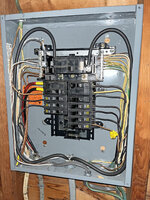
Your panel does not look 50 years old and is fine regardless. As far as what you need to charge an EV I have no idea and hope I never need to.
 

Norcal

Well-known member
Joined
Mar 16, 2008
Messages
13,753
Is there anything that yinz see that I need to fix? Anything old that needs replaced?

The doubled neutrals, & the neutral & grounding conductors under 1 screw is no good but a EZ fix. It is OK for a couple of grounding conductors to be under one screw as long as they are the same size & material, but only one neutral conductor is permitted under one set screw.
 
To avoid these ads, REGISTER NOW!
Top Bottom