Alright been looking around for a compressor, im a DIY when it comes to car stuff. I'm not looking for a compressor that could paint a car so nothing fancy.
I'm still on the toss up between a 220V unit as I need to install a subpanel in my garage for this first. And I know their better, but also a lot more $$.
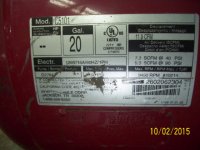
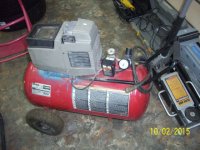
I stumbled on this 5HP, 120V, 5.8 CFM Campbell Hausfeld compressor for sale for a reasonable price but what I don't understand is how can this unit be 5HP and only be 120V?
5HP at 120V is rated at 56A according to my knowledge.
So school me here what's the catch 22 here?
As mentioned, that 5.8 cfm compressor is
NOT 5 hp.
They lied.
C-H (and Craftsman, and others) were sued several years ago (more than once IIRC) because of those lies.
http://www.truetex.com/aircompressors.htm
http://www.wisedan.com/aircomp.html
Wow, lots of input. Thanks for the info for both the compressor and shop vacs.
Still torn on whether to spend the extra bucks or not. Like a few have said, I'm more of a believer in actually using the unit then it just sitting their looking pretty - I've seen some garages on here that look fantastic but there isn't a spec of dirt anywhere's and I highly doubt it even gets used as such.
I'd prefer something a little smaller but yet powerful enough to handle DIY mechanic jobs, also considering my garage is limited in space it's a 20x20 I don't want to put in a 60gallon tank and have it take up a whole corner.
Currently my 3gallon, 120V, Craftsman just doesn't hold up to par or have the SCFM output..
http://www.quincycompressor.com/about-us/air-compressor-horse-power/
Air tools are (or can be) rather handy. I have and use several.

But air tools are rather inefficient.

First you are taking electricity (usually) and turning that into compressed air. Losses in the electric motor and losses in the compressor pump. Then you take that compressed air, run it through some (often) overly long and too narrow hose and some restrictive fittings and try and turn the potential energy stored in that compressed air back into mechanical energy in an air tool (more losses).
So if you want or need to use air tool(s), accept all that inefficiency and make sure you have 'enough' compressor to supply 'enough' air (cfm) at the needed delivery pressure for the tool(s) to work.
Just want to air up some tires and don't really care how long it takes or how noisy the compressor is?
Almost any air compressor will be 'enough'.
Want to run an air impact or air ratchet for a few (single digit) seconds?
Most any air compressor with a tank greater than 10 gallons or so will let you run a 'burst' of air to run that impact wrench or ratchet for a few seconds (because it is using the air already in the tank). After a few seconds though, the air in the tank is 'gone' and now you are at the air-flow mercy of the compressor pump. Which means you have to wait for the tank to refill.
If you want to actually figure out how much air you 'need', pick your air tool of choice and look up what cfm it uses. (note: a
LOT of air tools list the cfm 'needs' of the air tool based on a duty cycle or usage time of only 15%. So if the tool says it 'uses' 5 cfm on a 15% duty cycle, that actually means that the tool is using more than 20 cfm of air.
example time:
http://www.ingersollrandproducts.com/in-en/products/tools
Let's look at a 1/2" impact wrench, the Ingersol_Rand 231
http://www.ingersollrandproducts.co...pactools/1-2-drive/231-series/modelspec/33374
The average air consumption is only 4.2 cfm at 90 psi.
But under load (actually being used), this impact wrench is sucking air at 22 cfm!
(note: I like I-R stuff, I'm
not picking on them. I like that their web pages list the average
and the actual under-load air usage of their air tools.)
An impact wrench is (often? usually?) used for a few seconds and then you move onto the next fastener or next task, so maybe letting your air compressor tank refill is no big deal and doesn't negatively impact (no pun intended) your use of the tool or you 'work flow'.
Hmmm, how about a die grinder where you might want or need to run the tool rather continuously until the task/job is done?
I-R 3108 1/4" die grinder, only 3 cfm @ 90 psi, average air consumption.
But under load and actually being used, the tool is using 18 cfm of air at 90 psi.
If your compressor can't actually deliver 18 cfm continuously, then you will end up waiting for the compressor tank to refill before you can get back to the task at hand.
Moral: It really ***** to not have enough available air for whatever air tool you are using. Waiting for the compressor to refill the tank instead of being able to actually use the tool and do the task/job gets real annoying, real fast.
Get the biggest compressor you can (within reason, a 25 hp scroll compressor is a bit 'much' for most home usage. And you don't have the available electrical power to run it anyway.

).
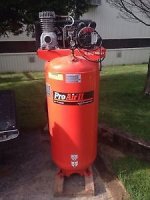
That usually means a 3-5 hp (real motor horsepower, not the bogus 'peak' rating) 60 or 80 gallon compressor that can supply ~10-20 cfm at 90 psi. Big enough to do most jobs, not so huge that you can't put it in the garage in the first place, and you can (usually) actually power it electrically. IMNSHO.


 We still have an old Hoover canister vacuum, (remember those?) that is 5 hp. We hardly ever use it anymore until we want the best possible job, like just before shampooing the carpet. Put anything within a foot of the powerhead, and it will start to move toward it. Anything within two inches or so gets sucked in.