To avoid these ads, REGISTER NOW!

60gal Compressor Installation Questions

MNiceGuy

Member
Joined
Dec 30, 2021
Messages
19
I just purchased a Quincy QT-54 and am in the process of getting its new home prepped for installation.

I have 8 THHN pulled through 1/2" EMT going to a 40A breaker. Total wiring length is about 25ft (to the main panel). This should be more than enough for the 21A Baldor as far as I can determine from searching.

QUESTION 1: To plug or not to plug. I understand that technically a plug in this situation is not acceptable unless a very expensive 5hp-rated plug is purchased. For my installation, considering the very limited access to this work area, the odds of someone unplugging a spinning motor are astronomical. In a perfect world, I'd have a 6-50P outlet or similar so a welder could be used on occasion. A friend, welder by trade, is willing to teach me via occasional lessons. If a welder became a permanent fixture I would provide it its own power source.

Could I do both this AND hard wiring? Could I drop a 6-50P in a wall box from the compressor's wall box knowing that I could never use both at the same time?

QUESTION 2: For hard-wiring, what do you use for the connection between the wall and pressure switch? I thought I could cannibalize a welder extension cord but the cost is making me think those are made of gold and condor feathers. I've been eying up a pre-made whip otherwise could I just run flexible conduit with the same THHN that is servicing the wall box from the panel?

QUESTION 3: I'm convinced the person that poured our garage slab had a clock that always pointed to Happy Hour. The slope is all over the place. I plan to mount to isolators and then thru to the floor. What do you do to account for the differences in floor height to at least get it reasonably close to level?
 
Last edited:
To avoid these ads, REGISTER NOW!

Rudyjr

Well-known member
Joined
Dec 28, 2009
Messages
555
Location
Central Ohio
My wiring for my upright 5 hp compressor terminates in a metal junction box in the wall with a metal plate screwed to it with a knockout in the center. I then ran liquidtight flexible conduit form there to the compressor switch with THHN inside it.
 

lilscorpion

Well-known member
Joined
Mar 15, 2010
Messages
3,600
Location
Colorado
I just purchased a Quincy QT-54 and am in the process of getting its new home prepped for installation.

I have 8 THHN pulled through 1/2" EMT going to a 40A breaker. Total wiring length is about 25ft (to the main panel). This should be more than enough for the 21A Baldor as far as I can determine from searching.

QUESTION 1: To plug or not to plug. I understand that technically a plug in this situation is not acceptable unless a very expensive 5hp-rated plug is purchased. For my installation, considering the very limited access to this work area, the odds of someone unplugging a spinning motor are astronomical. In a perfect world, I'd have a 6-50P outlet or similar so a welder could be used on occasion. A friend, welder by trade, is willing to teach me via occasional lessons. If a welder became a permanent fixture I would provide it its own power source.

QUESTION 2: For hard-wiring, what do you use for the connection between the wall and pressure switch? I thought I could cannibalize a welder extension cord but the cost is making me think those are made of gold and condor feathers. I've been eying up a pre-made whip otherwise could I just run flexible conduit with the same THHN that is servicing the wall box from the panel?

QUESTION 3: I'm convinced the person that poured our garage slab had a clock that always pointed to Happy Hour. The slope is all over the place. I plan to mount to isolators and then thru to the floor. What do you do to account for the differences in floor height to at least get it reasonably close to level?
Answer 1: I always plug because I've learned that I tend to want to use the outlet for something else. I know it costs a little more but to me having the option seems right.

Answer 2: I ran a soft extension-like cable between the machine and the wall that met the correct amp requirements. I ran mine to a plug that was isolated with a switch box. That's how I've always done it and I do it that way even if I put an outlet/plug for the machine. I suppose it could have been directly wired to the switch box as well.

"Safety switches are a necessity in all commercial and industrial applications, per the National Electrical Code (NEC) established by the National Fire Protection Association (NFPA). According to NEC article 430.102B, a safety switch must be located in sight from all motors or manufacturing equipment. The NEC defines “in sight” as visible and not more than 50 feet from the equipment it controls."

Answer 3: I've always left my compressors on the crate they were delivered on. Not sure if it's a bad idea or not but it has worked for a really long time. At one point I did direct mount to the floor and it was unlevel. I just shimmed up using heavy washers between the isolator and the unlevel feet until I had the entire compressor level and called it good. Think I only need a few washers at most on 2 of the feet. Worked perfectly.
 
OP
M

MNiceGuy

Member
Joined
Dec 30, 2021
Messages
19
Great info as always guys.

I'm leaning toward hard wiring due to the cost of rubber cord these days. In the future, could I run another wall box and have an outlet as well. Here's my extremely crude drawing:

1643045254626.png
 

csp

Well-known member
Joined
Mar 23, 2010
Messages
5,720
Location
Franktown, CO
Mine has a plug, but there's a disconnect between the plug and the compressor motor. It's always switched off at the disconnect before pulling the plug out of the outlet.
 

racecougar

Well-known member
Joined
Jan 26, 2021
Messages
5,180
Location
Missouri
No problem. Yes, that is the M7500 RapidAir Maxline kit. Install was super simple. I put it all up myself in a day. I've had it in place for a couple of years now, and I'm still very happy with it. Two add-ons that I did: a ball valve at each block to isolate the hoses from pressure when not in use (I don't want a hose to fail and whip around when I'm not present...or ever, really) and a water trap below each block (simple short section of pipe with a ball valve at the end).


IMG_2245.JPG
IMG_2253.JPG
IMG_2255.JPG
 
OP
M

MNiceGuy

Member
Joined
Dec 30, 2021
Messages
19
In my application, being 20ft from the main panel of the home, how necessary is the disconnect? I can't remember exactly but I believe it's 50ft to the box before something like that is needed?
 

brownbagg

Well-known member
Joined
Mar 20, 2006
Messages
5,208
mine has a welder plug that you buy from home depot, I want air, plug in wall, i want welder, plug in wall. noo instalment, its still sitting on pallet, I need air, plug the air hose in. no installment, been that way for 32 years.
 

Hobby_Man22

Well-known member
Joined
Nov 16, 2020
Messages
3,581
Location
tx
Mine has one of those 90 degree 30/50amp plugs wired into 10 guage sjoow wire. Works great. I turn it on and off from the little red switch and I can cut power from the breaker if needed. I have to walk past the panel to get to the compressor. Seems safe enough.
 

PoorUB

Well-known member
Joined
Mar 29, 2021
Messages
11,707
Location
Fargo, ND
In my application, being 20ft from the main panel of the home, how necessary is the disconnect? I can't remember exactly but I believe it's 50ft to the box before something like that is needed?
The circuit breaker has to be "in sight". If the breaker is in another room, or around the corner a disconnect is required.
 

ScaldedDog

Well-known member
Joined
Jan 15, 2008
Messages
1,065
Location
Sedalia, CO/NSB, FL
My only issue with sharing the plug with the compressor is once you learn to weld you will decide a plasma cutter is really handy and then you need the compressor and outlet at the same time....
I was thinking exactly the same thing.

As for floor mounting, both times I've installed an 80g Eaton, I just placed the compressor on a stall mat, and neither of them ever moved. I screwed my current one to the mat, only, not the floor, as a just in case. I suppose if your floor wasn't level you could do the same thing, with enough fender washers to level things up.

Mark
 

nadogail

Well-known member
Joined
Jan 23, 2009
Messages
32,044
Location
Coronado, CA
My compressor sits on the floor and has rubber tired wheels and rubber mounts under where the metal touches the floor. It is plugged into a dedicated circuit. The Welde is plugged into a 50Amp dedicated circuit.
 
To avoid these ads, REGISTER NOW!

TJMtl

Well-known member
Joined
Nov 8, 2018
Messages
247
Location
Montreal
No problem. Yes, that is the M7500 RapidAir Maxline kit. Install was super simple. I put it all up myself in a day. I've had it in place for a couple of years now, and I'm still very happy with it. Two add-ons that I did: a ball valve at each block to isolate the hoses from pressure when not in use (I don't want a hose to fail and whip around when I'm not present...or ever, really) and a water trap below each block (simple short section of pipe with a ball valve at the end).


IMG_2245.JPG
IMG_2253.JPG
IMG_2255.JPG
Great shop! How many pencil sharpeners do you have?
 

Lotek

Well-known member
Joined
Dec 9, 2007
Messages
9,098
Location
Los Angeles, Ca.
I have the same compressor, and the instructions specifically say, no insulators, just bolt it to the concrete with expansion bolts. Not an issue, because you really don't feel any vibration while it's running. My compressor has it's own circuit, the welders and the mill share a circuit, and the hoist has it's own circuit, safer that way.
 

CraigStu

Well-known member
Joined
May 22, 2014
Messages
4,053
Location
Blacksburg, Va
My old small Craftsman compressor ran on 240V. My Miller welder is also 240V and it came w/ it's own cord w/ a plug on the end. So I installed an outlet that matched the welder plug. Then I got a matching plug to replace the one on the compressor. I plug in which ever one I need so it is the compressor 95% of the time. A couple of weeks ago I got a new compressor that runs on 120V. So I ran a new 20amp outlet to plug it into. Then I decided I was tired of forgetting to turn the compressor off and hearing it later. Looked at a bunch of different options and decided on a rotary switch. The type that you turn on to the amount of expected time you will need and then it unwinds and shuts off. So I installed a new outlet box 4 inches below the existing one. Moved the outlet to the newer box, and put the timer in the first box. Now when I need air, I rotate the timer to let the compressor come on and it will shut off by itself. The timer will go for 60 minutes so it is working out fine.
 
OP
M

MNiceGuy

Member
Joined
Dec 30, 2021
Messages
19
I have the same compressor, and the instructions specifically say, no insulators, just bolt it to the concrete with expansion bolts. Not an issue, because you really don't feel any vibration while it's running. My compressor has it's own circuit, the welders and the mill share a circuit, and the hoist has it's own circuit, safer that way.

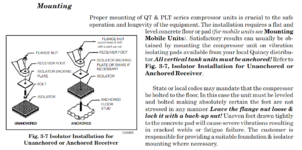
That's what I thought too but then I found this in the manual:
1643122164295.png
 

brownbagg

Well-known member
Joined
Mar 20, 2006
Messages
5,208
all vertical tanks must be mounted, who came up with that? out of fifty years, I have never mounted mine and never saw one that was. I alway slide mine away from the wall, to sweep behind it, dust get evereywhere
 

racecougar

Well-known member
Joined
Jan 26, 2021
Messages
5,180
Location
Missouri
all vertical tanks must be mounted, who came up with that? out of fifty years, I have never mounted mine and never saw one that was. I alway slide mine away from the wall, to sweep behind it, dust get evereywhere
You slide around a 60 gallon vertical compressor to sweep behind it?!
 

Rudyjr

Well-known member
Joined
Dec 28, 2009
Messages
555
Location
Central Ohio
Forgot to mention my compressor is a 1970s model 80 gallon Curtis/ Toledo two stage that is old enough to have a motor contactor /switch mounted directly to it that is used as a disconnect switch.
 

PoorUB

Well-known member
Joined
Mar 29, 2021
Messages
11,707
Location
Fargo, ND
Good luck sliding my 80 gallon Curtis to sweep behind it!

It weighs 500 pounds!

I got it used and we stripped the motor and pump from that tank to be able to load it. The tank went into the compressor closet and I reassembeld it in there. When it is time for it to come put, it will come out in pieces!
 
OP
M

MNiceGuy

Member
Joined
Dec 30, 2021
Messages
19
I'm trying to figure out why Quincy would say not to use isolators. Not picking on you Lotek as I've seen this mentioned a couple times elsewhere.

Why would you not want to dampen the vibration from a reciprocating pump? I imagine it cuts down on noise and gives the legs of the tank a little shock absorption.

I'm nearing the finish line with this project and I owe a lot to the folks on this site. Thank you to those that took the time to guide me through getting the wiring done correctly, safely, and up to code as well as making informed decisions about placement and the eventual air delivery setup.
 

Rudyjr

Well-known member
Joined
Dec 28, 2009
Messages
555
Location
Central Ohio
Yep mine weighs in at the same amount! I moved it once from our old house to where it is now and the guys that helped said never again!
 

PoorUB

Well-known member
Joined
Mar 29, 2021
Messages
11,707
Location
Fargo, ND
I have four heavy rubber pads under the legs of my 80 gallon Curtis. It isn't bolted down. It is in a 4x4 foot closet so nobody is running into it and it isn't going to fall over.
 

NUTTSGT

Super Moderator
Staff member
Joined
Sep 14, 2009
Messages
51,110
Location
Northern Central Ohio
I would, if possible, put compressor far away from your work areas as possible. Plumb the air to where you need it so you don't have to listen to it as much.

I'd use a disconnect, they are cheap and some flexible conduit to the compressor.

I use a section of hydraulic hose between the compressor and the black iron pipe of my system, along with a ball valve to shut the system down. I leave the compressor powered up all the time.

I also use some rubber pads under mine. Why not to try to dampen the vibrations down ?
 
OP
M

MNiceGuy

Member
Joined
Dec 30, 2021
Messages
19
My compressor has a 3/4" output but I'm doubting I need that much flow. Would there be any reason not to adapt down to a 1/2" regulator and go 1/2" from there?

I don't currently have any extremely high-flow tools (i.e. pressure blaster, DA)
 

fsae0607

Well-known member
Joined
Aug 15, 2011
Messages
2,290
Location
San Fernando Valley, CA
My compressor has a 3/4" output but I'm doubting I need that much flow. Would there be any reason not to adapt down to a 1/2" regulator and go 1/2" from there?

I don't currently have any extremely high-flow tools (i.e. pressure blaster, DA)
1/2" is more than enough flow. If you haven't plumbed your shop yet, you can keep it all 3/4" for more capacity. If not, 1/2" is fine.
 

Lotek

Well-known member
Joined
Dec 9, 2007
Messages
9,098
Location
Los Angeles, Ca.
My compressor has a 3/4" output but I'm doubting I need that much flow. Would there be any reason not to adapt down to a 1/2" regulator and go 1/2" from there?

I don't currently have any extremely high-flow tools (i.e. pressure blaster, DA)
Run 3/4...cause you never know...
 
OP
M

MNiceGuy

Member
Joined
Dec 30, 2021
Messages
19
Correction: the tank output is 1/2”NPT. I have no idea how I got 3/4” in my head.

I have 8awg wire running from a 40A breaker to a junction box. From there it’s going to be direct-wired to the compressor PS using flex conduit.

I’ve hit a snag:

The PS doesn’t leave a lot of room for wiring so getting 8awg to squeeze in and bend where it needs is going to be difficult. I see Quincy themselves are using 10/2 SOOW cord to go from the PS to the motor. Also, it’s hard to find 8awg spade terminals and a crimper designed for them. The 10awg terminals however are practically raining from the heavens at my local stores and I have several crimpers here that will work.

The 8awg is already paid for and in conduit so I’m going to leave that alone. I’m starting to think about running 10awg from the junction box to the compressor though. I estimate total distance will be somewhere in the 5ft range.

Should I then downgrade the breaker to 30A?
Is there a safety or performance impact to using the smaller wire?
 
To avoid these ads, REGISTER NOW!
Top Bottom