I missed out on this thread up until now because I've been on my phone app a lot and mostly read "participated" threads. It appears you've done some great work on this thing so far, I'll check it out better when on my computer this week. Keep it up!


You are using an out of date browser. It may not display this or other websites correctly.
You should upgrade or use an alternative browser.
You should upgrade or use an alternative browser.
60s Shopsmith 10e restoration
- Thread starter Scimonetti
- Start date
duke5572
Well-known member
I like it! No such thing as too in-depth on the GJ.
Hephaestus29
Well-known member
If it helps someone else it will be worth it. I always get a feeling of accomplishment when I finish something and that's how you might want to look at it. Personally I thought you could have got a newer Shopsmith ready to use for a reasonable amount of money but if that's what you want to do I'd be happy with it. You should please yourself first and not worry about what everyone else thinks.
I'm sure it will look nice when you're done. There's a guy that makes Speed Reducer kits for those older models, I've seen them on ebay before.
Here's the you tube video it's a jackshaft kit.
I'm sure it will look nice when you're done. There's a guy that makes Speed Reducer kits for those older models, I've seen them on ebay before.
Here's the you tube video it's a jackshaft kit.
Toymeister
Well-known member
It is all very similar to my experiences on 2 ER10 restorations. Well, 3 if you consider a third that I started. The real question is what you do with the ER when its done. Its an excellent DP, good spindle lathe but -relative to the Mark V shopsmiths- the usefulness drops off from there.
jakemac
Well-known member
I'm just hanging out and enjoying the ride. Keep it coming. 
OP
Scimonetti
Well-known member
Just checking, didn't realize there were so many following! I like writing out a thread like this because it helps me catch a flaw in my thinking if I have to write out something I am about to do.
I completely agree that a newer one would be more useful, but this one just dropped into my hands for 25 bucks complete and you just can't beat that. Also I really like the styling on this.
I already have a 10" table saw, 15" floor model dp and 4' homemade lathe I've turned some bowls and spindle work on, but I can find a place for this. I might use it as a drum sander, second dp, dedicated pen/spindle lathe and might even use a buffing wheel from time to time.
They just look so cool! My favorite thing to do in the shop are restorations, so I would rather have this than a new mark 5
I completely agree that a newer one would be more useful, but this one just dropped into my hands for 25 bucks complete and you just can't beat that. Also I really like the styling on this.
I already have a 10" table saw, 15" floor model dp and 4' homemade lathe I've turned some bowls and spindle work on, but I can find a place for this. I might use it as a drum sander, second dp, dedicated pen/spindle lathe and might even use a buffing wheel from time to time.

They just look so cool! My favorite thing to do in the shop are restorations, so I would rather have this than a new mark 5
OP
Scimonetti
Well-known member
I lucked out and my large puller fit


Both bearings are trashed.
The tool rest arm I put in the vise very well and hit it side to side with a hammer and pb blaster until I was able to twist it off
I need 2 handles.
As thrifty as the tennis racquet handle was, it didn't do it for me. The other one is stripped out.
These cold rolled rods I'll replace. too much pitting and set screw marks.
Other than that I am all good! Everything is apart at this point and bearings and those are all I need!


Both bearings are trashed.
The tool rest arm I put in the vise very well and hit it side to side with a hammer and pb blaster until I was able to twist it off

I need 2 handles.

As thrifty as the tennis racquet handle was, it didn't do it for me. The other one is stripped out.
These cold rolled rods I'll replace.
 too much pitting and set screw marks.
Other than that I am all good! Everything is apart at this point and bearings and those are all I need!
Last edited:
AnEv942
Well-known member
Go back to first post, edit it using advanced editor and you can change title.I should add that it is not actually from the 60s, but rather 47. The owner said 60s but that was for a different model. I wish I could change the thread title.
Pretty awesome project, as to detail-myself I enjoy more than briefly skimming over, especaily restorations. And the detail you leave out might be the one a 'lurker' is looking for..just an opinion.
I didnt quite get the wooden dowel bit, was there a set screw in the other boss?
OP
Scimonetti
Well-known member
Re: 1947 Shopsmith 10e restoration
Here's the motor I rebuilt and planned on putting on it. since I won't be putting it in the garage I will trade this and use the Dayton it came with.
Here begins the work on the Dayton.
My photobucket account is almost maxed out on bandwidth, so it will probably make all the images dead before the 28th, then reset. I'll upgrade tomorrow morning but hopefully they are up over night.

Here's a helpful tip, use the bolt to split the end bells from the center. It never goes in right when putting it together, so use that to your advantage!
 from there use a screwdriver then prybar to knock it off. The windings are perfect, as is the wiring and bearings surprisingly. Armature is rusted but noy pitted. Mineral spirits to clean windings? Or WD-40?
 looks like peanut butter!


 dark machinery gray

Torn tag corner, not sure what to do, maybe use bigger drive screw to hide it?
Here's the motor I rebuilt and planned on putting on it.
 since I won't be putting it in the garage I will trade this and use the Dayton it came with.
Here begins the work on the Dayton.
My photobucket account is almost maxed out on bandwidth, so it will probably make all the images dead before the 28th, then reset. I'll upgrade tomorrow morning but hopefully they are up over night.

Here's a helpful tip, use the bolt to split the end bells from the center. It never goes in right when putting it together, so use that to your advantage!

 from there use a screwdriver then prybar to knock it off. The windings are perfect, as is the wiring and bearings surprisingly. Armature is rusted but noy pitted. Mineral spirits to clean windings? Or WD-40?
 looks like peanut butter!


 dark machinery gray

Torn tag corner, not sure what to do, maybe use bigger drive screw to hide it?

Last edited:
OP
Scimonetti
Well-known member
Re: 1947 Shopsmith 10e restoration
I ended up using my lathe to polish one of the poles. It only took about 20 mins.
Here is at 1000 grit. I used a really hack job steady rest, didn't feel like making one. I really should at some point. It will be safer and easier.
 forgive the mess, my lathe bench always is covered in filings, sawdust and random sandpaper scraps.
 I wasn't trying to remove all pits so I started at 180 grit, then skipping some steps went up to 4000. I tried it wet but it didn't leave a shiny finish? I didn't have tailstock support so I always pushed the sandpaper towards the chuck. It hopped out once before I remembered.

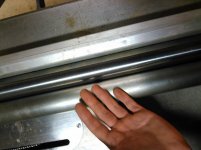
I am very happy with this so far. The pits are there but try and find them!
I ended up using my lathe to polish one of the poles. It only took about 20 mins.
Here is at 1000 grit. I used a really hack job steady rest, didn't feel like making one. I really should at some point. It will be safer and easier.
forgive the mess, my lathe bench always is covered in filings, sawdust and random sandpaper scraps. I wasn't trying to remove all pits so I started at 180 grit, then skipping some steps went up to 4000. I tried it wet but it didn't leave a shiny finish? I didn't have tailstock support so I always pushed the sandpaper towards the chuck. It hopped out once before I remembered. I am very happy with this so far. The pits are there but try and find them!
Last edited:
ctb
Well-known member
Your phone pics show up fine. All the others are gone though 
Keep up the good work.
Keep up the good work.
OP
Scimonetti
Well-known member
Re: 1947 Shopsmith 10e restoration
I do actually like how absurdly shiny these are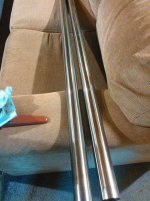
I do actually like how absurdly shiny these are
OP
Scimonetti
Well-known member
Re: 1947 Shopsmith 10e restoration
After a couple hours with the grinder and cup brush I got the castings all cleaned up. Now I will take them to the car wash this week and blast them all with hot soapy water to get all of the crud and grease off. Before priming I'll do a final degreasing with acetone or brake cleaner.

After a couple hours with the grinder and cup brush I got the castings all cleaned up.
 Now I will take them to the car wash this week and blast them all with hot soapy water to get all of the crud and grease off. Before priming I'll do a final degreasing with acetone or brake cleaner.

OP
Scimonetti
Well-known member
Re: 1947 Shopsmith 10e restoration
After 4 attempts, and several hours I got it acceptable! I waited about 12 hours after a light coat of valspar before I started to scrape off the top layer with q tips and mineral spirits.


I still have some minor clean up with once the paint cures.
Once you go too far you have to start over, there is no filling in spots. The q tips make a slurry of liquefied paint that will dry in puddles, gently smooth over everything with a blue rag soaked in mineral spirits at the end. You can always take off more but can never add to it, the paint is absorbed into the shop towel. Slow and steady and it will work fine, but also know when to stop! Example of messing up:
After 4 attempts, and several hours I got it acceptable! I waited about 12 hours after a light coat of valspar before I started to scrape off the top layer with q tips and mineral spirits.


I still have some minor clean up with once the paint cures.
Once you go too far you have to start over, there is no filling in spots. The q tips make a slurry of liquefied paint that will dry in puddles, gently smooth over everything with a blue rag soaked in mineral spirits at the end. You can always take off more but can never add to it, the paint is absorbed into the shop towel. Slow and steady and it will work fine, but also know when to stop! Example of messing up:

OP
Scimonetti
Well-known member
Re: 1947 Shopsmith 10e restoration
Okay, so I hope to get almost done in the next week. I painted about half the castings and started assembly.
This is the method of masking I used for every part.

There is an absurd amount of holes in all the accessories, so this worked great. Just make sure to not get any on your degreased piece and wipe the edges down with more degreaser. I left the motor outside overnight, dew got the best of me. luckily the primer cured before morning, no damage done.
I decided to wait until it hit 50 to paint the actual machine, that's why this has been taking so long.
I'm still kind of bummed my dad didn't want it, but it makes perfect sense. He has all the basic sawzall, chop saw, skilsaw, bench grinder, angle grinder type homeowner stuff at the house, and I doubt this would ever really get used. I am excited to have it, I will really use the lathe! Because it will live in a basement, I am keeping the 110v Dayton. Now is a good time to talk about paint choices. I used valspar cobalt cannon, the same as my 100 model drill press and table saw, and wards jointer. It is my favorite shade of blue-er dark machinery gray. The very bottom is the as found gray on the base, with a band of valspar on top.
 according to other photos the gray is a bit darker blue, http://joeswoodshop.yolasite.com/resources/10ER Jog Saw Picture1.jpg it's all I could find and had extra on hand.
Okay, so I hope to get almost done in the next week. I painted about half the castings and started assembly.
This is the method of masking I used for every part.


There is an absurd amount of holes in all the accessories, so this worked great. Just make sure to not get any on your degreased piece and wipe the edges down with more degreaser. I left the motor outside overnight, dew got the best of me.
 luckily the primer cured before morning, no damage done.
I decided to wait until it hit 50 to paint the actual machine, that's why this has been taking so long.
I'm still kind of bummed my dad didn't want it, but it makes perfect sense. He has all the basic sawzall, chop saw, skilsaw, bench grinder, angle grinder type homeowner stuff at the house, and I doubt this would ever really get used. I am excited to have it, I will really use the lathe! Because it will live in a basement, I am keeping the 110v Dayton.
 Now is a good time to talk about paint choices. I used valspar cobalt cannon, the same as my 100 model drill press and table saw, and wards jointer. It is my favorite shade of blue-er dark machinery gray. The very bottom is the as found gray on the base, with a band of valspar on top.
 according to other photos the gray is a bit darker blue, http://joeswoodshop.yolasite.com/resources/10ER Jog Saw Picture1.jpg it's all I could find and had extra on hand.
Last edited:
OP
Scimonetti
Well-known member
Re: 1947 Shopsmith 10e restoration
As I go through this down to every bolt, it really is apparent it is one of the first ones off the assembly line.
It is well built and heavy, just poorly machined in a few areas.
The quill collar that the depth gauge (which doesn't have any damn measurements on it!!!) Is a piece of vast steel that had porous faces and the most inconsistent and chattery marks on the side. I forgot to take pictures before but the sides were horrible. This side saw abuse but was made fine.
I did the faces on my 6x48 belt sander. I broke the edges with a mill ******* file then a sharpening file and round file on the edges. I started out with a file on the sides but quickly went to a dremel with 400 grit drums. I quickly realized that was ideal and did the sides with that. I then hit the whole thing with a 220grit sanding sponge and put it on! I am super pleased with this, it's the tiny details that make a resto special.


The quill bearings have not been replaced, I am ordering everything tomorrow and leaving them in for now.
As I go through this down to every bolt, it really is apparent it is one of the first ones off the assembly line.

It is well built and heavy, just poorly machined in a few areas.
The quill collar that the depth gauge (which doesn't have any damn measurements on it!!!) Is a piece of vast steel that had porous faces and the most inconsistent and chattery marks on the side. I forgot to take pictures before but the sides were horrible. This side saw abuse but was made fine.

I did the faces on my 6x48 belt sander.
 I broke the edges with a mill ******* file then a sharpening file and round file on the edges. I started out with a file on the sides but quickly went to a dremel with 400 grit drums. I quickly realized that was ideal and did the sides with that. I then hit the whole thing with a 220grit sanding sponge and put it on! I am super pleased with this, it's the tiny details that make a resto special.


The quill bearings have not been replaced, I am ordering everything tomorrow and leaving them in for now.
OP
Scimonetti
Well-known member
Re: 1947 Shopsmith 10e restoration
Here's a full page spread on the speed changer.


I have not freed the pulleys from the bronze bushing, I will wait until setup to see if they even need to be adjusted.
Here's a full page spread on the speed changer.


I have not freed the pulleys from the bronze bushing, I will wait until setup to see if they even need to be adjusted.
RickP
Well-known member
Re: 1947 Shopsmith 10e restoration
I like your detailed write-up of this resto - I'm going to follow many of your steps when I start work on my Mark V.
Sorry I can't help with your loose quill - I have the same problem but I haven't taken it apart yet to figure out how to fix it. Good luck figuring it out!
Does anybody know how to adjust for wear in a casting? I do not have the ability to bore and sleeve, I am looking for something more simple. I really appreciate any input whatsoever, even if you have never done it before anything to get me thinking is good! I am thinking of a Teflon tape of the quill lock threads to give enough resistance to apply slight pressure on the quill via the brass wedges and keep it tight without vibrating unlocked.
Thanks for any input!
I like your detailed write-up of this resto - I'm going to follow many of your steps when I start work on my Mark V.
Sorry I can't help with your loose quill - I have the same problem but I haven't taken it apart yet to figure out how to fix it. Good luck figuring it out!
OP
Scimonetti
Well-known member
Re: 1947 Shopsmith 10e restoration
Thanks, good luck on the Mark V! I know somebody who just redid one. They are certainly way more practical, and support and finding parts is easy through the actual company. There is also an easy fix for the quills on the Mark Vs, there are lock tabs that can be bent in, making the races effectively smaller. If you have any questions, don't hesitate to ask! There are other things I did that I don't think I took pictures of.I like your detailed write-up of this resto - I'm going to follow many of your steps when I start work on my Mark V.
Sorry I can't help with your loose quill - I have the same problem but I haven't taken it apart yet to figure out how to fix it. Good luck figuring it out!
OP
Scimonetti
Well-known member
Re: 1947 Shopsmith 10e restoration
Sneak peek

I have been moving things around, scroll saw and lathe are in a different side of the shop. The jointer, saw, and do are having motors swapped out currently.
Sneak peek

I have been moving things around, scroll saw and lathe are in a different side of the shop. The jointer, saw, and do are having motors swapped out currently.
Last edited:
Re: 1947 Shopsmith 10e restoration
Love your shop and the SS is coming along great! What about putting a small tack weld around one lip of the loose sleeve, then hand filing or dremel sanding it down to tolerances? You don't need a machine shop but you'd have to be real careful. Looking at what you've done so far, I think you're capable of whatever needs to be done.
Great work man!
Love your shop and the SS is coming along great! What about putting a small tack weld around one lip of the loose sleeve, then hand filing or dremel sanding it down to tolerances? You don't need a machine shop but you'd have to be real careful. Looking at what you've done so far, I think you're capable of whatever needs to be done.
Great work man!
OP
Scimonetti
Well-known member
Re: 1947 Shopsmith 10e restoration
I like that tack weld idea, but you made me think of something else, JB weld! I have never used it before, but I imagine if I put a bead around the race and jammed in the quill, spun it and quickly retracted it it would displace the JB in the high spots and fill in some of the space. I will have to test the open time and viscosity of it before I try anything though, also find which solvent will remove excess off the quill before it dries!
Thanks Nine! I have definitely put more time into the shopsmith than anything else, but I am loving it's looks so far.Love your shop and the SS is coming along great! What about putting a small tack weld around one lip of the loose sleeve, then hand filing or dremel sanding it down to tolerances? You don't need a machine shop but you'd have to be real careful. Looking at what you've done so far, I think you're capable of whatever needs to be done.
Great work man!
I like that tack weld idea, but you made me think of something else, JB weld! I have never used it before, but I imagine if I put a bead around the race and jammed in the quill, spun it and quickly retracted it it would displace the JB in the high spots and fill in some of the space. I will have to test the open time and viscosity of it before I try anything though, also find which solvent will remove excess off the quill before it dries!
If you try the JB Weld, or any epoxy method, be sure to WAX that quill and it will slide in/out better and also clean up well. Also, be sure to wipe the race area real good with acetone or similar so that the JB Weld adheres to it better. That's an old car audio installer trick.
OP
Scimonetti
Well-known member
Will do, I will be testing everything before, don't want to end up stuck! I have this metal impregnated gel epoxy that is designed for cast iron. I used it on a 4" drain pipe that cracked and it dried rock hard. I might try that instead.If you try the JB Weld, or any epoxy method, be sure to WAX that quill and it will slide in/out better and also clean up well. Also, be sure to wipe the race area real good with acetone or similar so that the JB Weld adheres to it better. That's an old car audio installer trick.
Squashfest81
Well-known member
The early machines are so cool looking.
Looking forward to the epoxy results.
The SS forum is a wealth of info. They've seen it all.
Looking forward to the epoxy results.
The SS forum is a wealth of info. They've seen it all.
OP
Scimonetti
Well-known member
Thanks everybody!
Last edited:
1/2 Cup
Member Emeritus
I have to say you do some awesome stuff, with a nice eye for detail.
Many thanks for sharing sir.
Many thanks for sharing sir.
OP
Scimonetti
Well-known member
Thank you! I figured it's time for a quick update. I ordered a bunch of rod, bearings and drive screws and am just waiting. I got the 1" bar last weekendI have to say you do some awesome stuff, with a nice eye for detail.
Many thanks for sharing sir.

I have a local supplier, but they have limited hours and 20 ft minimums on most stuff. Online was about 30 bucks delivered to my door.
I also tested the quill for runout with my new lever indicator.

around 8 thou 3/4 of the way out, slightly less as pictured. Priority is getting it working, then I'll open up a new project with that.
Last edited:
1/2 Cup
Member Emeritus
I am hearing you, life does get busy
OP
Scimonetti
Well-known member
Re: 1947 Shopsmith 10e restoration
Good news, the file cabinets have very good ball bearing slides and are very handy.


They work great for storing stuff used less than daily. I need to get more for tool bases!
Bad news, they are identical in build and color, but an inch different depth!

Ill just take that into account building the bench, no big deal
Good news, the file cabinets have very good ball bearing slides and are very handy.


They work great for storing stuff used less than daily. I need to get more for tool bases!
Bad news, they are identical in build and color, but an inch different depth!

Ill just take that into account building the bench, no big deal
bulletpruf
Well-known member
Great thread! Love your attention to detail. Lots of great tips here. No such thing as too detailed on GJ!
Scott
Scott
RTUmark
Well-known member
Nice work. Enjoying it.
Squashfest81
Well-known member
It's looking good. File cabs make great storage. Perfect for that lathe. The inch difference strikes me as very strange. Would have guessed they would all be pretty standard...
njhoudini
Well-known member
Though it's been a few years since this thread was active, I just acquired the same exact machine. My problem is I can't get the quill to move. Do you have any advice? Any recommendations are much appreciated.
usdemt
Well-known member
This brings back memories. This was my late grandfathers 10er. It had been sitting in my parents basement for 40+ years. I dug it out and it is now my go to drill press. I added a variable frequency drive to mine to make it more useful.
View media item 93202
View media item 93201
View media item 93200
View media item 93203
View media item 93198
View media item 93199
View media item 93202
View media item 93201
View media item 93200
View media item 93203
View media item 93198
View media item 93199
njhoudini
Well-known member
This brings back memories. This was my late grandfathers 10er. It had been sitting in my parents basement for 40+ years. I dug it out and it is now my go to drill press. I added a variable frequency drive to mine to make it more useful.
View media item 93202
Very nice! How did you remove the rust before painting? I'm able to do electrolysis, but I'm guessing that will take a lot longer than I want to wait. On the upside, I do have 2 machines so I suppose I could restore one while using the other. Definitely want to clean up all of my way tubes.
usdemt
Well-known member
Lots and lots of sandblasting. For the way tubes I actually used another shop Smith with wheels at one end to turn them and sand then polish.
njhoudini
Well-known member
Did you have to chase any threads or were all in pretty good shape? Sorry for all of the questions, but it's what I'm working on lately and I just noticed that my saw arbor doesn't have a set screw. Hoping that the $0.68 pair that Lowe's carries is a good match.