To avoid these ads, REGISTER NOW!

A/C disconnect

Status
Not open for further replies.

MikeF2316

Well-known member
Joined
Dec 29, 2012
Messages
9,605
Location
Thornhill, ON
I'm thinking of replacing my 25+ year old house A/C. It's still working fine, but it's showing its age. Currently there is no disconnect, so before I call any contractors, I'd like to add one. I have 2 questions:

1. Is there a type that I should avoid? There's the pull-out for safety, or the no pull-out so nothing can get lost. This will be out in the weather too.

2. Is there a minimum height for installation? Currently there is only about 3 feet of wire outside, the cable come through only a few inches above the ground.
 
To avoid these ads, REGISTER NOW!

Brian_WK

Well-known member
Joined
Jun 30, 2015
Messages
1,177
Location
NE South Dakota
As a A/C guy who has dealt with both. I hate the pull out kind. The fake breaker kind is way nicer to deal with. Also if yours is ran in conduit I would look in pulling a hot and neutral 120v and get the one with a integrated outlet. My city requires a outlet with-in 10 visible feet of the A/c condenser unit when changing the disconnect.

Brian
 

brewchief

Well-known member
Joined
Sep 20, 2008
Messages
2,370
Location
Michigan
I would talk to the contractors first, as an HVAC contractor I end up replacing about 75% of the disconnects when we replace a unit.

If you want to replace it you need to know what the max fuse size for the new unit will be, you don't want to put a 30 amp fusible on and end up with a unit that needs a 35 and you don't want a 60 fusible when max is a 30 amp fuse since 30 amp fuses won't fit in a 60 amp holder. Using a 60 unfused sounds good except when it comes time to track down an uncommon size breaker.

We run across a job like yours with no disconnect on occasion and we simply install a new disconnect, we don't charge extra for it.
 

wyliesdiesels

Well-known member
Joined
Aug 14, 2012
Messages
19,983
Location
Modesto, CA
As a A/C guy who has dealt with both. I hate the pull out kind. The fake breaker kind is way nicer to deal with. Also if yours is ran in conduit I would look in pulling a hot and neutral 120v and get the one with a integrated outlet. My city requires a outlet with-in 10 visible feet of the A/c condenser unit when changing the disconnect.

Brian

The service outlet is required by NEC so this is a good point to bring up.
 

Trey T

Well-known member
Joined
Aug 3, 2011
Messages
3,749
Location
Houston, TX
I prefer something simple which is the pull-out disconnect w/ fuse. The proper fuse (slow blow) sitting close to the unit will provide the best protection for the outdoor unit.

The height of the disconnect box is likely dependent on local codes but fundamentally, it should be above the concrete slab or house floor. For best practice, it should be about 3ft above ground level or above the condenser.
 
OP
M

MikeF2316

Well-known member
Joined
Dec 29, 2012
Messages
9,605
Location
Thornhill, ON
Thanks for all the replies.

The cable is 10/2 NMD90, it goes through the basement wall behind the furnace apparently upprotected. When it appears on the outside, it's in conduit. Note my main floor is about 3 feet above grade.

I was under the impression these disconnects were just 60 amp capable switches, there was no current protection in them, like this one. If it should have current protection, then I'd at least wait until I knew what was recommended for whatever I buy. Although I see there's a Square D one that takes what appears to be a normal breaker.

Since I'm limited by the amount of wire outside, I guess it will just get mounted as high as possible.

There is already a 120 volt plug "just around the corner". It's more than 10' away, but less than 20. If I really need one closer, then it would be easier tapping off the furnace room light or one of the other outlets that are handy there. (But don't worry, I won't use the furnace circuit.)
 

thewatusi

Well-known member
Joined
Dec 27, 2013
Messages
1,256
Location
Philly Burbs
I just got a new HVAC system in October and they replaced the disconnect as part of their package price. Just let them do it.
 

wyliesdiesels

Well-known member
Joined
Aug 14, 2012
Messages
19,983
Location
Modesto, CA
Thanks for all the replies.

The cable is 10/2 NMD90, it goes through the basement wall behind the furnace apparently upprotected. When it appears on the outside, it's in conduit. Note my main floor is about 3 feet above grade.

I was under the impression these disconnects were just 60 amp capable switches, there was no current protection in them, like this one. If it should have current protection, then I'd at least wait until I knew what was recommended for whatever I buy. Although I see there's a Square D one that takes what appears to be a normal breaker.

Since I'm limited by the amount of wire outside, I guess it will just get mounted as high as possible.

There is already a 120 volt plug "just around the corner". It's more than 10' away, but less than 20. If I really need one closer, then it would be easier tapping off the furnace room light or one of the other outlets that are handy there. (But don't worry, I won't use the furnace circuit.)

Fuses would be required if the unit nameplate only lists fuses...another reason why you need to know what you have.
 
OP
M

MikeF2316

Well-known member
Joined
Dec 29, 2012
Messages
9,605
Location
Thornhill, ON
Fuses would be required if the unit nameplate only lists fuses...another reason why you need to know what you have.

OK, you guys have convinced me to do nothing... :lol_hitti

Any contractor that tries to add a ridiculous amount to install a disconnect just won't get the job.
 

LS6 Tommy

Well-known member
Joined
Dec 27, 2013
Messages
26,162
Location
Northern NJ
NEC requires a disconnect if the breaker panel is not within sight of the unit and cannot be locked in the "Off" position. The total current draw of every motor load in the machine is considered to figure the disconnect load rating, not the breaker or wire size. The fuse size used in a fused disconnect is rated the same way. UL rated equipment manufacturers sometimes require a fused disconnect because breakers are not considered current limiting and the unit was tested with a fused disconnect.

If the unit label states "maximum fuse size" you must have a fused disconnect. If it says "Use HACR breaker" you do not need to use a fused disconnect.

Tommy
 
Last edited:

Norcal

Well-known member
Joined
Mar 16, 2008
Messages
13,752
The OP is in Canada & Canukistani code is not nessasarly the same as the NEC.
 

eddieK

Well-known member
Joined
Mar 2, 2017
Messages
695
Location
Nampa Idaho
The service outlet is required by NEC so this is a good point to bring up.

It's only required when the breaker is more than 50' from unit and not in line of sight.

I prefer fused disconnect with 5 amp smaller fuses than breaker, so it is the weakest point. As long as your equipment minimum size is at least 30...#10 wire protection is a 30 amp breaker and then install 25 amp fuses. Look at new unit nomenclature, it will show minimum ampacity and maximum fuse/breaker size.

48" above grade AND 18" from unit, left or right. (local code) Install quote should include new fusible disconnect.

Most importantly, an A/C unit needs it's own ground wire, back to the panel. You can no longer consider the conduit as your ground...and if you still could, it's a bad idea.
 
Last edited:

wyliesdiesels

Well-known member
Joined
Aug 14, 2012
Messages
19,983
Location
Modesto, CA
It's only required when the breaker is more than 50' from unit and not in line of sight.

I prefer fused disconnect with 5 amp smaller fuses than breaker, so it is the weakest point. As long as your equipment minimum size is at least 30...#10 wire protection is a 30 amp breaker and then install 25 amp fuses. Look at new unit nomenclature, it will show minimum ampacity and maximum fuse/breaker size.

48" above grade AND 18" from unit, left or right. (local code) Install quote should include new fusible disconnect.

Most importantly, an A/C unit needs it's own ground wire, back to the panel. You can no longer consider the conduit as your ground...and if you still could, it's a bad idea.

Youre confusing different things.

I said service OUTLET not service disconnect.

A service outlet is required so a service technician has a place to plug in equipment such as vacuum pump for refrigerant recovery.

And installing fuses that are rated for less than the nameplate calls for is a violation.

Also, there are units that call for combinations that have breakers rated higher than the wire ampacity. Such as #10 on a 50a breaker... this is code permissable.

So dont automatically go to #10 and 30a...

240.4(D) doesnt apply to air conditioners among other things.
 
Last edited:

eddieK

Well-known member
Joined
Mar 2, 2017
Messages
695
Location
Nampa Idaho
Youre confusing different things.

I said service OUTLET not service disconnect.

A service outlet is required so a service technician has a place to plug in equipment such as vacuum pump for refrigerant recovery.

And installing fuses that are rated for less than the nameplate calls for is a violation.

Also, there are units that call for combinations that have breakers rated higher than the wire ampacity. Such as #10 on a 50a breaker... this is code permissable.

So dont automatically go to #10 and 30a...

240.4(D) doesnt apply to air conditioners among other things.

I don't know where you got your training...but wow.

I've been in this trade since 1978...

Breakers and fuses protect the wire...#10 is for UP TO 30 amp load, absolutely NO more.

You can legally and safely under size fuses, for example...unit calls for maximum 30 amp breaker, it's RLA is 20...you can safely install 25 amp fuses to protect the wire between the disconnect and the outdoor unit.

I was responding to the main question about an outdoor diaconnect... it's nice to have an outlet near for vacuum pump etc...but hardly an issue.

Service outlets are not required in my zone ( southern cal...only in some cases on commercial properties when specifically called out for.) If the national electrical code has been updated to service outlet requirements...I guarantee they are not grand fathered onto existing residences.
 
Last edited:

alfredeneuman

Well-known member
Joined
Mar 3, 2011
Messages
4,580
Location
Fullerton, CA
I don't know where you got your training...but wow.

I've been in this trade since 1978...

Breakers and fuses protect the wire...#10 is for UP TO 30 amp load, absolutely NO more.

Exceptions to that rule apply to motor, AC loads, and welders because of start currents or duty cycle

Read Articles 430, 440, and 630 carefully
 
Last edited:

alfredeneuman

Well-known member
Joined
Mar 3, 2011
Messages
4,580
Location
Fullerton, CA
I should qualify this by saying all of these are permitted to be on bigger breakers than listed in Article 310
The #10 wire is allowed in the cases of motors and AC is 35Amps, unless it's NM cable
 
Last edited:

bigb56

Well-known member
Joined
Jan 27, 2018
Messages
169
Location
Tucson, Arizona
I don't know where you got your training...but wow.

I've been in this trade since 1978...
.

I am assuming you mean the HVAC trade not the electrical trade because you are completely off base and wyliesdiesels is absolutely correct. Have you ever even looked in a code book? Just sayin. The rules regarding motor circuits are probably the least understood of all.
 
Last edited:
To avoid these ads, REGISTER NOW!

eddieK

Well-known member
Joined
Mar 2, 2017
Messages
695
Location
Nampa Idaho
I am assuming you mean the HVAC trade not the electrical trade because you are completely off base and wyliesdiesels is absolutely correct. Have you ever even looked in a code book? Just sayin. The rules regarding motor circuits are probably the least understood of all.

This is a discussion about residential HVAC. There is NEVER a case to use a 50 amp breaker with number 10 wires on a unit with a maximum amp draw of 30...ever.
 

eddieK

Well-known member
Joined
Mar 2, 2017
Messages
695
Location
Nampa Idaho
In my area any time the unit is replaced the service receptacle is required to be added.

In residential? Maybe commercial...If this is a requirement a hose bib within a reasonable distance would also be required.
 

bigb56

Well-known member
Joined
Jan 27, 2018
Messages
169
Location
Tucson, Arizona
This is a discussion about residential HVAC. There is NEVER a case to use a 50 amp breaker with number 10 wires on a unit with a maximum amp draw of 30...ever.

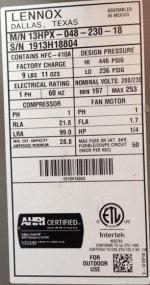
I disagree.... this unit can be wired with #10 & a 50 amp breaker safely and legally, residential or commercial, in the US.
 

Attachments

  • name plate.JPG
    name plate.JPG
    48.6 KB · Views: 98
Last edited:

Norcal

Well-known member
Joined
Mar 16, 2008
Messages
13,752
I disagree.... this unit can be wired with #10 & a 50 amp breaker safely and legally, residential or commercial, in the US.

I agree, that poster needs to read the code articles suggested by alfredeneuman. Wire for the minimum, use maximum overcurrent protection allowed by the data plate.

The reason it's allowed is that the compressor has overload protection, the fuses/circuit breaker is for short circuit protection.
 

eddieK

Well-known member
Joined
Mar 2, 2017
Messages
695
Location
Nampa Idaho
I agree, that poster needs to read the code articles suggested by alfredeneuman. Wire for the minimum, use maximum overcurrent protection allowed by the data plate.

The reason it's allowed is that the compressor has overload protection, the fuses/circuit breaker is for short circuit protection.

Its summer...temps rise to 110 F...the filter is plugged up, the condenser coil is blocked...liquid refrigerant is slugging the compressor and the fuses blow. 110 ambient, 380 head pressure, 140 suction pressure, one leg of the compressor is drawing 18.6 the other is drawing 20 ...They call out a repairman and he notices the blown fuses sees a 50 amp breaker and installs 50 amp fuses at the unit - the nomenclature is no longer readable due to the sun and age, the unit still won't start because the high pressure switch has failed in the open position. He simply wires it out and the unit starts...now that undersize wire is subject to higher amperage that it is designed to carry.

This is why in this trade you never undersize the wire and hope a units overload protection never fails. That internal overload may trip and trip and trip...but in the process it leaves a dangerous situation before it does. I've seen bars in panels melt - seen breakers completely blown up. At least the wire was not burning in the structure at a pinch or a junction, because they were sized larger than the maximum amp draw.
 

grounded-b

Well-known member
Joined
Oct 23, 2012
Messages
285
Location
Milwaukee, WI
I don't know where you got your training...but wow.

I've been in this trade since 1978...

Breakers and fuses protect the wire...#10 is for UP TO 30 amp load, absolutely NO more.


I do not know where YOU got your training.... But the NEC definitely allows you to put OCPD's rated for more than the wire ampacity on HVAC equipment.

35 years as a commercial/industrial electrician.

The manufacturer states it all right there on the nameplate: "Minimum circuit ampacity" = wire size. "Maximum OCPD" = HACR rated breaker or fuse size.

breaker/fuse will usually be higher than the wire ampacity.

Steve
 

Bert_

Well-known member
Joined
Dec 24, 2016
Messages
9,697
Location
NW Iowa
Its summer...temps rise to 110 F...the filter is plugged up, the condenser coil is blocked...liquid refrigerant is slugging the compressor and the fuses blow. 110 ambient, 380 head pressure, 140 suction pressure, one leg of the compressor is drawing 18.6 the other is drawing 20 ...They call out a repairman and he notices the blown fuses sees a 50 amp breaker and installs 50 amp fuses at the unit - the nomenclature is no longer readable due to the sun and age, the unit still won't start because the high pressure switch has failed in the open position. He simply wires it out and the unit starts...now that undersize wire is subject to higher amperage that it is designed to carry.

This is why in this trade you never undersize the wire and hope a units overload protection never fails. That internal overload may trip and trip and trip...but in the process it leaves a dangerous situation before it does. I've seen bars in panels melt - seen breakers completely blown up. At least the wire was not burning in the structure at a pinch or a junction, because they were sized larger than the maximum amp draw.

If that is the way you do things that's fine, your certainly not breaking any codes by over sizing the wire a couple times. The fact remains that the NEC, even the label right on the unit, clearly allow you to use a larger breaker than normal for a given wire size, to allow for startup.

If you feel so strongly about your beliefs maybe you should write up some code proposals instead of preaching to us here.
 

tapered-pin

Well-known member
Joined
Sep 12, 2017
Messages
277
Location
Alpharetta, GA
lol, you guys are comical..

You honestly believe that a medium sized home (2,000-3,500 SF) has two 2.5T or 3.0T AC units and two 50A breakers (and the accompanying 6ga wire) in the panel for them...?
(yes, i realize that image was from a 4T unit)

I dont care what the NEC says, that's not how things are installed..
 

eddieK

Well-known member
Joined
Mar 2, 2017
Messages
695
Location
Nampa Idaho
:lol_hitti You don't have a clue

In the 40 years I have been opening panels to inspect/repair/replace A/C units in Southern California I have yet to recall finding something like was described - #10 wired to a 50 amp breaker. What I do see is people following basic guidelines for copper wire (it's always up sized with aluminum)...30 amp breaker #10 4 amp breaker #8 50 amp breaker #6.

This is because the internal, heat controlled overload resets after it cools. This causes units to repeat high amp draws without tripping breaker or blowing fuses. I've seen many bus bars in panels burned out completely without harm to the wire...if a unit that draws 20 RLA ran with #10 wire to a 50 amp breaker and has excessive pressure/heat that amp draw skyrockets (LRA because the rotor is locked) overloading the wire with more amps than it is designed to carry...This is without even taking into consideration the particular circuit length.

In operation the typical scenario is...

Leave the unit running because they think it may possibly fix itself "if we just keep lowering the temp at the stat"...Now we have an internal overload that is short cycling every time... overload...cool down...overload...cool down

When a unit is struggling to handle over charge or excessive pressures the LRA is extended. Instead of momentary (so fast you almost can't read it) it can become a constant and does certainly lengthen for an extended duration.
 
Last edited:

eddieK

Well-known member
Joined
Mar 2, 2017
Messages
695
Location
Nampa Idaho
If that is the way you do things that's fine, your certainly not breaking any codes by over sizing the wire a couple times. The fact remains that the NEC, even the label right on the unit, clearly allow you to use a larger breaker than normal for a given wire size, to allow for startup.

If you feel so strongly about your beliefs maybe you should write up some code proposals instead of preaching to us here.

It's not oversizing the wire a couple times. It's installing the proper breaker/fuses and the appropriate wire size for the RLA.
 

Norcal

Well-known member
Joined
Mar 16, 2008
Messages
13,752
It's not oversizing the wire a couple times. It's installing the proper breaker/fuses and the appropriate wire size for the RLA.

You can pound your fists on the floor & kick your legs all you want, but wiring A/C equipment per the manufacturers data plate, minimum circuit amperes, & maximum overcurrent protection, is still code compliant, took me a while to get it, but it meets code requirments & so there is nothing wrong with it.
 

eddieK

Well-known member
Joined
Mar 2, 2017
Messages
695
Location
Nampa Idaho
You can pound your fists on the floor & kick your legs all you want, but wiring A/C equipment per the manufacturers data plate, minimum circuit amperes, & maximum overcurrent protection, is still code compliant, took me a while to get it, but it meets code requirments & so there is nothing wrong with it.

It's still not done. Unless you happen to trust the only protective device left in the circuit...and no one I know does.

You assume what I am talking about is NOT following the unit data plate requirements. In fact I am speaking of holding to them in the most protective manner possible.

So far, not one person commenting from the minimum NEC requirements has spoken of wire distance and the associated resistance.
 
Status
Not open for further replies.
To avoid these ads, REGISTER NOW!
Top Bottom