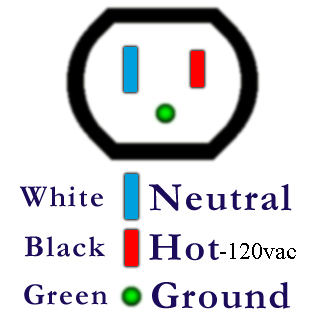
1. Does it matter which screw (brass screws) on a duplex outlet the line or load gets hooked to...I dont see where it would matter but code wise, maybe it does... at any rate..., I would like to create a standard and thus far it has been line or power in on top screw and outgoing power to next outlet or fixture is bottom screw...
As long as we're talking about standard (i.e., not GFCI or other "special purpose") duplex outlets, it really doesn't matter. Each of the two screws in either set (i.e., brass or silver/tinned, for the Hot and Neutral conductors, respectively) are in parallel (electrically identical) until and unless you remove the little "jumper tabs" on the sides of the device (which you would do only if you wanted to run each socket in the duplex from a different circuit or switch leg).
Personally, I generally use whichever set makes for the "neatest" installation and aids packing of the excess wire into the back of the box when I'm done. There's really no point in being sufficiently OCD as to insist that all the outlets in a given room (or given house, or whatever) use the same set of screws.
2. I keep seeing where people are posting that all outlets in "garages" need GFCI outlets. Is my 30x50 shop which is 90 yds from my house considered a "garage"..?
By my read, yes. But I don't claim to be an expert at interpreting the NEC.
I have already installed 2 gang outlets (20 amp tamper proof) throughout my shop and it will get rather pricey if I have to stop mid stream and change all of these out...?

You don't need to change ALL the outlets. At worst, you need to change the FIRST outlet in any given "daisy chain" of outlets which all run off the same breaker. The GFCI outlet will also have TWO sets of terminals. But in this case, one set is marked "Line" (to which the feed from the breaker connects), and the other is marked "Load" (which gets used to feed the "downstream" outlets, thus automagically also providing GFCI protection for them, as well).
Usually the duplex outlet has brass screws on the right side and silver on the left and hot in on the right "copper" side and neutral on the left
That would depend on the orientation of the outlet in the box.

While MOST folks tend to install duplexes so that the EGC prong is on the bottom, as illustrated in the link you posted:
The pseudo-official NEMA illustrations almost always show it the other way:
thank you both for the replies which leads me to two more questions...
Jayrush: Are you saying that I can run a jumper wire for power from one duplex to the other in the same box...? I have wondered about this and have seen it done like this in some diagrams. I did this on one of my circuits like this to save box space from the wire nuts the pigtails would have required. Could you explain this a little further as to the reasoning of using the pigtail method esp when they are side by side...
Either method (i.e., via pigtail or by using the second set of screws to feed "daisy-chained" outlets) is as good as the other from a load and safety standpoint.
The main point of the pigtail method is to ease future troubleshooting. If/when you have trouble with one of the outlets on a given chain, you can easily remove the suspect outlet WITHOUT breaking the "downstream" circuit. Similarly, if something goes wrong with THAT outlet, so that power no longer flows, it doesn't also take out all the downstream ones.
Mr Finn: If I stored a mower or ATV in the shop would that fit the Gasoline storage criteria you mentioned thus making it fall in the garage category ?
I could be wrong; but I do not believe that "gasoline storage" is the definitive issue.
And If I do put in GFCIs eventually, someone on here , mentioned that only the first outlet in the circuit had to be GFCI which would in effect protect the other downstream receptacles...? Could you clarify this as well...?
See above. Also, see the following illustrations:
As someone mentioned, the "Load" terminals are usually/often covered with some yellow tape when you first purchase the device.
Tim - not sure if you saw the explanation of terminal screw colors in post #4, but the white wire goes on the silver screw and the black wire goes on the gold screw terminal.
Good point. I (among others) assumed he already knew that, and was asking about "which brass screw" and "which silver screw"; but it certainly doesn't hurt to make sure the basics are covered!
B = Black = Brass
That's the memory trick for me to remember it....
That works, too!