To avoid these ads, REGISTER NOW!

A couple basic electric questions...?

Tim Fitzgerald

Well-known member
Joined
Dec 1, 2013
Messages
60
Location
Anacoco, La
1. Does it matter which screw (brass screws) on a duplex outlet the line or load gets hooked to...I dont see where it would matter but code wise, maybe it does... at any rate..., I would like to create a standard and thus far it has been line or power in on top screw and outgoing power to next outlet or fixture is bottom screw...

2. I keep seeing where people are posting that all outlets in "garages" need GFCI outlets. Is my 30x50 shop which is 90 yds from my house considered a "garage"..? I have already installed 2 gang outlets (20 amp tamper proof) throughout my shop and it will get rather pricey if I have to stop mid stream and change all of these out...?:headscrat

3. I am not an electrician but am doing my own wiring. I study each step or process for a lengthy amount of time to ensure I do things safely and from how I understand it to code. These two basic questions have eluded me though and i would like a solid answer...?
 
To avoid these ads, REGISTER NOW!

jayrush13

Well-known member
Joined
Dec 30, 2006
Messages
340
Location
Lebanon Oregon
1. Does it matter which screw (brass screws) on a duplex outlet the line or load gets hooked to...I dont see where it would matter but code wise, maybe it does... at any rate..., I would like to create a standard and thus far it has been line or power in on top screw and outgoing power to next outlet or fixture is bottom screw...

2. I keep seeing where people are posting that all outlets in "garages" need GFCI outlets. Is my 30x50 shop which is 90 yds from my house considered a "garage"..? I have already installed 2 gang outlets (20 amp tamper proof) throughout my shop and it will get rather pricey if I have to stop mid stream and change all of these out...?:headscrat

3. I am not an electrician but am doing my own wiring. I study each step or process for a lengthy amount of time to ensure I do things safely and from how I understand it to code. These two basic questions have eluded me though and i would like a solid answer...?


#1 there is no line in line out srew except on a GFCI outlet. With that said I would wire nut the incoming and outgoing wires and put a pigtail to the receptical that way it's not part of the circuit path


#2 any garage or shop or basement would need GFCI outlets
 

JoeFin

Well-known member
Joined
Sep 13, 2013
Messages
717
Location
NorCal - where the Rednecks Race
No t doesn't matter which screw you use for line or load on duplex recps. It just means your very meticulous

Its only a "Garage" by the NEC definition "IF" you store cars (gasoline storage) in it. But if it is a dedicated "Wood Shop" then that could become an entirely different Div. and Class. hazardous area
 

jayrush13

Well-known member
Joined
Dec 30, 2006
Messages
340
Location
Lebanon Oregon
this is from 2005 NEC but it hasn't changed much


210.8 Ground-Fault Circuit-Interrupter Protection for Personnel.
FPN: See 215.9 for ground-fault circuit- interrupter protection for personnel on feeders.
(A) All Occupancies. All 125-volt, single-phase, 15 and 20-ampere receptacles installed in the locations specified in (1) through (9) shall have ground-fault circuit-interrupter protection for personnel.

(1) Bathrooms

(2) Garages, and also accessory building that have a floor located at or below grade level not intended as habitable rooms and limited to storage area, work areas, and areas of similar use
 
OP
T

Tim Fitzgerald

Well-known member
Joined
Dec 1, 2013
Messages
60
Location
Anacoco, La
thank you both for the replies which leads me to two more questions...

Jayrush: Are you saying that I can run a jumper wire for power from one duplex to the other in the same box...? I have wondered about this and have seen it done like this in some diagrams. I did this on one of my circuits like this to save box space from the wire nuts the pigtails would have required. Could you explain this a little further as to the reasoning of using the pigtail method esp when they are side by side...

Mr Finn: If I stored a mower or ATV in the shop would that fit the Gasoline storage criteria you mentioned thus making it fall in the garage category ?

And If I do put in GFCIs eventually, someone on here , mentioned that only the first outlet in the circuit had to be GFCI which would in effect protect the other downstream receptacles...? Could you clarify this as well...?
 

Xtremetalworks2

Well-known member
Joined
Nov 7, 2011
Messages
66
Location
Honeoye Falls,NY
Wow dont think ive been in a garage/shop yet with GFCI ...Interesting guess if its a huge concern can always invest in on GFCI Extension outlet OSHA approved of course.. :)
 

chaingang

Well-known member
Joined
Oct 5, 2006
Messages
246
Location
B'ville Ga
Being mindful of correct wiring, line side/load side, a GFCI will protect the string after the initial outlet.

Do you have to get it inspected? If so, call the inspector and ask him about the GFCI issue. If not, I wouldn't worry about it. My inspector never questioned it on my detached shop.
 

jayrush13

Well-known member
Joined
Dec 30, 2006
Messages
340
Location
Lebanon Oregon
thank you both for the replies which leads me to two more questions...

Jayrush: Are you saying that I can run a jumper wire for power from one duplex to the other in the same box...? I have wondered about this and have seen it done like this in some diagrams. I did this on one of my circuits like this to save box space from the wire nuts the pigtails would have required. Could you explain this a little further as to the reasoning of using the pigtail method esp when they are side by side...

Mr Finn: If I stored a mower or ATV in the shop would that fit the Gasoline storage criteria you mentioned thus making it fall in the garage category ?

And If I do put in GFCIs eventually, someone on here , mentioned that only the first outlet in the circuit had to be GFCI which would in effect protect the other downstream receptacles...? Could you clarify this as well...?


I just found this pic on google images

View media item 36593
but you can see there is a black in and out and a white in and out and ground in and out. they are wire nutted to a smaller (pig tail) that is connected to the receptacle. That way if something did happen to the receptacle it would more than likely not effect devices down stream


As far as GFCI circuits you would just have to put one at the first receptacle then feed the rest of the load side of the GFCI that would be a time when you wouldn't pig tail your circuit you feed the line on one set of screws and the load on the other
 

Stuart in MN

Well-known member
Joined
Sep 8, 2005
Messages
22,995
Location
Minneapolis
You didn't mention where you live, but in most if not all parts of the US any residential garage is required to have GFCI receptacles. It doesn't matter if it's attached to the house or separate, or if there's gasoline in there or not, it could be a woodworking shop and the same rules apply.

Yes, you can put a GFCI receptacle in the first spot and then use regular receptacles downstream of that. They have 'line in' and 'line out' connections. You are supposed to put little stickers on the downstream receptacles to indicate they're GFCI protected, there should be some in the package with the GFCI.

The flip side of this is you want to make sure that GFCI in the first spot is easily accessible, you don't want to have it hidden behind a cabinet where it's hard to reach if you have to reset it.

Finally, you can get GFCI breakers that go in your panel and then use regular receptacles in all the spots, but they're fairly expensive.
 
To avoid these ads, REGISTER NOW!

mooseeater19

Active member
Joined
Nov 29, 2013
Messages
31
Location
BC Canada
thank you both for the replies which leads me to two more questions...

Jayrush: Are you saying that I can run a jumper wire for power from one duplex to the other in the same box...? I have wondered about this and have seen it done like this in some diagrams. I did this on one of my circuits like this to save box space from the wire nuts the pigtails would have required. Could you explain this a little further as to the reasoning of using the pigtail method esp when they are side by side...

And If I do put in GFCIs eventually, someone on here , mentioned that only the first outlet in the circuit had to be GFCI which would in effect protect the other downstream receptacles...? Could you clarify this as well...?

The pigtail method is preferred because the circuit does not rely on the terminal screws to provide a fool proof connection and if the quick wire connections on the receptacle are used this a recipe for failure down the road.

The gfci recpts have terminals marked LINE and LOAD ,the incoming power is hooked to the LINE terminals and the outgoing wires feeding the rest of the circuit are connected to the LOAD terminals.
 

Charles (in GA)

Well-known member
Joined
Jan 11, 2006
Messages
12,489
Location
50 mi south of Atlanta
GFCI receptacles have clearly marked Line (input) and Load (output) terminals. Most are the backwire type where you loosen the side screw and push the wire straight in and tighten the screw securely. Usually a new GFCI receptacle has the Load terminals taped over with a thin band of yellow tape, which you remove if you are daisy chaining receptacles downstream from it. A 15 amp GFCI will be rated for a 20 amp feed thru, so no need to buy a 20 amp receptacle version.

Charles
 

RickP

Well-known member
Joined
Jan 15, 2013
Messages
1,547
Location
Annapolis, MD
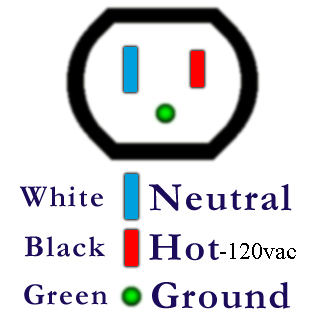
Tim - not sure if you saw the explanation of terminal screw colors in post #4, but the white wire goes on the silver screw and the black wire goes on the gold screw terminal.

Edit: maybe I misunderstood your question - if so, sorry about that!
 
Last edited:

sberry

Banned
Joined
Jun 18, 2005
Messages
35,747
Location
Brethren, Michigan
Rick, good job. Worth making clear. I need to go back and gfci a circuit or 2 myself where they got installed early on, and it has defaulted in to convenience outlets with the potential user unaware they are not on gfci, have some bypassed for heating and cooling equipment. I got one available if I decide to run a cord thru a mud puddle. Got them on outdoor.

I got some dangerous **** in general and could easily spend a couple days fixing a few code violations but thanks to forums over the years have corrected a lot of work that I installed 35 years ago early in my career as well as done a ton of upgrades. Its amazing a guy can have a PHD and cant fathom installing installing a wire from a panel to outlet. It aint only them but a lot of people that should know don't.
 
Last edited:

67carl

Well-known member
Joined
Dec 10, 2013
Messages
3,887
Location
California
Pictures are worth... Well, you know. I just finished wiring my garage and pictures were invaluable. To summarize what others have said:

* black wire to brass screw
* white wire to silver screw
* make first receptacle in the circuit a GFCI and the others downstream can be standard
* pigtail the line/load connection in the box to the receptacle
 

Attachments

  • image.jpg
    image.jpg
    109 KB · Views: 49

rharman

Well-known member
Joined
Apr 22, 2012
Messages
8,735
Location
SoCal
Tim - not sure if you saw the explanation of terminal screw colors in post #4, but the white wire goes on the silver screw and the black wire goes on the gold screw terminal.

Edit: maybe I misunderstood your question - if so, sorry about that!

B = Black = Brass

That's the memory trick for me to remember it....
 

2ManyProjects

Well-known member
Joined
Jul 18, 2013
Messages
757
1. Does it matter which screw (brass screws) on a duplex outlet the line or load gets hooked to...I dont see where it would matter but code wise, maybe it does... at any rate..., I would like to create a standard and thus far it has been line or power in on top screw and outgoing power to next outlet or fixture is bottom screw...

As long as we're talking about standard (i.e., not GFCI or other "special purpose") duplex outlets, it really doesn't matter. Each of the two screws in either set (i.e., brass or silver/tinned, for the Hot and Neutral conductors, respectively) are in parallel (electrically identical) until and unless you remove the little "jumper tabs" on the sides of the device (which you would do only if you wanted to run each socket in the duplex from a different circuit or switch leg).

Personally, I generally use whichever set makes for the "neatest" installation and aids packing of the excess wire into the back of the box when I'm done. There's really no point in being sufficiently OCD as to insist that all the outlets in a given room (or given house, or whatever) use the same set of screws.

2. I keep seeing where people are posting that all outlets in "garages" need GFCI outlets. Is my 30x50 shop which is 90 yds from my house considered a "garage"..?

By my read, yes. But I don't claim to be an expert at interpreting the NEC.

I have already installed 2 gang outlets (20 amp tamper proof) throughout my shop and it will get rather pricey if I have to stop mid stream and change all of these out...?:headscrat

You don't need to change ALL the outlets. At worst, you need to change the FIRST outlet in any given "daisy chain" of outlets which all run off the same breaker. The GFCI outlet will also have TWO sets of terminals. But in this case, one set is marked "Line" (to which the feed from the breaker connects), and the other is marked "Load" (which gets used to feed the "downstream" outlets, thus automagically also providing GFCI protection for them, as well).


Usually the duplex outlet has brass screws on the right side and silver on the left and hot in on the right "copper" side and neutral on the left

That would depend on the orientation of the outlet in the box. ;)

While MOST folks tend to install duplexes so that the EGC prong is on the bottom, as illustrated in the link you posted:

7_outlet_wiring.jpg


The pseudo-official NEMA illustrations almost always show it the other way:

nema-receptacle-5-15r.jpg


thank you both for the replies which leads me to two more questions...

Jayrush: Are you saying that I can run a jumper wire for power from one duplex to the other in the same box...? I have wondered about this and have seen it done like this in some diagrams. I did this on one of my circuits like this to save box space from the wire nuts the pigtails would have required. Could you explain this a little further as to the reasoning of using the pigtail method esp when they are side by side...

Either method (i.e., via pigtail or by using the second set of screws to feed "daisy-chained" outlets) is as good as the other from a load and safety standpoint.

The main point of the pigtail method is to ease future troubleshooting. If/when you have trouble with one of the outlets on a given chain, you can easily remove the suspect outlet WITHOUT breaking the "downstream" circuit. Similarly, if something goes wrong with THAT outlet, so that power no longer flows, it doesn't also take out all the downstream ones.

Mr Finn: If I stored a mower or ATV in the shop would that fit the Gasoline storage criteria you mentioned thus making it fall in the garage category ?

I could be wrong; but I do not believe that "gasoline storage" is the definitive issue.

And If I do put in GFCIs eventually, someone on here , mentioned that only the first outlet in the circuit had to be GFCI which would in effect protect the other downstream receptacles...? Could you clarify this as well...?

See above. Also, see the following illustrations:

GFI-Outlet-Install.jpg

8_DSC06507.jpg


As someone mentioned, the "Load" terminals are usually/often covered with some yellow tape when you first purchase the device.


Tim - not sure if you saw the explanation of terminal screw colors in post #4, but the white wire goes on the silver screw and the black wire goes on the gold screw terminal.

Good point. I (among others) assumed he already knew that, and was asking about "which brass screw" and "which silver screw"; but it certainly doesn't hurt to make sure the basics are covered!

B = Black = Brass

That's the memory trick for me to remember it....

That works, too! ;)


JoeFin

Well-known member
Joined
Sep 13, 2013
Messages
717
Location
NorCal - where the Rednecks Race
I could be wrong; but I do not believe that "gasoline storage" is the definitive issue.

I realize its not enforced in all parts of the country - but yes the garage is or can be classified as "Temporary Gasoline Storage" (fuel in the tank)

Out here you are required to have vents in the walls, a 1 hour fire barrier (*** Firerock) and all the receptacles greater then 18" above finished floor.

The classified area is the floor and 18" above
 

Zeke

Well-known member
Joined
Aug 13, 2009
Messages
17,176
Location
Long Beach CA, the sewer by the sea.
I realize its not enforced in all parts of the country - but yes the garage is or can be classified as "Temporary Gasoline Storage" (fuel in the tank)

Out here you are required to have vents in the walls, a 1 hour fire barrier (*** Firerock) and all the receptacles greater then 18" above finished floor.

The classified area is the floor and 18" above

It's the NEC, National Electric code. It's not just out here.

AFA as pigtailing I like the idea because I can run stranded to the device and make it a lot easier to pull out if needed. Even better would be using terminals at the end of the stranded under the lugs. But, how often do you need to change out outlets?
 
To avoid these ads, REGISTER NOW!
Top Bottom