To avoid these ads, REGISTER NOW!

A Question about Tool History

Downwindtracker 2

Well-known member
Joined
Jun 13, 2019
Messages
1,715
Location
BC
Digging through a box of wrenches at the fleamarket there were many combination wrenches, but only a couple of double open ended, both Craftsman =V=, BTW. This got me questioning when did combinations become the common wrench ? I know Plomb invented the combination as we know it. When my Dad after the war bought a set of wrenches, it was a big deal then, it was a set of DOE . Twenty years later in the late '60 when I bought a set of wrenches, they were combinations.
 
To avoid these ads, REGISTER NOW!

r_olson_06

Well-known member
Joined
Feb 12, 2012
Messages
4,160
Location
SD
Not entirely for sure. I know that I see quite a few =v= combos. The earlier underline versions are hard to come by. I know SK didn't make them early on and made DBEs for quite a while. As mentioned about Plomb I see combos being the most popular in their 40s generation stuff but the earlier versions are really rare. I would say sometime mid to late 40s but just my humble opinion.

Looking for the following Plomb Pebbles Wrench 3061
 

Oldtuleguy

Well-known member
Joined
Nov 4, 2017
Messages
10,472
Blackhawk had some pretty early combos. Here is a 30s hexo and some later hexites. For blackhawk it seems combos became more common later, almost 60s. If I were making wrenches,l would rather sell doe and box than combos, basically doubling my sales!
 

Attachments

  • 20190714_132333.jpg
    20190714_132333.jpg
    77.9 KB · Views: 38

Farmer J.

Well-known member
Joined
Sep 18, 2016
Messages
1,997
Location
UK, Cornwall/Hertfordshire.
I think that combination wrenches only became common at the same time as interchangeable sockets, and they are usually only of any use when used as a compliment to a socket wrench set.. They're totally useless and very frustrating if one has to undo a bolt with a nut on it nut and are in a field on the prarie miles from anywhere with only a combination wrench. The bolt head and the nut are both the same size, and so are both ends of the wrench, but you can only use one of them at a time! I think they probably became popular from the 1940's onward as the earliest ones I have seen here are from WW2 tool kits.
Just my opinion, interested if anyone knows more on this.
 

d42jeep

Well-known member
Joined
Oct 22, 2014
Messages
16,672
Location
Northern California
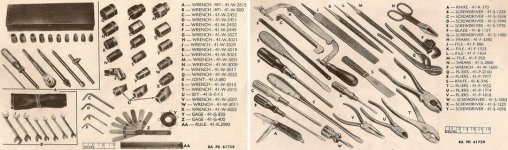
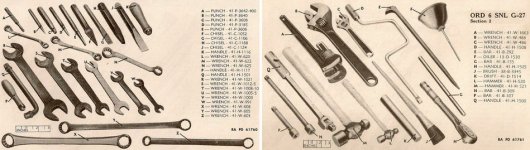
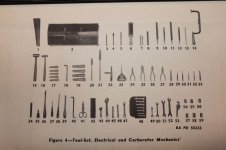
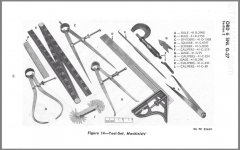
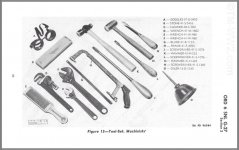
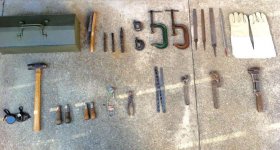
Actually, during WW2, combination wrenches were not included in the early Motor Vehicle Mechanic’s Tool Sets or the later but similar General Mechanic’s Tool Sets. They only included Double Open End and Double Box End wrenches.
-Don
 

Attachments

  • 49A926F0-79F2-4BD5-A060-97FB22501217.jpg
    49A926F0-79F2-4BD5-A060-97FB22501217.jpg
    50.2 KB · Views: 36
  • 3F9E1A77-7950-4A01-8507-53FA98231B6B.jpeg
    3F9E1A77-7950-4A01-8507-53FA98231B6B.jpeg
    111.8 KB · Views: 29
  • ADFCFC03-9CB1-4A50-85F3-F9B4668E3921.jpeg
    ADFCFC03-9CB1-4A50-85F3-F9B4668E3921.jpeg
    92.8 KB · Views: 22
Last edited:

Private Lugnutz

Well-known member
Joined
Mar 30, 2012
Messages
30,958
Location
The Authentic Jersey Shore
I know SK didn't make them early on and made DBEs for quite a while.
Funny you should mention SK. There is a Plomb ad from April 1933 floating around where they are extolling the virtues of combination wrenches "eliminating S.K.*" When you follow the little asterisk to the footnote, it says, "Skinned Knuckles," but I always read it like Plomb throwing a little shade on Sherman Klove.

I think that combination wrenches only became common at the same time as interchangeable sockets,
Plomb made the first ever set of combination open/box end wrenches in 1933, about 13 years after interchangeable sockets.

Farmer J. said:
The bolt head and the nut are both the same size, and so are both ends of the wrench, but you can only use one of them at a time!
The common efficiency angle (reducing the number of your end wrenches by half) is a fallacy for the same reason. In the 40's, you could go from 3/8" to 1" in six (6) DOE's (723, 25, 27C, 28S, 731A, and 33C) without duplicating an opening/end, and covering both SAE and USS fasteners. Same range, opening sizes, and standards coverage with six (6) DBEs (723, 25, 727, 29, 731A, and 33C). That's a total of twelve shanks. You would still need twelve (12) wrenches to cover those openings with both end types with combination wrenches.

Actually, during WW2, combination wrenches were not included in the early Motor Vehicle Mechanic’s Tool Sets or the later but similar General Mechanic’s Tool Sets. They only included Double Open End and Double Box End wrenches.
They weren't included in the Emergency Repair Truck's Master Mechanics kits, either. I can check later tonight, but I don't believe they appear in the ORD 5 SNL J-4 catalog.

Given that there was no customer larger than the military in the 40's, I think it's fair to say it took until at least the 50's for combos to become more popular than DOE's and DBE's.
 

Provincial

Well-known member
Joined
Sep 21, 2011
Messages
6,882
Location
Near Salem, OR
One factor in the spread of combination wrenches was the improvement in strength of steels used to make the wrenches. Combinations became practical only after better steels became available.

I believe that this enabled designers to make devices that had less accessible fasteners. This degraded access was enabled by the widespread adoption of detachable socket wrench sets, which allowed fasteners to be recessed behind obstructions. Not only that, but as sockets developed further, they became thinner-walled, requiring less space around the fastener head in any recess.

As a result, the socket wrench became the desired tool, and the end (open- or box-) was relegated to holding the opposite end of a fastener that used a nut. Box ends can access a tighter spot and require less space around the fastener head than open-end wrenches. Thus, the open-end became less utilized, but never completely obsoleted. In my observation, combination wrenches displaced double-open-end wrenches more than double-box-end wrenches.

The DBE can apply more torque than a DOE for two reasons. First, it applies the torque over all the points of the hex, and second, the length of the wrench can be greater due to the greater torque capacity of the box design. I was taught early in my mechanical training to always use a box or socket if possible.

In practice, one rarely would be in a situation where one only had one set of combination wrenches. They would more likely be teamed with a set of DBE wrenches, and possibly a set of DOE wrenches. In my case, I never owned DOE wrenches, since I had DBE, combos, and sockets. The exception for this was obstruction and tubing wrenches, which are a special case.
 

Farmer J.

Well-known member
Joined
Sep 18, 2016
Messages
1,997
Location
UK, Cornwall/Hertfordshire.
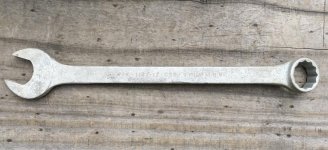
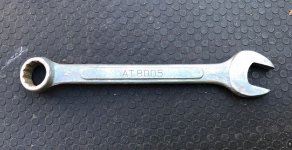
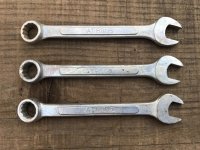
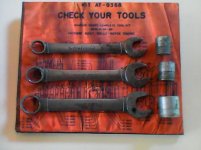
Don, Lugz and Provincial. Thank you for posting all the extra information on this as it has been something I have occasionally wondered about for years. I should have said in my post above " The earliest combination wrenches I have seen here are the 3 'AT' ones I have from the WW2 Merlin Engine tool kit".. Rather a small sample for me to base a wide sweeping judgement on! Later today I was driving the tractor, and thought "I reckon those GMTK's only had DBE's and DBE wrenches"!
 

Private Lugnutz

Well-known member
Joined
Mar 30, 2012
Messages
30,958
Location
The Authentic Jersey Shore
Provincial:

Great points! But the apotheosis of what you're describing (modern steel composition and tool design) happened in the late 1930's (Zenel, Vitalloy) through 1943 (end of WPB/AISI "New Emergency" steel development). That is when triple alloys (entire AISI 8XXX series) were born. Relatively speaking, modern end (box, open, combo) and socket wrenches don't look much different. It seems inconceivable when almost everything else has transformed so drastically (automobiles, for example) in the same time period. But if you compare the profile (dimensions) and weight of end (open, box, or combo) and socket wrenches today to the same wrenches in WWII, you would find negligible (< / = 3%) difference. Processes for double- and triple-alloy steel have been tweaked for hardness, tensile strength, and durability, but the overall sleekness of wrenches has not changed much.

My point is that despite their advantages, for the reasons you so poignantly described, it still took another 10 or so years for them to catch on for some reason.

Probably just human natural forces resisting change, if I had to guess.
 

BarryWells

Well-known member
Joined
May 26, 2019
Messages
647
Location
In the mountains
You have found a real nice thing(s) to hunt down and collect. They were/are HEAVY DUTY
Not so much practical like todays offerings......but who cares ?
 

Private Lugnutz

Well-known member
Joined
Mar 30, 2012
Messages
30,958
Location
The Authentic Jersey Shore
Rather a small sample for me to base a wide sweeping judgement on!
Maybe not. Maybe it's our GMTK fixations abnormally coloring our impressions. And maybe your instincts were pretty good! :)

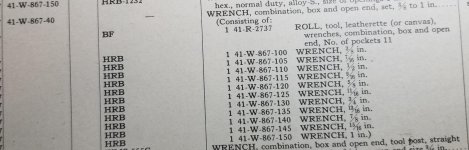
There are combination wrenches listed in the April 1945 Ordnance Supply Catalog ORD 5 SNL J-4, and there is an 11-wrench set listed, too!

attachment.php


attachment.php


Unlike more specific Ordnance catalogs for a specific truck (e.g., jeep) or a specific tool-set (e.g. MVTS/GMTS, or colloquially, "GMTK"), the ORD 5 is a comprehensive catalog for all common tools and equipment, so I can't use it to identify the application. Which means I have no idea where (echelon, etc) or by whom these combination wrenches or the set were used. It wasn't in any of the upper echelon sets.

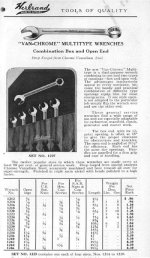
The "BF" refers to Bonney Forge and the "HRB" refers to Herbrand. The numbers are model numbers. The 11xx series is Bonney TuType and later Bonaloy. The 12xx series was Herbrand Multi-Type. The numbers in that column that start with an A or B are Ordnance Dept stock numbers (drawing numbers). It doesn't mean only Bonney and Herbrand supplied them wrenches. That column is a Specification column. When the Ordnance Dept had a drawing, they used their own stock number. When they didn't, they used an industry standard.

As I have said many times before here on GJ, I don't tend to collect combination wrenches, mainly because my collecting all started with WWII jeep and GMTK sets, which, as Don pointed out, didn't include combos. So I don't have any examples of Bonney or Herbrand combos to show.

But here are some 1941 and 1942 catalog excerpts...

attachment.php


attachment.php
 

Attachments

  • 1942 Herbrand Multi-Type Wrenches.jpg
    1942 Herbrand Multi-Type Wrenches.jpg
    111 KB · Views: 173
  • 1941 Bonney TuType cat excerpt.jpg
    1941 Bonney TuType cat excerpt.jpg
    125.6 KB · Views: 175
  • ORD 5 Combos 2.jpg
    ORD 5 Combos 2.jpg
    102.2 KB · Views: 175
  • ORD 5 Combos.jpg
    ORD 5 Combos.jpg
    158 KB · Views: 175
Last edited:

d42jeep

Well-known member
Joined
Oct 22, 2014
Messages
16,672
Location
Northern California
In the few additional WW2 sets I’ve put together, there were no combination wrenches included. I have plenty of wartime combos in various brands, though.
-Don
 

Attachments

  • 03F163E1-0C39-44CD-87A4-61993C3321F2.jpeg
    03F163E1-0C39-44CD-87A4-61993C3321F2.jpeg
    83.3 KB · Views: 16
  • 84AC5477-81E2-4D55-92DE-83866B30D9A5.jpeg
    84AC5477-81E2-4D55-92DE-83866B30D9A5.jpeg
    110 KB · Views: 18
  • E55AFFF8-1C16-4CEA-B4A8-945AB182A170.jpeg
    E55AFFF8-1C16-4CEA-B4A8-945AB182A170.jpeg
    85.8 KB · Views: 15
  • 9B5731FC-017A-4654-B09F-B67F186537AF.jpeg
    9B5731FC-017A-4654-B09F-B67F186537AF.jpeg
    103.2 KB · Views: 15
  • 16997C71-856D-4C88-8828-1ACEE51F91F2.jpeg
    16997C71-856D-4C88-8828-1ACEE51F91F2.jpeg
    77.3 KB · Views: 15
  • AA2D3B64-C571-4E45-A902-7631920519BD.jpeg
    AA2D3B64-C571-4E45-A902-7631920519BD.jpeg
    90.6 KB · Views: 16
Last edited:

d42jeep

Well-known member
Joined
Oct 22, 2014
Messages
16,672
Location
Northern California
More set pictures.
-Don
 

Attachments

  • E39683F0-0093-474C-B56A-C807BE3F0FA8.jpeg
    E39683F0-0093-474C-B56A-C807BE3F0FA8.jpeg
    85 KB · Views: 12
  • A7E08E08-4463-4E3C-9173-1E50E58E6B0B.jpeg
    A7E08E08-4463-4E3C-9173-1E50E58E6B0B.jpeg
    105.2 KB · Views: 13
  • DF4DBA02-F17A-4DB5-BA7C-397B3DA04415.jpeg
    DF4DBA02-F17A-4DB5-BA7C-397B3DA04415.jpeg
    56.3 KB · Views: 12
  • B515257B-3607-4148-989A-AD1D7BBD7723.jpg
    B515257B-3607-4148-989A-AD1D7BBD7723.jpg
    103.9 KB · Views: 12
To avoid these ads, REGISTER NOW!

d42jeep

Well-known member
Joined
Oct 22, 2014
Messages
16,672
Location
Northern California
The Navy lists some combos as well as the ones Lugz pointed out.
-Don
 

Attachments

  • A233A47B-B974-441D-8EF9-A7808F1CFBC7.jpg
    A233A47B-B974-441D-8EF9-A7808F1CFBC7.jpg
    148 KB · Views: 13
  • EC2B6258-01CA-4F59-A079-54AE0481616D.jpg
    EC2B6258-01CA-4F59-A079-54AE0481616D.jpg
    149 KB · Views: 12
Last edited:

d42jeep

Well-known member
Joined
Oct 22, 2014
Messages
16,672
Location
Northern California
Don, Lugz and Provincial. Thank you for posting all the extra information on this as it has been something I have occasionally wondered about for years. I should have said in my post above " The earliest combination wrenches I have seen here are the 3 'AT' ones I have from the WW2 Merlin Engine tool kit".. Rather a small sample for me to base a wide sweeping judgement on! Later today I was driving the tractor, and thought "I reckon those GMTK's only had DBE's and DBE wrenches"!

No Barcalo collection should be without at least one AT combo wrench.
-Don
 

Attachments

  • 8E2DD518-7020-4481-94A8-25C598E06F48.jpeg
    8E2DD518-7020-4481-94A8-25C598E06F48.jpeg
    120.3 KB · Views: 20
  • 865F0EA7-1CB3-43C1-BEA3-2C5D62676835.jpeg
    865F0EA7-1CB3-43C1-BEA3-2C5D62676835.jpeg
    111.9 KB · Views: 19
  • 0F35A7CD-CF1C-46C5-9A1A-7398CCDE9FDE.jpeg
    0F35A7CD-CF1C-46C5-9A1A-7398CCDE9FDE.jpeg
    113.1 KB · Views: 23
  • A85F84E4-280B-4959-8CEF-EA0EBE4DAD8E.jpg
    A85F84E4-280B-4959-8CEF-EA0EBE4DAD8E.jpg
    149.2 KB · Views: 18
Last edited:
OP
D

Downwindtracker 2

Well-known member
Joined
Jun 13, 2019
Messages
1,715
Location
BC
So during the war, combinations were available but not considered essential. Unlike now when it's the first wrench set you buy. Looking back on my first wrench set I purchased in the '60s, 20 years after the war, combinations were the main ones available then.
 

d42jeep

Well-known member
Joined
Oct 22, 2014
Messages
16,672
Location
Northern California
So during the war, combinations were available but not considered essential. Unlike now when it's the first wrench set you buy. Looking back on my first wrench set I purchased in the '60s, 20 years after the war, combinations were the main ones available then.

Exactly. Now whenever I grab a wrench to use on a job, it’s almost always a combo. Occasionally I’ll use a DBE but rarely a DOE. It’s funny how things have changed over the years.
-Don
 
OP
D

Downwindtracker 2

Well-known member
Joined
Jun 13, 2019
Messages
1,715
Location
BC
Recently I've discovered that I'm finding short deep offset box ends handy around the mill and lathe. Rest of the time much like you.

Ray
 

Private Lugnutz

Well-known member
Joined
Mar 30, 2012
Messages
30,958
Location
The Authentic Jersey Shore
So during the war, combinations were available but not considered essential.
That's a good and fair summary. I am sure the combos in the 1945 catalog were essential to something, but it wasn't the ~175,000 GMTK's shipped to the ETO and issued to every individual general mechanic in the US Army Ordnance Dept, one each, at 2nd, 3rd and 4th echelon, or to the two gigantic unit-level toolsets (No. 1 and No. 2) issued to every 3rd and 4th echelon maintenance depot from which individual mechanics also drew tools. I'd like to find out where they were used.

I didn't expect to spark you all off on such a lot of research and a debate just to follow it up..!
It's a good question (when exactly did combos become go-to?), the Army is a good yardstick, and I am on a mission.

Judging by my GMTK tool inspection layouts (with life-size outlines), it was at least 1973...

View media item 83650
...and well before 1980! :)

View media item 83653
But the gap in my Army general maintenance research between 1945 and 1973 is pretty big! :lol:

I can tell you that by 1949 the Army had dropped DOE wrenches from the on-board toolkits put on trucks. But that might not mean so much as the definition of driver-level Preventive Maintenance was changing.

I have a line on a 1955 document that should be very helpful. I will report back when I have read it.
 
Last edited:
OP
D

Downwindtracker 2

Well-known member
Joined
Jun 13, 2019
Messages
1,715
Location
BC
"But the gap in my Army general maintenance research between 1945 and 1973 is pretty big! "

Your comment got me thinking. I had thought about it from the sales point of view. An impossible search. I doubt Sears has last year's numbers. let alone some from the '50s or '60s. But your idea of tool kits is clever. In the tool catalogues there are mechanic's tool kits, in the Master, they try to sell every tool they make. But in the Apprentice kit might suggest what the tool companies thought.

In the 1952 Gray-Bonney catalogue , they only list a Master set, and it does not contain combinations. They made them, but the listing for DOEs, take up a page.
 
Last edited:

Private Lugnutz

Well-known member
Joined
Mar 30, 2012
Messages
30,958
Location
The Authentic Jersey Shore
I went through the catalogs with order/sequence of presentation in mind, and in the wrench section, most mfgrs were still listing DOEs first, then DBEs, then Combos, well into the 50's. But I didn't think of the Master Mechanics type kits. That's a much better idea. I tend to disagree with you about their purpose. Many of the Master Mechanics type kits were explicitly configured for and advertised as the tools needed by senior mechanics to accomplish all of the most common jobs. I do think their contents would be telling.

EDIT: I have a game tonight. But I will have some time to go through some catalogs tomorrow. I plan to pick mfgrs for whom I know I have 30's and 50's catalogs.
 
Last edited:
OP
D

Downwindtracker 2

Well-known member
Joined
Jun 13, 2019
Messages
1,715
Location
BC
In the 1954 Plomb-Proto catalogue the mechanics tool set has combinations and DBEs. Canada being behind the States in those years, the Gray -Bonney of 1952 reflects that.
 
To avoid these ads, REGISTER NOW!
Top Bottom