To avoid these ads, REGISTER NOW!

A question for Window installers.

Hiball

Well-known member
Joined
Apr 30, 2009
Messages
14,026
Location
Missery
I’m in the process of building a New house and we decided to go with Anderson 200 double hung windows. I feel like the installer my builder used might not of been up to the task. I went around and checked all the windows after he left and the reveal was solid when you opened the window an inch or so and when closed, so I assumed everything was golden.

I’m gonna preface the next section by explaining I’m not a builder, so my technical descriptions might be off.

I started noticing soon after that the windows started getting wonky, the bottom reveal was out of whack, as was the reveal on the side between the sash and frame/jamb. I voiced my concern with the builder and he sent the window rep from the lumber yard to the house. Come to find out, the installer removed all the shims at the bottom and didn’t use any between the jamb and wall framing, so the entire window was being supported by the nailing flange. I was told this is a No.. No especially on some of my Bigger windows that are molded in the middle.

I tried finding the information on Anderson site but couldn’t seem to find it, What is a good reveal distance between the sash and frame/jamb. Currently mine is all over the place and I would definitely like to be more on top of the situation when the installer shows up next week to address the install issues.

Thanks fellas.
 
To avoid these ads, REGISTER NOW!
OP
H

Hiball

Well-known member
Joined
Apr 30, 2009
Messages
14,026
Location
Missery
Nail fin windows are designed to be supported by the nail fin, no shims needed. Reveals should be equal all around.
So no support on the bottom of the window between the window and sill? I’m not questioning you, but the window rep was adamant, especially on my larger windows that there needed to be support at the base. In regards to the reveal on the sides, is that not adjusted with shims? I only ask because I can reach up and grab the frame and move it in/out a substantial distance.
 

The Cobbler

Super Moderator
Staff member
Joined
Oct 24, 2013
Messages
25,806
Location
Niagara Region, Ontario, Canada
any window projects I was involved in, there was a shim on each lower corner & the middle of the frame. never used any windows with nail fins but I can see that sagging on a large window with no support
 
OP
H

Hiball

Well-known member
Joined
Apr 30, 2009
Messages
14,026
Location
Missery
I think you should call Anderson.
A case has already been opened, but they won’t send their rep till the lumber yard window/door guy gives his report and based off our conversation my windows are suffering from poor install practices.
 
OP
H

Hiball

Well-known member
Joined
Apr 30, 2009
Messages
14,026
Location
Missery
That is not what Marvin Windows says in their install guide.

I would expect it should be properly shimmed all the way around.
I managed to navigate the Anderson website and found there technical Installation documents. The windows are definitely supposed to have shims on the bottom and sides during the installation process.
Unfortunately, my installer used carpenter pencils on the sill during the initial set, but after leveling it and putting nails in the flange he removed the pencils.
 

Wolley

Well-known member
Joined
Jun 24, 2022
Messages
420
Location
Maine
I recently installed a couple Andersen 100 Windows and the nail flange was quite lame. If your RO is on the bigger side I could see them being flexible. There is a ton of install info on the Andersen website for all windows. I could see not having shims on the bottom once nailed. If the sides are bowed it could be how it was nailed.
 
OP
H

Hiball

Well-known member
Joined
Apr 30, 2009
Messages
14,026
Location
Missery
If they screwed that up, better check on how the flashed/taped the outside. Leaks ****
Amazingly, they got that right. I was concerned when I didn’t notice that the drip cap wasn't installed till after the vinyl was in place, but after some phone calls and research. It appears that’s pretty common on New Construction/flange window installation, when house wrap and flashing tape is installed properly.
 
To avoid these ads, REGISTER NOW!

loganb

ALLIANCE MEMBER
Joined
Dec 29, 2011
Messages
5,496
Location
Omaha, NE
Chiming in to try and remember this thread tomorrow for a longer reply

Windows should be shimmed, hung windows especially as too much shimming will hourglass(bow inward) the frame and makes hard to operate, not enough shimming and the weatherstripping don't make proper contact between frame and sash

The fasteners thru the nail fin attach the window to the structure and secure it during wind events against both positive and negative pressures. Shimming is done for different reasons and is absolutely still required on nailfin installation
 

mark198

Active member
Joined
Jan 13, 2012
Messages
29
Hiball, what are you referring to when you say reveal, is the interior trim in place?

Under no circumstances should the frame move when pushed or pulled?

If the windows are new construction/nail fin, from my experience a standard size is supported by shims on the bottom corners only, the nail fin does the rest. Pocket instal/replacement windows need side shims because they have screws through the jambs into the rough opening.

If the installer is not certified by Andersen, they will walk away from an installation issue, they will only warranty defects with their product. I would find out if it your builder or installer is certified, if they are not I would begin conversations with your builder regarding how they will correct it.
 
OP
H

Hiball

Well-known member
Joined
Apr 30, 2009
Messages
14,026
Location
Missery
Hiball, what are you referring to when you say reveal, is the interior trim in place?
Yeah this is where my non-construction background muddies things up. When I say reveal I’m talking about the gap between the window sash and the frame/jamb on most windows. I also have some windows, where if you open the bottom window, say an inch or so and stand back and look the distance between the bottom of the window and lower frame isn’t even all the way across. The trim guys wouldn’t even begin to try and trim the windows out because of the above issues.
Under no circumstances should the frame move when pushed or pulled?
There is No frame movement In/out but from the unfinished inside, I can squeeze the jambs and control the gap relatively easily between the sash/side jamb. I can do this because there is No friggin shims there also. On the plus side, the windows are level and plumb and corner to corner measurements are within a 1/8” if not spot on.

Thanks
 

loganb

ALLIANCE MEMBER
Joined
Dec 29, 2011
Messages
5,496
Location
Omaha, NE
So when there is a question about window install, the first step should be the instructions from the manufacturer in question. There are a lot of common practices and some industry standards, but at the end of the day the manufacturer is the one standing behind the warranty and if you don't install it as they say and problems arise down the road, you can be at risk if you didn't install per their instructions. A very significant % of window and door issues are due to the installation not being done correctly....plus they're not cheap so you want to be confident that everything is right!

So for Andersen, you can get printed instructions that are customized for your application below:


I've attached what I expect is the proper instructions for this project based on the details shared above regarding product and project

And look what's on Pg 4

shim.png

Ok, so shim's must be important....let's scroll thru and see where they're required to be "properly shimmed"

Pg 11, Image 16 calls for shims under the jambs, inset 1/4" from each side

Note that on Image 17 they call for a "backbed" sealant bed to be placed on the sheathing/weather barrier prior to the window being set into the opening. This particular call out varies on mfg and also by weather barrier system being used, again when in question refer to the installation instructions from each manufacturer

Now getting to the meat of it....Image 19 and 21 are what you're needing:
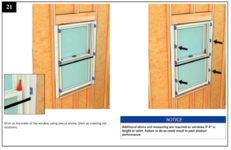
image 21.png

Step 19 calls out where you need to shim for your 2 and 3 wide units that you may have, insuring you have shims under all jambs/mullions

21 shown above calls out the requirements for where shims at the jambs should be for hung units. If units are taller than 5'4" you should add the additional shim locations at the "middle" of each sash stile...not that it's not necessarily bad to do that on shorter units, but not as important. As mentioned above, hung windows rely on weatherstrip contact between frame and sash to seal the air/water out. Those weatherstrips push against the jamb and will bow it outwards if not properly shimmed. When that jamb bows outwards, the pressure of the weaterstrip against the sash isn't as designed, which will generally negatively impact performance...air leakage goes up, operating force may be off...sashes may "sag" or "droop" when opened...lots of things happen

Note that at this point, properly shimmed is relative and you're still only working with a window with (1) fastener attaching it to the building per prior steps so you need to be careful when operating, but the sash to frame reveal should be equal and consistent from side to side, both when sash are closed as well as when open. Operate both sashes several times and see how it looks. If you have a laser you can use that to shoot a beam on the jamb and see both if it's straight(not bowed) as well as plumb and then if it's moving around as you operate a sash.

Completing the fastening of the windows isn't done till step 25 on their document...aka AFTER it's fully shimmed, square and level. Getting things square, plumb and shimmed can be fast or slow...it's all dependent on the quality of the rough opening. If sill is level, jambs are plumb and the opening is both square and the right size...this goes quickly. If you have to compensate for framing issues...this gets more challenging but it's critical for a quality installation.


So some other things to watch for....based on the lack of shims I'm not expecting all the other things were done right either....

To properly shim...the windows need the fasteners into the nail fin removed...which if they're flashed and sealed properly will be "fun". Trying to shim while fully anchored isn't effective because the anchors are preventing the frame jambs from moving as desired

Note the fastener chart on Pg 2....especially the spacing call out. Common error is not putting in the required fasteners....it says "every hole" so it should be done as documented.

The flashing sequence for sealing the window flange to the weather barrier is important for proper "watershed" or "shingle" style water management....review it and see how it looks compared to what's there...not saying what's there is wrong...but a lot of installs get this wrong

Also note image 33 where it details the interior air seal which is your low expansion foam. NOTE it's not supposed to fill that entire shim space! A 1" deep bead or as shown there roughly 1/3" of the frame depth is all that's required....more is not better! This is done for air seal, not insulation purposes and filling that space full of foam can prevent any incidental moisture that gets into that space from properly traveling to the sill area and then getting out at the sill. Again this is another common mistake as low expansion foam is fun and especially if using disposable can's(vs gun foam) if you don't use it all it goes in the trash. A more reliable(but more expensive and slower to do) air seal is their other shown option of backer rod and caulk as it's a superior air seal vs low expansion foam. You can also do caulk over foam

If this was my house...I'd make the builder get a different installer to basically pull and reset all openings and discuss what options exist for labor warranty on the install.

After you get a chance to review happy to answer other questions. The day job is as an engineer for a window/door manufacturer doing installation design/detailing "stuff", so I can probably lend better perspective and reasoning on "why" certain things are specified
 

Attachments

  • 12,87,152,66,9,213,211,212,19,51,64,141,137,40,102,193,138.pdf
    2.6 MB · Views: 2

Rusted Nut

Well-known member
Joined
Dec 11, 2022
Messages
1,800
Location
PNW
So no support on the bottom of the window between the window and sill? I’m not questioning you, but the window rep was adamant, especially on my larger windows that there needed to be support at the base. In regards to the reveal on the sides, is that not adjusted with shims? I only ask because I can reach up and grab the frame and move it in/out a substantial distance.
Is there not a nail fin on the bottom? The window should move once installed. Hopefully a factory rep will solve this for you.
 

Zeke

Well-known member
Joined
Aug 13, 2009
Messages
17,176
Location
Long Beach CA, the sewer by the sea.
Is there not a nail fin on the bottom? The window should move once installed. Hopefully a factory rep will solve this for you.
If the nail fin on the bottom is nailed off that supports the outer edge of the frame bottom. The inner frame near the stool and apron (if that's how they are trimmed) can flex. People put weight on the bottom inadvertently. Shims support the entire width of the bottom profile.

Similarly, side shims stabilize the sides so the frame doesn't hourglass or football. Being that DH windows are likely tip in, that puts stress on the side jambs when tilting for whatever reason. Although I don't condone it, people tilt in the sash on higher windows for cleaning. Doing this too many times takes a toll on the window. At least it should be shimmed, but properly or the inner sides won't flex enough to allow for the tilt procedure.

Lastly, all windows should be checked for plumb, level and square. In addition, just in case the plumb both ways isn't done with a lot of care, 2 strings should be run diagonally from corner to corner from the outer tips. As they cross in the center they should just touch with no deflection. Reverse the strings in for out and they should not have a space between them. You know then the window is not scissored. This happens on patio doors more than you think.
 
Last edited:

loganb

ALLIANCE MEMBER
Joined
Dec 29, 2011
Messages
5,496
Location
Omaha, NE
Is there not a nail fin on the bottom? The window should move once installed. Hopefully a factory rep will solve this for you.

In addition to the great points @Zeke shared, another significant issue when not shimming product is that it now will perform differently than it was designed to when the wind blows on it. For instance, hung windows generally fail in positive pressure(pressure attempting to force window into the house), casement type generally fail in negative pressure which is actually the stronger force but that's another topic.

Hung windows with jambs that aren't properly shimmed will bow outward and the interior part of the jamb will actually rotate toward the rough opening/away from the sash as positive pressure is applied. If the shims are there, it keeps that jamb in place and prevents the rotation...however if it's not shimmed and it rotates enough...pop! The window sash just disengaged from the frame and is not letting a substantial amount of air and probably water in along with it. Now to not be a fear monger...the wind that it'll take to do that is substantial and likely at least 50+ mph gusts...but that is likely significantly LOWER than the product was designed to resist...so you just cut probably 30 to 50% of the performance rating of your window due to not shimming properly

So to continue to reiterate....shims are a required part of a quality window installation and they not only need to be present, they need to have been done in the proper sequence prior to fully fastening the product to the structure to achieve the desired result.

"Yes, but it was done using a low expanding foam."
Low or non expanding foam? It should be non expanding foam with shims

Curious...do you have an example of a non-expanding foam? All major manufacturers I'm aware of specifically call out Low Expansion, most commonly the Great Stuff Low Expansion Window & Door foam
 

Zeke

Well-known member
Joined
Aug 13, 2009
Messages
17,176
Location
Long Beach CA, the sewer by the sea.
@loganb, good points as well. Consider that most casements are multi latch now so they shouldn't push out much during a positive pressure incident. BTW, that would have to be one hell of a lot of pressure to move a window sash outward. I can see a DH window that is closed but not latched blowing in. Since we don't have hurricanes in SoCal we don't think like that.
 

Hank11

Well-known member
Joined
Aug 19, 2019
Messages
1,138
Location
Tennessee
For windows with nail fins I do not tightly nail or seal the bottom. It can be shimmed behind the fin if you feel the need to fasten and still have a little drainage space. The window is sitting on shims and the bottom fin is left unsealed to let water drain. The top and sides are set into a bed of sealant, then nailed. This on a full Zip system building.

Also, depending on how you trim the windows, you may gain mounting strength there.
 
Last edited:

loganb

ALLIANCE MEMBER
Joined
Dec 29, 2011
Messages
5,496
Location
Omaha, NE
@loganb, good points as well. Consider that most casements are multi latch now so they shouldn't push out much during a positive pressure incident. BTW, that would have to be one hell of a lot of pressure to move a window sash outward. I can see a DH window that is closed but not latched blowing in. Since we don't have hurricanes in SoCal we don't think like that.

Yes, with the bulk of casements having a multi-point lock helping to pull that sash tight against a frame stop, they do very well under positive pressure. Negative pressure often ends up being a hardware or fastener failure...or depending on how the glass to sash glazing is done, can **** the glass right out of the sash Your wind speeds in Southern California generally being around 90mp for a design wind speed in residential definitely helps...midwest is often 107 to 115 mph(depending on location and what code is being used) while east coast ranges from 115 to 135-ish depending on how close you are to the coast....Florida and hurricane areas excluded for sake of simplicity

Also spot on with the DH window that isn't locked being a quick source of failure...that lower checkrail or the top horizontal member on the lower sash is a common failure point and it being locked to the other checkrail(lower horizontal member on the upper sash) improves performance substantially.

For windows with nail fins I do not tightly nail or seal the bottom. It can be shimmed behind the fin if you feel the need to fasten and still have a little drainage space. The window is sitting on shims and the bottom fin is left unsealed to let water drain. The top and sides are set into a bed of sealant, then nailed. This on a full Zip system building.

Great practice not sealing that sill nailing fin to the building....it's how we call it out in many of our instructions and are migrating to that on more of them. That cavity where the shims are is a wet cavity and moisture will get in there, so it needs a designed way out and that's a great place for it to exit safely and continue it's path down and out the wall cavity. It's not well understood across the building space that the shim cavity/shim space will collect water and historically many have tried to treat window flashing more like a dam then a water managed system. Dam's can work...but a lot more work to get stray water from the "dry side" back to the wet side when it happens.
 
OP
H

Hiball

Well-known member
Joined
Apr 30, 2009
Messages
14,026
Location
Missery
Just an Update, Window installer came out Monday and adjusted/shimmed all the windows according to the Anderson guidelines set forth in their instructions. I happily printed them out for him.. Ha! We had to pull siding to remove 4 of the windows to make things right, the Majority of them straightened up simply by shimming them properly. I really expected it to be a bigger mess with removing the flashing tape around the nailing flange, but once you got it started it came off in one piece. It nice to see my Window investment nice and square, smooth to open and close like they are supposed to.

It’s onto the next issue that will surely arise, They said “Build a House, It will be fun… “

/facepalm

Thanks to everyone who chimed in.
 
Last edited:
To avoid these ads, REGISTER NOW!
Top Bottom