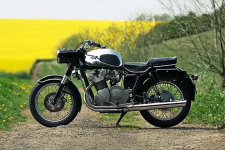
I've treated "gravity bleeding" as tying the hand lever back so the MC piston is ib far enough that the return port is also open to the MC reservoir, and then let the air in the system rise its way out of the system.
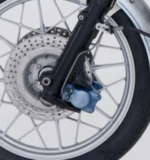
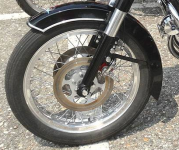
I learned back in 82 what results on a motorcycle if converted from single to dual discs. I mounted a 2nd disc on my 78 Suzuki GS1000 without changing out the MC. Holy ****, the brakes were too touchy to be effective, like having power brakes. A single disc MC has a larger diameter piston than does a double disc MC. So a dual disc brake system requires a smaller diameter MC piston.
The #/pistons in the calipers also make a difference in 'feel' of the brake system. A single piston working with a fixed pad caliper will need a different master cyl. diameter compared to a set of twin rotor/caliper brakes with three pairs of moving, opposed pistons (each caliper having six total pistons).
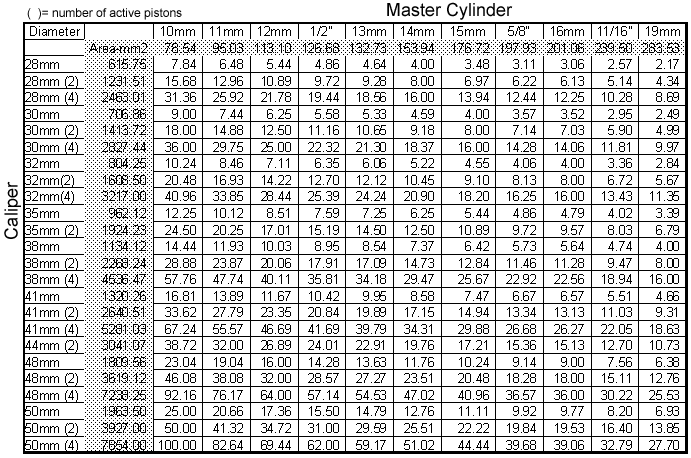
There's a website with a chart showing how to make the calculation to get the proper master cyl 'feel' so you obviate having a 'wooden' feel or overly-sensitive brakes as you had. I'm sure there are many of those charts out there, but you might want to compare a couple to see if they're in-agreement.
This is the one I have used, there are others:
https://www.vintagebrake.com/mastercylinder.htm Be aware I get a pop-up about the certificate for the website is expired.
Front Master Cylinder to Wheel Cylinder
Ratio Chart
The accompanying website paragraphs:
While attending Vintage Days West, and thoroughly enjoying it, I was reminded that many of the people I had occasion to talk to, lacked an understanding of the importance of master cylinder to wheel cylinder ratios. This critical ratio is of paramount importance in determining "feel". It has been my experience that there is a "sweet spot" in the range. I like ratios in the 27:1 range-2 finger power brakes, feeling some line and/or caliper flex. 23:1 is at the other end of the spectrum-firm. Ratios lower than 20:1 can result a feel so "wooden" as to have a toggle switch effect: nothing happens until the wheel locks. Disc and wheel diameters must be taken into consideration. A 10 inch disc working against an 19" wheel just doesn't have the leverage ratio that a 13 inch disc working a 17" wheel does. The hand lever ratio counts too: witness the adjustable master cylinders from Lockheed and Brembo.
A case in point: I had a complaint from a racer about Ferodo CP901- a compound renown for its great feel. His comment was that they worked poorly until the wheel locked. He had been thrown on the ground twice. Intrigued, I inquired as to the application. "Yamaha RD350" he replied. A red flag went up. CP901 was not available for the 48mm Yamaha caliper. I asked "How that could that be?" He had up-graded his braking system with the 41mm Lockheed unit, but was unaware that a master cylinder change was in order. A stock RD 350 has an already poor ratio of 18.3 :1, and with Lockheed, became an unhealthy 13.3 :1. The "sweet spot" formula said a change to a 11 or 12mm master cylinder was in order: my personal preference and recommendation would have been an 11mm. He was able to switch to a 1/2" , and although not ideal, he was keeping the rubber side down.
For 2 piston opposed calipers, I like ratios in the 27:1 range, feeling some line and caliper flex. For a firmer lever, use 23:1. I think ratios lower than 23:1 produce a lever feel so "wooden" as to have little, if any feel. Combine "low" leverage ratios with sticky pads, and unpredictable lockup is the result. The high effort required at the lever also results in undesired input to the bars. Single piston calipers are much happier in the 14:1 to 12:1 range. Disc and wheel diameters, as well as hand lever ratios, must be considered.
[end]
Back to GJ member
driftpin's comment:
I have used this chart and the explanations accompanying it, and in my experience I find the information accurate. I am not a professional motorcycle mechanic, just a 2-wheeled enthusiast of nearly 60 years.