To avoid these ads, REGISTER NOW!

About Bleeding Brakes.

Mr.N

Well-known member
Joined
Jul 13, 2005
Messages
2,221
Location
Mpls, MN
A short time ago I asked about brake bleeders. Some guys mentioned a couple models of vaacuum bleeders and it got me thinking. I have one of those hand pump Mityvac pumps, and earlier version of this, MV8500 and I shop made vacuum jar,

shockoilchange2.jpg

so I grabbed some tubing and gave it a try. I had a buddy come over for back up and told him to keep the brake reservoir full and I went around and bleed each brake. It worked fairly well, but the big surprise was to put a vacuum on the wheel cylinder and go pump the brakes. A few pumps and 16 ounces of fluid would come out in maybe ten seconds. No need to close the bleeder with the vacuum in place, but I manually bleed each brake cylinder to be certain, and no air came out. We bleed all for wheels in maybe 15 minutes. I did pull all four tires as I don't have a lift, so plus that time to R&R the wheels.

Just thought I would pass on the info. It really made a slightly miserable job go better.
Thanks for taking the time to share your experience, PoorUB. I’m sure this will help others, and when they see how long it took you, it’ll motivate them to tackle the job instead of putting it off.

On my Jeep, I've swapped master cylinders multiple times—often for axle changes and a lot of times to fine‑tune pedal feel (manual brakes can be finicky). Countless brake lines have been replaced over the years. Fresh fluid is always flushed in during the process, and once clean fluid appears while bleeding, a hose can be run from the bleeder back to the master cylinder reservoir before pumping the brakes. It’s a true one‑person job, but it definitely takes longer than 15 minutes.
 
To avoid these ads, REGISTER NOW!

Ak Jim

Well-known member
Joined
Jan 5, 2012
Messages
528
Location
Interior AK
Gravity bleeding - so, you just open the bleeders and let it drain?
Yes. I do this when I replace the fluid. I have not tried this when replacing a caliper or brake hose but I think it would work. I use a clear piece of hose and put it on the bleeder a crack it lose. You can see the fluid move and you can see when the clean fluid is in the hose. Sure it takes a while but it works.

The other thing I’ve read about is sometimes on an older car when you do the traditional bleeding method and the brake pedal goes all the way to the floor the piston in the master cylinder travels to a place it hasn’t been in the bore and there can be some corrosion or a lip and when you force the piston past that place you can create problems with the master cylinder.
 

andyvh1959

Well-known member
Joined
Feb 15, 2020
Messages
2,590
Location
Green Bay WI
I've treated "gravity bleeding" as tying the hand lever back so the MC piston is ib far enough that the return port is also open to the MC reservoir, and then let the air in the system rise its way out of the system.

I learned back in 82 what results on a motorcycle if converted from single to dual discs. I mounted a 2nd disc on my 78 Suzuki GS1000 without changing out the MC. Holy ****, the brakes were too touchy to be effective, like having power brakes. A single disc MC has a larger diameter piston than does a double disc MC. So a dual disc brake system requires a smaller diameter MC piston.
 

joe_pinehill1

Well-known member
Joined
Feb 23, 2013
Messages
537
Location
Northern Virginia
I've never had good results from a pressure bleeder. I bleed brakes on my two cars once ever few years, I find it easier to ask my wife or kids to sit in the car and pump the peddle while I loosen and tighten the bleeder.
 
To avoid these ads, REGISTER NOW!

driftpin

Well-known member
Joined
Dec 22, 2016
Messages
11,178
Location
Miami-Dade/Broward Co. Florida
I've treated "gravity bleeding" as tying the hand lever back so the MC piston is ib far enough that the return port is also open to the MC reservoir, and then let the air in the system rise its way out of the system.

I learned back in 82 what results on a motorcycle if converted from single to dual discs. I mounted a 2nd disc on my 78 Suzuki GS1000 without changing out the MC. Holy ****, the brakes were too touchy to be effective, like having power brakes. A single disc MC has a larger diameter piston than does a double disc MC. So a dual disc brake system requires a smaller diameter MC piston.
The #/pistons in the calipers also make a difference in 'feel' of the brake system. A single piston working with a fixed pad caliper will need a different master cyl. diameter compared to a set of twin rotor/caliper brakes with three pairs of moving, opposed pistons (each caliper having six total pistons).

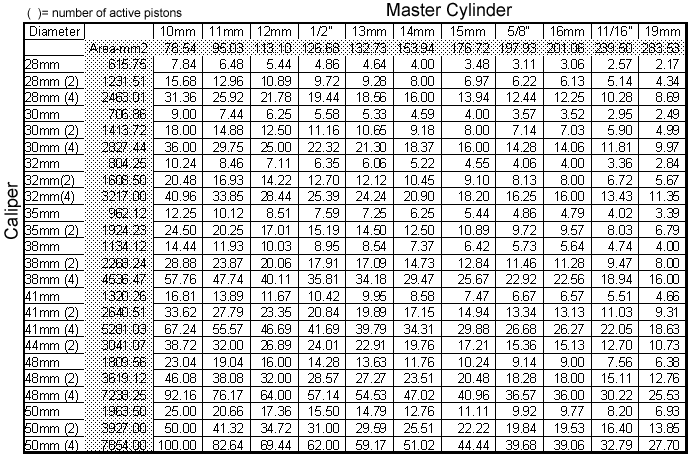
There's a website with a chart showing how to make the calculation to get the proper master cyl 'feel' so you obviate having a 'wooden' feel or overly-sensitive brakes as you had. I'm sure there are many of those charts out there, but you might want to compare a couple to see if they're in-agreement.

This is the one I have used, there are others: https://www.vintagebrake.com/mastercylinder.htm Be aware I get a pop-up about the certificate for the website is expired.


Front Master Cylinder to Wheel Cylinder
Ratio Chart


mastercylinder.gif

The accompanying website paragraphs:

While attending Vintage Days West, and thoroughly enjoying it, I was reminded that many of the people I had occasion to talk to, lacked an understanding of the importance of master cylinder to wheel cylinder ratios. This critical ratio is of paramount importance in determining "feel". It has been my experience that there is a "sweet spot" in the range. I like ratios in the 27:1 range-2 finger power brakes, feeling some line and/or caliper flex. 23:1 is at the other end of the spectrum-firm. Ratios lower than 20:1 can result a feel so "wooden" as to have a toggle switch effect: nothing happens until the wheel locks. Disc and wheel diameters must be taken into consideration. A 10 inch disc working against an 19" wheel just doesn't have the leverage ratio that a 13 inch disc working a 17" wheel does. The hand lever ratio counts too: witness the adjustable master cylinders from Lockheed and Brembo.

A case in point: I had a complaint from a racer about Ferodo CP901- a compound renown for its great feel. His comment was that they worked poorly until the wheel locked. He had been thrown on the ground twice. Intrigued, I inquired as to the application. "Yamaha RD350" he replied. A red flag went up. CP901 was not available for the 48mm Yamaha caliper. I asked "How that could that be?" He had up-graded his braking system with the 41mm Lockheed unit, but was unaware that a master cylinder change was in order. A stock RD 350 has an already poor ratio of 18.3 :1, and with Lockheed, became an unhealthy 13.3 :1. The "sweet spot" formula said a change to a 11 or 12mm master cylinder was in order: my personal preference and recommendation would have been an 11mm. He was able to switch to a 1/2" , and although not ideal, he was keeping the rubber side down.


For 2 piston opposed calipers, I like ratios in the 27:1 range, feeling some line and caliper flex. For a firmer lever, use 23:1. I think ratios lower than 23:1 produce a lever feel so "wooden" as to have little, if any feel. Combine "low" leverage ratios with sticky pads, and unpredictable lockup is the result. The high effort required at the lever also results in undesired input to the bars. Single piston calipers are much happier in the 14:1 to 12:1 range. Disc and wheel diameters, as well as hand lever ratios, must be considered.
[end]
Back to GJ member driftpin's comment:
I have used this chart and the explanations accompanying it, and in my experience I find the information accurate. I am not a professional motorcycle mechanic, just a 2-wheeled enthusiast of nearly 60 years.
 

andyvh1959

Well-known member
Joined
Feb 15, 2020
Messages
2,590
Location
Green Bay WI
Great information! Thank you. I have theorized the function of multi piston calipers are internally ported to slightly advance one piston ahead of the others to provide more progressive feel as the pistons extend and fully press the pads to the rotors. Not sure if that is right. Certainly a single piston caliper like that on a 1975 CB750K versus a three piston caliper on a current ZX14 Kawasaki has no where near the better feel and progressive action, which requires the right master cylinder to match feel and reaction expected by the rider. When single piston disc brakes became common in the early 70s we thought they were great. Yet they were simple, single acting calipers where the piston had to extend and then pull over the static side of the caliper. Now a bike like my 1600 Vulcan has huge 320mm full floating dual rotors, SS/braided hoses, and four piston calipers to produce great feel and huge grip on the discs.

My 1976 BMW R100RS has the unique BRE single acting piston calipers that actually pivot on a pin as the piston extends out and pulls the static side of the caliper pads onto the disc. Simple, good looking for a vintage bike, but it does cause the caliper to pivot into full pad contact creating odd beveled pad wear. Just had a thought, these 1976 era calipers are actually similar to the current "radial" mount design as the caliper mount is integral to the fork slider casting.
 

Attachments

  • Screenshot 2025-11-27 2.17.57 PM.png
    Screenshot 2025-11-27 2.17.57 PM.png
    252.4 KB · Views: 7
Last edited:

Milton Shaw

Well-known member
Joined
Feb 11, 2011
Messages
4,835
I keep cars as long as I can so I end up doing brakes about every seven years or so. I normally replace calipers every brake job because of corrosion inside the caliper boots. First brakes get 70,000 miles or so and second brakes on old calipers were getting 20,000 or so from that corrosion stopping the piston from releasing on at least one or two wheels. Replace with rebuilt and back to 70,000 mile life. I fill the master cylinder with new fluid and remove the banjo bolt and hang pads and calipers. Then pre-fit the pads, caliper and rotors by using a rubber tip air gun before installing the banjo bolt. Then open the new bleeder screw and let it drain while I finish that wheel up. You can see it finally work all the old fluid out and get clear fluid, close bleeder, refill master cylinder and do the next wheel. This serves several purposes it keeps from having to bottom out the master cylinder and destroying the rubber internal seals and makes it where just a simple pump and push for each wheel and get the last bubble out, Job done. This means full pedal and again not having to ever bottom out the master cylinder for the first several stops. I have seen wrecks where absent minded parts hangers have wrecked cars because they didn't pre-fit the pads, and the first stop didn't happen the first time it needed too.
 

driftpin

Well-known member
Joined
Dec 22, 2016
Messages
11,178
Location
Miami-Dade/Broward Co. Florida
My 1976 BMW R100RS has the unique BRE single acting piston calipers that actually pivot on a pin as the piston extends out and pulls the static side of the caliper pads onto the disc. Simple, good looking for a vintage bike, but it does cause the caliper to pivot into full pad contact creating odd beveled pad wear. Just had a thought, these 1976 era calipers are actually similar to the current "radial" mount design as the caliper mount is integral to the fork slider casting.
I believe the BMW motorcycles' spec calipers of that style were from ATE. not sure where your name 'BRE' came-from. I owned an R100RT, the 60th Anniversary Edition (1983) and by that time the brakes were of a better spec, by Brembo, the front were a pair of single opposed piston calipers. and a drum rear.

About the radial calipers, it's not 'if the caliper mount is integral to the fork slider casting,' it's if the centerline of the front wheel axle passes through the centerline of the caliper. Most motorcycles have the calipers' mounting points cast as part of the fork sliders. Early in the use of the hydraulic disc brakes on motorcycles, there might be a bracket acting as a carrier for the caliper, in the style of the 1969+ Honda SOHC 750.

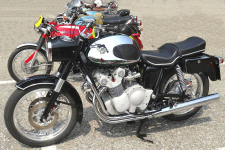
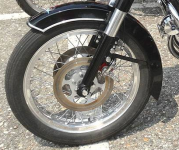
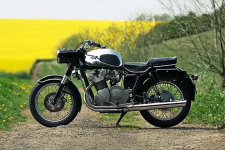
An interesting point about the use of early adoption of disc brakes on motorcycles, the mid-1960's MV Agusta four cylinder used not hydraulics, but cable-actuated disc brakes.

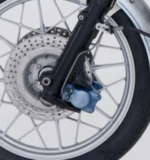
1764538165225.png

A good pic of the cable-operated front disc brakes. Be glad you aren't able to see the front of the headlight, the rectangular bucket is bulbous and 'piggy.' It's rumored that Count Agusta made his transverse inline-four motorcycles shaft-drive to lessen the possibility that he would suffer the indignity of losing to a competitor fielding one of the MV Agustas. Note the sand-cast engine cases.

1764539217508.png
 

Attachments

  • 1764537995574.png
    1764537995574.png
    425.9 KB · Views: 3
Last edited:

andyvh1959

Well-known member
Joined
Feb 15, 2020
Messages
2,590
Location
Green Bay WI
Yes and thank you, I am corrected, the BMW vintage pivoting calipers were ATE (old brain stuck on BRE for some reason) and thanks for the clarification of "radial" calipers as it make sense that that centerline of the front axle passes through the caliper centerline. Which curiously, it does on the ATE style caliper so maybe it was a very early radial mount style? However the ATE caliper pivots at 90 degrees to the caliper/axle centerline which the current radial calipers are solid mounted through the caliper/axle centerline.

I have used cable operated disc brakes on a recumbent bike I built fron scrath, very capable brakes. But cable operated disc brakes on a motorcycle? Then again, drum brakes of that vintage were not great for feel/action, so on the Agusta it may have actually worked. Yes, that Agusta was homely, especially the headlight area. But the rest of it is intriguing, as was the Ducati Apollo 1260 V4. That V4 made way more power than 1960s tires were able to handle. https://en.wikipedia.org/wiki/Ducati_Apollo

If that Ducati (with very Harley like style) had come out in 1964 with 100hp it would have flattened any Harley which made maybe 55hp (crank) while the Harley weighed well over 700lbs and the Ducati weighed only 600lbs. The Apollon would really have been a V-Max 20 years before Yamaha did it.
 
Last edited:
To avoid these ads, REGISTER NOW!
Top Bottom