To avoid these ads, REGISTER NOW!

About Bleeding Brakes.

PoorUB

Well-known member
Joined
Mar 29, 2021
Messages
11,615
Location
Fargo, ND
A short time ago I asked about brake bleeders. Some guys mentioned a couple models of vaacuum bleeders and it got me thinking. I have one of those hand pump Mityvac pumps, and earlier version of this, MV8500 and I shop made vacuum jar,

shockoilchange2.jpg

so I grabbed some tubing and gave it a try. I had a buddy come over for back up and told him to keep the brake reservoir full and I went around and bleed each brake. It worked fairly well, but the big surprise was to put a vacuum on the wheel cylinder and go pump the brakes. A few pumps and 16 ounces of fluid would come out in maybe ten seconds. No need to close the bleeder with the vacuum in place, but I manually bleed each brake cylinder to be certain, and no air came out. We bleed all for wheels in maybe 15 minutes. I did pull all four tires as I don't have a lift, so plus that time to R&R the wheels.

Just thought I would pass on the info. It really made a slightly miserable job go better.
 
To avoid these ads, REGISTER NOW!

theoldwizard1

Well-known member
Joined
Feb 22, 2011
Messages
43,073
Location
SE MI
I am "old school" and cheap !

Sport drink bottle. Drill hole in cap for a snug fit for tubing. Insert tubing through the hole making sure is reaches the bottom. Add enough brake fluid so that the bottom of the tube is covered. Open bleeder. Couple of pumps on the pedal.

The key is to make sure the reservoir never runs dry and the bottom of the tube is always cover with brake fluid.
 

Jeepster04

Well-known member
Joined
Jun 25, 2013
Messages
3,092
I am "old school" and cheap !

Sport drink bottle. Drill hole in cap for a snug fit for tubing. Insert tubing through the hole making sure is reaches the bottom. Add enough brake fluid so that the bottom of the tube is covered. Open bleeder. Couple of pumps on the pedal.

The key is to make sure the reservoir never runs dry and the bottom of the tube is always cover with brake fluid.

How do you know the bleeder screw isnt sucking in air around the threads when you let off of the pedal?

Ive had 100% success rate with a vacuum bleeding. I just recently started also pumping the pedal while the vacuum bleeder is doing its thing. I figure it should help push out an air bubble if its stuck in there.
 

charbar

Well-known member
Joined
Feb 6, 2021
Messages
1,993
Location
Midwest
I have the same canning jar contraption as you but I use an A/C vacuum pump and an old yellow service hose with one end cut off and attached to the canning jar. Automagic....none of that hand pumping work :D Had everything I needed sitting around sound it cost me zero dollars and about 10 minutes worth of my time.
 

CraigStu

Well-known member
Joined
May 22, 2014
Messages
4,009
Location
Blacksburg, Va
I've tried the Mighty Vac and found it ***** air around the threads of the bleeder screws. I'd rather use pressure bleeding.
Yep, back when I worked at a dealer they bought a vacuum bleeder setup. I used it once. It ended up working as it was a simple system on that car. But the technique seemed to be, when you first start you get a lot of bubbles. Cause the leaking around the bleeder adds to the actual bubbles. So, since the bubbles never stop, the trick is to guess when the somewhat reduced amount of bubbles indicates a bled caliper. I pressure bled my own stuff since I have a regulator that goes down to 5#. At a friend's house we used a fish tank air pump but I was nervous since we had no way to know what pressure it could produce.
 

Daedalus

Well-known member
Joined
Sep 28, 2009
Messages
5,949
I've tried the Mighty Vac and found it ***** air around the threads of the bleeder screws. I'd rather use pressure bleeding.
That has been my experience. Bleeder screws have loose tolerances and I always get more air that brake fluid. A venturi vacuum bleeder has saved me from a lot of hand cramps from when I used the hand vacuum. I also use an auto filler to keep the reservoir full. Then just hook up the hose, turn on the vacuum, open the screw, and close the screw when the color's good. As long as the vacuum is pulling when the bleeder is closed, no detrimental amount of air actually gets into the caliper, even if it's leaking around the threads.
 

mikedodge

Well-known member
Joined
Jun 27, 2017
Messages
2,747
I've never had much luck with the vacuum way of doing it. Using the hose and bottle usually seems to get better results or in some cases gravity bleeding, especially on some vehicles where the bleeder is a pain to get at like some old Fords.
 

ToolmanGary

Well-known member
Joined
Oct 25, 2008
Messages
66
Location
South Lyon Michigan
I have some caps from a brake bleeder kit that go on the master cylinder. I rigged up a regulator so it will put about 15 psi on the brake fluid. I’ll bleed a truck that has all new lines on in a couple minutes by myself, I just have to walk around the vehicle a couple times and crack the bleeders, that’s it and I’m done.
These GM trucks are impossible to bleed without it.
 
OP
P

PoorUB

Well-known member
Joined
Mar 29, 2021
Messages
11,615
Location
Fargo, ND
I've tried the Mighty Vac and found it ***** air around the threads of the bleeder screws. I'd rather use pressure bleeding.
I would too, but I don't have a pressure bleeder. And for the once every couple years I don't see buying one!
 

andyvh1959

Well-known member
Joined
Feb 15, 2020
Messages
2,587
Location
Green Bay WI
Been succesful in the past on my cars and motorcycles. But just recently on my 1600 Vulcan build I can't seem to get the solid lever feel I'm after. I replaced all the OEM brake hoses with braided SS (Teflon inner tube is really what matters, not the SS braid). I used my usual mocked up bleeder bottle and got most of the air out but still get a mushy lever. Moved the calipers around, tied the lever back to let it set overnight, pushed the claiper pads in (Vise Grip) and out (system pressure) repeated times, yet still mushy lever. Got a syringe, filled it with brake fluid and tried pushing fluid in at the bleeder and up to the master cylinder. Got fluid going up as confirmed by the little return port fluid spurt. Still a mushy lever feel. So now I am installing a rebuild kit into the master cylinder.
 

racecougar

Well-known member
Joined
Jan 26, 2021
Messages
4,978
Location
Missouri
Been succesful in the past on my cars and motorcycles. But just recently on my 1600 Vulcan build I can't seem to get the solid lever feel I'm after. I replaced all the OEM brake hoses with braided SS (Teflon inner tube is really what matters, not the SS braid). I used my usual mocked up bleeder bottle and got most of the air out but still get a mushy lever. Moved the calipers around, tied the lever back to let it set overnight, pushed the claiper pads in (Vise Grip) and out (system pressure) repeated times, yet still mushy lever. Got a syringe, filled it with brake fluid and tried pushing fluid in at the bleeder and up to the master cylinder. Got fluid going up as confirmed by the little return port fluid spurt. Still a mushy lever feel. So now I am installing a rebuild kit into the master cylinder.
Stock arrangement? If not, you may play around with master cylinder vs caliper piston diameter ratio.
 
To avoid these ads, REGISTER NOW!

alwaysFlOoReD

Well-known member
Joined
Sep 24, 2013
Messages
2,375
Location
Airdrie, Alberta, Canada
A short time ago I asked about brake bleeders. Some guys mentioned a couple models of vaacuum bleeders and it got me thinking. I have one of those hand pump Mityvac pumps, and earlier version of this, MV8500 and I shop made vacuum jar,

shockoilchange2.jpg

so I grabbed some tubing and gave it a try. I had a buddy come over for back up and told him to keep the brake reservoir full and I went around and bleed each brake. It worked fairly well, but the big surprise was to put a vacuum on the wheel cylinder and go pump the brakes. A few pumps and 16 ounces of fluid would come out in maybe ten seconds. No need to close the bleeder with the vacuum in place, but I manually bleed each brake cylinder to be certain, and no air came out. We bleed all for wheels in maybe 15 minutes. I did pull all four tires as I don't have a lift, so plus that time to R&R the wheels.

Just thought I would pass on the info. It really made a slightly miserable job go better.
I use the same system. But just drill holes and push the tubes in. I hook to a vacuum source on the engine.
 

andyvh1959

Well-known member
Joined
Feb 15, 2020
Messages
2,587
Location
Green Bay WI
Stock arrangement? If not, you may play around with master cylinder vs caliper piston diameter ratio.
Stock was the four piston calipers and 300mm dual rotors. Now it's the same calipers and 320mm rotors. It felt good last year with the stock master cylinder, so all I've changed are the brake hoses.
 

racecougar

Well-known member
Joined
Jan 26, 2021
Messages
4,978
Location
Missouri
Stock was the four piston calipers and 300mm dual rotors. Now it's the same calipers and 320mm rotors. It felt good last year with the stock master cylinder, so all I've changed are the brake hoses.
Yeah, the rotor diameter change wouldn't have any effect here. The master cylinder could have been damaged by going full stroke when bleeding after changing the hoses; I agree with rebuilding it.
 

paulsomlo

Well-known member
Joined
Jul 16, 2013
Messages
3,852
Location
Northern Colorado
I just flushed my brake fluid today - started with a Mityvac and failed; the lid for the plastic bottle doesn't fit tightly enough, so I couldn't maintain vacuum. And the gasket was present in the lid, just wasn't doing its job. I switched to the Harbor Freight venturi bleeder, which worked, but it's slow - it just doesn't seem to create a strong vacuum. With a different fluid container, like the one pictured in the 1st post here, I think the Mityvac would work well.
 

Torque&Recoil

Well-known member
Joined
Dec 13, 2015
Messages
424
Location
NE Ohio
I've tried the Mighty Vac and found it ***** air around the threads of the bleeder screws. I'd rather use pressure bleeding.
Yep, same experience here. I have wrapped the bleed screw threads with teflon tape, which solves that problem. Except you have to remove the screw to wrap it. So I have gone to pressure bleeding, which works well for me. I buy a spare cap for the reservoir, attach an air fitting, and hit it with 20 psi compressed air using a regulator. Effective, fast and cheap. I haven't touched my Motive or Mityvac since I came up with this method.
 

driftpin

Well-known member
Joined
Dec 22, 2016
Messages
11,178
Location
Miami-Dade/Broward Co. Florida
I also am a fan of the pressure-bleed using a 60ml irrigation syringe and using the bleeder ****** to push the brake fluid up. My friend's shop, where they build things like Hyabusas and Kawasakis that break 200mph and are wearing motorcycle tags, uses the HFT venturi system bleeder. Below, a GSXR 1100 w/a Hyabusa engine, from the shop. What do you think that round ring is for, in-front of the swingarm cross-brace?

1763647334582.png

I have > one MityVac, the oldest is probably 40+ years old, but I usually just use the irrigation syringe and am soon done with the job. Pushing the fluid from the bleeder ****** upwards also helps the air bubbles rise. I don't bother with the 'tie the lever back overnight' but some like to do that.

1763646964531.png
 
Last edited:

TRWham

Well-known member
Joined
Aug 11, 2017
Messages
1,954
Location
East Cobb County, Georgia
...What do you think that round ring is for, in-front of the swingarm cross-brace?...

... I don't bother with the 'tie the lever back overnight' but some like to do that.

That ring is obviously a cup holder...

The tie the lever back method is somewhat effective on my Commando, but you really need to squeeze the front brake lever through 100 cycles to get the last of the air out. On the 850 Mk 3 the front caliper is rotated slightly so the ****** is not at the highest point, but cycling the brake enough will bring the air out and up to the reservoir. 90 is close, but I go to 100 to ensure a firm feel.
 
Last edited:

58Yeoman

Well-known member
Joined
Oct 1, 2010
Messages
8,999
Location
Central IL
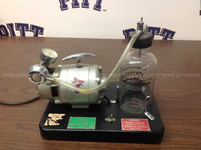
I have a retired aspirator (vacuum pump) from a hospital where I was working about 20 years ago.
1763641892771.png
A hose from the fitting on the far side of the bottle cap goes to the caliper bleeder.
Have had absolutely NO problems using it.

.
I've got one that is similar that I bought at a closed dentist office for $15, but I still have the problem with the threads leaking air. Wish I had bought both vacuum pumps so I could've sold the second one to someone needing one.
 

andyvh1959

Well-known member
Joined
Feb 15, 2020
Messages
2,587
Location
Green Bay WI
Yeah, the rotor diameter change wouldn't have any effect here. The master cylinder could have been damaged by going full stroke when bleeding after changing the hoses; I agree with rebuilding it.
Actually, given the same clamping capability of the caliper and without changing the friction coefficient of the pads and rotors, increasing the rotor diameter does change the results because the 20mm greater distance from the axle centerline to the effective centerline of the brake pads is a longer "lever".

Also I had the handlebar off the mounts and the master cylinder was upside down for many months, so perhaps a seal in the master cylinder plunger suffered damage from that when I later turned it upright and started pumping it.
 

robin1731

Well-known member
Joined
Dec 25, 2007
Messages
483
Location
Decatur, Indiana
"What do you think that round ring is for, in-front of the swingarm cross-brace?"

That's easy. The bike in my avatar has one too. Mine are 2.5lb bottles. ;)
 

Ryan87LX

Well-known member
Joined
Dec 21, 2005
Messages
76
Location
Regina, Saskatchewan, Canada
I used a power bleeeder for the first time this past weekend and it was the easiest brake bleed I have ever done. I used the OMT Bleeder which is significantly less expensive than the motive (https://orionmotortech.com/products...-adapter-manual-brake-fluid-pressure-bleeder?).

They are a pain to clean, however. I've been told that some people use these only to apply pressure and top up the fluid directly in the master cylinder. I'll try that the next time.
 

racecougar

Well-known member
Joined
Jan 26, 2021
Messages
4,978
Location
Missouri
Actually, given the same clamping capability of the caliper and without changing the friction coefficient of the pads and rotors, increasing the rotor diameter does change the results because the 20mm greater distance from the axle centerline to the effective centerline of the brake pads is a longer "lever".
Of course it makes a difference in braking. You were talking about lever "mushiness"; It makes no difference there.
 

CraigStu

Well-known member
Joined
May 22, 2014
Messages
4,009
Location
Blacksburg, Va
About 10 yrs ago I was messing w/ different MC sizes on my cobra replica after changing to larger rear calipers. 2 different brake component manufacturers mentioned keeping pressure bleeding pressure to 5# max to avoid MC damage. I was never quite clear on exactly how pressure could damage an MC but, since one of those sources was also where I bought MCs, their warning could actually cost them a sale. So I listened.
 
To avoid these ads, REGISTER NOW!
Top Bottom