To avoid these ads, REGISTER NOW!

Adding a Ceiling

dmc3535

Member
Joined
Oct 20, 2012
Messages
21
I'm looking to add a ceiling in my garage, insulate it, and heat the place (no storage above ceiling).
It's a small two-car, attached garage. Stick construction, pretty basic.

I plan to add ledger boards along the studs above the top plate to give me a 9 ft ceiling. Can I use 1/4" lags with 1" washers, and 3 1/2" in length? The length will give me 2" of bite into the stud. I've seen a lot of recommendations for 1/2" lags, but that seems like a lot of lag going into a 2x4 stud.

Also, does anyone have any input on vapor barrier in the ceiling and walls? I don't plan on keeping it heated all the time, just when I work out there. I'll be insulating and sheet-rocking the ceiling and walls. It gets pretty cold in the winter (Minneapolis area), and can get humid in the summer.
 
Last edited:
To avoid these ads, REGISTER NOW!

Gary S

Well-known member
Joined
Dec 27, 2008
Messages
2,972
Location
Bismarck, ND
You need a good vapor barrier whether you heat it full time or not. The insulation alone will make it warmer in the garage during winter, so you will have a temperature difference between inside and outside. That temp difference can cause condensation and frost buildup. If you use blanket insulation, the tar paper on it acts as a vapor barrier. If not, use plastic sheeting or any other waterproof material.
 
OP
D

dmc3535

Member
Joined
Oct 20, 2012
Messages
21
Thats what I thought. I'll plan on a vapor barrier all around.

Any thoughts on the 1/4" lag bolts? Are they enough?

Sent from my DROID X2 using Tapatalk 2
 

kbs2244

Well-known member
Joined
Nov 11, 2006
Messages
14,065
1/4 is way more than enough. even with the weight of dry wall.
 

benjamintmiller

Well-known member
Joined
Feb 8, 2011
Messages
284
Location
IA
What do you mean when you say "ledger boards"?

Typically, a ledger board is a board placed horizontally that other boards are set on, such as a deck-to-house connection. I can't see how that would come into play when framing a ceiling, but I may be missing something.

If you're talking about adding rafters, because your existing roof somehow doesn't have them, then I would use 3" framing nails. In a stick built roof, there should already be rafters to prevent the walls from spreading under the weight of the roof.

On my existing stick-built roof, I added framing members and plywood gussets to build trusses. IIRC, it took something like 4000 nails and 6 giant tubes of construction adhesive to do this, but the end result is rock solid.

If you have a stick-built ceiling that doesn't have trusses, you will not be able to hold the weight of drywall and insulation unless you have some SERIOUSLY large rafters. For an average 2 car garage, that would require 2x12s along the bottom, which is not economical at all.
 

Attachments

  • IMG_0373[1].jpg
    IMG_0373[1].jpg
    144.5 KB · Views: 388
Last edited:
OP
D

dmc3535

Member
Joined
Oct 20, 2012
Messages
21
What do you mean when you say "ledger boards"?

Typically, a ledger board is a board placed horizontally that other boards are set on, such as a deck-to-house connection. I can't see how that would come into play when framing a ceiling, but I may be missing something.

If you're talking about adding rafters, because your existing roof somehow doesn't have them, then I would use 3" framing nails. In a stick built roof, there should already be rafters to prevent the walls from spreading under the weight of the roof.

On my existing stick-built roof, I added framing members and plywood gussets to build trusses. IIRC, it took something like 4000 nails and 6 giant tubes of construction adhesive to do this, but the end result is rock solid. I'm an engineer, and designed these trusses to be almost twice as strong as is required by code.

If you have a stick-built ceiling that doesn't have trusses, you will not be able to hold the weight of drywall and insulation unless you have some SERIOUSLY large rafters. For an average 2 car garage, that would require 2x12s along the bottom, which is not economical at all.

I'm not planning on using the rafters to bear any weight of the ceiling. We can get some pretty heavy snow, and I already don't like the look of the 2x4 rafters.

I am planning on running my ceiling joists off of the ledger boards using those sheetmetal joist hangars. The joists will be perpendicular to the rafters, and I will have rafter ties running in the bottom 1/3 of the rafters (sitting right on top of the joists).
 
OP
D

dmc3535

Member
Joined
Oct 20, 2012
Messages
21
Joist hangers on the perimeter ledger board. Lag the the ledger board the wall studs.

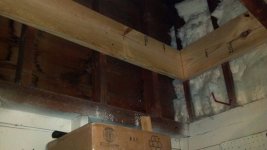
That's the plan. Here is a pic of the ledgers tacked in. Still need to lag them and move the rafter supports up to the height of the ledgers.

Sent from my DROID X2 using Tapatalk 2
 

Attachments

  • uploadfromtaptalk1351383345496.jpg
    uploadfromtaptalk1351383345496.jpg
    34.1 KB · Views: 145
OP
D

dmc3535

Member
Joined
Oct 20, 2012
Messages
21
So... here's what I decided to do. It seems to be working out well. Hopefully I can get some vapor barrier, sheetrock, and insulation up before the end of the year. We've been spoiled with warm weather here in Minneapolis...

Sent from my DROID X2 using Tapatalk 2
 

Attachments

  • uploadfromtaptalk1355062635608.jpg
    uploadfromtaptalk1355062635608.jpg
    38.8 KB · Views: 120
To avoid these ads, REGISTER NOW!

little d

Well-known member
Joined
Nov 13, 2009
Messages
815
Location
NW Oklahoma
Don't put the vapor barrier on the ceiling. Did this on a job when I was younger and had to come back because the nails were wicking moisture. After I climbed up into the attic, pulled back the insulation and cut the plastic and put the insulation back, a coupla days later, they dried up.
 
OP
D

dmc3535

Member
Joined
Oct 20, 2012
Messages
21
Don't put the vapor barrier on the ceiling. Did this on a job when I was younger and had to come back because the nails were wicking moisture. After I climbed up into the attic, pulled back the insulation and cut the plastic and put the insulation back, a coupla days later, they dried up.

I've heard mixed things about vapor barrier. I'm in Minneapolis, so it gets pretty cold. I plan to heat it only for a few hours a week while I'm working out there...

Anyone else know much about this topic?
 

thebreeze2012

Well-known member
Joined
Dec 9, 2012
Messages
157
Location
Northern Il.
I've heard mixed things about vapor barrier. I'm in Minneapolis, so it gets pretty cold. I plan to heat it only for a few hours a week while I'm working out there...

Anyone else know much about this topic?


Yes, there's alot of controversy about vapor barriers. I have spent 4 or 5 hours researching vapor barriers in the last few days and I'm getting a little frustrated.I insulated my walls with r13 and ceiling with r38 with kraft paper and I'm trying to decide wether to put a additional vapor barrier before drywall or use no kraft paper or VB.

They say in the hot climates the VB goes to the outside and in the cold climates goes to the inside,in my situation I have both very hot and humid in summer and pretty darn cold and mostly damp in the winter,I'm in zone 5 but very close to zone 6.

In my research some say the wall needs to breath and don't use kraft paper or VB,and others say it's a must in certain areas.I've read where some are contractors and have ripped apart walls with VB to find extreme damage because moisture couldn't get out and caused mold and rotted out the wood,while the inside wall looked fine it wasn't until drywall, VB,and insulation was removed that the damage could be seen.The one contractor said if you don't use a VB that if there was a problem,from a leak or whatever that chances are you will catch the problem before it becomes Very costly,because you will see wall getting wet or paint peeling etc.


The problem is how many people put up a VB and have a problem and never know about it until many,many years later.Once you put up drywall etc. there's no way to tell unless you remove paneling,VB,and insulation.


I'm very frustrated and wish I could afford sprayed on closed cell foam to eliminate any problems or Very costly repairs in the future. I'm not sure what I'm gona do.I'm actually thinking about removing kraft faced paper and using house wrap on the inside in place of the VB,this might keep most water out of wall and still let it breathe a little.The garage has no rotting after 50+ years and would like to make it another 50+. Maybe I'll just leave drywall off and leave kraft paper on and watch and see what happens over the winter,I'm not sure yet.

I'm a new guy here and would like to say I've been trolling for a little bit and found alot of great info on here and seems like a great site.
 

little d

Well-known member
Joined
Nov 13, 2009
Messages
815
Location
NW Oklahoma
Guys,
since I'm not an insulation contractor I can't say 100% but, around here (central Missouri) we use kraft face (to the inside) walls and ceiling with vapor barrier on walls only. My suggestion would be to find a new house being built in your area and explain to the general contractor what you are doing and if at all possible, could he give his expert advice on how it should be done and done right.

Most of these guy's are busy but, if approached right, they will usually take the time to give advice or steer you in the right direction.
 

Stuart in MN

Well-known member
Joined
Sep 8, 2005
Messages
23,000
Location
Minneapolis
As far as I know a vapor barrier is standard procedure in Minnesota on walls and ceilings, usually a sheet of Visqueen plastic with the seams taped. Without a vapor barrier, moisture from inside the conditioned space rises through the insulation, condenses, and freezes. Then, when it warms up all that ice melts and you have mold or rot problems.
 

Kevin54

MEMBER EMERITUS
Joined
Jan 12, 2005
Messages
29,341
Location
Urbana, Ohio
If you are going to use fiberglass batts with Kraft paper, the paper itself is a moisture barrier. You have to make sure you fold it out so the rafters are covered before you staple it. If you use batt insulation that does not have paper on it, you can put up a visqueen vapor barrier. In doing that, make sure that you overlap your seams or tape your seams.

My wifes craft building, which was originally built as a place for her to raise her flowers, had batt insulation put in that had no paper. I put visqueen in as a vapor barrier. It's been built for 6 going on 7 years now with not one single problem. No moisture from screws, no cracks in the ceiling, no mold.

For your garage, it's not going to ever be as tight as a house. If it were mine, I would put visqueen up, drywall or OSB over it and not give it a second thought. Just make sure you put in adequate insulation. R30 or higher.
 

rebelranger

Well-known member
Joined
Sep 18, 2012
Messages
188
How about if you have rooms above your garage? I'm in this same boat. I have a two car garage with 3 bedrooms and 2 bathrooms about it (split level house). The house was built in the 60s and has ZERO insulation between the garage and living space above so the floors get chilly in the living space. Also the HVAC main trunk runs along (perpendicular) the ceiling joists and the HVAC branches run (parallel) inside the the ceiling joists. I want to remove the drywall and insulate this space but get such conflicting information. The best is spray foam but that is really not in the budget, so I'm going to remove the drywall, install R30 unfaced, then 1/2" R3 foam board + tape the seams, then reinstall 5/8 drywall. That is what the EPA says to do to get the benefits of airsealing from the foam board and the insulation of fiberglass/denim/loosefill, etc. I'm treating this space as an attic, I guess.

What do does everyone think?
 

cbracer

Well-known member
Joined
Feb 27, 2012
Messages
637
Location
Costa Mesa, CA
condensation happens on cold objects in warm air. The moisture held in warm air is higher, and the cold surfaces will lower the air temperature sitting next to them creating moisture. Saying you have no moisture problems after 6-7 years isn't saying much as it takes many years for the water damage to likely occur. In hot climates like Florida it goes on the outside, places with cold winters goes on the inside. If you live in a climate for both do the inside. I live in southern California, no moisture vapor required anywhere. I understand your frustration and did the same research you did. Also, kraft style paper should never be put into an attic due to fire concerns. Foam is the best solution.
 

Kevin54

MEMBER EMERITUS
Joined
Jan 12, 2005
Messages
29,341
Location
Urbana, Ohio
condensation happens on cold objects in warm air. The moisture held in warm air is higher, and the cold surfaces will lower the air temperature sitting next to them creating moisture. Saying you have no moisture problems after 6-7 years isn't saying much as it takes many years for the water damage to likely occur. In hot climates like Florida it goes on the outside, places with cold winters goes on the inside. If you live in a climate for both do the inside. I live in southern California, no moisture vapor required anywhere. I understand your frustration and did the same research you did. Also, kraft style paper should never be put into an attic due to fire concerns. Foam is the best solution.

If I have a place that catches on fire, the last thing I would be concerned about is the Kraft paper in the attic. If a dire starts from the roof down, everything in the attic is destroyed anyways. If it starts from the bottom up, by the time they get done with firehoses and picks, the ceiling and attic is again trashed.
 
To avoid these ads, REGISTER NOW!
Top Bottom