Two Door
Well-known member
This may be the single biggest problem. If these can't be expanded I would think a supplemental upstairs unit of some sort would be almost unavoidable.Sadly 4 inch in most cases

This may be the single biggest problem. If these can't be expanded I would think a supplemental upstairs unit of some sort would be almost unavoidable.Sadly 4 inch in most cases
problem with that is you've basically zoned it but without proper zoning you now have uncontrolled cooling upstairs. so zone panel and 1 thermostat per zone it is!Good point about closing vents. The tstat is in the dining room, which is great for the half dozen times a year we entertain, but is worthless most of the time. I found that closing registers in the dining room has helped regulate temperature in the other rooms downstairs but the upstairs is about 5 degrees warmer than downstairs.
I wonder if a motorized damper that closes downstairs vents at night and an upstairs tstat is a viable option.
Those guys don't have a or much of a website.Look for the guy that talks technical on his website
I have yet to see one of those installs that actually works.so zone panel and 1 thermostat per zone it is!
mine seems to work fine. what're they doing wrong?I have yet to see one of those installs that actually works.
I have a unit picked out (mitsubishi 17" cased coil, 4 ton hyperheat ODU) for if/when my 20 year old AC takes a dump.Zoning an existing system is a major crapshoot and turns out poorly more often then not. Normally you end up with a 4 ton unit trying to move only 2 tons of air through ductwork big enough for 1 ton.
Multi stage and modulating equipment can fix that but not many manufacturers make modulating equipment and zone controls that can work together to provide the needed airflow for each zone. Without it you end up using bypass dampers or dump zones to either recirculate air or send it somewhere it's not needed.
Zone systems with that have a zone that can only handle a small portion of the airflow tend to be a nightmare .


Yes basement is unfinished and could handle another trunk line. I don't know how to get new ductwork to the second floor without major surgery. Only two 2 x 6 interior walls. Exterior walls are 2 x 4. Most of the second floor registers have flex ducts, but I have no idea of how the ductwork gets to the second floor.Zoning an existing system is a major crapshoot and turns out poorly more often then not. Normally you end up with a 4 ton unit trying to move only 2 tons of air through ductwork big enough for 1 ton.
Multi stage and modulating equipment can fix that but not many manufacturers make modulating equipment and zone controls that can work together to provide the needed airflow for each zone. Without it you end up using bypass dampers or dump zones to either recirculate air or send it somewhere it's not needed.
Zone systems with that have a zone that can only handle a small portion of the airflow tend to be a nightmare .
Is there room and access in the basement to run another truck line to feed the second floor if you were to zone it? How many runs and what size to the second floor?
What is the current system as far as size, age etc?
Would you consider replacing it if needed to zone the house properly?
Honestly what type of budget do you have in mind?
What thermostat do you have currently?Yes basement is unfinished and could handle another trunk line. I don't know how to get new ductwork to the second floor without major surgery. Only two 2 x 6 interior walls. Exterior walls are 2 x 4. Most of the second floor registers have flex ducts, but I have no idea of how the ductwork gets to the second floor.
Existing system is less than 5 years old. Heat pump single stage cooling, 2 stage heat with high efficiency propane furnace backup. I would hope that the existing system can be retained but I try to keep an open mind.
Budget SWAG right now before I talk to any contractors is $15K. But that assumes retaining existing equipment.
Thanks
Wondering if you have circulation mode for fan. Many of the Honeywell units do.Honeywell T6 Pro. Why do you ask?
If the installer knows what he is doing they will work. We installed many zone systems. One thing we did was up size all the duct work. Plus you need a bypass damper to relieve the air flow if only a smaller zone is calling for heat of cooling.The OP mentioned his duct work to the upstairs was questionable. I wouldn't recommend a zone system in this case. A zone system often doesn't work on an older system unless duct sizes are changed. Also, if you have one room that gets hot, OP mentioned a hot bathroom, it is a bad deal to try cool one small room when the rest of the house doesn't need it.I have yet to see one of those installs that actually works.
Yeah, that is undersized for A/C.Sadly 4 inch in most cases
The builder decides the quality of the job based upon the bid that's accepted.Sounds like the contractor or installer cut corners for whatever reason.
Air duct sizing was known way more than 35 years ago.You mentioned the house was built 35 years ago.... I was in the HVAC business 35 years ago and I can tell you that contractors did know how to properly size air ducts back then.
That depends on how many there are feeding each room.Yeah, that is undersized for A/C.
You mentioned the house was built 35 years ago.... I was in the HVAC business 35 years ago and I can tell you that contractors did know how to properly size air ducts back then. So, just because the house is 35 years old does not automatically mean the HVAC system was undersized by default. (or designed wrong)
Sounds like the contractor or installer cut corners for whatever reason. Sorry to hear that...
a single 4" flex duct isn't going to cool much.@danski0224 , @u3b3rg33k , @AA/FC
House was built with a heatpump (AC) and electric backup heat because electric utility was trying to increase usage to justify the nuke that they built, according to my neighbor, and I never checked his story.
Builder went out of business according to my neighbors for not paying his subs according to the original owners. I bought the house when it was 5 years old.
The drywall guys did a horrible job, not that I can blame them if they weren't paid. The electrical in the house was competently installed and the plumbing is fine. The HVAC is where things got ugly.
Main ductwork in the basement has flex running from the main run a good 20+ ft to a vent in the foyer. The flex duct takeoff to feed the tiny powder room is located on the end of the main duct instead of the sides / top / bottom. It had more airflow into the powder room than any other vent in the house.
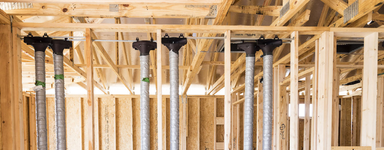
I don't have a good way of finding out how the ductwork gets upstairs and how the ducts are distributed to each room. I do know that when I tore out bedroom carpet, the 4×10 vent outlet elbow connected to 4 in flex.
Master bedroom has 2 vents. One cleverly placed under the bed which is due to how the house is built, but what were they thinking?
All other upstairs rooms have one vent.


Not on every job. If I hire a contractor to build a house specially for me, I make all the decisions. When a developer builds houses that will be for sale to a customer once they have been competed, sure the builder makes decisions. We don't know the history of the OP's house. (at the time of my post, anyway)The builder decides the quality of the job based upon the bid that's accepted.
I never said duct sizing was invented 35 years ago.... I said contractors knew HOW to properly size ducts 35 years ago. I never specified when it was originally invented.Air duct sizing was known way more than 35 years ago.
In my area, a load calculation, equipment selection or duct drawing was NOT part of the residential HVAC permit process until at least 2012.
Duct sealing was not part of a residential job until 2012.
Blower door testing and duct leakage... same thing.
2012 refers to the international energy code. All of it was not adopted in 2012.
Using building stud or joist cavities as return ductwork was allowed until the 2012 code, unless the local AHJ didn't allow it.
Until the 2012 code adoption, pretty much anything went in residential new construction HVAC. It only had to last a year... or whatever warranty that the builder specified.
And that's without the slam it in and leave early "hours booking" that was going on in my area.
**** it in and get it done, move on to the next one. Union or not.
That is one of the first things I learned as a young Tinner apprentice. It's basically day #1 of HVAC Tinner 101..... "NEVER put a take-off on the end of a trunk line."@danski0224 , @u3b3rg33k , @AA/FC
The flex duct takeoff to feed the tiny powder room is located on the end of the main duct instead of the sides / top / bottom. It had more airflow into the powder room than any other vent in the house.
That is one of the first things I learned as a young Tinner apprentice. It's basically day #1 of HVAC Tinner 101..... "NEVER put a take-off on the end of a trunk line."
It's a good indicator of the quality of installers that worked on your house. Unfortunately.
it's velocity pressure.It's an interesting situation IMHO, as the flow of an opening on the end of a trunk line is noticeably higher than the same size opening on the sides of the trunk line.
Yet when I think of it as a physics problem where I have a pressurized box, intuitively I expect the flow to be the same no matter where the opening is made.
It's an interesting situation IMHO, as the flow of an opening on the end of a trunk line is noticeably higher than the same size opening on the sides of the trunk line.
Yet when I think of it as a physics problem where I have a pressurized box, intuitively I expect the flow to be the same no matter where the opening is made.