To avoid these ads, REGISTER NOW!

Additional Attic Flooring Support

fireant911

Well-known member
Joined
Dec 22, 2012
Messages
51
Location
Alabama
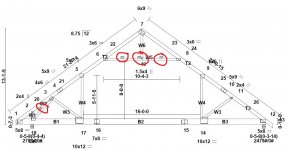
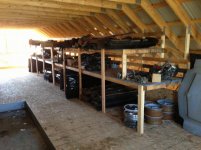
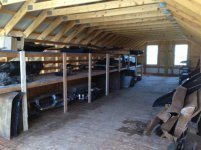
My first post here so please be gentle. We are in process of getting a nice 24’X40’ garage/shop built. It is constructed with attic trusses and there is a nice 10’ wide area running the 40’ length of the garage/shop. The garage/shop walls are constructed with 2”X4” (16” OC) whereas the attic trusses' bottom chord are 2”X8”, top cord are 2”X6”, and webs are 2”X4” (24” OC), the flooring is 23/32” thick, and the roof has a 10/12 pitch - see attached. I have nothing yet in the garage/shop because it is not yet finished though I do have a question for the experts here. I think that it would be wise to add some additional support to the areas in between the trusses (for additional flooring support). I have searched through the garagejournal looking for similar questions and did not find anything definitive. I looked on the Internet and found loads o’ stuff but some of the information seemed to conflict. What I thought would provide additional support/strength would be to add bridging but another site stated “Bridging is the term used to describe blocks nailed between joists in the middle of long spans. Bridging does not, as is commonly believed, do much to help stiffen a floor.” (http://www.saratogadeckpool.com/DeckManual/part4.htm). Yet another site states “Floor joist bridging is critical to the structural strength of a floor,…. Proper bridging distributes the load on the floor to other joists and over time prevents floors from sagging and squeaking do to floor joists twisting and warping.” (http://www.renovation-headquarters.com/floor-joist bridging.htm#.UXmh-spQggQ). I thoroughly understand that the trusses are an engineered item and I will not be modifying the trusses themselves, I am just wanting to add some additional support because of the 24” between the trusses.

I did read the ENTIRE thread here (http://www.garagejournal.com/forum/showthread.php?t=88914&highlight=bridging) and, although it appears that this is a very good approach and stiffen the trusses, I am looking to add support to the attic flooring itself (the 24” span between the trusses is troubling me). There is currently no flexing or 'give' to the flooring when walking across it. So, after a rather long-winded introduction to my question, here it is… Does adding bridging between the bottom chords significantly add to the strength of the attic’s floor?
Thanks,
 

Attachments

  • below picture.jpg
    below picture.jpg
    146.6 KB · Views: 165
  • above picture.jpg
    above picture.jpg
    138.8 KB · Views: 162
To avoid these ads, REGISTER NOW!

readhead

Well-known member
Joined
Dec 8, 2012
Messages
6,175
Location
Durango, Co.
Simple answer is no. You should be good to go unless you are storeing anvils up there. Somewhere in your plans there should be a live load spec for that floor if that will make you feel better.
 

Conductor562

Well-known member
Joined
Oct 2, 2012
Messages
2,312
Location
West "By God" Virginia
Simple answer is no. You should be good to go unless you are storeing anvils up there. Somewhere in your plans there should be a live load spec for that floor if that will make you feel better.

:+1: I wouldn't put any additional support up there unless you needed to sure up something at a seam or something.
 

kert

Well-known member
Joined
May 31, 2009
Messages
371
Location
Franklin, MI
In general, bridging/blocking will not increase the overall strength of the floor. What it will do is to help distribute point loads (such as a person) across several trusses. This will make the floor seem less bouncy.

Also, the bridging/blocking wi prevent the bottom cords from twisting under load, which will add some strength.

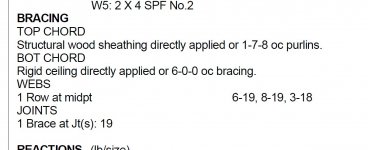
Your truss manufacturer may specify that blocking/bridging is required. I know the sheet on my trusses specified either blocking, bridging, or a rigid ceiling.
 

Zeke

Well-known member
Joined
Aug 13, 2009
Messages
17,176
Location
Long Beach CA, the sewer by the sea.
Precision cut installed blocking is called pressure blocking. While it may not add significantly to the live load, it will make for a more solid floor system. Pressure blocking does distribute the load. I would certainly do this at the outside edge of your flooring. Since it's only 10' of attic span, I would ignore the center assuming you are using T&G.
 

readhead

Well-known member
Joined
Dec 8, 2012
Messages
6,175
Location
Durango, Co.
Zeke has a good point. It would be worthwhile to block the outside edges to support the sheeting and it would be a good idea to put something on the walls so stuff doesn't dissapear of the edges.
 
OP
F

fireant911

Well-known member
Joined
Dec 22, 2012
Messages
51
Location
Alabama
Zeke,
That is exactly what I was considering although I did not know the proper terminology - a more solid floor system is what I was after. Yes, the flooring is tongue and groove, but I am curious as to why you suggest putting the pressure blocking on the outside edges rather than putting supports, for example, distributed evenly at three points across the bottom chord (if 10' attic space, why not one in the middle and one on either side at 2' 6" from the middle). Again, the attic room is very secure and stable at this point - I just want to add some support for the flooring. Thanks for the replies!

I will include photographs as soon as the construction is finished (vinyl was completed today and all that remains is the brickwork and installation of three garage doors).
 
Last edited:

Cemoto

Well-known member
Joined
Aug 26, 2012
Messages
427
Location
Central Massachucetts
Daryl,

I asked my builder the same question a couple of weeks back. His reply was that the 3/4" floor stabilizes the floor and no other bracing is necessary.

It does seem like there should be something there w/ a 24" OC doesn't it?
 

passinthru

Active member
Joined
Feb 28, 2012
Messages
30
Location
S.W.Pa.
Daryl,
My garage is 30' wide with 18' of attic space. I blocked the center and 4' on either side, before I put the floor down. It really made a big differance stiffening up the trusses.
 

Cemoto

Well-known member
Joined
Aug 26, 2012
Messages
427
Location
Central Massachucetts
Any photos of the "blocking"?

Do you stagger them like firestops in a wall?

Wouldn't nailing drywall strapping or 2x4's to the bottom of the trusses almost accomplish the same thing?

I sort of tend to overbuild everything.

Thanks in advance..........

I'm wondering the same thing, I have my permit and the excavation is starting this week for a 36'x32'.

Regards,
 
OP
F

fireant911

Well-known member
Joined
Dec 22, 2012
Messages
51
Location
Alabama
passinthru,
What you did is what I was considering doing. As I look at the bottom chords and the flooring from below, this approach appears to give the most support to the flooring. I did dig out my old college text on statics this evening to run some numbers but I was unable to find an example that used attic trusses (plenty of information was present dealing with roof trusses... but nothing on attic trusses). I am not surprised that you immediately noticed an increase in the rigidity of your flooring.

Cemoto,
Your question is the same one I had earlier which still remains unanswered... I saw some recommendations advocating running the supports in a straight line whereas others recommended staggering. If straight, the nails would have to be toenailed while staggered would allow face nailing. I do not know the advantages/disadvantages of each so I, just like you, do not know which method to use. I will talk to my builder on Monday to see what he thinks and why.

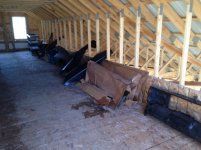
Here is a picture, from the back, of our 'not-yet-completed' garage.
 

Attachments

  • day 12 rear.jpg
    day 12 rear.jpg
    145.5 KB · Views: 47

fury9

Well-known member
Joined
Mar 4, 2012
Messages
1,277
Location
Mchenry, IlLaHnoYs
OP, Your fine, the trusses were designed to give you that space, hell you could make a (yikes) mancave up there,Bridging is for side to side movement where the top of the joistt is not secured by sheeting (obviously yours is taken care of) and the bottom is secured by only drywall or vise versa, bridging does not help with the floor deflection if you jump up and down. Although I do hink x bridging helps more with this than solid blocks
 

passinthru

Active member
Joined
Feb 28, 2012
Messages
30
Location
S.W.Pa.
I staggered mine,because i wanted to be able to face nail them.
I'am planing on keeping my rideing mowers, and small tractor up there.
I wanted it as solid as possable.DSCF2322garagemail.jpg

DSCF2321garagemail.jpg

IMG_7217 resize.jpg
 

NUTTSGT

Super Moderator
Staff member
Joined
Sep 14, 2009
Messages
50,863
Location
Northern Central Ohio
If it was mine, I'd add them for peace of mind if nothing else. I'd do like Zeke suggested, at the edges.

passinthru, why don't you have a build thread on that place ?
 
OP
F

fireant911

Well-known member
Joined
Dec 22, 2012
Messages
51
Location
Alabama
I was thinking about this question again this morning. I came to the realization that this is not attic truss equation, but instead it is a flooring equation - although the attic portion is constructed with properly engineered attic trusses, my question JUST involves adding support to the attic’s floor. Decreasing the floor’s tendency to deflect is the purpose of my exercise… therefore, I now expect this to simply be a supported beam-type problem. The greatest deflection amount realized/calculated will be at the center of the floor. The solid blocking method, as Zeke proposed, appeals to my logical side. The length of the pieces is critical (they should be cut a “whisker longer” than the actual space between the joists). Additionally, this approach is meant to work as a system thus the blocking should not be staggered but instead run in a line.

My plans are to wait until Winter and install three rows of solid blocking; one in the middle and another row on both sides spaced equidistant from the center to the outer edge of my attic space. Below is an article describing this procedure. One more possible benefit of the application of solid blocking is this will also serve as additional truss bracing.
http://www.finehomebuilding.com/PDF/Free/021184090.pdf (page 6)

I do have a question - two responses had advocated putting the support at the outside edge of the flooring. This recommendation does not make sense to me. In looking at the truss design and the flooring as installed, I would still expect the maximum deflection of the flooring to be at the middle. Why would it be optimal to put the solid blocking at the outer edges? Granted, the middle section would gain some additional strength by installing the blocking on the outside but that is not where the greatest strength already exists?
 

Cemoto

Well-known member
Joined
Aug 26, 2012
Messages
427
Location
Central Massachucetts
My trusses are arriving next Friday so I'm looking at this thread again.

It would seem a very good plan to use the bracing at the outer non-floor area as the nailed floor helps to stabilize the center.

My trusses are 35' overall w/ 31' inside, 24" OC. The attic floor is 16', this leaves 7'6" un-braced at each of the inside ends.

I'm leaning toward using one false beam (blocking) on each side approx 2/3's of the distance from the outer edge where the strapping will fall for the sheetrock.

What did you end up doing fireant?
 

bczygan

Well-known member
Joined
Nov 4, 2009
Messages
22,002
Location
DETROIT! Arsenal of Scrappers
I was thinking about this question again this morning. I came to the realization that this is not attic truss equation, but instead it is a flooring equation - although the attic portion is constructed with properly engineered attic trusses, my question JUST involves adding support to the attic’s floor. Decreasing the floor’s tendency to deflect is the purpose of my exercise… therefore, I now expect this to simply be a supported beam-type problem. The greatest deflection amount realized/calculated will be at the center of the floor. The solid blocking method, as Zeke proposed, appeals to my logical side. The length of the pieces is critical (they should be cut a “whisker longer” than the actual space between the joists). Additionally, this approach is meant to work as a system thus the blocking should not be staggered but instead run in a line.

My plans are to wait until Winter and install three rows of solid blocking; one in the middle and another row on both sides spaced equidistant from the center to the outer edge of my attic space. Below is an article describing this procedure. One more possible benefit of the application of solid blocking is this will also serve as additional truss bracing.
http://www.finehomebuilding.com/PDF/Free/021184090.pdf (page 6)

I do have a question - two responses had advocated putting the support at the outside edge of the flooring. This recommendation does not make sense to me. In looking at the truss design and the flooring as installed, I would still expect the maximum deflection of the flooring to be at the middle. Why would it be optimal to put the solid blocking at the outer edges? Granted, the middle section would gain some additional strength by installing the blocking on the outside but that is not where the greatest strength already exists?

Blocking or bridging will NOT decrease deflection. In fact, you are adding a bit of dead load which will slightly INCREASE deflection.

The extra thickness of your attic floor sheeting accounts for the 24" span and your finished ceiling below replaces blocking or bridging as a method of transferring point loads to adjacent structure.

I like solid blocking over "X" bridging, but it makes it more difficult to run wiring or piping.

And any extra structure adds to the dead load and requires more strength (And structure and even more dead load) to support it.

I dislike most attic truss solutions since they place walls at approximately 1/3 points of a very long span and give only about 1/3 usable space compared to the floor below. I would rather just add a story.

Long spans require deeper members to get rid of that bouncy feeling. I always go deeper than the span tables to account for that. And long span floors aren't for heavy loads.
 
To avoid these ads, REGISTER NOW!
OP
F

fireant911

Well-known member
Joined
Dec 22, 2012
Messages
51
Location
Alabama
What did you end up doing fireant?

Well, nothing yet... the electricians wired it last week so I can clearly see where I must steer clear of.

Although many claim that additional support does not add any strength to the flooring, I cannot see how this would not work (I,too, have read these negatives during my searching but the logical side of me does not agree - because much advice has also been encountered stating the benefits of such supports).

Given that the bottom trusses are 24" OC, adding bridging in between has to increase the rigidity of the floor as a whole. I had a lengthy discussion with my builder about this question and he stated that, yes, the floor will be stronger BUT they tend to squeak more when bridging is added using nails - if screws were used, it works great and adds strength.

Looking further... in the equation for deflection, the length (which is cubed^3), is in the numerator... as the length between supports increases the deflection increases exponentially. Conversely, decreasing the distance between the supports (which the bridging will do), should dramatically decrease the likelihood/tendency for the floor to deflect when dynamic loads are encountered.

In a civil manner, I would certainly be interested in someone explaining why adding supports in-between the current 24" spaces would NOT add strength to the floor. Imagine a floor that is supported at 36" OC... which has more of a tendency to deflect? One at 24" or the example one at 36"?
 

Nowater

Well-known member
Joined
Nov 29, 2011
Messages
744
Location
Southwest Florida
IF I understand your point of view, the solid wood bridging would resist any twisting of the attic truss "floor" joist. The bridging is not an additional support as would be used in a deflection equation. That equation relates to the overall deflection from one outside wall to the other, they would however make the floor feel more stiff and less bouncy.
 

bczygan

Well-known member
Joined
Nov 4, 2009
Messages
22,002
Location
DETROIT! Arsenal of Scrappers
Well, nothing yet... the electricians wired it last week so I can clearly see where I must steer clear of.

Although many claim that additional support does not add any strength to the flooring, I cannot see how this would not work (I,too, have read these negatives during my searching but the logical side of me does not agree - because much advice has also been encountered stating the benefits of such supports).

Given that the bottom trusses are 24" OC, adding bridging in between has to increase the rigidity of the floor as a whole. I had a lengthy discussion with my builder about this question and he stated that, yes, the floor will be stronger BUT they tend to squeak more when bridging is added using nails - if screws were used, it works great and adds strength.

Looking further... in the equation for deflection, the length (which is cubed^3), is in the numerator... as the length between supports increases the deflection increases exponentially. Conversely, decreasing the distance between the supports (which the bridging will do), should dramatically decrease the likelihood/tendency for the floor to deflect when dynamic loads are encountered.

In a civil manner, I would certainly be interested in someone explaining why adding supports in-between the current 24" spaces would NOT add strength to the floor. Imagine a floor that is supported at 36" OC... which has more of a tendency to deflect? One at 24" or the example one at 36"?

Perhaps you are mixing up some terminology here.

Certainly, if you decrease the distance between supports for the floor deck, you will have less deflection in the DECKING material. But what this means is that you must space the TRUSSES closer together. Your floor decking is already thicker, to span the 24" space, so this is not necessary. If you did want to add additional floor support members in between the existing trusses, they would have to be either additional trusses, or a member designed to span the same total span as the trusses do (From outside wall to outside wall).

Bridging or blocking runs perpendicular to the trusses. It gives NO additional support for overall loads. It DOES transfer loads between the decking and bottom chords of the adjacent trusses. It does this in a way that makes the floor feel stiffer.

Are we clear on this?
 

bczygan

Well-known member
Joined
Nov 4, 2009
Messages
22,002
Location
DETROIT! Arsenal of Scrappers
Well, nothing yet... the electricians wired it last week so I can clearly see where I must steer clear of.

Although many claim that additional support does not add any strength to the flooring, I cannot see how this would not work (I,too, have read these negatives during my searching but the logical side of me does not agree - because much advice has also been encountered stating the benefits of such supports).

Given that the bottom trusses are 24" OC, adding bridging in between has to increase the rigidity of the floor as a whole. I had a lengthy discussion with my builder about this question and he stated that, yes, the floor will be stronger BUT they tend to squeak more when bridging is added using nails - if screws were used, it works great and adds strength.

Looking further... in the equation for deflection, the length (which is cubed^3), is in the numerator... as the length between supports increases the deflection increases exponentially. Conversely, decreasing the distance between the supports (which the bridging will do), should dramatically decrease the likelihood/tendency for the floor to deflect when dynamic loads are encountered.

In a civil manner, I would certainly be interested in someone explaining why adding supports in-between the current 24" spaces would NOT add strength to the floor. Imagine a floor that is supported at 36" OC... which has more of a tendency to deflect? One at 24" or the example one at 36"?

Perhaps you are mixing up some terminology here.

Certainly, if you decrease the distance between supports for the floor deck, you will have less deflection in the DECKING material. But what this means is that you must space the TRUSSES closer together. Your floor decking is already thicker, to span the 24" space, so this is not necessary. If you did want to add additional floor support members in between the existing trusses, they would have to be either additional trusses, or a member designed to span the same total span as the trusses do (From outside wall to outside wall).

Bridging or blocking runs perpendicular to the trusses. It gives NO additional support for overall loads. It DOES transfer loads between the decking and bottom chords of the adjacent trusses. It does this in a way that makes the floor feel stiffer.

A load must travel from the floor deck into a truss bottom chord and then into a vertical wall and into the ground. Think of everything as a beam. The floor decking is a beam that transfers a load across the space between truss bottom chords into the truss bottom chord on either side. Solid blocking can help do this in a particular spot. Now that the load is supported by the trusses, nothing increases the load supporting capability of them except closer spacing of the trusses or stronger design of the trusses themselves.

Are we clear on this?
 
OP
F

fireant911

Well-known member
Joined
Dec 22, 2012
Messages
51
Location
Alabama
Nowater,
Precisely that!

bczygan,
Yes... I think. I wanted to reduce the tendency of the 3/4" flooring to deflect by using bridging (note that ABSOLUTELY no bouncing/deflection has been encountered while walking, or even jumping, through the attic... my intent was to cover the 'just in case' scenarios). I thoroughly understand that the trusses are designed to carry a maximum load and this cannot be increased by adding bridging - the 24" span in-between the trusses has been my focus through this entire exercise. The floor with bridging just does not feel stiffer, it is stiffer.
 

bczygan

Well-known member
Joined
Nov 4, 2009
Messages
22,002
Location
DETROIT! Arsenal of Scrappers
Something else you can do to make the floor decking material stiffer is to make a lamination. In other words, add another layer and glue and screw it down to the existing decking. This adds a bit of weight and should be planned for in the original truss design. We used to do high end homes this way exclusively. Sub floor was 5/8" ply, with a finish floor of 1/2" ply run the other direction, and then carpet. Helps with sound too.
 
OP
F

fireant911

Well-known member
Joined
Dec 22, 2012
Messages
51
Location
Alabama
bczygan,
That ties in with a discussion my wife and I had this weekend. My wife wants to add hardwood flooring to the attic flooring (running perpendicular to the trusses, of course). Would the 3/4" hardwood flooring installed in this fashion serve the same the purpose? I, on the other hand, am currently undecided about the extent of finishing the garage attic (too much money has already been spent and I just need it to stop!).
 

bczygan

Well-known member
Joined
Nov 4, 2009
Messages
22,002
Location
DETROIT! Arsenal of Scrappers
bczygan,
That ties in with a discussion my wife and I had this weekend. My wife wants to add hardwood flooring to the attic flooring (running perpendicular to the trusses, of course). Would the 3/4" hardwood flooring installed in this fashion serve the same the purpose? I, on the other hand, am currently undecided about the extent of finishing the garage attic (too much money has already been spent and I just need it to stop!).

Hell of a finish floor! A bit of weight too.

It would certainly add some spanning ability. But hardwood flooring isn't glued and screwed often like plywood. It needs to expand and contract as it isn't so dimensionally stable across the grain. So it doesn't become part of the floor sandwich like the plywood.

The larger plywood sheets, glued and screwed would make the floor sandwich much more monolithic.


Sounds like your answer is in the wife's hands. Hold on to that wallet.
 

theoldwizard1

Well-known member
Joined
Feb 22, 2011
Messages
43,077
Location
SE MI
I've got some 3/4" plywood in my rafters for storage. I add some 2x4 under the seams and connected them to the joists with 2x4 joist hangers. Keeps the 2 sheets from deflecting relative to each other. Probably could have use roof decking plywood clips.
 

Cemoto

Well-known member
Joined
Aug 26, 2012
Messages
427
Location
Central Massachucetts
I'm in the middle of my build and can tell you what made a difference in regards to floor bounce in my case.

Firstly, my attic trusses are 35' in length. The building is 32' deep, there is a 1' overhang on the back and a 2' one on the front.

After they were first installed (no bridging or internal bracing) there was some noticeable bounce especially toward the center of the building. I had the guys install the floor blocking first, that took care of most of it, but what really made the difference was the installation of the "V" bracing upstairs. It is VERY solid now w/ no movement even when jumping up and down.

On one side, in two places, we moved a block back to accommodate the light box for the skylights to illuminate the first floor.

Here are a few pics.

Regards,
 

Attachments

  • Img_2171ss.jpg
    Img_2171ss.jpg
    131.9 KB · Views: 90
  • Img_2153ss.jpg
    Img_2153ss.jpg
    127.5 KB · Views: 95
Last edited:
OP
F

fireant911

Well-known member
Joined
Dec 22, 2012
Messages
51
Location
Alabama
Cemoto,
I have three questions with your impressive project!

Question 1: applies to the 'V' bracing that you stated made the most improvement. Is this bracing visible in the picture taken from the attic and made with 2X4 that appear to be 10' or 12' in length (the ones that connect the trusses to one another)?
Question 2: was the blocking installed in the area between the attic floor and the outside edges of the trusses? If so, why? I am extremely curious about this because I have seen cases (here) where people recommended adding blocking on the outside edges to supposedly provide additional strength to the flooring. When I questioned these same folks as to why, no one ever responded.
Question 3: how are you going to finish your upstairs? I am looking for ideas and yours looks very much like mine.

That is one great looking garage!
 

nolimits76

Well-known member
Joined
Jul 11, 2013
Messages
959
Location
Oklahoma
My company builds highway bridges, etc. Assuming your part of the country uses traditional drilled shafts, columns, pier caps and beams (steel or concrete) with a concrete deck on top, you should see that between both the steel and concrete beams you have these support pieces.

In our world, we call them diaphragms. And their purpose is to prevent the beams from rolling until the entire system is constructed and in-place. Theoretically, our beams carry the real loads.

I am not an engineer, but applying the same logic, you would need to use bigger trusses and/or lesser spacing to carry more physical load.
 

Cemoto

Well-known member
Joined
Aug 26, 2012
Messages
427
Location
Central Massachucetts
Cemoto,
I have three questions with your impressive project!

Question 1: applies to the 'V' bracing that you stated made the most improvement. Is this bracing visible in the picture taken from the attic and made with 2X4 that appear to be 10' or 12' in length (the ones that connect the trusses to one another)?
Question 2: was the blocking installed in the area between the attic floor and the outside edges of the trusses? If so, why? I am extremely curious about this because I have seen cases (here) where people recommended adding blocking on the outside edges to supposedly provide additional strength to the flooring. When I questioned these same folks as to why, no one ever responded.
Question 3: how are you going to finish your upstairs? I am looking for ideas and yours looks very much like mine.

That is one great looking garage!

Darryl,

Thank you for the compliment. It started off being a garage but is ending up more like a barn :)

#1
Yes, that is the brace I'm referring to. There is also additional bracing installed on what I'll call the 2nd floor ceiling joists. This was on the engineered truss design. (see pic)
#2
The specs on the trusses were if you were not to use a floor than bracing every 6.5 ft was required. For the small cost of lumber, I went halfway between the 2nd floor walls (floor edge) and the outside edge. Or think of it like this, half way between the floor and the edge and the roof, so the bracing made a tri-angle of sorts. The 3/4" Advantech was glued and nailed which helped to make a somewhat rigid structure.

No bounce at all, except for the slight flex of the subfloor. that will change when I install sanded plywood for a finished floor.

#3
My 2nd floor will be for parts storage of the cars and motorcycles. I do have a nice recliner to go there as well as a computer workstation. there will be shelves on one wall and drywall on the other. I'm uncertain as to whether to insulate the second floor or not and time will tell if that is warranted.

Regards,

Al
 

Attachments

  • truss1.jpg
    truss1.jpg
    137.7 KB · Views: 61
  • trussImage22.jpg
    trussImage22.jpg
    78.1 KB · Views: 48

The Boss

Well-known member
Joined
Dec 9, 2012
Messages
387
Location
Connecticut
Simple answer is no. You should be good to go unless you are storeing anvils up there. Somewhere in your plans there should be a live load spec for that floor if that will make you feel better.

This is the best answer by far.

Do the calculations - if your LL/DL is 40lbs/square foot you would be amazed at what you can put up there....for example - my storage loft is 14' wide by 60' long = 33,600 lbs or 4 - F-350/Crew Cab Diesel trucks.

My overall span is 36', my clear span is slightly over 34' - I opted for a 2x10 bottom cord and paid I think $350 more for that - but I was planning on storing a lot of car parts up there.
 

Attachments

  • IMG_0628 (1280x960).jpg
    IMG_0628 (1280x960).jpg
    136.7 KB · Views: 61
  • IMG_0629 (1280x960).jpg
    IMG_0629 (1280x960).jpg
    132.7 KB · Views: 59
  • IMG_0630 (1280x960).jpg
    IMG_0630 (1280x960).jpg
    126 KB · Views: 57

sberry

Banned
Joined
Jun 18, 2005
Messages
35,747
Location
Brethren, Michigan
I do have a question - two responses had advocated putting the support at the outside edge of the flooring. This recommendation does not make sense to me. In looking at the truss design and the flooring as installed, I would still expect the maximum deflection of the flooring to be at the middle. Why would it be optimal to put the solid blocking at the outer edges? Granted, the middle section would gain some additional strength by installing the blocking on the outside but that is not where the greatest strength already exists?
This has been brought up a couple of times but is this worth the effort? You hging to have Olympic boxing training up there 24/7? Is this not already engineered?
 
OP
F

fireant911

Well-known member
Joined
Dec 22, 2012
Messages
51
Location
Alabama
This is a long overdue followup if the event that anyone searches and finds this. We added additional supports just as CEMOTO did and there is absolutely no flex/bounce/squeak to the flooring after the modification. I spoke with my father-in-law about this situation earlier (retired Mechanical Engineer) and he recommended just using 2X4's as blocking. This is now one solid floor... so the blocking works! We both shrugged our shoulders at the recommendation at adding bracing at the edges as it doesn't make sense???

Overkill... maybe but by installing some simple blocking added much strength/rigidity to the flooring.
 
To avoid these ads, REGISTER NOW!
Top Bottom