To avoid these ads, REGISTER NOW!

Advice Needed on 8x8 Shed Construction

KPtexan05

Active member
Joined
Dec 8, 2018
Messages
32
Location
Texas
We moved into our house less than a year ago, and every since then I've been wanting a small shed to get certain things moved out of the garage (lawn equipment, gas cans, garden tools, etc). We recently decided to have our patio extended so I figured that would be a good time to have a shed slab poured. This work occurred the week before last, and it's safe to say these guys had more experience with patios than slabs.

I designed an 8' x 8' framed shed with the intention of building on this slab, so I asked them to make the form about 95.5" square which would let the sill plate hang off slightly. I confirmed no dimensions exceeded 96" before the pour, but after it was apparent there was a slight bow on one side of the form. This made the max width at the bow roughly 96.75". I've redesigned the shed frame to be 97" square now, which is irritating since I'll need a few pieces of 10' length lumber to make up that extra inch. That being said, I believe that would be a workable solution to the size issue.

Now on to my other issue, I asked for the slab to be a minimum of 4" thick, so that really made it about 3.5" above grade and the grass is almost up to that height. I'm now concerned about the siding being too close to grade. The main issue is really the front corner, and it's on a slight slope to the back is more around 6"+ above grade.

I suppose I could scrap the whole idea of building directly on the slab and make a platform, but that does away with one of the primary reasons I paid to have a slab poured in the first place.

Basically, the question I need help on is should I build directly on this slab, or do something else? I truly Appreciate the help!

A few photos of the slab in question (bear in mind frost heave is not an issue here in central TX):


 
To avoid these ads, REGISTER NOW!
OP
K

KPtexan05

Active member
Joined
Dec 8, 2018
Messages
32
Location
Texas
Also figured I'd give a few details about what I planned for the shed itself so y'all can make any suggestions needed there:

-2x4 studs and rafters ~16" OC
-Rafters attached to double top plate with TimberLOK screws
-Pressure treated sill plate with sill plate gasket
-LP Smartside panel and Trim
-LP Techshield roof decking
-GAF architectural shingles
-GAF ridge vent
-Tyvek wrap

Here's a basic frame drawing:
 
OP
K

KPtexan05

Active member
Joined
Dec 8, 2018
Messages
32
Location
Texas
Also, should I possibly use a double sill plate with a treated 2x6 on the bottom? Just hate to lose that extra 2" of floor space all the way around on such a small shed. Here's how a 97" square sill plate would lay on the slab (has <1" overhang max, green line is the slab):

 
OP
K

KPtexan05

Active member
Joined
Dec 8, 2018
Messages
32
Location
Texas
You could stick with your 8’ number and have a Z flashing made up to get by the extra 3/4” and raise the bottom of the siding at the same time.
Do you mean like a custom made Z-flashing? So it would extend up the wall a couple inches and then kick out past the slab a bit and then drop down past the slab?
 

rayra

Well-known member
Joined
Dec 1, 2014
Messages
4,724
Location
Escaped from Los Angeles
It's the siding that's supposed to overlap / hang over, not the sill / walls.

And it's a shed. The level of precision you are seeking is disproportionate.

Is your yard that sloped or is that camera parallax?, a that slab does not look flat or level in that picture.

Can't tell from the pictures how close the ends of the rebar were to the forms or where the oversize dimension is occurring. But it would be a simple matter to use a walk-behind concrete saw and shave the extra inch off the back or right side of that slab, where it wouldn't be noticeable and extend to the depth you intend to have the siding overlap.
 

Wolley

Well-known member
Joined
Jun 24, 2022
Messages
420
Location
Maine
You can cut the concrete with a circular saw and diamond blade to square up the slab to 8 ft. Also I think 2 ft OC would be fine. You could bolt down a PT 4x4 or 4x6 for a sill to get the siding away from the grass, or lay a course of concrete block.
 

duneslider

Well-known member
Joined
Jan 20, 2013
Messages
2,262
Location
Riverton, Utah
Not sure what your overall construction will be but if you frame it a standard 96x96 I would imagine your siding is going to be at least 1/2 on all sides so your overall width should be 97". This would still be just fine. If I were doing this shed I would have 7/16 osb on all sides then some sort of siding on it so I would be more like 98" overall.

Using a Z flashing would also be just fine to do but I don't think it is needed. You could just use a quality flashing tape (Like Siga Fentrim, there are others and yes they are a bit expensive but easier to diy than making a custom z flashing.
 
OP
K

KPtexan05

Active member
Joined
Dec 8, 2018
Messages
32
Location
Texas
It's the siding that's supposed to overlap / hang over, not the sill / walls.

And it's a shed. The level of precision you are seeking is disproportionate.

Is your yard that sloped or is that camera parallax?, a that slab does not look flat or level in that picture.

Can't tell from the pictures how close the ends of the rebar were to the forms or where the oversize dimension is occurring. But it would be a simple matter to use a walk-behind concrete saw and shave the extra inch off the back or right side of that slab, where it wouldn't be noticeable and extend to the depth you intend to have the siding overlap.
How can the siding overlap the slab if the sill plate isn't right at the edge of the slab or very slightly over? I basically told the concrete guy to aim for no more than 96" square - it could be very slightly under, but not over. Is that the level of precision you're referring to as being disproportionate?

The yard does have some slope but the camera makes it look off. The slab is pretty close to perfectly flat (there is a small area on one side I might need to shim about 1/8") and it's level according to my 4' level.
 
OP
K

KPtexan05

Active member
Joined
Dec 8, 2018
Messages
32
Location
Texas
Why not do a single course of block? Cheap and easy to do.

You can cut the concrete with a circular saw and diamond blade to square up the slab to 8 ft. Also I think 2 ft OC would be fine. You could bolt down a PT 4x4 or 4x6 for a sill to get the siding away from the grass, or lay a course of concrete block.
What kind of blocks would typically be used? Are the 4x8x16 hollow blocks or are they solid? I'll do some research, but my masonry skills are lacking.

I kind of like the idea of the taller sill plate made out of PT wood, if that's acceptable.
 
OP
K

KPtexan05

Active member
Joined
Dec 8, 2018
Messages
32
Location
Texas
Not sure what your overall construction will be but if you frame it a standard 96x96 I would imagine your siding is going to be at least 1/2 on all sides so your overall width should be 97". This would still be just fine. If I were doing this shed I would have 7/16 osb on all sides then some sort of siding on it so I would be more like 98" overall.

Using a Z flashing would also be just fine to do but I don't think it is needed. You could just use a quality flashing tape (Like Siga Fentrim, there are others and yes they are a bit expensive but easier to diy than making a custom z flashing.
I planned on using LP Smartside fastened directly to the studs since it is rated as both sheathing and siding. I think it's about 3/8" thick so that would make the overall width 96-3/4" if the framing were 96". That would not let me extend the siding down past the slab at all, but do you think that would be OK?

This is basically where the outside of the siding would be. Technically past the edges of the slab, but not out far enough to overlap the slab:

 
Last edited:

duneslider

Well-known member
Joined
Jan 20, 2013
Messages
2,262
Location
Riverton, Utah
I know this is just a shed...but I am a fan of having sheathing first. I believe if you use just LP Smartside (which I love) you are supposed to have some sort of bracing like a steel straping or a wood strap let in.

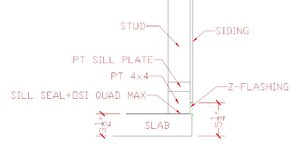
I would put a sill seal down under your bottom plate and then put a nice bead of OSI quad max at that joint and I think you would be fine no matter what you do.

At the end of the day this is a shed and Texas is dry enough I don't think you will have rot issues anyway.
 

Zeke

Well-known member
Joined
Aug 13, 2009
Messages
17,176
Location
Long Beach CA, the sewer by the sea.
When you cut your bottom plates, 2 will be 96". The other 2 are cut 7 inches shorter to fit between. Where is the problem? Cut the 2nd pair at -6" and you have your overhang on the long side. That's where you will square up the bow. Siding needs corners, so again, 8' lengths are long enough.
 

rayra

Well-known member
Joined
Dec 1, 2014
Messages
4,724
Location
Escaped from Los Angeles
One more thing, since you seen intent on exact dimensions, you mention siding panels. What is their length? 96" or 97" or longer?
If you frame exactly to an outside dimension of 96", what are you doing to close your exterior corners? if your siding is 96"L, you will be short the thickness of the siding at each corner. Are you properly boxing the corners to go with your siding, or were you planning to just **** them together? The latter is typical with things like T1-11 siding, but again if your wall is a full 96" across, this won't reach / close.
 

finn

Well-known member
Joined
Mar 27, 2005
Messages
16,261
Location
The UP, God's country
One more thing, since you seen intent on exact dimensions, you mention siding panels. What is their length? 96" or 97" or longer?
If you frame exactly to an outside dimension of 96", what are you doing to close your exterior corners? if your siding is 96"L, you will be short the thickness of the siding at each corner. Are you properly boxing the corners to go with your siding, or were you planning to just **** them together? The latter is typical with things like T1-11 siding, but again if your wall is a full 96" across, this won't reach / close.
He can always add a 1x4 cedar trim board on all four corners. That will finish the corners nicely.

I would look into a single course of block to take care of any slab size issues. The bonus is that the block gets the sill plate out of the wet.
 
OP
K

KPtexan05

Active member
Joined
Dec 8, 2018
Messages
32
Location
Texas
When you cut your bottom plates, 2 will be 96". The other 2 are cut 7 inches shorter to fit between. Where is the problem? Cut the 2nd pair at -6" and you have your overhang on the long side. That's where you will square up the bow. Siding needs corners, so again, 8' lengths are long enough.
I was planning on overlapping the double top plate so either way I'd need a couple 2x4s longer than 8' there. The extra 10 footers really aren't that big of a deal. I was just companioning about redesigning the thing and the fact that the sill plate wont sit the same on top of the slab along the whole length of the wall.
 

jkuro

Well-known member
Joined
Apr 28, 2009
Messages
552
Use a treated 4x4 for the bottom plate if you want a little more height.

Put in a roof vent and soffit vent for some air circulation.
 
OP
K

KPtexan05

Active member
Joined
Dec 8, 2018
Messages
32
Location
Texas
One more thing, since you seen intent on exact dimensions, you mention siding panels. What is their length? 96" or 97" or longer?
If you frame exactly to an outside dimension of 96", what are you doing to close your exterior corners? if your siding is 96"L, you will be short the thickness of the siding at each corner. Are you properly boxing the corners to go with your siding, or were you planning to just **** them together? The latter is typical with things like T1-11 siding, but again if your wall is a full 96" across, this won't reach / close.
I'm not really intent on exact dimensions - what dimensions do you think the shed should be for my slab? Is 8' x 8' as originally planned going to work? I'll be using LP SmartSide trim on all corners - it's roughly 3.5" x .75".
 
OP
K

KPtexan05

Active member
Joined
Dec 8, 2018
Messages
32
Location
Texas
Use a treated 4x4 for the bottom plate if you want a little more height.

Put in a roof vent and soffit vent for some air circulation.
I think I'm leaning this direction with the 4x4.

Yep, I've already got ridge vents and soffit vents in my BOM. I was planning on enclosing the soffits and putting three 4" wide soffit vents on each side, which should match pretty well with the flow from the ridge vent.
 
To avoid these ads, REGISTER NOW!

Hank11

Well-known member
Joined
Aug 19, 2019
Messages
1,152
Location
Tennessee
One course of block will make you so much happier about 8 - 10 years from now.
If you don't do concrete, be sure to paint a couple of coats on the siding all sides and edges the bottom foot or so.
 

CraigStu

Well-known member
Joined
May 22, 2014
Messages
4,034
Location
Blacksburg, Va
One course of block will make you so much happier about 8 - 10 years from now.
If you don't do concrete, be sure to paint a couple of coats on the siding all sides and edges the bottom foot or so.
I agree. I haven't done much concrete or block work either but this is a perfect project for it. It isn't that difficult but there are a few tricks of the trade and watching a couple of youtubes will tell you all you need to know.
 
OP
K

KPtexan05

Active member
Joined
Dec 8, 2018
Messages
32
Location
Texas
I appreciate all the replies! I'm basically trying build a basic equivalent to a Tuff Shed, but slightly higher quality and at a lower cost. An 8x8 Tuff Shed would be about $3,800 according to their design tool and I'm building this one for about $1,800 in materials.

I know block would probably be the #1 choice here, but I'd rather stick with wood if at all possible. Would this arrangement with a 4x4 have a reasonable lifespan? I will also have 7-8" of roof overhang at the eves/gables. Bear in mind this is at the shortest corner of the slab and at the back side the siding will be closer to 8" above the ground:

Sill.JPG
 

captain14

Well-known member
Joined
Dec 19, 2012
Messages
7,049
Location
Near College Park Maryland 20740
Do you mean like a custom made Z-flashing? So it would extend up the wall a couple inches and then kick out past the slab a bit and then drop down past the slab?

Here’s a link for an example for Z-flashing. All thr big box store sell it in 10 foot lengths.

A lot of GJ members lay a course of block and then build their shed/garage on the block. Anything to keep the wood away from the ground moisture. Sill seal should be used on the PT bottom plate also.
 

Wolley

Well-known member
Joined
Jun 24, 2022
Messages
420
Location
Maine
Ground contact rated PT should last almost indefinitely. You need a bottom plate to nail the studs to, then nail the plate to the 4x4. You could make that PT also and run your siding a little higher. I'd make the the overhang all around as big as possible, like 12 inches
 
OP
K

KPtexan05

Active member
Joined
Dec 8, 2018
Messages
32
Location
Texas
OK, this is what I'm looking at now. I've just got to figure out the proper size of z-flashing. I really don't want it sticking out too far because sharp metal flashing near ground level + 3 young kids doesn't mix too well. I'm just going to pick up the treated sill plate 2x4s tonight, cut to length, and then mock it up on the slab to figure some of this out.

Base.JPG
 

Mick56

Well-known member
Joined
Nov 11, 2015
Messages
558
Location
Janesville Wisconsin
I would put a layer of block down, it will keep the bottom plate dry, as well as keep the siding out of the grass. Every few feet, you can fill a core with cement and put in an anchor bolt, to bolt down the bottom plate.
 

Attachments

  • block.jpg
    block.jpg
    3.7 KB · Views: 2

readhead

Well-known member
Joined
Dec 8, 2012
Messages
6,181
Location
Durango, Co.
Your latest plan looks good. I would make the horizontal on the Z flashing at the bottom of the siding and have it extend over the concrete. You might want to put a rip off siding behind the lower part of the flashing to make it more solid. The bottom of the flashing should have a hem so there isn’t a raw, sharp edge.
 
OP
K

KPtexan05

Active member
Joined
Dec 8, 2018
Messages
32
Location
Texas
Can I just say...
"I find this **** retentiveness rather comical?"

Can we start with the size!???
I can't really help it - I'm an engineer. The dimensions aren't all that big of a deal to me. I'm just not shed construction expert so I want to make sure I'm doing it right.
 

billconner

Well-known member
Joined
Jul 20, 2021
Messages
6,970
Location
Thousand Islands NYS
I would put a layer of block down, it will keep the bottom plate dry, as well as keep the siding out of the grass. Every few feet, you can fill a core with cement and put in an anchor bolt, to bolt down the bottom plate.
If you put a course of block down, they need to be anchored to the slab and mortar is definitely not sufficient. Drilling and epoxy for thread rod which also anchors sill. Should you go this route, consider dry stacking block and surface bond cement. That will water tight seal block to slab - even with a ledge.
 

FordTruckWench

Well-known member
Joined
Jan 8, 2015
Messages
539
Location
California
Once you figure out the bottom details, you'll need to figure out how tall to make the walls. Surprise - an "8 foot" wall isn't exactly 8 feet tall.

Here on the west coast, studs are 92 1/4" long. Adding one bottom plate and two top plates results in a total height of 96 3/4". Interior spaces have 1/2" ceiling drywall that is run all the way to the wall framing, and two 4' courses of drywall on the walls. The last 1/4" (at the bottom) allows for expansion/contraction, errors, irregularities, and so on. It will be hidden by trim, carpet, or something else.

96 3/4" is taller than a sheet of T1-11 or whatever siding you choose. However, lets put a roof on this. Assume a 4:12 roof with birdsmouth cuts in the rafters. The bottom edge of the rafter meets the interior top edge of the top plate. On the outside, the bottom edge of the rafter is below the wall framing. Lets calculate a point one T1-11 thickness away from the framing. 3 1/2" for the framing and 5/8" for the T1-11 is 4 1/8". At 4:12 pitch, the rafter will drop 1 3/8" in that distance. So: 96 3/4" minus 1 3/8" is 95 3/8". Thus, if the T1-11 is slid up until contacting the rafters, the bottom edge of the T1-11 will hang 5/8" below the bottom plate - a perfect amount of overhang.

Supposedly, on the east coast, studs are a little longer. I believe the idea is that from the top of the finish floor to the bottom of the finish ceiling is exactly 8 feet. I don't know what length is sold in Texas.

If you end up doubling up bottom plates, or even adding an extra 4x4 sleeper, you'll need to adjust your stud lengths to avoid situations where standard 8' material won't cover your walls.

My suggestion: Either cut the slab down to 96x96 and frame normal walls on it, or lay one course of 4" wide block and frame a shorter wall on that.
 

FordTruckWench

Well-known member
Joined
Jan 8, 2015
Messages
539
Location
California
No anchor bolts as I wasn't quite sure where the studs were going to be laid out.

This doesn't stop pros from stuffing anchor bolts willy-nilly! Saw a house being built where they placed an anchor bolt every 48". It turns out the wall studs landed right on the bolts. Their solution was to cut a wedge out of every third stud.
 

Zeke

Well-known member
Joined
Aug 13, 2009
Messages
17,176
Location
Long Beach CA, the sewer by the sea.
FordTruckWrench nailed it except to do this no concrete has to be altered. The LP corner trim will take care of the 96"+ side length. OP, if you're an engineer you better shake it off. As any framer will tell you, there ain't no 16ths in a house. They grow and shrink that much every 24 hours. Lumber being what it is today won't stay straight long after the bands are cut at the yard or store. Once you lay out the faming it gets worse. I watched framers work in Las Vegas in the summer. They started at o'dark thirty and went home at noon. What lumber was unstacked was either used that morning or it became blocking by the next.

If you want more perfect, use steel studs. In fact, if I ever build a home, it will have steel stud interior walls except for a few bearing walls which might end up being 2 x 6 24" O.C. The exterior will be also 24" O.C. using the optimum value engineering (OVE) method. The way things have to be completely sheathed these days makes over framing a waste.
 

coldh2o

Well-known member
Joined
May 21, 2013
Messages
1,428
Location
Ontario, Canada
This doesn't stop pros from stuffing anchor bolts willy-nilly! Saw a house being built where they placed an anchor bolt every 48". It turns out the wall studs landed right on the bolts. Their solution was to cut a wedge out of every third stud.

This sounds like a framing issue, not foundation. Easy fix to offset stud layout if the framer was paying attention.
 
To avoid these ads, REGISTER NOW!
Top Bottom