To avoid these ads, REGISTER NOW!

Advice on a used mill drill

wdfwguy

Active member
Joined
Oct 12, 2016
Messages
25
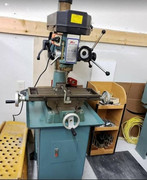
I've been watching CL, etc for a used mill to pop up. Something I could reasonably fit in the garage. I found this Enco for sale locally. Owner says it's like new, comes with a stand, vise, and some tooling.

Anyone recognize the model? What would be a reasonable price?


740b079a88725bff48e494100ccb8f4c-full.jpg
 
Last edited:
To avoid these ads, REGISTER NOW!

LeeG

Well-known member
Joined
Nov 29, 2012
Messages
1,525
Location
Phoenix, AZ
It looks pretty similar to an Enco 105 or a RF-30 (Rong-Fu). If so, they are about $1900 new for the made in Taiwan. The made in China ones are cheaper. The round column machines are not well thought of by machinists, but you can do good work with one if you keep their limitations in mind.

Base what you are willing to pay off of what it would cost to buy new. Tooling and accessories will affect that price, as well the relative scarcity of those types of machines in your area. In some parts of the country, that wouldn't be worth much, whereas in others it might for for $900 or so.
 

FlaGman

Well-known member
Joined
Aug 4, 2018
Messages
430
Location
Western North Carolina
There is a similar unit on my local listing for just $2100. Also a modified HF mini lathe that has been stretched with a longer bed for only $1000. People are crazy! I am going to probably resort to just buying new at some point.
 

jmudler

Member
Joined
Nov 6, 2013
Messages
11
I have the same mill. I stole it. Paid $300. Does everything I need it to do. The only complaint, as mentioned before, is due to being a round column you lose reference when you raise or lower the head. So you need to think out your operations to avoid raising the head.

I found the saving grace for me and this machine is short drill bits. I cant think of the proper term. That way I can drill and switch out to an end mill and not have to raise and lower the head.

Also change out the cheap bolts that lock the head with grade 8. There is a yahoo mill/drill group for the rung fu RF 30 & RF 31 mills with tons of great advice.


Edit - Screw machine drill bits are the short drill bits. Also never, ever buy import end mills. Only buy USA made bits. World of difference. You can find deals on ebay.
 
Last edited:

Aaron_W

Well-known member
Joined
Feb 6, 2018
Messages
2,891
Location
Northern California
I don't have one, but what I've heard about them is they are pretty stout for a small mill. They are a round column which means you have to re-tram them frequently, but with practice that doesn't appear to be a huge deal.

If you can get one cheap (under $1000) they are not a bad milling machine, but new or at the high prices some ask for them, you are not far off from some better machines.

It also depends on your uses for it, they are a pretty heavy duty drill press and if you aren't going for high precision, the tramming issue is much less of an issue.

I saw one sell at an auction recently for $1500 (started at $5 so the price was pure bidding war) which I thought was insane since new they are only around $1800-2000. It didn't even have any tooling with it.
 

Aaron_W

Well-known member
Joined
Feb 6, 2018
Messages
2,891
Location
Northern California
There is a similar unit on my local listing for just $2100. Also a modified HF mini lathe that has been stretched with a longer bed for only $1000. People are crazy! I am going to probably resort to just buying new at some point.

I wonder sometimes if people just don't bother looking at retail websites to see what they cost new. Sometimes a seemingly high price can be explained by tooling or accessories (DRO, power feed etc) but more often I can't figure out how they came up with a price.

Personally anything more than about 60% of the new price is too much for a used machine even if it is still sealed in the original box.
 
To avoid these ads, REGISTER NOW!

manwithtools

ALLIANCE MEMBER
Joined
Aug 24, 2015
Messages
13,647
Location
Lebanon, TN
I don't have one, but what I've heard about them is they are pretty stout for a small mill. They are a round column which means you have to re-tram them frequently, but with practice that doesn't appear to be a huge deal.

If you can get one cheap (under $1000) they are not a bad milling machine, but new or at the high prices some ask for them, you are not far off from some better machines.

It also depends on your uses for it, they are a pretty heavy duty drill press and if you aren't going for high precision, the tramming issue is much less of an issue.

I saw one sell at an auction recently for $1500 (started at $5 so the price was pure bidding war) which I thought was insane since new they are only around $1800-2000. It didn't even have any tooling with it.

Just being a bit picky about your reply, maybe it's just the terminology you are using. Tramming is the process of making the cutter face parallel to the table of the machine so that you can machine a part flat and parallel once it's mounted in a vice or on the X-Y table. Once trammed, there is not normally any need to do it again, unless the machine is moved or crashes in some catastrophic way. Tramming if necessary involves shimming the column mounting base so the column is perfectly perpendicular to the table in both X and Y planes. Frequent "Tramming" is not really an issue with these.

The main shortcoming of a mill-drill is that it changes its X-Y center line position relative to the part if you have to move the head up or down. It's too easy for the head to pivot slightly and that requires re-indicating the part to know it's exact location in X and Y.

They are very capable machines for heavy drilling and misc milling activities. However it takes very careful planning to make a complex part of odd dimensions to minimize the number of vertical moves of the milling head.
 
Last edited:

stioc

Well-known member
Joined
May 2, 2005
Messages
1,317
Location
SoCal
Agreed with @manwithtools

However, the round column mill's head movement is widely misunderstood. The head movement is only a problem if you have to raise and then lower the head during the same operation or an operation that requires multiple tools. An example of this would be a drill operation with a long drill/chuck and a mill operation on the drilled hole with a short mill. If you're moving the head up to do something unrelated the head doesn't have to be perfectly centered to the table in the x direction. When I do have to move the head in perfect alignment I just use a dial indicator with a mag base on the table to bring the head back to where it was before.

After the CNC conversion, however, I switched to collets, I have all of my most commonly used tools in their own collet holders that are ready to go. It's very rare I have to move the head. Just the quill movement covers almost all of them except the standard drill bits but been meaning to pickup shorter bits for those too. Most of my milling is on up to 1" thick plates or 2-3" round stock. Now, if you're taking on random repair jobs where you'll have to move the head up and down during the repair then you'd have to adjust the head's side to side movement.

Bottomline is if you can find a straight column mill in your price range great but for a first mill you can learn and do a lot with these mills for the money. They wouldn't still be making them for 30+ yrs if they were useless.
 
Last edited:

manwithtools

ALLIANCE MEMBER
Joined
Aug 24, 2015
Messages
13,647
Location
Lebanon, TN
stioc, good reply. After having a Mil/ Drill, I opted for a square column CNC mill. My oh my, have the gates been opened. With 15" of Z travel with no need to touch anything, my machining satisfaction has gone off the charts compared to the Mill/Drill.

I wish I had space to keep the Mill/Drill, because for some operations it's impossible to beat- large drilling at slow speed with accuracy for example.
 

matt_i

Well-known member
Joined
Mar 14, 2008
Messages
10,722
Location
SE Michigan
There's a reason they are bought and there's a reason they are sold...

...its a good way to start without the first uphill climb of moving & rigging a knee mill...

...as mentioned lack of a Z-way hurts its work envelope...

The nice thing is collets and edge tools and vises cross over to a knee mill quite nicely.

I have heard of permanently mounting a laser pointer on the head, aligning a spot on the far garage wall, like 20 feet away, and then scribing a vertical line that's a reference for the laser dot as the head is raised and lowered on the column. I've not tried this but it makes sense if you have good convergence on the laser spot and can reference a line parallel to the column.

Tramming...the spindle has to be normal to the plane of the table. Harder and much more involved to do when the head won't nod....
 

stioc

Well-known member
Joined
May 2, 2005
Messages
1,317
Location
SoCal
stioc, good reply. After having a Mil/ Drill, I opted for a square column CNC mill. My oh my, have the gates been opened. With 15" of Z travel with no need to touch anything, my machining satisfaction has gone off the charts compared to the Mill/Drill.

I wish I had space to keep the Mill/Drill, because for some operations it's impossible to beat- large drilling at slow speed with accuracy for example.

Right on! which mill do you have now?

There's a reason they are bought and there's a reason they are sold...

...its a good way to start without the first uphill climb of moving & rigging a knee mill...

...as mentioned lack of a Z-way hurts its work envelope...

The nice thing is collets and edge tools and vises cross over to a knee mill quite nicely.

I have heard of permanently mounting a laser pointer on the head, aligning a spot on the far garage wall, like 20 feet away, and then scribing a vertical line that's a reference for the laser dot as the head is raised and lowered on the column. I've not tried this but it makes sense if you have good convergence on the laser spot and can reference a line parallel to the column.

Tramming...the spindle has to be normal to the plane of the table. Harder and much more involved to do when the head won't nod....

Agreed!

Believe me if I had the budget for a good mill (read HAAS in my case) that's what I'd do too. Here's my problem I've always been very inquisitive and curious especially when it comes to machines, computers etc So I have a garage full of stuff for multiple hobbies (see my sig lol) If I bought top notch stuff for everything which I'd love to do I'd never have money left to feed the family let alone for having my hands in all those hobbies lol So my 'entry level' machines give me what I need to learn in the hopes that one day when I retire and move to a lower cost of living area where I'd then have a big shop I'd upgrade all my tools, by then I'll know what hobbies I'll actually stick with (so far all lol). Until then I'll learn on the cheapies and improve skill despite the limitations. I was the same way when I raced cars...cheap race cars that if I balled up wouldn't hurt the wallet much...consequently I was happy to run mid-pack :beer:
 

Aaron_W

Well-known member
Joined
Feb 6, 2018
Messages
2,891
Location
Northern California
Just being a bit picky about your reply, maybe it's just the terminology you are using. Tramming is the process of making the cutter face parallel to the table of the machine so that you can machine a part flat and parallel once it's mounted in a vice or on the X-Y table. Once trammed, there is not normally any need to do it again, unless the machine is moved or crashes in some catastrophic way. Tramming if necessary involves shimming the column mounting base so the column is perfectly perpendicular to the table in both X and Y planes. Frequent "Tramming" is not really an issue with these.

The main shortcoming of a mill-drill is that it changes its X-Y center line position relative to the part if you have to move the head up or down. It's too easy for the head to pivot slightly and that requires re-indicating the part to know it's exact location in X and Y.

They are very capable machines for heavy drilling and misc milling activities. However it takes very careful planning to make a complex part of odd dimensions to minimize the number of vertical moves of the milling head.


Probably using the term wrong, I'm a hobbyist not a professional machinist.

I gather what you are getting at is the head only rotates around the column, it doesn't tilt or nod so the issue is repeatability after movement rather than squareness to the table / vise.
Was not aware that tramming only applied to squareness, but I can see how indicating would be a more accurate term as it is more of a positional relationship issue.

I've only used mills with a square column and tilting head, never used a round column type so to me adjusting the mill is tramming and indicating is what I do to locate the part in relation to the cutter.
 
To avoid these ads, REGISTER NOW!
Top Bottom