To avoid these ads, REGISTER NOW!

Affordable Multiple Feature DMM

zendriver

Well-known member
Joined
Dec 10, 2014
Messages
29,719
Location
Indiana
Looking to configure my gen to the house, now obsessed with "inrush" current, hertz, etc. to map out what's what.

Searching around, this seemed to pop up a lot and has quite a few YT reviews. Considered one from HF, but with the inrush capability, runs $90. name brand stuff even more. Went for it, seems pretty solid and well made. Nice solid probes and included thermocouple (it reads temps) Bright screen. Built in light not really all that, better maybe than nothing. Tested clamped amps (and inrush) with generator/garage juice and two different bench grinders. (FWIW) measures approximately the same as old HF DMM. Thermocouple reads ambient temps not further tested.

This is quick results from turning on and using auto mode.
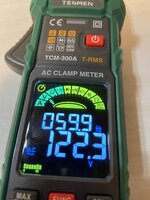
IMG_1916.jpeg
It's $30 bucks. Not sure how it would hold up to daily (not as solid feeling as my 35 yo Fluke DMM) use, but seems pretty sturdy.

 
To avoid these ads, REGISTER NOW!

mark-NJ

Well-known member
Joined
Apr 1, 2019
Messages
769
Location
new jersey
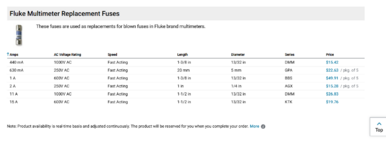
I stick with Fluke for all my meters for one reason & one reason only: Excellent fusing. When I mess up and set it for amps and try to check voltage (c'mon...admit it: we've all done it), that fast-fuse blows instantly.

Ever seen a cheap meter hand grenade? I have. Not pretty. I had a co-worker wind up losing sight in one eye & bad burns all over his face. Yes, he had it set wrong, but it was a cheap un-fused meter.

As my dad used to say, "If you have a 5 dollar brain, buy a 5 dollar helmet". For me, it's Fluke & nothing but Fluke.
 

richfinn

Well-known member
Joined
Jan 29, 2011
Messages
4,809
Location
Leeds, Yorkshire, England
I stick with Fluke for all my meters for one reason & one reason only: Excellent fusing. When I mess up and set it for amps and try to check voltage (c'mon...admit it: we've all done it), that fast-fuse blows instantly.

Ever seen a cheap meter hand grenade? I have. Not pretty. I had a co-worker wind up losing sight in one eye & bad burns all over his face. Yes, he had it set wrong, but it was a cheap un-fused meter.

As my dad used to say, "If you have a 5 dollar brain, buy a 5 dollar helmet". For me, it's Fluke & nothing but Fluke.

Yeah, but this discussion is about a non intrusive clamp meter, you don't need to break the circuit or switch jacks to measure current.
 

signcrafter

Well-known member
Joined
May 9, 2012
Messages
12,317
Is there a special setting for inrush or just set to amps and watch? I have a fluke I use in the shop but wanted a portable clamp meter for carrying with me for auto/house use and went with this one. It's been a nice little unit.

 
OP
Z

zendriver

Well-known member
Joined
Dec 10, 2014
Messages
29,719
Location
Indiana
Is there a special setting for inrush or just set to amps and watch? I have a fluke I use in the shop but wanted a portable clamp meter for carrying with me for auto/house use and went with this one. It's been a nice little unit.

Just press a button and it logs the highest reading until you press the button again
 

joel63

Well-known member
Joined
Oct 9, 2012
Messages
1,907
Location
Central FL
Looking to configure my gen to the house, now obsessed with "inrush" current, hertz, etc. to map out what's what.

Searching around, this seemed to pop up a lot and has quite a few YT reviews. Considered one from HF, but with the inrush capability, runs $90. name brand stuff even more. Went for it, seems pretty solid and well made. Nice solid probes and included thermocouple (it reads temps) Bright screen. Built in light not really all that, better maybe than nothing. Tested clamped amps (and inrush) with generator/garage juice and two different bench grinders. (FWIW) measures approximately the same as old HF DMM. Thermocouple reads ambient temps not further tested.

This is quick results from turning on and using auto mode.

IMG_1916.jpeg
It's $30 bucks. Not sure how it would hold up to daily (not as solid feeling as my 35 yo Fluke DMM) use, but seems pretty sturdy.

Nice looking multimeter. Only question is fused protected?
 

bwringer

Well-known member
Joined
Jan 1, 2013
Messages
10,250
Location
Indianapolis
So fuses are an exotic alien technology known only to Fluke?

Riiiiight.

Wish I had known that. I've revived more than one mid-market meter with a fresh fuse and a screwdriver. I even recall finding a handy spare fuse in one when I opened it up. Craftsman, I think, made by who-knows. But it was (and still is) a perfectly cromulent meter.
 
OP
Z

zendriver

Well-known member
Joined
Dec 10, 2014
Messages
29,719
Location
Indiana
So fuses are an exotic alien technology known only to Fluke?

Riiiiight.

Wish I had known that. I've revived more than one mid-market meter with a fresh fuse and a screwdriver. I even recall finding a handy spare fuse in one when I opened it up. Craftsman, I think, made by who-knows. But it was (and still is) a perfectly cromulent meter.
Geez I wasn’t shitting on fuses :lol:

Just stated maybe they use other technology now days

Kinda like fuses vs circuit breakers :
 

jayemm

Well-known member
Joined
Dec 18, 2018
Messages
1,509
Location
up high down low
So fuses are an exotic alien technology known only to Fluke?

Riiiiight.

Wish I had known that. I've revived more than one mid-market meter with a fresh fuse and a screwdriver. I even recall finding a handy spare fuse in one when I opened it up. Craftsman, I think, made by who-knows. But it was (and still is) a perfectly cromulent meter.
I'm with you there. Had a few ($40 or less) Radio Shack meters in the past and they had a spare fuse in the battery compartment with a small pull ribbon to remove it from the fuse holder. Also had a Fluke and managed to blow the expensive fuse a couple of times just with household voltage.
Fuse availability can be a pain in the ***. My most recent meter is a Uni-T UT61D+ which after purchase discovered it uses BS1362 6mmX25mm sand filled ceramic fuses. Love the meter but had to search for spare fuses. Apparently these fuses are common in the UK where they are incorporated into the plug of the electrical cord. And like many things these days are also counterfeited so I avoided ebay sourcing. Ended up ordering some spares from Newark Electronics where the shipping exceeded the cost of the fuses. So it goes.
 

jayemm

Well-known member
Joined
Dec 18, 2018
Messages
1,509
Location
up high down low
I looked at a couple of Flukes, couldn't find any Fused protection. SMH.
I had a Fluke 115 where the case must be taken apart to access the fuse inside. I think Fluke does this for safety to help contain a high energy arc. I don't think Fluke puts fuses accessible in the battery compartment. Others here could elaborate on this. That was my only experience with a Fluke DMM.
 
OP
Z

zendriver

Well-known member
Joined
Dec 10, 2014
Messages
29,719
Location
Indiana
I had a Fluke 115 where the case must be taken apart to access the fuse inside. I think Fluke does this for safety to help contain a high energy arc. I don't think Fluke puts fuses accessible in the battery compartment. Others here could elaborate on this. That was my only experience with a Fluke DMM.
They generally put something in the user manual, if it had a fuse and where it is located. Your model does.

376 FC no mention of a fuse at all in the user manual.

AI

The Fluke 376 FC clamp meter doesn't have a readily replaceable fuse like a multimeter. It's designed with a different type of protection circuitry, likely involving solid-state components rather than user-replaceable fuses. Therefore, if you're experiencing issues with your Fluke 376 FC, it's best to consult the manual or contact Fluke's customer support for troubleshooting or repair.
 

Max

ALLIANCE MEMBER
Joined
Jun 16, 2018
Messages
3,321
Location
Georgia
So fuses are an exotic alien technology known only to Fluke?

Riiiiight.

Wish I had known that. I've revived more than one mid-market meter with a fresh fuse and a screwdriver. I even recall finding a handy spare fuse in one when I opened it up. Craftsman, I think, made by who-knows. But it was (and still is) a perfectly cromulent meter.
Many cheap meters do not have adequate protection or a CAT rating. There is a discussion of one here: https://www.eevblog.com/forum/testgear/darwin-award-dvm/

As you know, adequate protection is much more than just adding a fuse.

Many meters other than Fluke have CAT ratings that they actually conform to. A good example would be Klein. But others don’t. And Fluke consistently has good protection.

If I wanted a new DVM and didn’t want to buy a Fluke, I’d start with the reviews at eeVBlog. https://www.eevblog.com/forum/testgear/multimeter-spreadsheet/
 
To avoid these ads, REGISTER NOW!
OP
Z

zendriver

Well-known member
Joined
Dec 10, 2014
Messages
29,719
Location
Indiana
Many cheap meters do not have adequate protection or a CAT rating. There is a discussion of one here: https://www.eevblog.com/forum/testgear/darwin-award-dvm/

As you know, adequate protection is much more than just adding a fuse.

Many meters other than Fluke have CAT ratings that they actually conform to. A good example would be Klein. But others don’t. And Fluke consistently has good protection.

If I wanted a new DVM and didn’t want to buy a Fluke, I’d start with the reviews at eeVBlog. https://www.eevblog.com/forum/testgear/multimeter-spreadsheet/
This one says certified to cat iii
 

Max

ALLIANCE MEMBER
Joined
Jun 16, 2018
Messages
3,321
Location
Georgia
Then you should be good:

Test equipment is rated with both a measurement category AND a voltage. The working voltage rating and the measurement category rating are both needed to determine if the test equipment will provide adequate protection for a given circuit.

The following table shows the overvoltage ratings for test equipment, based on category and working voltage. To determine the maximum overvoltage rating, find the row (CAT I/II/III/IV) that corresponds to the meter’s measurement category on the leftmost column, and then go across the row to find the column corresponding to the meter’s rated working voltage:

Working Voltage150V300V600V1000V
CAT I800V1500V2500V4000V
CAT II1500V2500V4000V6000V
CAT III2500V4000V6000V8000V
CAT IV4000V6000V8000V12000V
For instance, a meter rated CATIII, 300V can withstand an overvoltage of 4000V on a Category III circuit. As the rating suggests, it is suitable for CAT III circuits up to 300V working voltage. It is also rated as suitable for CAT II circuits up to 600V. It is not, however, suitable for use on CAT II circuits of 1000V, CAT III circuits over 300V, or any CAT IV circuits at all (despite the fact that it offers a 4000V overvoltage protection, which corresponds to a CAT IV circuit of 150V rated working voltage.
 

Hohn

Well-known member
Joined
Aug 25, 2016
Messages
2,623
Location
Diesel Central, Indiana
I stick with Fluke for all my meters for one reason & one reason only: Excellent fusing. When I mess up and set it for amps and try to check voltage (c'mon...admit it: we've all done it), that fast-fuse blows instantly.

Ever seen a cheap meter hand grenade? I have. Not pretty. I had a co-worker wind up losing sight in one eye & bad burns all over his face. Yes, he had it set wrong, but it was a cheap un-fused meter.

As my dad used to say, "If you have a 5 dollar brain, buy a 5 dollar helmet". For me, it's Fluke & nothing but Fluke.
The Brymen I have has an excellent ceramic-lined fuses. It's CAT IV in a small form factor.

Here's an in-depth comparison of the Fluke vs Brymen.


Mr_B

Well-known member
Joined
Nov 21, 2016
Messages
5,374
Location
Reading
Looking to configure my gen to the house, now obsessed with "inrush" current, hertz, etc. to map out what's what.

Searching around, this seemed to pop up a lot and has quite a few YT reviews. Considered one from HF, but with the inrush capability, runs $90. name brand stuff even more. Went for it, seems pretty solid and well made. Nice solid probes and included thermocouple (it reads temps) Bright screen. Built in light not really all that, better maybe than nothing. Tested clamped amps (and inrush) with generator/garage juice and two different bench grinders. (FWIW) measures approximately the same as old HF DMM. Thermocouple reads ambient temps not further tested.

This is quick results from turning on and using auto mode.

IMG_1916.jpeg
It's $30 bucks. Not sure how it would hold up to daily (not as solid feeling as my 35 yo Fluke DMM) use, but seems pretty sturdy.

How accurate does the amp clamp reading seem to be, does it fluctuate a lot or is pretty stable and fast reading .
 
OP
Z

zendriver

Well-known member
Joined
Dec 10, 2014
Messages
29,719
Location
Indiana
How accurate does the amp clamp reading seem to be, does it fluctuate a lot or is pretty stable and fast reading .

FWIW as far as accuracy it had the same readings as my cheapie harbor freight clamp, meter :lol:

As as far as fluctuation, I was just tested it off of a 1/3 and 1/2 Hp bench grinders neither meter seemed to fluctuate much at all

I’ve never really used a clamp meter before so I don’t have much to compare it to

Both were tested using generator and garage power
 

Hohn

Well-known member
Joined
Aug 25, 2016
Messages
2,623
Location
Diesel Central, Indiana
FWIW as far as accuracy it had the same readings as my cheapie harbor freight clamp, meter :lol:

As as far as fluctuation, I was just tested it off of a 1/3 and 1/2 Hp bench grinders neither meter seemed to fluctuate much at all

I’ve never really used a clamp meter before so I don’t have much to compare it to

Both were tested using generator and garage power
did you make a break-out cord? Normal clamp meter on AC will not have a correct reading when the ground and hot at both inside the clamp. I learned the hard way.
I ended up just buying a pigtail extension cord and stripping off the outer insulation so I could clamp the individual wires within it. It's redneck but it works.
 
OP
Z

zendriver

Well-known member
Joined
Dec 10, 2014
Messages
29,719
Location
Indiana
did you make a break-out cord? Normal clamp meter on AC will not have a correct reading when the ground and hot at both inside the clamp. I learned the hard way.
I ended up just buying a pigtail extension cord and stripping off the outer insulation so I could clamp the individual wires within it. It's redneck but it works.

In a roundabout way

I have a well used extension cord that the sheathing has departed about 4 inches away from the plug leaving the three wires right out there
 

pfbz

Well-known member
Joined
Dec 17, 2008
Messages
954
If I wanted a new DVM and didn’t want to buy a Fluke, I’d start with the reviews at eeVBlog. https://www.eevblog.com/forum/testgear/multimeter-spreadsheet/

Holy **** that is a lot of data to sort through!

The reality for me is that my DVM use-cases are largely automotive with some very occasional 120V quick checks and once in a blue moon checking a 240V circuit, so most of those meters are "overkill" (pun only slightly intended). Yes, I keep a few flukes around if i need to play with high voltage stuff, but this $30 import meter works great for everything else...


Max

ALLIANCE MEMBER
Joined
Jun 16, 2018
Messages
3,321
Location
Georgia
Holy **** that is a lot of data to sort through!

The reality for me is that my DVM use-cases are largely automotive with some very occasional 120V quick checks and once in a blue moon checking a 240V circuit, so most of those meters are "overkill" (pun only slightly intended). Yes, I keep a few flukes around if i need to play with high voltage stuff, but this $30 import meter works great for everything else...

Sure - for 12V or 24V, use whatever meter you like. But as the voltage and currents get higher the CAT ratings get more critical.

For the meter you linked to there is absolutely zero reference to any CAT ratings. I wouldn’t be worried about using the clamp to measure current or to use the probes at lower voltages. But I personally would not use that meter for 120V or 240V. YMMV.
 

Crazyjake8493

Well-known member
Joined
Sep 26, 2014
Messages
3,949
Location
Upstate NY
Electrical test equipment is one area that you don't cheap out. Avoid Harbor Freight and Amazon-Chinese products. Get a Fluke, Fieldpiece, Klein, etc.
 

Shoreline_

Well-known member
Joined
Aug 1, 2022
Messages
967
Location
Springfield, MA
Afaik circuit breakers have a really long heating time. Too long to safely interrupt inductive loads. Its why its better to have fuses or overloads closer to the appliance than relying on the main breaker to interrupt an over current situation. Thus if youre worried about protecting inrush circuits, you can get the correct slow blow fuse. So.. checking inrush current is pointless if you can't protect it in your circuit
 
OP
Z

zendriver

Well-known member
Joined
Dec 10, 2014
Messages
29,719
Location
Indiana
Afaik circuit breakers have a really long heating time. Too long to safely interrupt inductive loads. Its why its better to have fuses or overloads closer to the appliance than relying on the main breaker to interrupt an over current situation. Thus if youre worried about protecting inrush circuits, you can get the correct slow blow fuse. So.. checking inrush current is pointless if you can't protect it in your circuit
Good points.

I was just curious on what I was having in regards to hooking up to a generator.

Measured 20.5A starting a 1/2 hp old bench grinder. Didn’t seem to phase the 15A breaker of the generator.

I suspect the well pump might be all right as well since it’s oddly not popping the panel breaker it’s attached to. Have not measured it yet, but I will . Just collecting some measurements based by suggestion from others so I’m glad I didn’t waste my money on expensive test equipment..

It seems like a nice meter anyway.
 

Shoreline_

Well-known member
Joined
Aug 1, 2022
Messages
967
Location
Springfield, MA
Good points.

I was just curious on what I was having in regards to hooking up to a generator.

Measured 20.5A starting a 1/2 hp old bench grinder. Didn’t seem to phase the 15A breaker of the generator.

I suspect the well pump might be all right as well since it’s oddly not popping the panel breaker it’s attached to. Have not measured it yet, but I will . Just collecting some measurements based by suggestion from others so I’m glad I didn’t waste my money on expensive test equipment..

It seems like a nice meter anyway.
Yea for sure. I got a lot of stuff people used to make fun of me for having as it was "overkill" - like I had a 25mhz oscilloscope. But I could work my way around a scope way before the automotive world realized how crucial they are. So being ahead of the curve was nice.
 
To avoid these ads, REGISTER NOW!
Top Bottom