To avoid these ads, REGISTER NOW!

After-Cooler, Did I Do Something Wrong?

sp8zzz2

Member
Joined
Jul 22, 2017
Messages
8
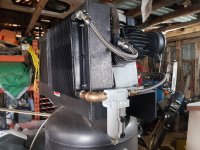
Okay, after many views on this forum and posting a few questions and spending way too much money I finally got the after-cooler installed. And I am somewhat underwhelmed. The temperature drop between the compressor head (+/- 250 degrees) and the tank input (+/- 80 degrees ) is significant but not enough to completely dry what's in the tank. I still see a little water in there. By far not as much as w/o the after-cooler, maybe about 1-2 tablespoons in an 80 gal. tank.
Should I lower my expectations or is this amount too significant to ignore?
 

Attachments

  • IMG_7803.jpeg
    IMG_7803.jpeg
    2.1 MB · Views: 144
To avoid these ads, REGISTER NOW!

engineer2

Well-known member
Joined
Dec 13, 2009
Messages
11,795
Location
Chicago burbs
A lot depends on where you live and what the ambient humidity is. The lower your relative humidity, the less you will condense out. Below about 30-40%, you may not get much. In my opinion, an aftercooler should be after the tank. The tank can get rid of a lot of heat to condense moisture out. The after cooler gets rid of a little more. No matter how much you aftercool, you'll never get rid of all the moisture on a humid day. The humidity in your tank will be near 100%. Open an air valve, drop the pressure, and you'll condense moisture, but usually not enough to worry about unless you are painting cars.
 

Jswain

Well-known member
Joined
Apr 26, 2013
Messages
2,457
Location
Calgary, AB
The aftercooler doesn't dry the air it just cools it so you can remove the water.
During heavy use you will still need a filter downstream of the tank but it will be much more efficient removing the water with the air cooled

I would also remove that water trap you have coming right off the head as I doubt it will take the heat during heavy use. Install it on your first drop coming out of the tank then a good filter/regulator and you're probably set unless you are painting cars
 
Last edited:

redmondjp

Well-known member
Joined
Nov 25, 2014
Messages
2,318
Location
Redmond, WA
How much space is between that aftercooler and the wall? It looks awfully close to the wall for effective air circulation. You would be better off locating the aftercooler above the unit at an angle with the fan underneath blowing up.
 
OP
S

sp8zzz2

Member
Joined
Jul 22, 2017
Messages
8
The aftercooler doesn't dry the air it just cools it so you can remove the water.
During heavy use you will still need a filter downstream of the tank but it will be much more efficient removing the water with the air cooled

I would also remove that water trap you have coming right off the head as I doubt it will take the heat during heavy use. Install it on your first drop coming out of the tank then a good filter/regulator and you're probably set unless you are painting cars
Thanks for replying. The water trap after the head is to catch any condensation in the hose going to the radiator. Since the radiator is mounted above the compressor head and the hose runs uphill I was advised to put a trap coming out of the head to keep any water running down the hose and back into the head.
 
OP
S

sp8zzz2

Member
Joined
Jul 22, 2017
Messages
8
How much space is between that aftercooler and the wall? It looks awfully close to the wall for effective air circulation. You would be better off locating the aftercooler above the unit at an angle with the fan underneath blowing up.
There is about 3" of space behind the radiator and wall. I mounted it that way do to space considerations. Tilting it out sounds like a good idea. I might try that.
 

Jswain

Well-known member
Joined
Apr 26, 2013
Messages
2,457
Location
Calgary, AB
Thanks for replying. The water trap after the head is to catch any condensation in the hose going to the radiator. Since the radiator is mounted above the compressor head and the hose runs uphill I was advised to put a trap coming out of the head to keep any water running down the hose and back into the head.
That pipe will get so hot you can't touch it, are the threads at least metal or are they plastic?

There shouldn't be any water until the air cools and as everytime your compressor cycles the unloader emptys out all those lines and the cooler in the opposite direction I doubt there will be a water issue. If a guy really wanted a steel drop/ball valve could go there, I'd just be worried about that water drop heating up then failing

Nice setup though and looks clean, the aftercooler must be cooling effectively if it's dropping the temps back to ~ ambient
 

Supa Dexta

Active member
Joined
Dec 16, 2018
Messages
44
Location
Ag
I just added one to mine, Pump> cooler> water trap> tank. The line leaving the trap is also up hill to the tank, which should help.
 

Attachments

  • 176803027_3941500932571160_7866467253492614854_n.jpg
    176803027_3941500932571160_7866467253492614854_n.jpg
    404 KB · Views: 95

American Locomotive

Well-known member
Joined
Jan 8, 2017
Messages
10,941
Location
Rhode Island
There seems to be some misconceptions about what the after cooler is supposed to do.

The amount of water vapor that air can hold increases dramatically with temperature. Above 200 degrees, a given weight of air can hold the same amount of weight in water vapor! Since air compressors typically have discharge temperatures of well over 200 degrees, a tremendous amount of water vapor is carried by the air.

When you install an after-cooler on a compressor, you dramatically drop the temperature of the air. This forces water to condense and drop out. Thus removing a lot of moisture from the air. However you have two things you need to keep in mind:

1) That water doesn't magically disappear. It has to go somewhere. As the air cools down, water vapor condenses and drops out of the air. Those water droplets will get pushed along by the air flow, through the after-cooler and into the tank. Once they get inside the tank, they will drop to the bottom. It's not a big deal, as your goal is to remove water vapor from the air. As long as your shop air connection isn't made at the bottom of the tank, that condensed liquid water will not re-enter your air stream. If seeing liquid water in the tank really bothers you, will need to build a large trap assembly at the discharge of your after cooler.

2) It's important to understand what is happening when you cool the air. As I mentioned, the temperature of air affects how much water vapor it can carry. When you lower the temperature of the air, it can't hold as much water. The ratio of how much water vapor the air has in it vs. how much it can possibly hold at a given temperature is called the Relative Humidity.

So take an amount of air with a given amount of water vapor in it - say 70% Relative Humidity: As you decrease the temperature, the maximum amount of water the air can hold goes down, which means the relatively humidity of the air increases. It will keep increasing until you hit 100%, at which point water begins to condense and drop out of the air. This is called the dew point.

So what does that mean? It means even with an after-cooler, the air in your air compressor tank is going to be close to, or at 100% relative humidity. It is going to be fully saturated, so you will still need a coalescing/desiccant filter/dryer after the tank to remove that final bit of moisture from the air. But since most of the water vapor has already been removed from the air by the aftercooler, the filter/dryer has a much easier job.
 
To avoid these ads, REGISTER NOW!

shoot summ

Well-known member
Joined
Jun 8, 2010
Messages
2,952
I would have a drop leg and valve when you exit the cooler, before you enter the tank.
 

pcmeiners

Well-known member
Joined
Aug 13, 2009
Messages
7,861
Location
In the only town in Pennsylvania, Bloomsburg.
"I would also remove that water trap you have coming right off the head as I doubt it will take the heat during heavy use. "

Have done more than a dozen after coolers and intercoolers. There is NO way your water trap could possibly heat up. As is your cooler will bring down the temperature to ambient or very close to ambient. As to the water traps position, you will need to empty it VERY often; on a very humid day, a compressor can produce more than a quarts of water over a few hours of use . Hope you braided hose is heat and chemical resistant internally; compressed air will be slightly acid due to pollution of sulfuric and nitric oxides. Awfully close to the wall, closer than recommended. Other then that you have a neat install, nice job.

"I would have a drop leg and valve when you exit the cooler, before you enter the tank."
Why?????????, it will fill with water which the trap would handle
 
Last edited:

shoot summ

Well-known member
Joined
Jun 8, 2010
Messages
2,952
"I would also remove that water trap you have coming right off the head as I doubt it will take the heat during heavy use. "

Have done more than a dozen after coolers and intercoolers. There is NO way your water trap could possibly heat up. As is your cooler will bring down the temperature to ambient or very close to ambient. As to the water traps position, you will need to empty it VERY often; on a very humid day, a compressor can produce more than a quarts of water over a few hours of use . Hope you braided hose is heat and chemical resistant internally; compressed air will be slightly acid due to pollution of sulfuric and nitric oxides. Awfully close to the wall, closer than recommended. Other then that you have a neat install, nice job.

"I would have a drop leg and valve when you exit the cooler, before you enter the tank."
Why?????????, it will fill with water which the trap would handle
Where does the moisture actually separate from the air?

When it is hot? Or when it cools?

The trap at the head is in the stream of the heated air. Would be interesting to have the OP tell us how much water is coming out there. He's already stated he is underwhelmed with the results, where else does he have the ability to let water out before the tank?

The drop leg before mine enters the tank(side entry) is after the air has cooled. I have a valve there, when I turn the compressor off each time, I open that valve and drain the leg. A significant amount of water comes out. When I drain my tank(not very often) very little water comes out.
 

Supa Dexta

Active member
Joined
Dec 16, 2018
Messages
44
Location
Ag
My picture above shows exactly where to get the water out. Just as it leaves the cooler, as the temp just dropped, it releases the moisture. I also have another trap/filter/regulator on the output of the tank, but neither the tank drain, nor it ever see any water really - its all caught at the first one as the temp drops, so the air entering the tank is cool - albeit compressed,
 

Jswain

Well-known member
Joined
Apr 26, 2013
Messages
2,457
Location
Calgary, AB
"I would also remove that water trap you have coming right off the head as I doubt it will take the heat during heavy use. "

Have done more than a dozen after coolers and intercoolers. There is NO way your water trap could possibly heat up. As is your cooler will bring down the temperature to ambient or very close to ambient. As to the water traps position, you will need to empty it VERY often; on a very humid day, a compressor can produce more than a quarts of water over a few hours of use . Hope you braided hose is heat and chemical resistant internally; compressed air will be slightly acid due to pollution of sulfuric and nitric oxides. Awfully close to the wall, closer than recommended. Other then that you have a neat install, nice job.

"I would have a drop leg and valve when you exit the cooler, before you enter the tank."
Why?????????, it will fill with water which the trap would handle
You should have another look at his picture as there is clearly a water trap coming right out of the head of the compressor before the aftercooler. Yes it will heat up
Thanks for letting us know you've done a dozen though lol


Assuming his is similiar to the one linked above max temp is 140f, pretty sure you are going to be exceeding that fairly quick. Actually OP posted 250f temps at the head so...

Also better off putting an auto drain water filter coming out of the aftercooler that way everytime your compressor cycles and the unloader bleeds off the lines it will auto drain to let the water out. Hook a small vinyl hose to it run down to the bottom of your tank and bobs your uncle
 
Last edited:

Jswain

Well-known member
Joined
Apr 26, 2013
Messages
2,457
Location
Calgary, AB
Where does the moisture actually separate from the air?

When it is hot? Or when it cools?

The trap at the head is in the stream of the heated air. Would be interesting to have the OP tell us how much water is coming out there. He's already stated he is underwhelmed with the results, where else does he have the ability to let water out before the tank?

The drop leg before mine enters the tank(side entry) is after the air has cooled. I have a valve there, when I turn the compressor off each time, I open that valve and drain the leg. A significant amount of water comes out. When I drain my tank(not very often) very little water comes out.
It also looks like he has a water filter on the discharge side of the aftercooler between it and the tank, you can kind of see the bottom of it in the picture behind the electrical switch.

That one makes sense, the one coming right off the head not so much
 

pcmeiners

Well-known member
Joined
Aug 13, 2009
Messages
7,861
Location
In the only town in Pennsylvania, Bloomsburg.
Apologize I did not see the front of the compressor due to small size, until I realized you could resize. The separator at the compressor exhaust would do better after the tank at some point. At the exhaust the air is holding the maximum water and will remain so until it hits the aftercooler. Pre-warning, those automatic valves in the water separator are finicky, Your better off letting water drain from the aftercool to the tank, then rigging an auto drain on the tank.

"Where does the moisture actually separate from the air?"
Upon cooling in the coils of the aftercooler, which continues until ambient temperature of the room is reached (approx. 70% of water drops out), then or at a point in the system where higher pressure drops to a lower pressure (which also cools air).. some water separators, air nozzle, spray gun tip, regulators, any restrictive valve or device in the system .
 

didit

Well-known member
Joined
Feb 11, 2020
Messages
892
Location
S.W. Ontario
There are several methods for removing water from the air. The tank itself serves to cool the air to some extent and in my opinion there is no reason to try removing the water before reaching the tank. The water can be removed regularly from the tank by whatever method you choose (automatic or manual valve). It has been my experience that the air needs to travel at least 30' after exiting the tank through a substantially heavy copper piping system with several drop legs to remove the water as it cools. I use type L 3/4" copper.
Other than a refrigerated system nothing else will cool as effectively. With 4 drop legs collecting water from progressively cooler air, my desiccant dryers and moisture bottles have had all the heavy water removed beforehand.
I imagine this is not what you want to hear, having invested time and money already and thinking you can nip the problem in the bud, but just had to chime in with what I know works.
 
To avoid these ads, REGISTER NOW!
Top Bottom