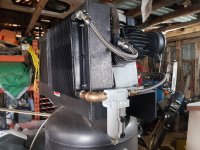
There seems to be some misconceptions about what the after cooler is supposed to do.
The amount of water vapor that air can hold increases dramatically with temperature. Above 200 degrees, a given weight of air can hold the same amount of weight in water vapor! Since air compressors typically have discharge temperatures of well over 200 degrees, a tremendous amount of water vapor is carried by the air.
When you install an after-cooler on a compressor, you dramatically drop the temperature of the air. This forces water to condense and drop out. Thus removing a lot of moisture from the air. However you have two things you need to keep in mind:
1) That water doesn't magically disappear. It has to go somewhere. As the air cools down, water vapor condenses and drops out of the air. Those water droplets will get pushed along by the air flow, through the after-cooler and into the tank. Once they get inside the tank, they will drop to the bottom. It's not a big deal, as your goal is to remove water vapor from the air. As long as your shop air connection isn't made at the bottom of the tank, that condensed liquid water will not re-enter your air stream. If seeing liquid water in the tank really bothers you, will need to build a large trap assembly at the discharge of your after cooler.
2) It's important to understand what is happening when you cool the air. As I mentioned, the temperature of air affects how much water vapor it can carry. When you lower the temperature of the air, it can't hold as much water. The ratio of how much water vapor the air has in it vs. how much it can possibly hold at a given temperature is called the Relative Humidity.
So take an amount of air with a given amount of water vapor in it - say 70% Relative Humidity: As you decrease the temperature, the maximum amount of water the air can hold goes down, which means the relatively humidity of the air increases. It will keep increasing until you hit 100%, at which point water begins to condense and drop out of the air. This is called the dew point.
So what does that mean? It means even with an after-cooler, the air in your air compressor tank is going to be close to, or at 100% relative humidity. It is going to be fully saturated, so you will still need a coalescing/desiccant filter/dryer after the tank to remove that final bit of moisture from the air. But since most of the water vapor has already been removed from the air by the aftercooler, the filter/dryer has a much easier job.