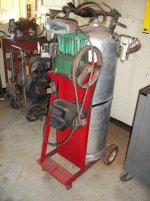
Respect the power that is stored in the compressed air, and maintain your compressor and lines.
fer instance:
1 hp = 746 watts = 550 ft-lb/sec
So if a little compressor with a little 1 hp motor ran for two minutes to fill up the tank before shutting off, then the motor ended up inputting
550 ft-lb/sec x 120 sec = 66,000 ft-lb of "work" done
Let's even throw in some efficiency factors of 80% for the electric motor and 80% for the air pump.
66,000 ft-lb x .8 (motor efficiency) x .8 (pump efficiency) = 42,240 ft-lbs of "work" or "energy" available.
So, thinking of it in another way, in those two minutes that the electric motor was running, it could have lifted 42,240 lbs one foot into the air (geared down or reduction pulleys or whatever).
Or 21,120 lbs lifted two feet into the air. Etc, etc, etc.
Jumping into SI units for a moment, where work=energy is measured in joules, we have (1 ft-lb = 1.4 J) 59,136 J.
Which is more energy than the muzzle energy of a 'elephant gun', about the energy contained in the combustion of 1 gram of gasoline, more than the energy contained in 1 gram of TNT, about the energy in a car moving about 25 mph, etc, etc, etc. But less than the energy contained in a 280 calorie candy bar.
 http://en.wikipedia.org/wiki/Orders_of_magnitude_(energy
)
Drop that weight suddenly and it can make a rather big smash/crash/boom.
That's a rough measure of how much "energy" has been input into the 'system' and is now stored in that compressed air in the tank.
And that's for our example 'little' 1 hp electric motor filling the tank in 2 minutes.
You have a bigger tank with a bigger motor that takes longer to fill up? Then even more energy is stored in that tank full of compressed air.
Which is 'good', because we can then use that energy from the compressed air to do some useful things, like turning it back into some sort of mechanical work like an impact wrench or a die grinder or whatever pneumatic tool you want to use at the moment.
But if that energy in that compressed air somehow is released 'instantly' and in an uncontrolled and unexpected manner (such as a tank or pipe suddenly bursting), then there can be various negative effects. Ranging from a need to change the shorts, to a need to clean up or repair broken items (damage to items), to a need for medical attention (injury), to a need for a mortician (fatality).
Respect the energy that is contained in compressed gases and maintain the equipment.
Most of the time, tank or metal pipe failures are on the more 'graceful' end of the failure spectrum. ie: a leak develops.
But not always. Sometimes, the item releases the compressed air rather suddenly and zips/peels/splits open rather forcefully and can launch or propel items (including the tank or other things in the vicinity) forcefully.
Respect and maintain.